Introduction
Modern web applications increasingly rival traditional desktop software in both functionality and complexity. Enterprise portals, customer relationship management platforms, productivity suites, collaboration tools, and Software as a Service (SaaS) applications now execute significant amounts of JavaScript directly within the browser.
As JavaScript workloads become larger, browser performance depends not only on rendering engines but also on the efficiency of the underlying JavaScript runtime. Execution speed, memory utilization, startup latency, and garbage collection directly influence user experience and application scalability.
With the release of Windows 10, Microsoft has introduced Microsoft Edge as its new browser alongside the Chakra JavaScript engine. Chakra represents Microsoft's modern JavaScript runtime, designed to execute increasingly sophisticated client-side applications while supporting current web standards.
For enterprise architects and web developers, understanding Chakra provides valuable insight into how modern browsers execute JavaScript and optimize increasingly complex applications.
Industry Background
JavaScript has evolved from a lightweight scripting language into one of the most important technologies in enterprise software development.
Modern browser applications now depend on:
- ◆AJAX communication
- ◆HTML5 APIs
- ◆CSS3 rendering
- ◆Single Page Applications
- ◆Client-side templating
- ◆RESTful services
- ◆Rich user interfaces
JavaScript engines have therefore become highly optimized execution environments employing advanced compilation techniques rather than interpreting source code line by line.
Chakra reflects Microsoft's continued investment in browser performance as enterprise workloads continue shifting toward client-side execution.
The Business Problem
Large JavaScript applications commonly experience:
- ◆Slow startup performance
- ◆Long execution times
- ◆High CPU utilization
- ◆Memory pressure
- ◆Inefficient script execution
- ◆Reduced responsiveness
- ◆Poor scalability under complex workloads
Browser vendors increasingly compete by improving JavaScript execution efficiency while maintaining standards compliance.
Understanding Chakra
Chakra is Microsoft's JavaScript execution engine used by Microsoft Edge.
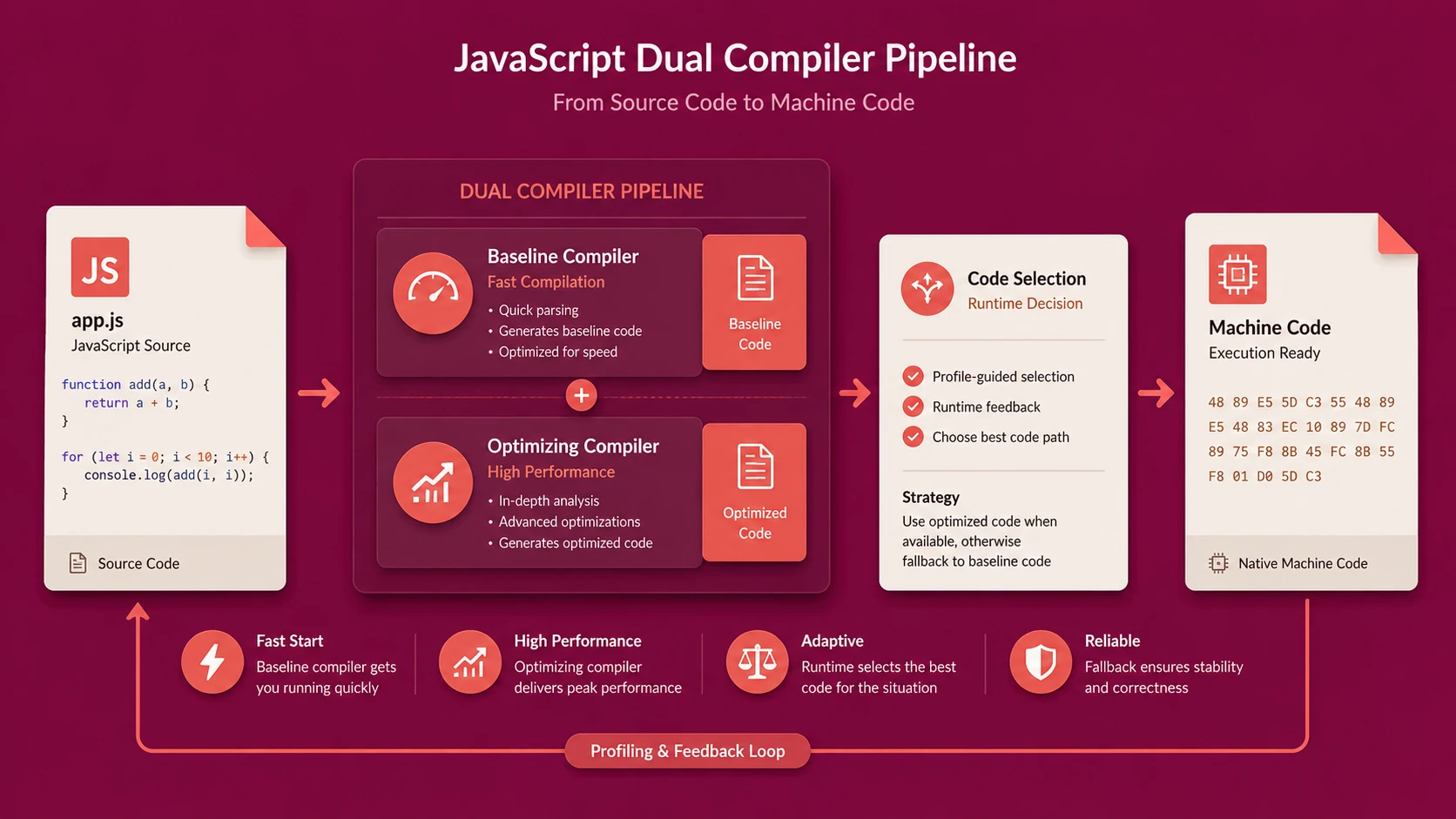
Rather than executing JavaScript purely through interpretation, Chakra combines parsing, optimization, Just-In-Time (JIT) compilation, and runtime execution to improve application performance.
The engine analyzes application behavior while programs execute and generates optimized machine code for frequently used operations.
This adaptive approach seeks to balance startup performance with long-running execution efficiency.
Core Architecture
| Component | Responsibility |
|---|---|
| Parser | Converts JavaScript source into an internal representation |
| Interpreter | Executes newly encountered code |
| Profiler | Collects runtime execution information |
| JIT Compiler | Produces optimized machine code |
| Garbage Collector | Manages memory reclamation |
| Runtime Environment | Executes compiled JavaScript |
Each component contributes to efficient execution while maintaining compatibility with JavaScript language semantics.
Parsing and Initial Execution
When a JavaScript application loads, Chakra first parses the source code.
The parser verifies language syntax and constructs internal structures representing the program.
Newly encountered code initially executes using lightweight execution mechanisms that minimize startup overhead.
This allows applications to begin running quickly while runtime information is collected.
Just-In-Time Compilation
// JavaScript trigger causing the JIT compiler to optimize code by identifying hot paths
function calculateInterest(amount, rate) {
  return amount * rate;
}

// Run function many times with identical type shapes to invoke JIT compilation optimization
for (let i = 0; i < 20000; i++) {
  calculateInterest(100.0, 0.05);
}
One of Chakra's defining capabilities is Just-In-Time compilation.
Rather than compiling every script before execution, the engine identifies code that executes frequently.
The execution process generally follows these stages:
- 1.JavaScript source is parsed.
- 2.Initial execution begins.
- 3.Runtime profiling collects execution information.
- 4.Frequently executed code is identified.
- 5.Optimized native machine code is generated.
- 6.Future executions use the optimized implementation.
This adaptive optimization strategy allows Chakra to improve performance over the lifetime of an application.
Runtime Profiling
Profiling provides valuable information about application behavior.
Chakra monitors characteristics such as:
- ◆Frequently executed functions
- ◆Object usage patterns
- ◆Property access
- ◆Loop execution
- ◆Call frequency
These observations guide optimization decisions while avoiding unnecessary compilation of rarely executed code.
Optimization Strategies
The JIT compiler attempts to improve execution efficiency through various optimization techniques.
Examples include:
- ◆Native code generation
- ◆Reduced interpretation overhead
- ◆Optimized property access
- ◆Improved function execution
- ◆Efficient arithmetic operations
Optimization decisions remain dependent on actual runtime behavior rather than static assumptions.
Memory Management
Enterprise web applications frequently manipulate large object graphs.
Chakra includes automatic memory management through garbage collection.
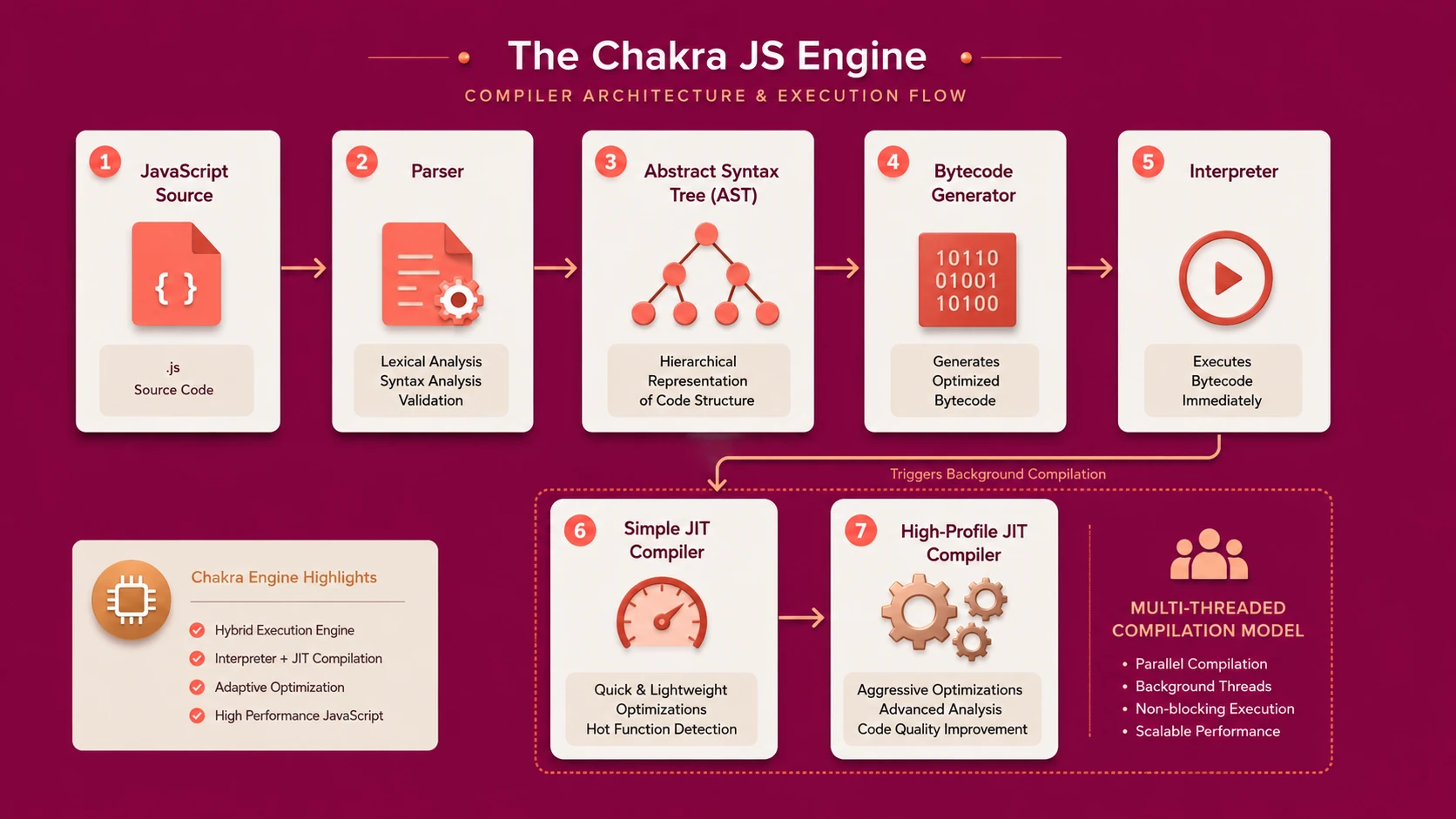
System architecture diagram and conceptual workflow layout for Windows 10 and Edge.
Responsibilities include:
- ◆Identifying unused objects
- ◆Reclaiming memory
- ◆Reducing memory leaks caused by abandoned objects
- ◆Supporting long-running browser sessions
Effective memory management contributes to stable browser performance during extended application use.
JavaScript Standards Support
Modern enterprise applications increasingly adopt ECMAScript 5 and emerging ECMAScript 6 language capabilities.
Chakra continues expanding support for contemporary JavaScript language features while maintaining compatibility with established web standards.
Organizations should continue validating application behavior across supported browsers as implementations evolve.
Enterprise Use Cases
| Scenario | Benefit |
|---|---|
| Enterprise Dashboards | Faster client-side execution |
| Single Page Applications | Improved responsiveness |
| SaaS Platforms | Better JavaScript performance |
| Business Intelligence Portals | Efficient data visualization |
| Internal Web Applications | Reduced script execution overhead |
| HTML5 Applications | Modern browser capabilities |
Applications with substantial client-side logic benefit directly from improvements within the JavaScript engine.
Performance Considerations
Application performance depends upon more than the JavaScript engine alone.
Organizations should evaluate:
- ◆Script organization
- ◆Network latency
- ◆DOM manipulation
- ◆Memory usage
- ◆Rendering complexity
- ◆API response time
Although Chakra improves JavaScript execution, overall application responsiveness continues to depend upon sound application architecture.
Security Considerations
Chakra executes untrusted web content within the browser environment.
Enterprise applications should continue implementing:
- ◆HTTPS
- ◆Input validation
- ◆Authentication
- ◆Authorization
- ◆Protection against cross-site scripting
- ◆Secure API communication
Browser runtime improvements complement, but do not replace, secure application design.
Scalability
Modern JavaScript engines support increasingly complex enterprise applications.
Chakra contributes through:
- ◆Adaptive optimization
- ◆Efficient memory management
- ◆Native code generation
- ◆Runtime profiling
- ◆Improved execution performance
Scalable browser applications still require modular application architecture and efficient client-server communication.
Best Practices
Organizations building applications for modern browsers should:
- ◆Minimize unnecessary JavaScript execution.
- ◆Reduce excessive DOM updates.
- ◆Modularize application code.
- ◆Avoid unnecessary object allocation.
- ◆Profile application performance regularly.
- ◆Test across supported browsers.
- ◆Optimize network communication.
- ◆Follow established JavaScript coding standards.
Well-designed applications benefit regardless of the underlying browser engine.
Common Mistakes
Development teams frequently encounter several performance issues.
Common mistakes include:
- ◆Assuming faster JavaScript engines compensate for inefficient code.
- ◆Creating unnecessary global objects.
- ◆Excessive DOM manipulation.
- ◆Ignoring memory usage.
- ◆Blocking the browser with long-running synchronous operations.
- ◆Neglecting cross-browser testing.
Application architecture remains the primary determinant of long-term performance.
Technology Comparison
| Capability | Traditional JavaScript Interpreters | Chakra JIT Engine |
|---|---|---|
| Native Code Generation | Limited | Yes |
| Runtime Profiling | Minimal | Yes |
| Adaptive Optimization | Limited | Yes |
| Automatic Memory Management | Yes | Yes |
| Enterprise Application Performance | Moderate | Improved |
| Modern JavaScript Support | Varies | Expanding |
Chakra's architecture reflects the broader industry trend toward increasingly sophisticated JavaScript execution environments.
Adoption Strategy
Organizations supporting Windows 10 and Microsoft Edge should:
- 1.Validate enterprise applications using Edge.
- 2.Benchmark JavaScript-intensive workloads.
- 3.Optimize client-side rendering.
- 4.Reduce unnecessary script execution.
- 5.Follow modern JavaScript development practices.
- 6.Test compatibility across supported browsers.
- 7.Monitor application performance using representative workloads.
Cross-browser validation remains essential despite improvements in JavaScript engine performance.
Limitations
As of August 2015, organizations should recognize several considerations.
Current observations include:
- ◆Browser performance depends on the complete rendering pipeline rather than the JavaScript engine alone.
- ◆Cross-browser testing remains necessary.
- ◆Some emerging ECMAScript features continue to evolve.
- ◆Enterprise applications should avoid relying on browser-specific behavior.
Standards-based development continues to provide the greatest long-term compatibility.
Looking Ahead
The introduction of Microsoft Edge alongside the Chakra JavaScript engine marks a significant modernization of Microsoft's browser platform. By combining adaptive Just-In-Time compilation, runtime profiling, optimized native code generation, and automatic memory management, Chakra is designed to meet the growing performance demands of modern web applications.
As of August 2015, organizations building HTML5 applications, Single Page Applications, and enterprise web platforms should evaluate Microsoft Edge as part of their browser compatibility strategy. Applications that emphasize efficient JavaScript architecture, modular design, and standards-based development are well positioned to benefit from continuing improvements in browser execution engines such as Chakra.