Introduction
Every major technology conference generates a predictable wave of headlines. Product names dominate social media, demonstrations attract attention, and speculative commentary often overshadows the broader architectural direction being presented.
For enterprise architects, engineering managers, and CTOs, however, the important question is not which keynote received the loudest applause. The important question is what strategic platform changes are actually being introduced and how they influence enterprise software over the next several years.
The 2026 developer conference season reinforces a clear industry trend. Microsoft Build 2026, Google I/O 2026, and Amazon Web Services have all shifted their focus beyond simply delivering larger language models. Instead, each organization is investing in complete AI platforms that combine reasoning models, enterprise context, orchestration, governance, and developer tooling into production-ready ecosystems.
Although the terminology differs between vendors, the underlying direction is remarkably consistent. AI assistants are evolving into long-running software agents capable of planning work, invoking enterprise tools, accessing organizational knowledge, and operating within governed environments.
For enterprise organizations, this represents a much larger transition than another generation of foundation models. It signals a movement toward software architectures where applications increasingly expose capabilities that autonomous agents can discover, compose, and execute.
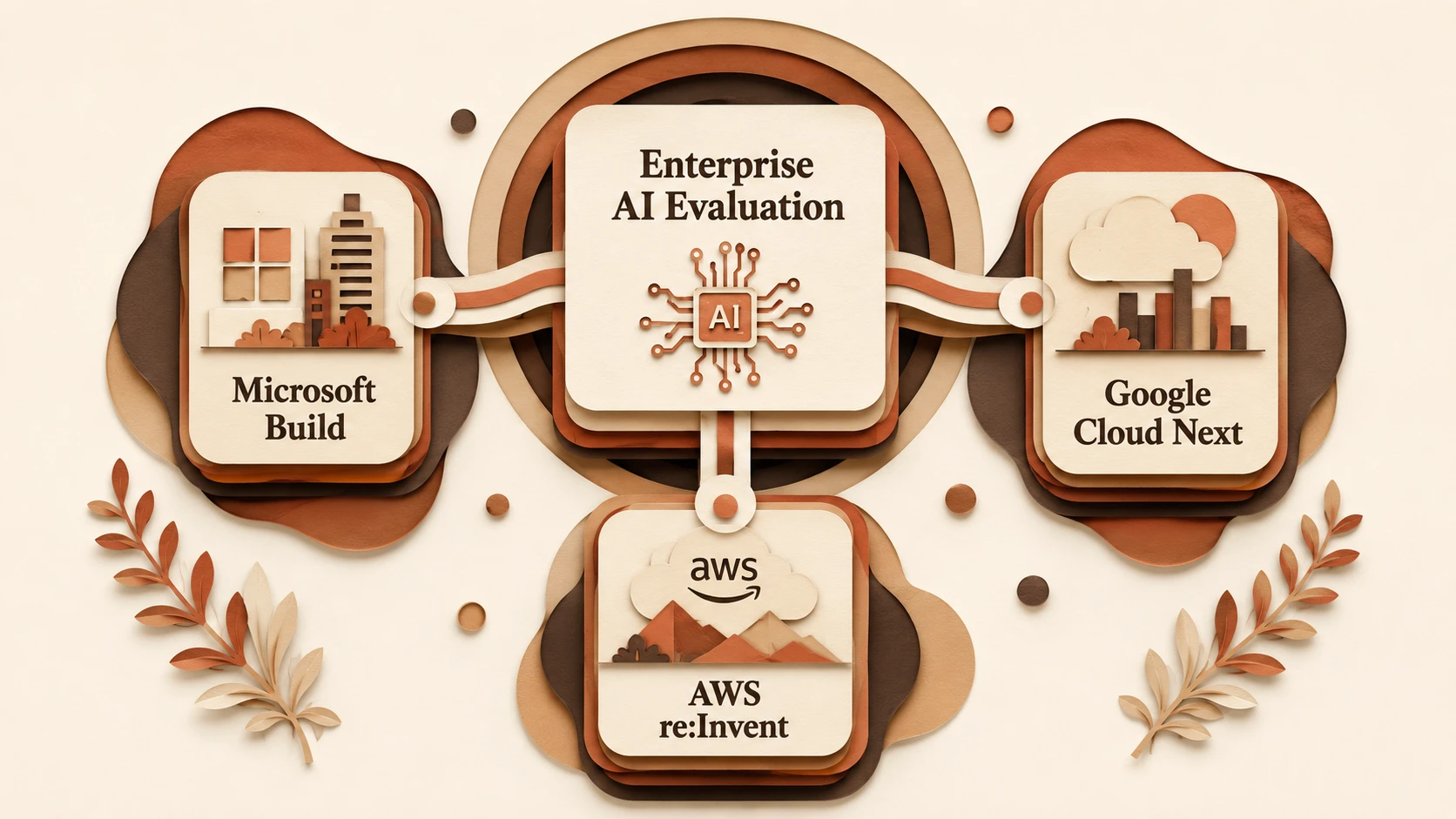
This article examines the most significant announcements from Microsoft Build 2026, Google I/O 2026, and the broader AWS platform strategy as of early June 2026, focusing on their architectural implications rather than keynote demonstrations.
Industry Background
Over the past decade, enterprise cloud platforms have evolved through several distinct phases.
| Era | Primary Focus |
|---|---|
| Virtualization | Infrastructure consolidation |
| Cloud Computing | Elastic infrastructure and managed services |
| Containers | Portable application deployment |
| Kubernetes | Cloud-native orchestration |
| Serverless | Event-driven execution |
| Generative AI | Foundation models and copilots |
| Agentic Platforms | Autonomous enterprise software systems |
The first wave of enterprise AI primarily emphasized productivity assistants capable of generating text, code, images, and documentation.
The second wave, now emerging across major cloud providers, extends these capabilities by allowing AI systems to perform work rather than simply generate responses.
Several themes consistently appear across vendor announcements:
- ◆Enterprise context retrieval
- ◆AI agent orchestration
- ◆Tool execution frameworks
- ◆Governance and security
- ◆Production observability
- ◆Model flexibility
- ◆Enterprise knowledge integration
Rather than competing solely on model intelligence, platform vendors are increasingly differentiating themselves through the surrounding ecosystem that enables AI systems to operate reliably within enterprise environments.
The Business Problem
Most enterprise organizations now possess three distinct technology layers.
The first consists of traditional business applications responsible for finance, customer management, operations, manufacturing, collaboration, and reporting.
The second layer contains cloud infrastructure supporting APIs, data platforms, messaging systems, and application services.
The third layer, introduced during the past two years, includes generative AI models capable of reasoning over natural language and structured information.
Connecting these layers safely remains a significant engineering challenge.
Organizations require AI systems that can:
- ◆Understand enterprise knowledge
- ◆Respect organizational permissions
- ◆Invoke business applications
- ◆Maintain audit trails
- ◆Operate securely
- ◆Produce predictable outcomes
Simply exposing a language model to internal documentation is insufficient.
Enterprise deployments require contextual understanding, governance, identity management, monitoring, approval workflows, and integration with existing business systems.
The announcements made during the 2026 conference season largely address these operational requirements rather than focusing exclusively on larger foundation models.
Understanding the Technology
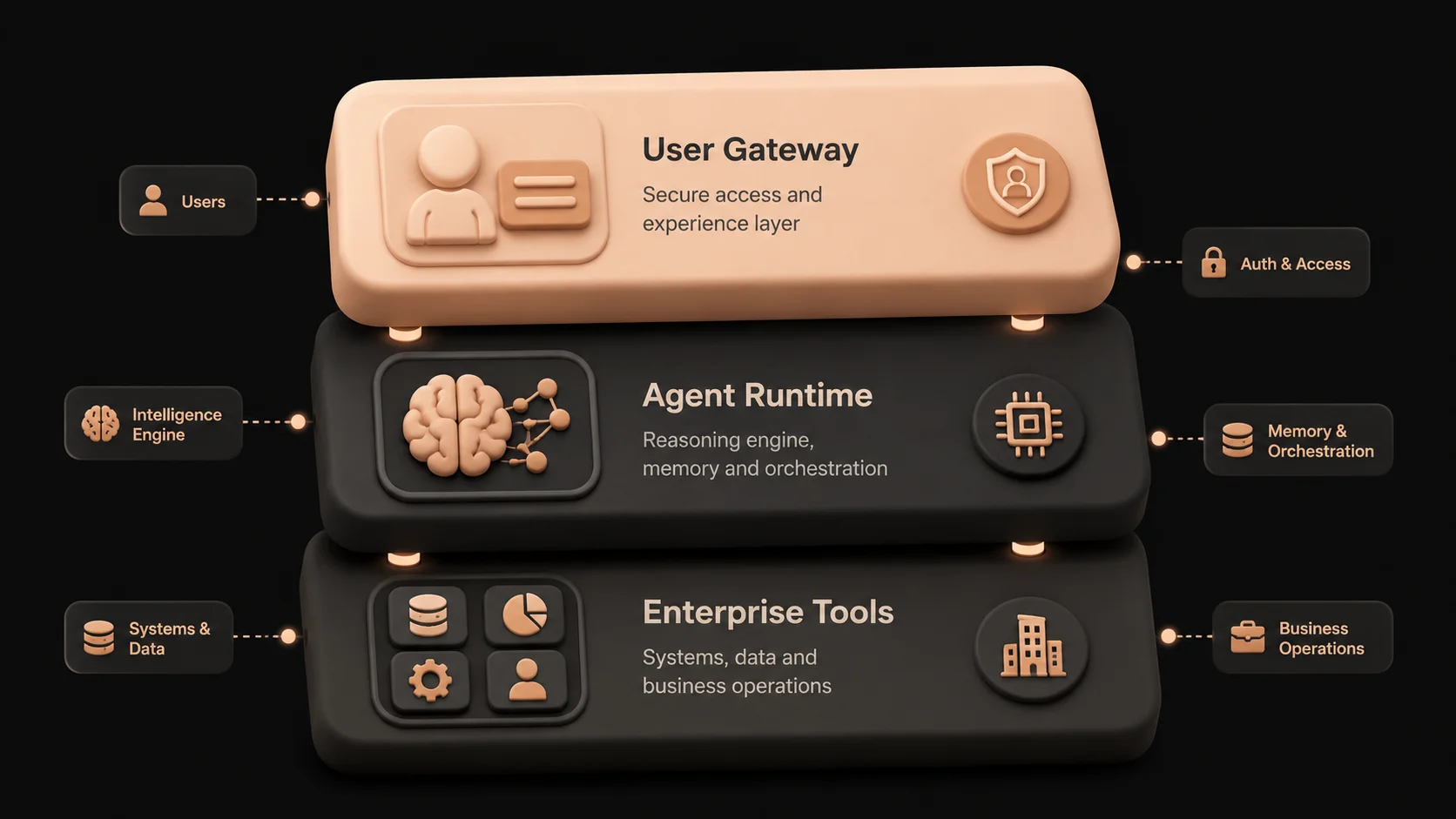
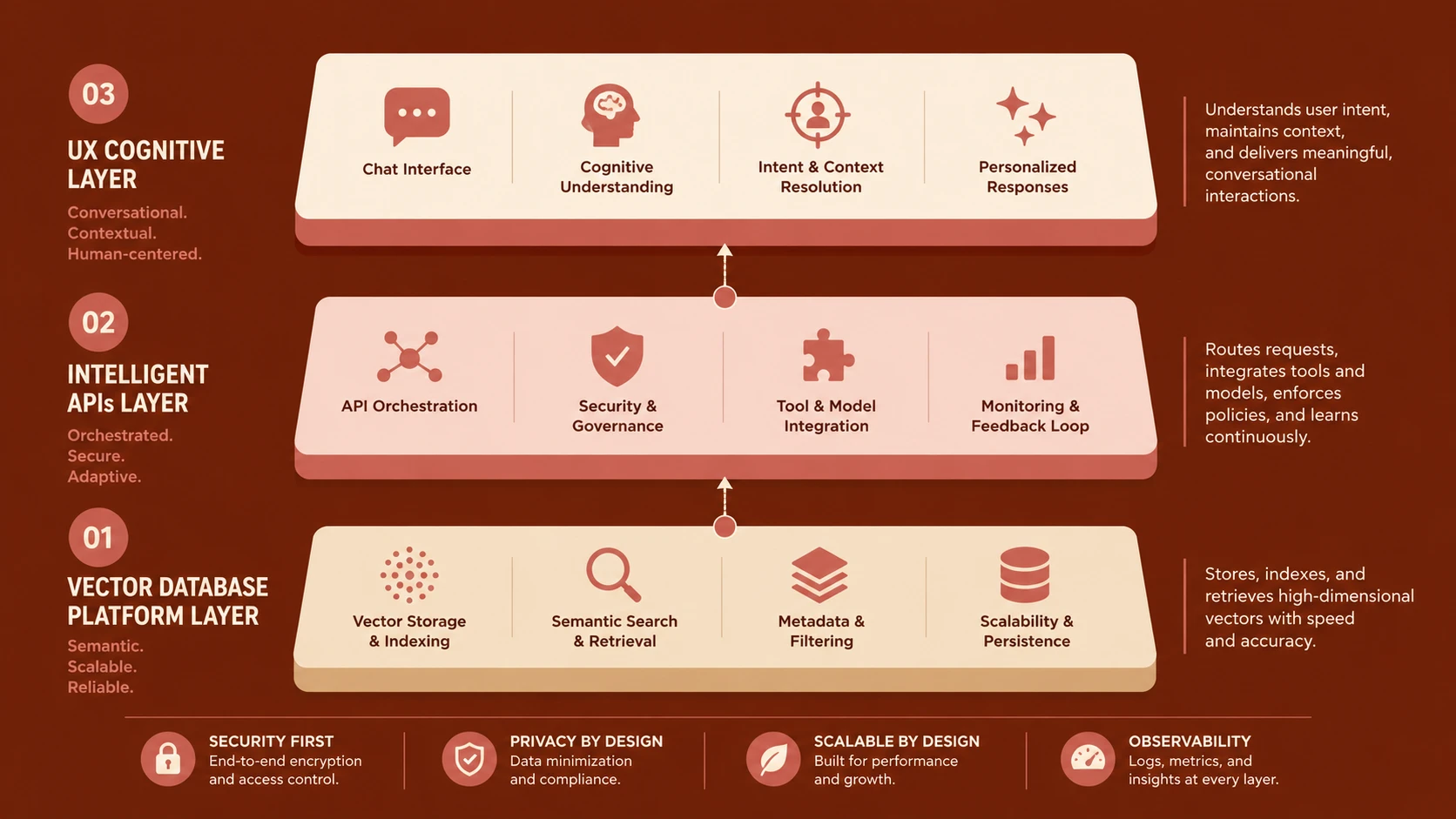
Despite differences in branding, Microsoft, Google, and AWS are building remarkably similar architectural stacks.
A modern enterprise AI platform generally consists of the following layers:
| Layer | Purpose |
|---|---|
| Foundation Models | Model reasoning and generation |
| Context Layer | Enterprise knowledge retrieval |
| Agent Framework | Planning and orchestration |
| Tool Layer | Business capability execution |
| Governance | Identity, permissions, auditing, compliance |
| Observability | Evaluation, tracing, optimization |
Each layer addresses a different aspect of deploying AI systems into production.
Foundation models provide reasoning capabilities.
Context layers connect those models with enterprise documents, emails, structured business data, and approved external information.
Agent frameworks coordinate multi-step workflows while invoking enterprise tools through governed interfaces.
Governance ensures AI systems remain compliant with organizational security policies.
Observability provides visibility into execution quality, latency, failures, and operational performance.
Viewed through this architectural lens, the announcements from Microsoft and Google become easier to interpret. Rather than introducing isolated features, both companies are assembling comprehensive AI execution platforms.
Core Architecture
Microsoft Build 2026 presented perhaps the clearest example of this platform strategy.
Instead of emphasizing only new AI models, Microsoft introduced an integrated ecosystem centered around enterprise context, production governance, and long-running agents.
Among the most significant announcements were:
- ◆Microsoft IQ as a unified enterprise context layer
- ◆Work IQ APIs for accessing Microsoft 365 organizational intelligence
- ◆Fabric IQ for structured enterprise data
- ◆Foundry IQ for unified retrieval planning
- ◆Web IQ for high-speed web grounding
- ◆Microsoft Scout as an always-on workplace agent
- ◆Continued investment in Microsoft Foundry for deploying and governing production AI agents
Collectively, these components position Microsoft AI infrastructure as an operating environment for enterprise agents rather than merely a collection of language models.
Google presented a parallel vision during Google I/O 2026.
Its announcements emphasized:
- ◆Gemini 3.5 Flash
- ◆Gemini Omni
- ◆Expansion of Google Antigravity as an agent-first development platform
- ◆Agent-powered Search experiences
- ◆Broader Gemini integration across Workspace and developer tooling
Google's emphasis centered on creating AI systems capable of acting across products while extending multimodal reasoning into practical enterprise and consumer workflows.
Key Features
Although each vendor introduced a wide range of products and services, several themes consistently emerged across the announcements.
AI Agents Become First-Class Platform Components
# Python agent executing tasks with tool calling capability (LangChain style agent block)
from langchain.agents import initialize_agent, AgentType
from langchain.chat_models import ChatOpenAI
from langchain.tools import Tool

# Initialize agent with corporate data access tool
llm = ChatOpenAI(temperature=0, model="gpt-4")
tools = [
    Tool(name="QueryStore", func=query_store, description="Useful for querying database records")
]

agent = initialize_agent(tools, llm, agent=AgentType.STRUCTURED_CHAT_ZERO_SHOT_REACT_DESCRIPTION)
response = agent.run("Find active sales metrics for July 2026")
print(response)
One of the clearest trends is the transition from conversational assistants toward autonomous software agents.
Rather than simply generating responses, these agents are expected to:
- ◆Plan multi-step tasks
- ◆Invoke enterprise tools
- ◆Maintain execution context
- ◆Collaborate with other agents
- ◆Operate within organizational governance
Microsoft emphasized this vision through Microsoft Foundry and its expanding AI agent ecosystem.
Google extended Gemini beyond conversational experiences into agent-oriented workflows integrated across Workspace and Search.
AWS continued investing in Amazon Bedrock capabilities that allow organizations to build, manage, and govern production AI agents.
Enterprise Context Is Becoming a Competitive Advantage
Raw model intelligence is no longer the primary differentiator.
All three vendors increasingly focus on providing AI systems with secure access to organizational knowledge.
Examples include:
| Vendor | Enterprise Context Strategy |
|---|---|
| Microsoft | Microsoft 365 knowledge, Fabric, Work IQ, Foundry IQ |
| Workspace, Search, Gemini context integration | |
| AWS | Bedrock knowledge bases, enterprise retrieval, organizational data integration |
The emphasis is shifting from larger models toward better enterprise grounding.
Model Flexibility
Organizations increasingly expect the ability to select models based on workload rather than committing to a single provider.
This trend appears throughout recent platform announcements.
Developers now expect:
- ◆Multiple model choices
- ◆Interchangeable inference providers
- ◆Flexible deployment targets
- ◆Cost optimization
- ◆Performance optimization
Rather than forcing customers into proprietary ecosystems, vendors are increasingly competing on platform capabilities surrounding the models.
Production AI Governance
As AI moves into business-critical workflows, governance becomes essential.
Important capabilities now include:
- ◆Identity management
- ◆Permission enforcement
- ◆Audit logging
- ◆Policy management
- ◆Evaluation frameworks
- ◆Prompt protection
- ◆Responsible AI controls
These capabilities received significantly more attention than previous conference cycles, indicating increasing enterprise maturity.
How It Works
Although implementations differ, the emerging enterprise AI architecture follows a similar execution model across vendors.
| Stage | Description |
|---|---|
| User Objective | Business user submits a goal |
| Planning | AI agent decomposes the objective |
| Context Retrieval | Enterprise knowledge is collected |
| Tool Selection | Required business systems are identified |
| Execution | APIs and enterprise applications are invoked |
| Validation | Policies and permissions are enforced |
| Delivery | Results returned to user or workflow |
This architecture transforms AI from a passive assistant into an active participant in enterprise business processes.
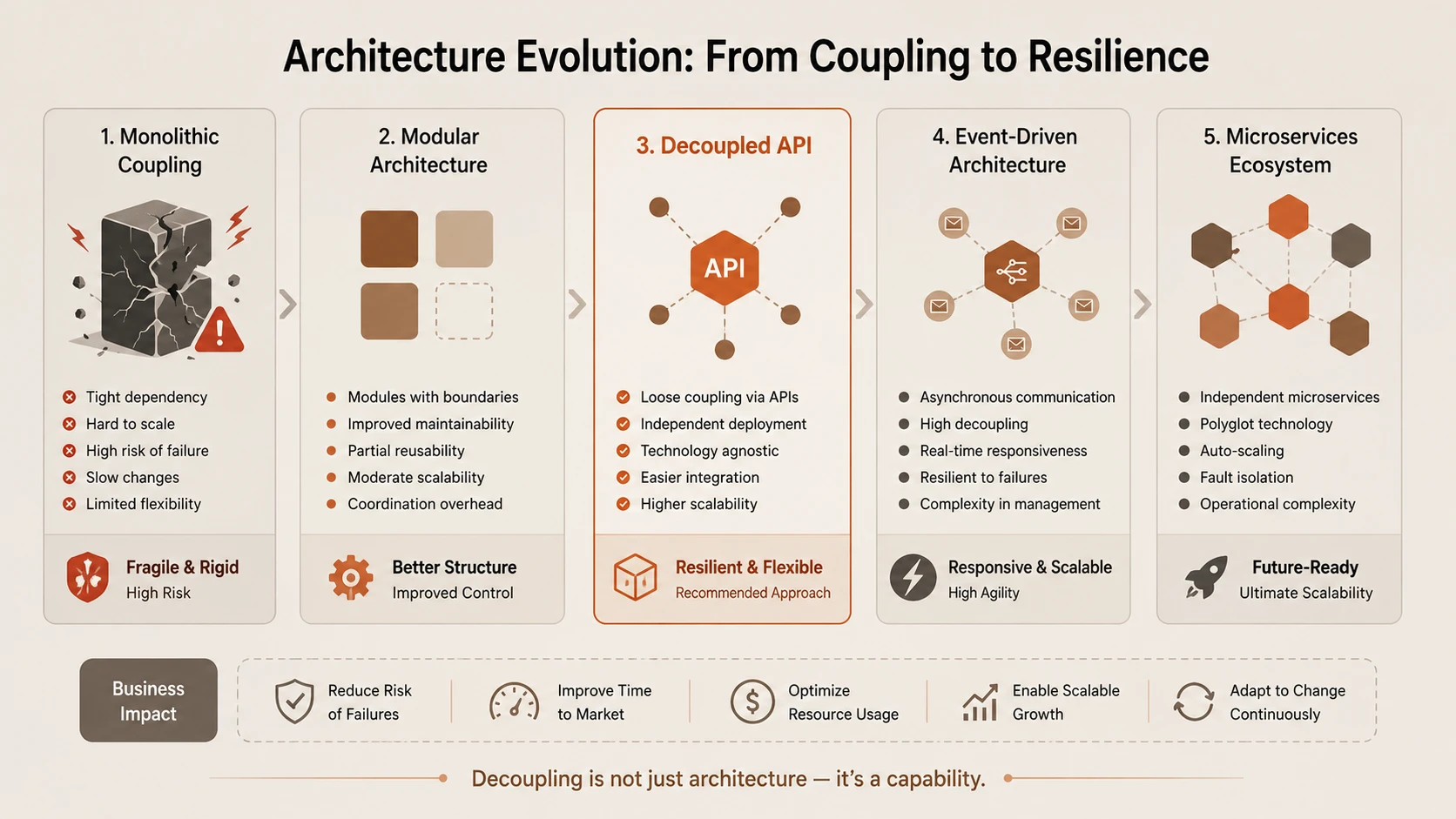
Applications increasingly expose reusable capabilities while AI systems coordinate execution.
Enterprise Use Cases
The announcements collectively indicate that vendors are targeting practical enterprise workloads rather than experimental demonstrations.
Representative scenarios include:
Knowledge Discovery
Employees increasingly expect AI systems capable of locating information distributed across documents, email, collaboration platforms, structured databases, and business applications.
Rather than manually searching multiple repositories, enterprise AI platforms retrieve, summarize, and contextualize relevant information.
Software Engineering
Developer productivity continues to receive significant investment.
Recent announcements improve:
- ◆Code generation
- ◆Code review
- ◆Documentation
- ◆Testing
- ◆Refactoring
- ◆Security analysis
- ◆Deployment automation
Rather than replacing software engineers, these capabilities automate repetitive development activities while allowing engineers to focus on architectural decisions.
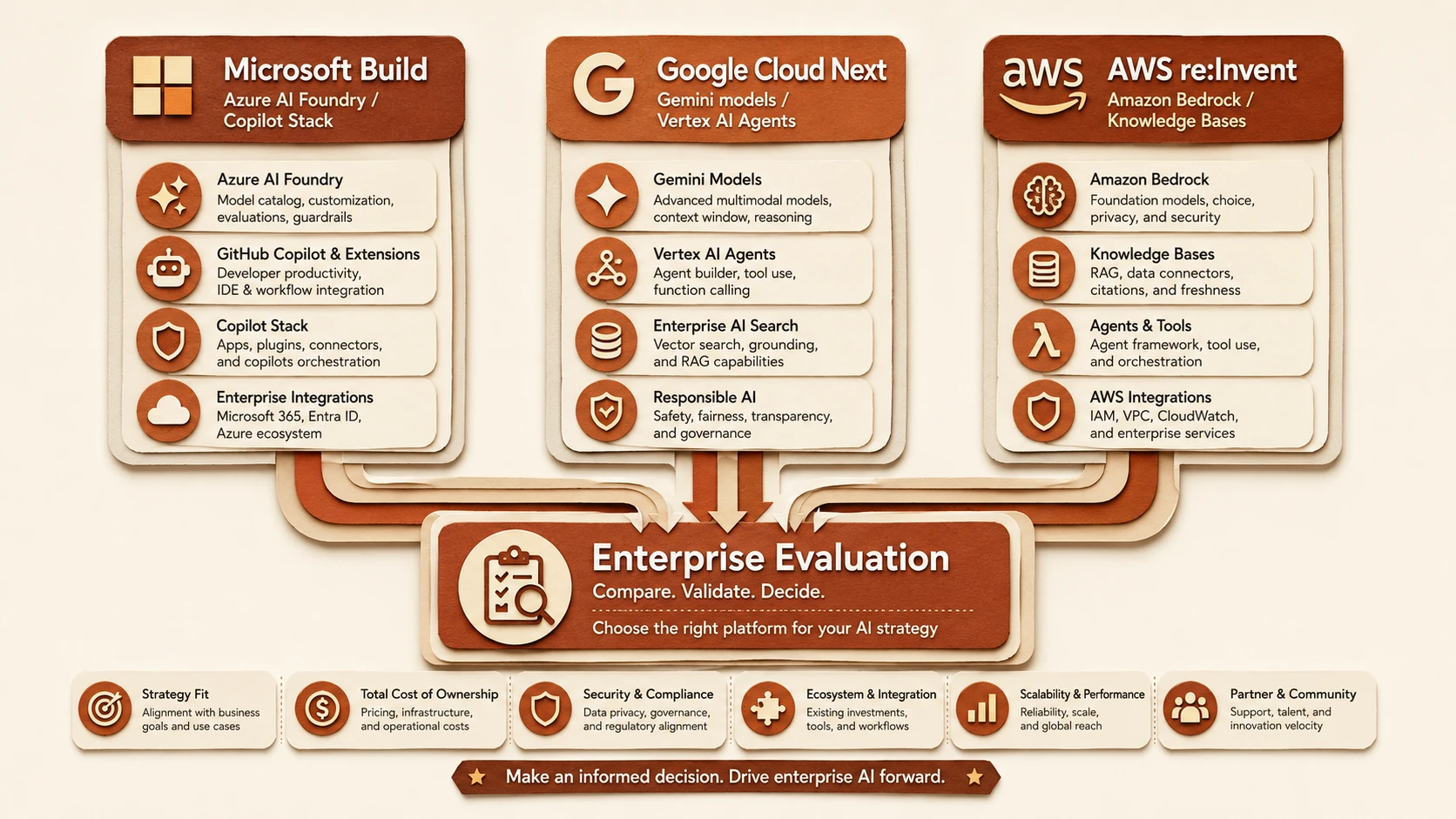
Comparative timeline of platform capability announcements across Microsoft, Google, and AWS.
Business Process Automation
Agent platforms increasingly orchestrate workflows spanning multiple enterprise systems.
Examples include:
- ◆Employee onboarding
- ◆Procurement approvals
- ◆Financial reporting
- ◆Customer support
- ◆Compliance documentation
- ◆IT service management
These scenarios demonstrate the industry's movement beyond isolated chatbot interactions.
Performance Considerations
Enterprise AI platforms introduce new performance considerations extending beyond model inference speed.
Organizations should evaluate:
| Component | Primary Consideration |
|---|---|
| Model Inference | Response latency |
| Context Retrieval | Search efficiency |
| Tool Execution | API responsiveness |
| Workflow Orchestration | Multi-step coordination |
| Agent Memory | Context management |
| Infrastructure | Elastic scalability |
Vendors are investing heavily in reducing orchestration overhead while improving the efficiency of enterprise knowledge retrieval.
Microsoft's announcements emphasized tighter integration across its AI infrastructure.
Google focused on lower-latency multimodal reasoning.
AWS continues expanding optimized AI infrastructure alongside Bedrock's managed agent capabilities.
Security Considerations
Security remains one of the defining enterprise requirements for production AI systems.
Across vendor announcements, several themes repeatedly appeared.
Identity Integration
AI systems increasingly operate using existing enterprise identities rather than isolated credentials.
This allows organizations to apply existing authentication and authorization policies consistently.
Permission-Aware Retrieval
Enterprise knowledge retrieval must respect document permissions.
Users should never receive information beyond their authorized access level simply because an AI system generated a response.
Auditability
Organizations require complete visibility into:
- ◆Agent actions
- ◆Tool invocations
- ◆Retrieved information
- ◆Generated outputs
- ◆Approval workflows
These capabilities support regulatory compliance and operational governance.
Policy Enforcement
Rather than relying solely on prompt instructions, enterprise AI platforms increasingly enforce organizational policies through platform services.
This architectural approach improves consistency and simplifies enterprise administration.
Scalability
The scale of enterprise AI systems extends well beyond serving individual chat requests.
Modern platforms must support:
- ◆Thousands of concurrent users
- ◆Long-running agents
- ◆Distributed orchestration
- ◆Enterprise search
- ◆Model routing
- ◆API execution
- ◆Workflow persistence
Cloud-native infrastructure remains central to achieving this scalability.
Each vendor continues investing in managed services that allow organizations to scale AI workloads independently from traditional application infrastructure.
Best Practices
Based on the announcements, several architectural recommendations emerge for enterprise organizations.
Treat AI as Platform Infrastructure
AI should become part of enterprise architecture rather than an isolated application feature.
Expose Business Capabilities Through APIs
Well-defined enterprise services simplify agent orchestration while preserving existing business logic.
Establish Governance Early
Identity, permissions, auditing, and compliance should be designed before large-scale AI deployment.
Design for Human Oversight
Autonomous execution should include configurable approval points for sensitive business operations.
Build Vendor-Neutral Architectures
Where practical, organizations should avoid unnecessary coupling to a single model provider.
Abstraction layers and standardized interfaces improve long-term flexibility while allowing future model evolution without extensive application redesign.
Common Mistakes
As enterprise organizations evaluate the latest AI platforms, several architectural mistakes are becoming increasingly common.
Focusing Only on Foundation Models
Many organizations compare AI platforms solely on model quality.
While model capabilities are important, the surrounding platform—including governance, identity, observability, tool execution, and enterprise context—often has a greater impact on production success.
Treating AI as Another Chatbot
The latest platform announcements make it clear that AI is evolving beyond conversational interfaces.
Architectures designed only for chat interactions may struggle to support long-running agents, workflow orchestration, and enterprise automation.
Ignoring Existing Enterprise Systems
Successful AI initiatives build upon existing ERP, CRM, collaboration platforms, identity providers, and business applications.
Replacing established enterprise software is rarely necessary.
Instead, organizations should expose business capabilities through secure APIs that agents can consume.
Neglecting Governance
Allowing AI systems unrestricted access to enterprise data introduces unnecessary operational and security risks.
Identity-aware retrieval, approval workflows, policy enforcement, and comprehensive audit logging should be considered foundational requirements rather than optional enhancements.
Overlooking Observability
Production AI systems require continuous monitoring.
Organizations should measure:
- ◆Agent success rates
- ◆Tool invocation latency
- ◆Retrieval quality
- ◆Model costs
- ◆Failure rates
- ◆User satisfaction
- ◆Policy violations
Operational visibility enables continuous optimization while reducing business risk.
Technology Comparison
Although Microsoft, Google, and AWS approach AI platform development differently, their long-term architectural direction shows significant convergence.
| Area | Microsoft | AWS | |
|---|---|---|---|
| Primary AI Platform | Microsoft Foundry | Gemini Platform | Amazon Bedrock |
| Enterprise Productivity | Microsoft 365 | Google Workspace | AWS integrations |
| Agent Strategy | Long-running enterprise agents | Gemini-powered agent workflows | Managed enterprise agents |
| Enterprise Data | Fabric, Work IQ, Foundry IQ | Workspace and Search integration | Bedrock Knowledge Bases |
| Governance | Integrated Microsoft security ecosystem | Google Cloud security services | AWS IAM and Bedrock governance |
| Target Audience | Enterprise organizations | Consumer and enterprise developers | Cloud-native enterprise workloads |
Rather than competing on isolated features, each vendor is building a complete AI platform spanning models, enterprise data, orchestration, governance, and developer tooling.
Adoption Strategy
Enterprise organizations should approach these platform capabilities incrementally.
A practical adoption roadmap consists of several stages.
| Phase | Objective |
|---|---|
| Assessment | Identify high-value AI opportunities |
| Foundation | Establish governance, identity, and security |
| Pilot | Deploy limited production AI workloads |
| Integration | Connect AI with enterprise systems |
| Expansion | Scale successful implementations across business units |
Suitable initial workloads include:
- ◆Enterprise search
- ◆Documentation generation
- ◆Knowledge assistants
- ◆Internal developer tools
- ◆Customer support
- ◆Meeting preparation
- ◆Reporting automation
After establishing operational confidence, organizations can expand toward more autonomous agent-driven workflows.
Limitations
Despite the significant progress demonstrated during the 2026 conference season, enterprise AI platforms continue to face important challenges.
Current considerations include:
- ◆Managing operational costs for large-scale AI workloads
- ◆Maintaining high-quality enterprise knowledge
- ◆Preventing inaccurate or incomplete responses
- ◆Meeting regulatory and compliance obligations
- ◆Ensuring explainability for business-critical decisions
- ◆Integrating with complex legacy environments
- ◆Measuring business value beyond demonstration scenarios
Organizations should therefore evaluate AI initiatives using measurable business outcomes rather than focusing exclusively on model capabilities or benchmark performance.
Looking Ahead
The announcements from Microsoft Build 2026, Google I/O 2026, and AWS collectively illustrate that enterprise AI has entered a new phase of maturity.
The industry is moving beyond standalone copilots toward intelligent software platforms capable of understanding enterprise context, orchestrating business processes, invoking organizational tools, and operating within governed environments.
For technology leaders, the strategic decision is no longer whether AI will become part of enterprise architecture. The more important consideration is how quickly organizations can establish the governance, integration patterns, and operational foundations necessary to support production AI systems responsibly.
While each cloud provider continues to differentiate through its ecosystem and developer experience, the underlying direction is increasingly evident: enterprise software is evolving toward platforms where applications expose capabilities, organizational knowledge is securely accessible, and intelligent agents coordinate work across previously disconnected systems.
Organizations that invest in strong architectural foundations today will be better positioned to adopt future AI capabilities while maintaining security, compliance, and operational excellence.