Introduction
Artificial intelligence is rapidly evolving from isolated assistants into collaborative systems capable of solving increasingly complex business problems. While a single AI agent can perform planning, reasoning, and tool usage for many tasks, enterprise workloads often require multiple specialized agents working together. Coordinating these agents efficiently is the responsibility of multi-agent orchestration.
Multi-agent orchestration is becoming a foundational capability in enterprise AI architecture because modern business processes rarely belong to a single domain. A customer support request, for example, may involve customer relationship management systems, billing platforms, technical documentation, inventory databases, security policies, and internal approval workflows. Expecting one general-purpose agent to handle every responsibility creates scalability, reliability, and governance challenges.
Instead, organizations are increasingly designing software around teams of specialized AI agents coordinated by orchestration platforms that assign responsibilities, manage communication, monitor execution, and ensure business objectives are completed efficiently.
As of 2026, multi-agent orchestration is emerging as one of the defining architectural patterns for enterprise AI systems, complementing cloud-native architectures, microservices, and event-driven software by introducing intelligent coordination into existing enterprise ecosystems.
What Is Multi-Agent Orchestration?
Multi-agent orchestration is the architectural process of coordinating multiple autonomous AI agents that collaborate to achieve shared business objectives while maintaining clear responsibilities, communication pathways, governance policies, and execution visibility.
Unlike workflow automation, where every execution path is predefined, orchestration allows agents to dynamically coordinate work, exchange information, delegate responsibilities, and adjust execution strategies as new information becomes available.
Each agent focuses on a specific domain of expertise while the orchestration layer ensures collaboration remains organized, secure, and aligned with enterprise objectives.
Rather than building one increasingly complex AI assistant, enterprises build intelligent teams.
Why Multi-Agent Systems Are Needed
Large enterprise environments contain numerous specialized business functions.
Examples include:
- ◆Finance
- ◆Human Resources
- ◆Customer Support
- ◆Sales
- ◆Procurement
- ◆Security
- ◆Compliance
- ◆Software Development
- ◆Cloud Operations
- ◆Business Intelligence
Each department possesses unique knowledge, business rules, terminology, and operational requirements.
Attempting to centralize all responsibilities inside one AI agent introduces several problems:
- ◆Excessive prompt complexity
- ◆Large context requirements
- ◆Higher operational costs
- ◆Difficult maintenance
- ◆Reduced reasoning quality
- ◆Increased security exposure
- ◆Poor scalability
Specialized agents address these limitations by focusing on narrowly defined responsibilities while collaborating through orchestration.
Evolution of Enterprise Automation
Enterprise automation has evolved significantly over the past two decades.
| Generation | Primary Focus | Characteristics |
|---|---|---|
| Manual Processes | Human execution | Individual knowledge workers |
| Script Automation | Task automation | Deterministic scripts |
| Workflow Engines | Business processes | Rule-based orchestration |
| Robotic Process Automation | User interface automation | Repetitive task execution |
| Intelligent Agents | Autonomous reasoning | Goal-oriented execution |
| Multi-Agent Orchestration | Collaborative intelligence | Specialized autonomous agents working together |
Each stage reduced manual effort while increasing system intelligence.
Multi-agent orchestration extends this progression by enabling collaboration rather than isolated automation.
Core Principles of Multi-Agent Orchestration
Successful orchestration platforms follow several architectural principles.
Specialization
Each agent should own one clearly defined responsibility.
Examples include:
- ◆Planning
- ◆Coding
- ◆Documentation
- ◆Security
- ◆Compliance
- ◆Analytics
- ◆Deployment
Specialization improves reasoning quality while simplifying maintenance.
Coordination
Agents should never operate independently without oversight.
An orchestration layer coordinates:
- ◆Task assignment
- ◆Dependency management
- ◆Communication
- ◆Progress tracking
- ◆Error handling
- ◆Final aggregation
Shared Context
Agents require access to consistent enterprise knowledge.
Shared context prevents conflicting decisions while improving collaboration.
Controlled Autonomy
Agents should possess sufficient independence to solve assigned problems while remaining governed by enterprise policies.
Observability
Every reasoning step, communication event, and tool invocation should be measurable and auditable.
Core Architecture
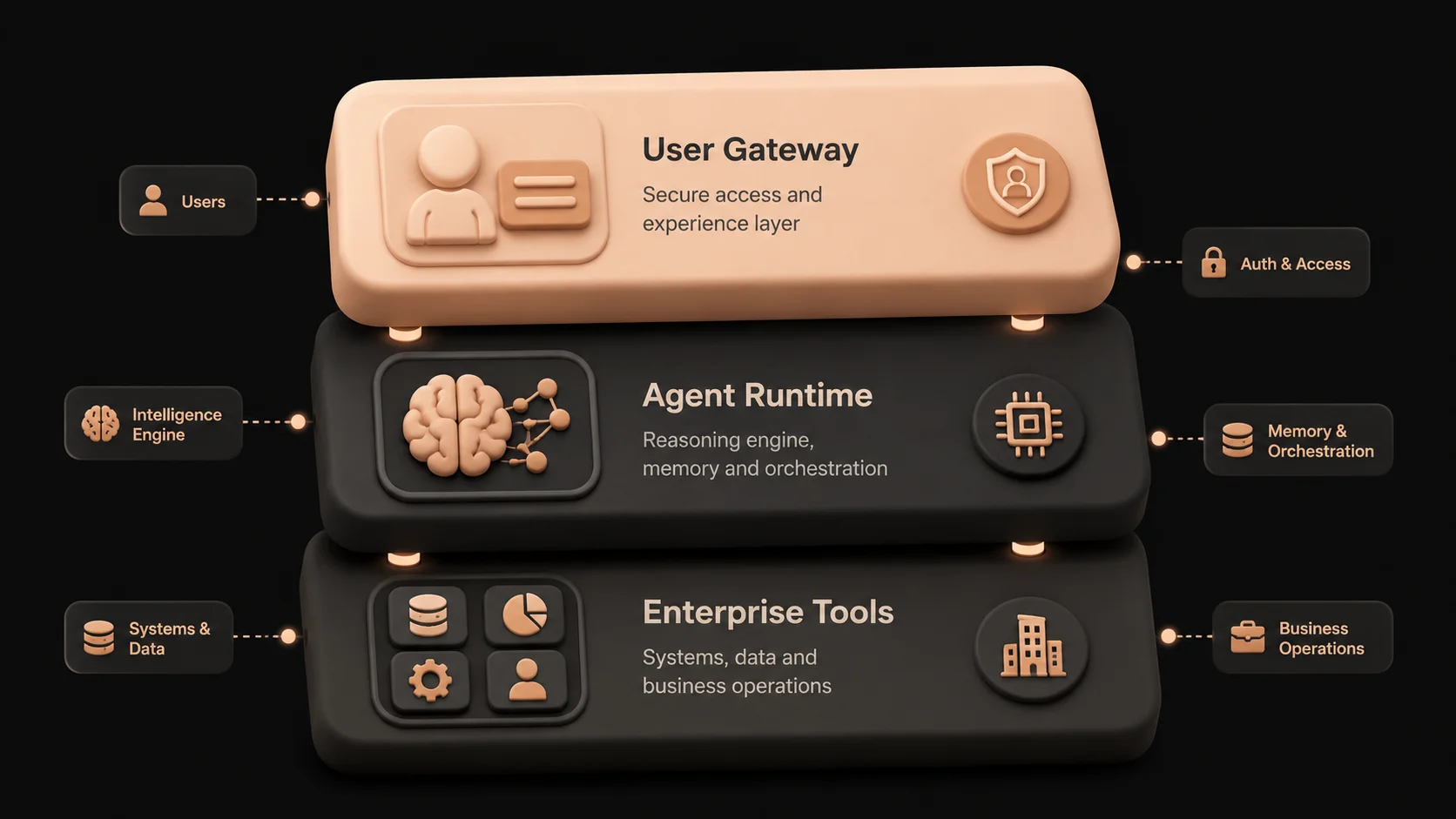
Although implementations differ, most enterprise orchestration platforms include several architectural layers.
| Layer | Responsibility |
|---|---|
| User Layer | Receives business objectives |
| Orchestration Engine | Coordinates execution |
| Planning Layer | Decomposes complex objectives |
| Agent Runtime Layer | Executes specialized agents |
| Shared Memory Layer | Maintains organizational context |
| Knowledge Layer | Retrieves enterprise information |
| Tool Integration Layer | Connects enterprise applications |
| Governance Layer | Security, policies, auditing |
| Infrastructure Layer | Compute, networking, storage |
Each layer can evolve independently, allowing organizations to improve AI capabilities without redesigning existing business systems.
The Orchestration Engine
The orchestration engine is the central coordinator responsible for managing agent collaboration.
Typical responsibilities include:
- ◆Receiving business objectives
- ◆Selecting appropriate agents
- ◆Assigning responsibilities
- ◆Monitoring execution
- ◆Managing dependencies
- ◆Handling failures
- ◆Resolving conflicts
- ◆Combining outputs
- ◆Delivering final results
Unlike workflow engines that execute predefined sequences, orchestration engines continuously evaluate execution progress and adapt coordination strategies as conditions change.
Understanding Agent Roles
Large enterprise systems rarely deploy identical agents.
Instead, different agents perform specialized functions.
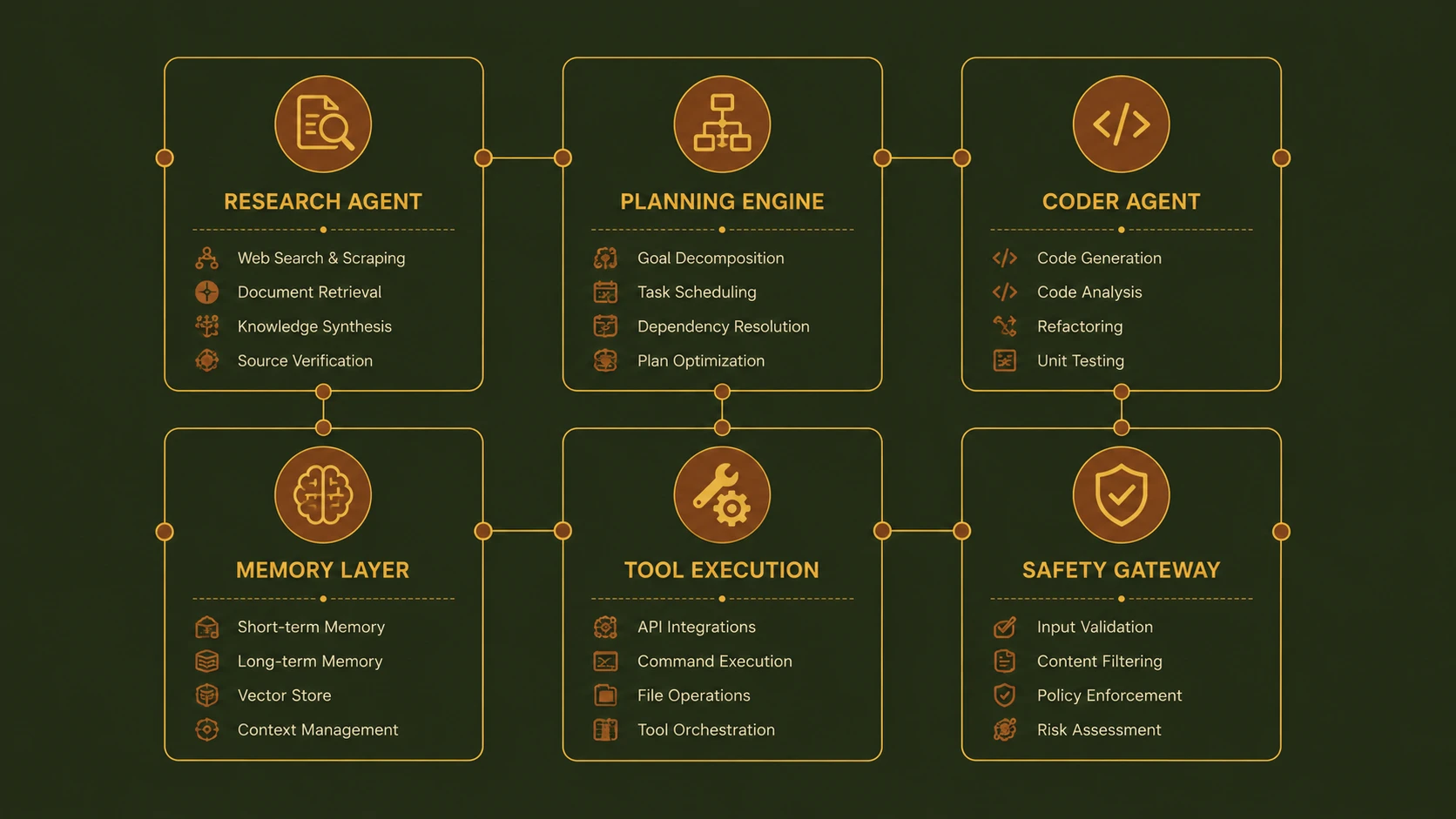
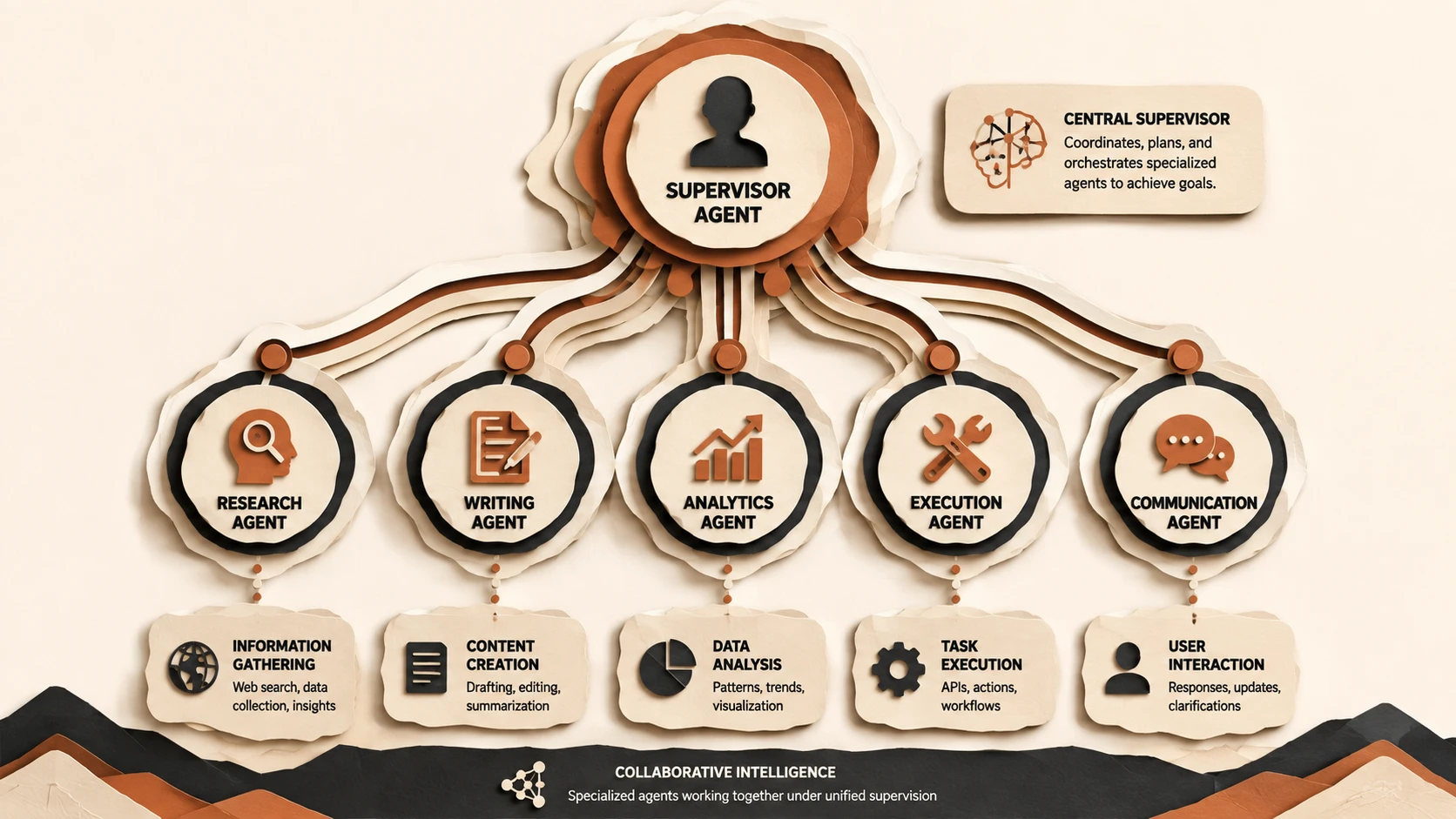
Supervisor Agent
Responsible for:
- ◆Overall coordination
- ◆Objective interpretation
- ◆Agent selection
- ◆Progress monitoring
- ◆Final validation
Planning Agent
Responsible for:
- ◆Breaking objectives into tasks
- ◆Prioritizing execution
- ◆Sequencing activities
- ◆Updating plans dynamically
Research Agent
Responsible for:
- ◆Gathering enterprise knowledge
- ◆Searching documentation
- ◆Collecting supporting information
- ◆Validating available sources
Execution Agent
Responsible for:
- ◆Invoking enterprise tools
- ◆Calling APIs
- ◆Performing deterministic operations
- ◆Updating business systems
Review Agent
Responsible for:
- ◆Quality validation
- ◆Compliance checks
- ◆Policy verification
- ◆Identifying inconsistencies
Organizations may introduce additional specialized agents depending on business requirements.
Task Decomposition
One of the most important orchestration capabilities is decomposing large objectives into manageable tasks.
Consider the request:
"Prepare a security assessment for our customer portal."
A planning agent may automatically generate subtasks such as:
- 1.Collect architecture documentation.
- 2.Analyze authentication systems.
- 3.Review infrastructure configuration.
- 4.Examine security policies.
- 5.Identify vulnerabilities.
- 6.Evaluate compliance requirements.
- 7.Generate recommendations.
- 8.Produce an executive report.
Rather than relying on one large reasoning process, orchestration distributes these activities across specialized agents.
Agent Communication Models
Effective collaboration requires well-defined communication mechanisms.
Several communication patterns are commonly used.
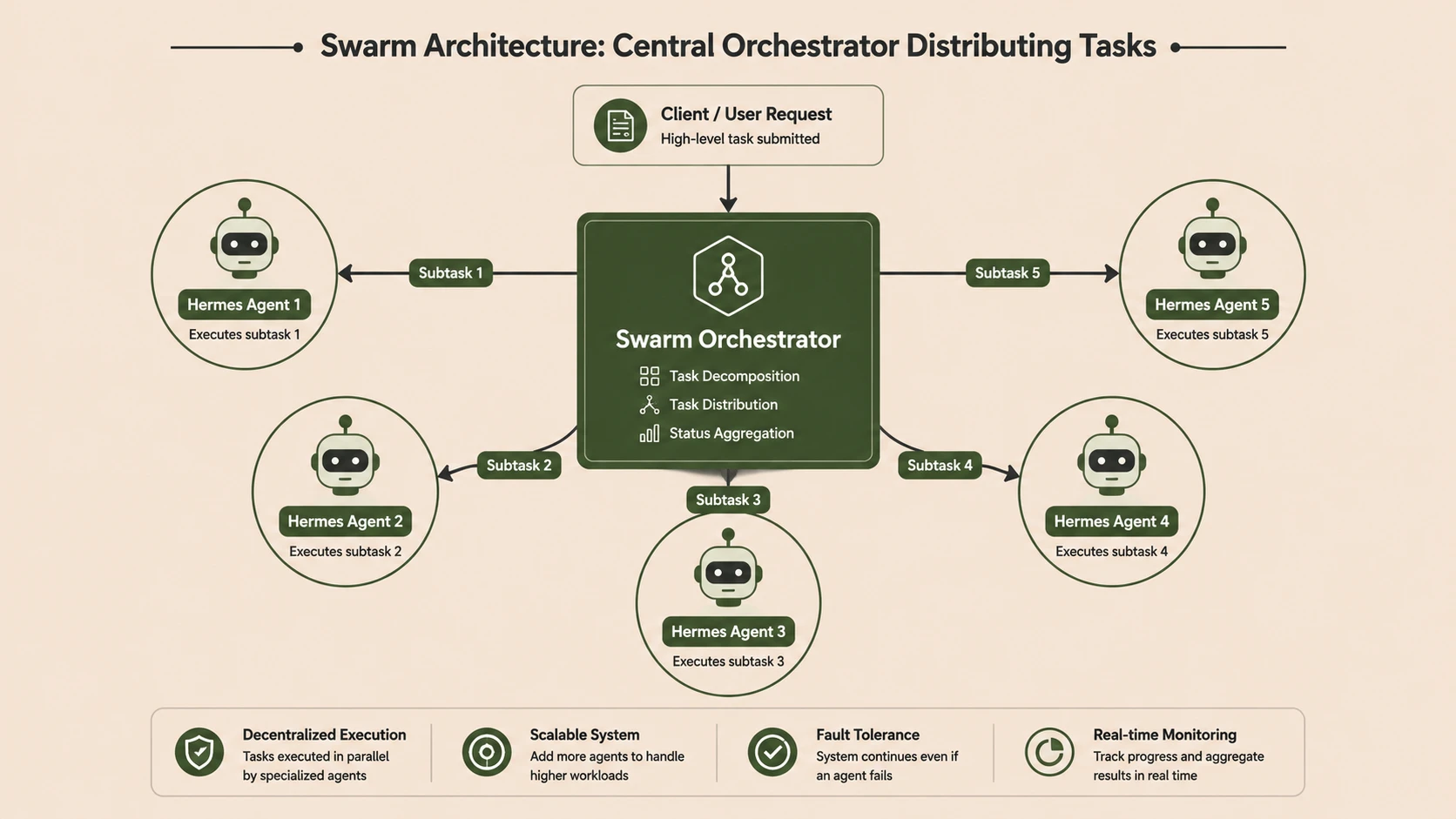
Centralized Coordination
Every agent communicates through a central orchestrator.
Advantages include:
- ◆Clear governance
- ◆Easier monitoring
- ◆Simpler debugging
- ◆Better policy enforcement
This model is commonly adopted by enterprise organizations.
Peer-to-Peer Collaboration
Agents communicate directly when sharing information.
Advantages include:
- ◆Lower coordination overhead
- ◆Faster collaboration
- ◆Greater flexibility
However, governance becomes more challenging.
Hierarchical Coordination
Senior agents supervise teams of specialized agents.
This model mirrors organizational management structures and scales well for large enterprise environments.
Shared Memory and Context
Successful collaboration depends on consistent organizational knowledge.
Most enterprise orchestration platforms maintain multiple memory layers.
| Memory Type | Purpose |
|---|---|
| Working Memory | Active execution context |
| Session Memory | Current business interaction |
| Shared Memory | Information exchanged between agents |
| Long-Term Memory | Organizational knowledge and historical decisions |
Shared memory ensures agents remain synchronized throughout long-running business processes.
Without consistent context, duplicate work, conflicting recommendations, and inaccurate reasoning become significantly more likely.
Knowledge Retrieval
Agents should not depend solely on model training.
Instead, orchestration platforms retrieve relevant enterprise information during execution.
Knowledge sources commonly include:
- ◆Internal documentation
- ◆Architecture diagrams
- ◆Product specifications
- ◆Operational runbooks
- ◆Business policies
- ◆Compliance documents
- ◆Customer records
- ◆Technical knowledge bases
Grounding agent decisions in enterprise information improves consistency, reduces unsupported conclusions, and enables organizations to maintain current knowledge without retraining foundation models.
Planning and Dynamic Coordination
Enterprise environments change continuously.
Systems become unavailable.
Business priorities shift.
Additional approvals become necessary.
New information appears during execution.
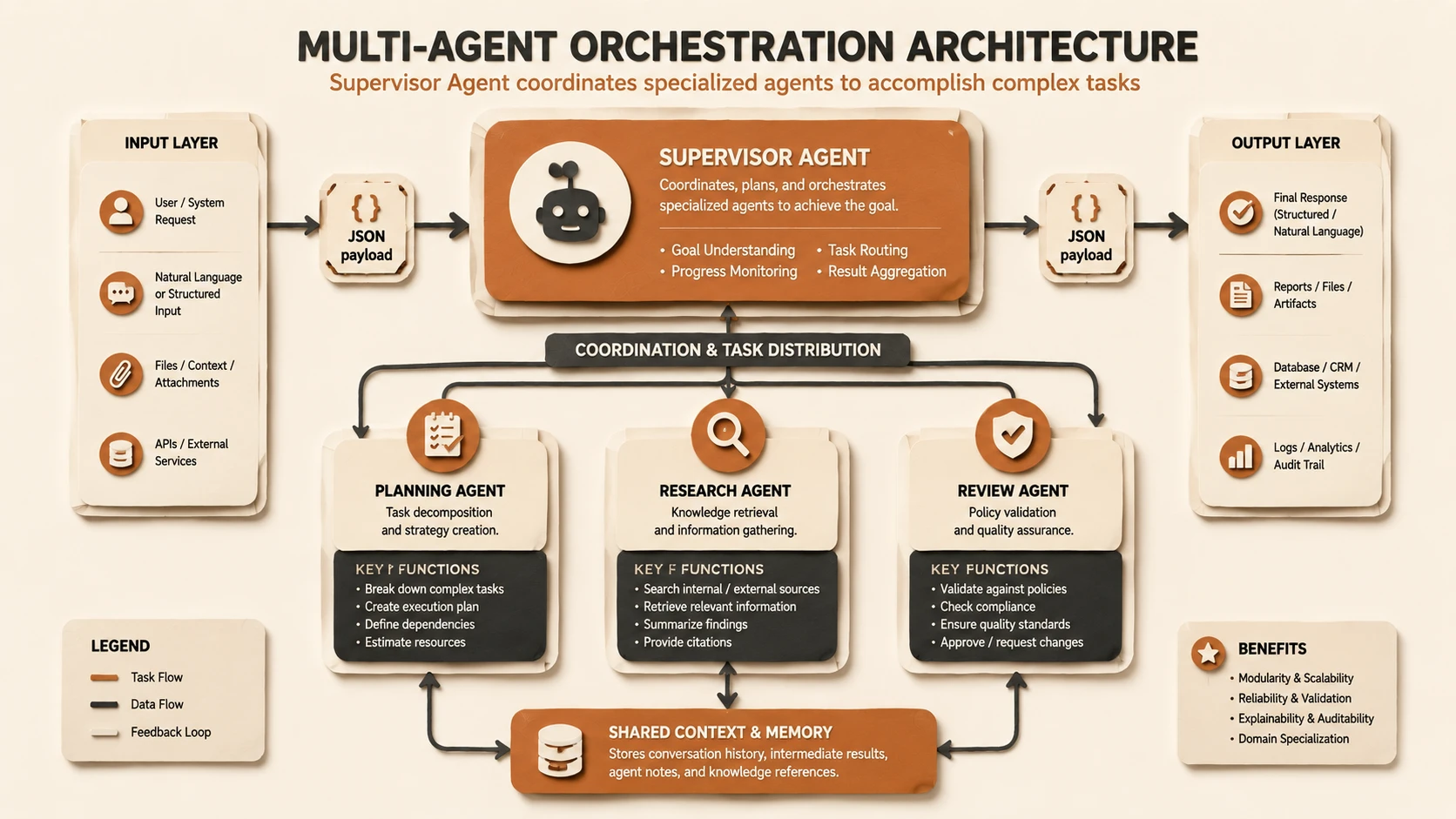
Component diagram of multi-agent orchestration showing a Supervisor Agent coordinating specialized planning, research, and review agents.
For this reason, orchestration platforms continuously reassess execution plans.
Rather than following rigid workflows, planners dynamically:
- ◆Reassign tasks
- ◆Introduce additional agents
- ◆Remove completed work
- ◆Adjust priorities
- ◆Retry failed operations
- ◆Escalate unresolved issues
Dynamic coordination is one of the defining characteristics that distinguishes multi-agent orchestration from traditional workflow automation and deterministic business process management.
Enterprise Use Cases
Multi-agent orchestration delivers the greatest value when business processes span multiple departments, systems, and decision points. Rather than assigning every responsibility to one intelligent agent, organizations distribute work across specialized agents that collaborate through an orchestration platform.
Software Engineering
Engineering organizations can orchestrate specialized agents for:
- ◆Requirements analysis
- ◆Architecture review
- ◆Code generation
- ◆Pull request analysis
- ◆Security scanning
- ◆Test generation
- ◆Documentation creation
- ◆Release validation
Each agent contributes domain expertise while the orchestration engine coordinates the overall software delivery process.
IT Operations
Operations teams can deploy multiple agents to:
- ◆Investigate infrastructure alerts
- ◆Correlate monitoring events
- ◆Analyze logs
- ◆Identify probable root causes
- ◆Recommend remediation
- ◆Generate incident reports
Instead of manually coordinating information across monitoring platforms, agents collaborate automatically while maintaining complete execution visibility.
Cybersecurity
Security operations benefit from specialized orchestration involving:
- ◆Threat Detection Agent
- ◆Log Analysis Agent
- ◆Vulnerability Assessment Agent
- ◆Compliance Agent
- ◆Incident Response Agent
These agents exchange findings while the orchestration engine prioritizes risks and coordinates response activities according to organizational policies.
Customer Operations
Customer-facing organizations can orchestrate agents responsible for:
- ◆Customer history retrieval
- ◆Billing verification
- ◆Product knowledge
- ◆Technical troubleshooting
- ◆Escalation management
- ◆Case summarization
This enables support teams to resolve complex issues more efficiently while ensuring consistent customer experiences.
Enterprise Knowledge Management
Organizations often struggle with fragmented knowledge spread across multiple repositories.
Multi-agent orchestration enables specialized knowledge agents to:
- ◆Index enterprise documentation
- ◆Categorize information
- ◆Validate outdated content
- ◆Answer employee questions
- ◆Recommend related resources
The result is a continuously evolving organizational knowledge ecosystem.
Performance Considerations
Coordinating multiple intelligent agents introduces new performance considerations beyond traditional enterprise software.
Key metrics include:
- ◆Agent startup time
- ◆Planning latency
- ◆Knowledge retrieval speed
- ◆Tool execution duration
- ◆Inter-agent communication overhead
- ◆Parallel execution efficiency
- ◆Overall task completion time
- ◆Infrastructure utilization
Architects should avoid excessive coordination where simpler workflows are sufficient.
Not every business process benefits from multiple collaborating agents.
A common design principle is:
- ◆Use one agent for simple objectives.
- ◆Use orchestrated agents for complex, cross-domain objectives.
This balance minimizes operational cost while maximizing business value.
Security Considerations
As intelligent agents gain access to enterprise systems, security becomes an architectural responsibility rather than an implementation detail.
Critical security controls include:
Identity Management
Each agent should authenticate using enterprise identity providers with unique identities rather than shared credentials.
Authorization
Agents should receive only the permissions necessary for their assigned responsibilities.
Applying least-privilege access reduces organizational risk.
Secure Communication
Communication between agents should be encrypted and authenticated to prevent unauthorized interception or manipulation.
Data Governance
Sensitive enterprise information should remain governed by existing organizational policies.
Agents should never bypass established security controls.
Human Approval
Actions involving financial transactions, regulatory reporting, infrastructure changes, or customer-impacting decisions should require explicit approval before execution.
Observability
Enterprise orchestration platforms must provide comprehensive operational visibility.
Observability extends beyond traditional application logging.
Organizations should monitor:
- ◆Objective completion rate
- ◆Agent utilization
- ◆Planning accuracy
- ◆Communication frequency
- ◆Tool invocation success
- ◆Retry rates
- ◆Failure causes
- ◆Cost per workflow
- ◆Average execution time
- ◆Human intervention frequency
Complete execution traces allow architects to understand not only what occurred but why orchestration decisions were made.
This transparency becomes increasingly important as systems grow in complexity.
Governance
Successful enterprise adoption depends on strong governance.
An effective governance framework should define:
- ◆Agent responsibilities
- ◆Permission boundaries
- ◆Approval requirements
- ◆Escalation procedures
- ◆Audit policies
- ◆Compliance controls
- ◆Lifecycle management
- ◆Performance measurement
Governance should remain independent of individual AI models so that organizational policies continue to evolve without requiring architectural redesign.
Scalability
Scalability is achieved through specialization rather than increasing the complexity of individual agents.
Instead of continuously expanding one general-purpose assistant, organizations deploy multiple focused agents responsible for specific business capabilities.
Examples include:
- ◆Finance Agent
- ◆Procurement Agent
- ◆Sales Agent
- ◆Infrastructure Agent
- ◆Security Agent
- ◆Compliance Agent
- ◆Analytics Agent
- ◆Documentation Agent
The orchestration engine distributes work dynamically while allowing each agent to evolve independently.
This modular architecture improves resilience, maintainability, and operational efficiency.
Best Practices
Organizations implementing multi-agent orchestration should consider the following recommendations.
- ◆Assign one primary responsibility to each agent.
- ◆Keep orchestration separate from business logic.
- ◆Maintain centralized governance.
- ◆Ground reasoning using enterprise knowledge.
- ◆Implement comprehensive audit logging.
- ◆Design communication protocols before scaling.
- ◆Measure business outcomes rather than model outputs.
- ◆Monitor operational costs continuously.
- ◆Establish fallback procedures for failed workflows.
- ◆Continuously evaluate orchestration quality through testing and operational metrics.
These practices help organizations build reliable, maintainable, and trustworthy orchestration platforms.
Common Mistakes
Many early implementations experience similar architectural challenges.
| Mistake | Enterprise Impact |
|---|---|
| Creating overly general agents | Reduced reasoning quality |
| Excessive agent communication | Increased latency |
| Poor task decomposition | Duplicate work |
| Missing governance | Compliance risk |
| Weak observability | Difficult troubleshooting |
| Shared unrestricted permissions | Security exposure |
| Ignoring failure recovery | Operational instability |
| Overengineering simple workflows | Increased infrastructure cost |
Recognizing these issues early significantly improves long-term success.
Technology Comparison
| Capability | Workflow Engines | Single AI Agent | Multi-Agent Orchestration |
|---|---|---|---|
| Planning | Rule-based | Dynamic | Collaborative |
| Specialization | Limited | General-purpose | Domain-specific |
| Scalability | Moderate | Moderate | High |
| Collaboration | Minimal | None | Native |
| Adaptability | Limited | High | Very High |
| Governance | Strong | Moderate | Strong |
| Enterprise Complexity | Moderate | Moderate | High |
| Cross-Domain Coordination | Limited | Limited | Excellent |
Workflow engines remain valuable for deterministic processes.
Single agents perform well for focused objectives.
Multi-agent orchestration becomes the preferred architecture for enterprise-scale intelligent systems involving multiple business domains.
Enterprise Adoption Strategy
Organizations should adopt orchestration incrementally.
Phase 1 — Identify Suitable Workloads
Select business processes involving:
- ◆Multiple knowledge sources
- ◆Cross-functional collaboration
- ◆Complex decision making
- ◆Repetitive coordination
Phase 2 — Introduce Core Agents
Deploy a small number of specialized agents with clearly defined responsibilities.
Phase 3 — Implement Orchestration
Introduce centralized coordination while maintaining governance and operational visibility.
Phase 4 — Expand Enterprise Integrations
Connect additional enterprise applications through secure tool interfaces.
Phase 5 — Measure Business Value
Evaluate:
- ◆Productivity improvements
- ◆Execution quality
- ◆Operational cost
- ◆User satisfaction
- ◆Governance effectiveness
Phase 6 — Enterprise Standardization
Establish organization-wide standards covering:
- ◆Agent design
- ◆Communication protocols
- ◆Security controls
- ◆Observability
- ◆Lifecycle management
- ◆Performance measurement
A phased approach enables organizations to mature both technical architecture and operational processes together.
Limitations
Although multi-agent orchestration offers significant advantages, organizations should recognize its challenges.
Common limitations include:
- ◆Increased architectural complexity
- ◆Higher infrastructure requirements
- ◆Communication overhead
- ◆Greater governance responsibilities
- ◆More sophisticated monitoring requirements
- ◆Additional integration effort
- ◆Continuous evaluation and optimization
- ◆Organizational change management
These considerations should be balanced against the expected business benefits before large-scale adoption.
Looking Ahead
As of 2026, multi-agent orchestration is rapidly emerging as a foundational capability for enterprise AI platforms. Organizations are moving beyond isolated AI assistants toward collaborative ecosystems in which specialized agents coordinate planning, reasoning, execution, and governance across business systems.
The architectural direction is becoming increasingly clear. Future enterprise AI platforms are expected to rely on orchestration engines that intelligently coordinate domain-specific agents, integrate securely with enterprise applications, and provide the transparency, governance, and operational control required for mission-critical workloads.
Technology leaders who invest in modular orchestration architectures, standardized communication models, strong governance, comprehensive observability, and measurable operational practices today will be well positioned to build scalable AI ecosystems capable of supporting increasingly sophisticated enterprise workflows while maintaining the reliability, security, and accountability expected of modern enterprise software.