From Single Agents to Intelligent Swarms
Enterprise AI is rapidly moving beyond single-agent architectures. While one language model can answer questions and execute isolated tasks, modern business workflows often require multiple specialized agents working together. This collaborative approach is known as an Agentic Swarm.
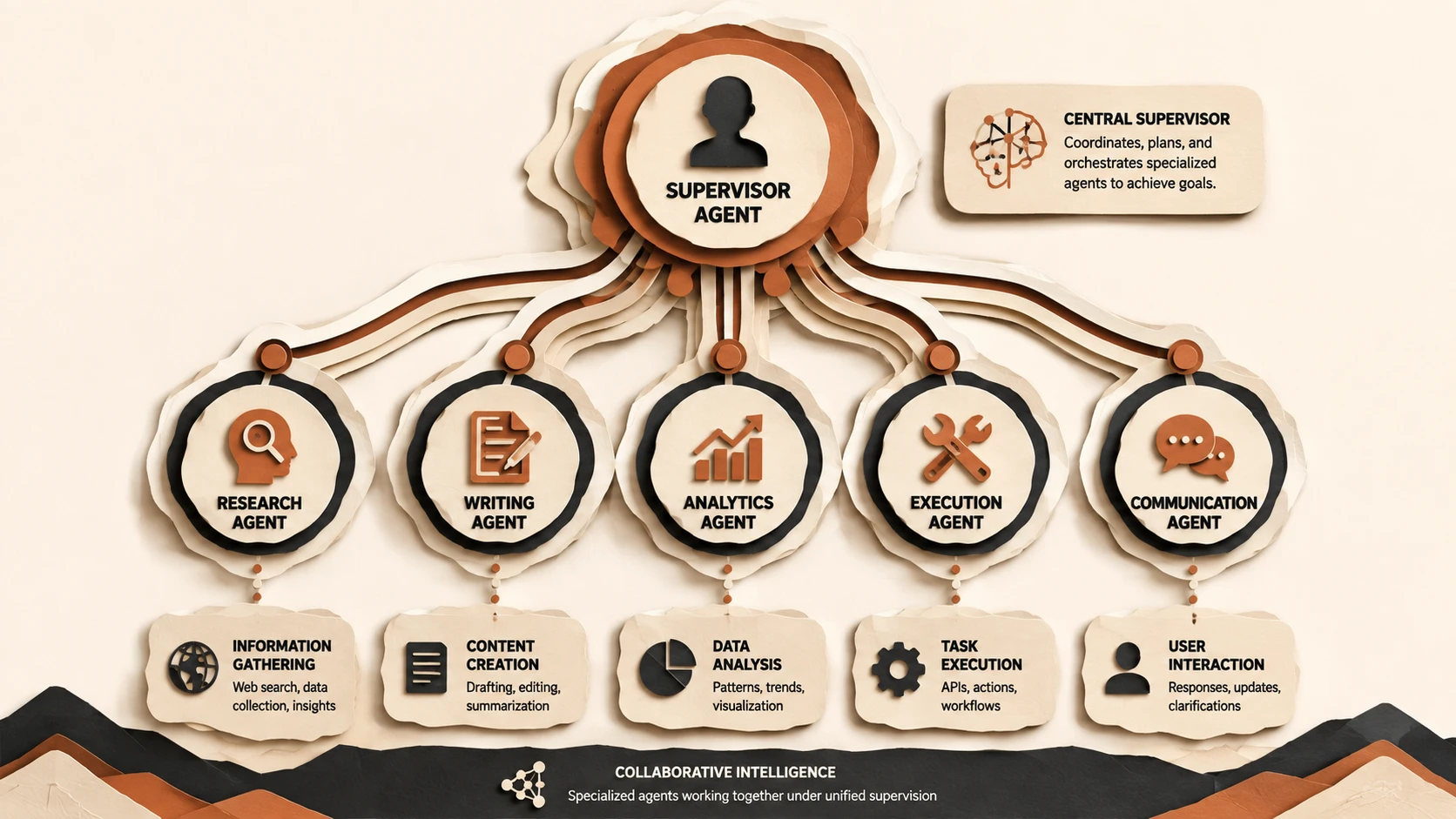
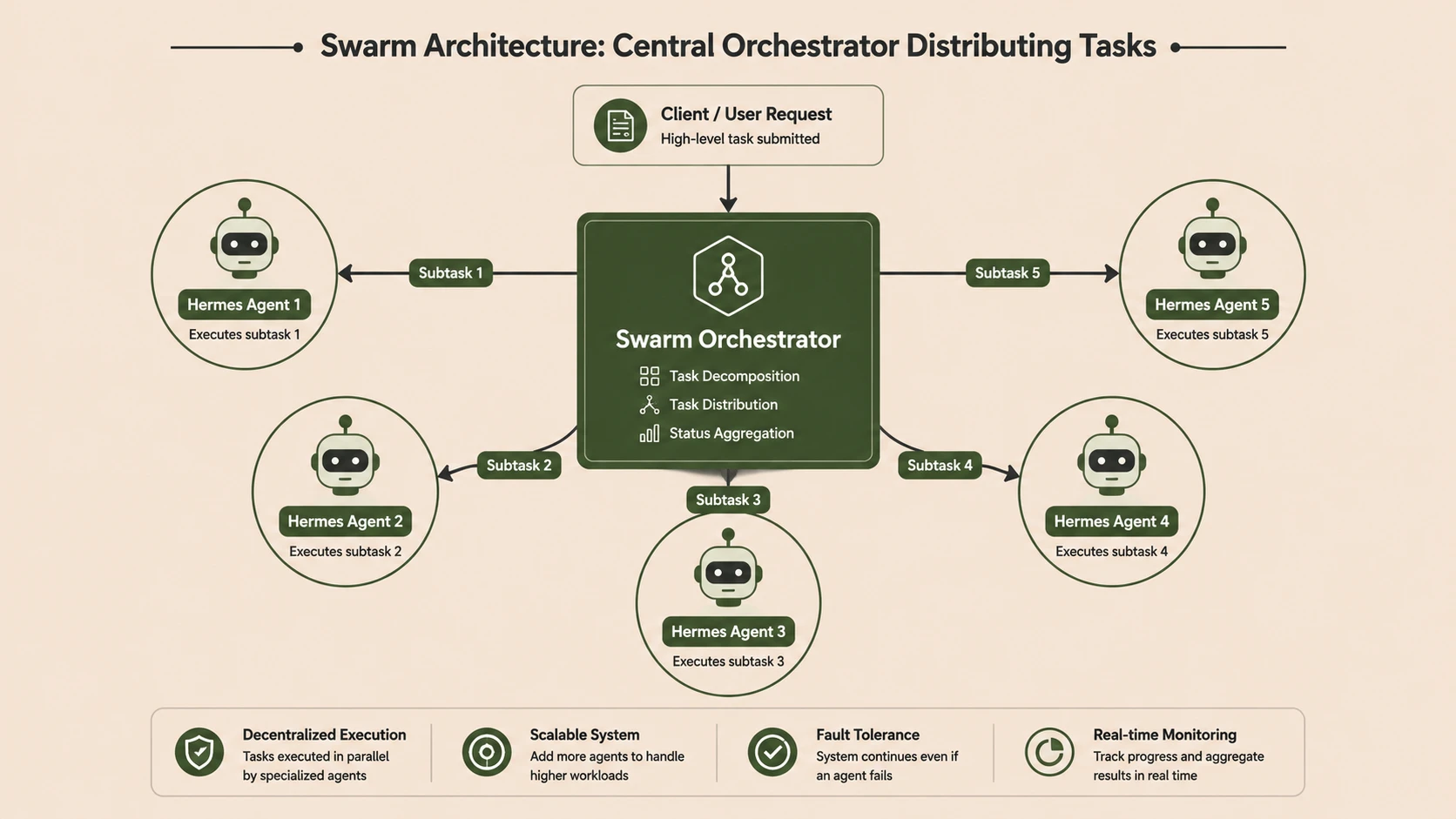
Instead of relying on a single model to perform planning, reasoning, coding, validation, and execution, a swarm distributes responsibilities across multiple Hermes models. Each agent contributes its expertise while a central orchestrator coordinates communication, task allocation, and final decision-making.
Architecture Principle: Complex enterprise problems should be solved through coordinated collaboration between specialized AI agents rather than a single monolithic model.
---
What Is an Agentic Swarm?
An Agentic Swarm is a collection of autonomous AI agents that communicate, share context, and collaborate to complete tasks.
Unlike traditional AI pipelines, swarm architectures allow multiple models to work simultaneously while exchanging information through shared memory and orchestration layers.
Typical swarm participants include:
- ◆Planner Agent
- ◆Research Agent
- ◆Coding Agent
- ◆Validation Agent
- ◆Security Agent
- ◆Documentation Agent
- ◆Reviewer Agent
- ◆Execution Agent
Each agent focuses on a specific responsibility, improving both quality and scalability.
---
Why Hermes Models Work Well in Swarms
Hermes models are particularly suited for collaborative reasoning because they excel at structured instruction following, tool usage, and multi-step planning.
In a swarm architecture, Hermes models can independently:
- ◆Analyze requirements
- ◆Generate implementation plans
- ◆Execute specialized tasks
- ◆Validate outputs
- ◆Identify risks
- ◆Review generated code
- ◆Produce documentation
The orchestrator combines these individual outputs into a unified result.
---
Swarm Architecture
A production-grade swarm typically follows a layered architecture.
User Request
      │
      ▼
Swarm Orchestrator
      │
────────────────────────────────────
│ Planner │ Research │ Memory │
│ Coding │ Validation │ Security │
│ Review │ Documentation │
────────────────────────────────────
      │
Shared Knowledge Store
      │
Tool Execution Layer
      │
Enterprise Applications
The orchestrator manages communication, retries, dependencies, and result aggregation while keeping individual agents loosely coupled.
---
Distributed Task Resolution
Large enterprise requests are automatically decomposed into smaller tasks.
For example, building a secure API may involve:
- 1.Requirement analysis
- 2.Architecture planning
- 3.Database design
- 4.Backend implementation
- 5.Security review
- 6.Performance optimization
- 7.Documentation generation
- 8.Final quality assurance
Instead of executing these sequentially with one model, the orchestrator assigns them to different Hermes agents that work in parallel whenever possible.
This significantly reduces execution time while improving overall output quality.
---
Shared Memory and Context
Collaboration requires a reliable mechanism for exchanging information.
A swarm commonly maintains shared memory containing:
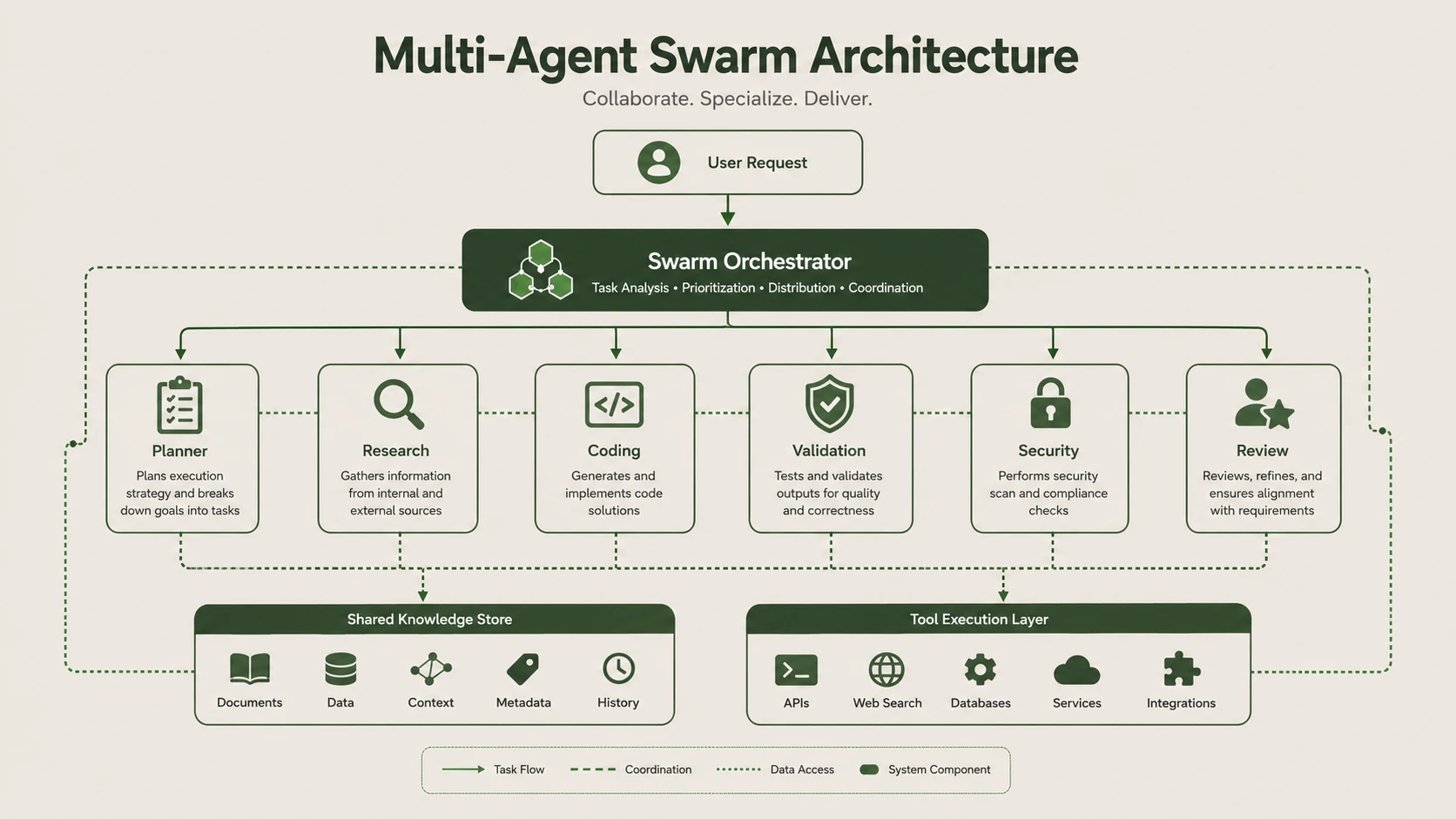
System architecture diagram and conceptual workflow layout for Agentic Swarms: Orchestrating Collaborative Task Resolution Across Multiple Hermes Models.
- ◆User objectives
- ◆Project requirements
- ◆Previous decisions
- ◆Retrieved knowledge
- ◆Generated artifacts
- ◆Tool outputs
- ◆Validation results
- ◆Execution history
Agents contribute to and consume this shared context, ensuring consistency throughout the workflow.
---
Communication Patterns
Effective swarm architectures support multiple communication strategies.
Common patterns include:
- ◆Broadcast messaging
- ◆Peer-to-peer collaboration
- ◆Publish-subscribe events
- ◆Shared memory updates
- ◆Hierarchical delegation
- ◆Event-driven workflows
Selecting the right communication model depends on workflow complexity and latency requirements.
---
Fault Tolerance and Resilience
Enterprise AI systems must continue operating even when individual agents fail.
A resilient swarm includes:
- ◆Automatic retries
- ◆Agent replacement
- ◆Timeout handling
- ◆Fallback models
- ◆Consensus validation
- ◆Health monitoring
- ◆Checkpoint recovery
- ◆Distributed logging
These capabilities prevent isolated failures from affecting the overall workflow.
---
Enterprise Security
Swarm intelligence introduces additional security considerations because multiple agents may access enterprise tools and sensitive data.
Recommended safeguards include:
- ◆Role-based agent permissions
- ◆Secure tool authorization
- ◆Prompt isolation
- ◆Secret management
- ◆Encrypted communication
- ◆Audit logging
- ◆Policy enforcement
- ◆Human approval for critical actions
Security policies should be enforced by the orchestrator rather than individual agents.
---
Enterprise Use Cases
Agentic Swarms are increasingly being adopted for complex business workflows such as:
- ◆Software development
- ◆Security operations
- ◆Healthcare diagnostics
- ◆Financial compliance
- ◆Infrastructure automation
- ◆Customer support
- ◆Research automation
- ◆Content generation
- ◆Enterprise search
- ◆AI copilots
Their ability to parallelize reasoning makes them well suited for high-complexity environments.
---
Best Practices
Organizations implementing Agentic Swarms should follow these architectural principles:
| Area | Best Practice |
|---|---|
| Coordination | Central Swarm Orchestrator |
| Memory | Shared Context Store |
| Reasoning | Specialized Hermes Agents |
| Security | Policy-Based Access Control |
| Reliability | Retry & Fallback Strategy |
| Monitoring | Distributed Observability |
| Scalability | Stateless Agent Design |
| Governance | Human-in-the-Loop Approval |
---
The Future of Collaborative AI
Agentic Swarms represent the next generation of enterprise artificial intelligence. Rather than depending on increasingly larger individual models, organizations are moving toward ecosystems of specialized AI agents that collaborate through intelligent orchestration.
By combining distributed reasoning, shared memory, autonomous decision-making, and resilient orchestration, Hermes-powered swarms enable enterprises to build scalable AI platforms capable of solving sophisticated, real-world business challenges with greater efficiency, reliability, and accuracy.