Introduction
Voice interfaces are entering a new era. Traditional Interactive Voice Response (IVR) systems and first-generation voice assistants primarily relied on scripted menus, keyword detection, and predefined workflows. While effective for simple requests, they often struggled with natural conversations, contextual understanding, and complex business processes.
Advances in speech recognition, large language models (LLMs), real-time reasoning, and speech synthesis have fundamentally changed what voice systems can accomplish.
Modern Voice AI Agents no longer act as simple voice-enabled chatbots. They function as intelligent conversational systems capable of listening, understanding intent, retrieving enterprise knowledge, invoking business applications, coordinating AI agents, and responding naturally in real time.
This evolution transforms voice from a user interface into an operational intelligence platform capable of supporting customer service, healthcare, sales, field operations, IT support, and enterprise productivity.
What Is a Voice AI Agent?
A Voice AI Agent is an intelligent conversational system that combines speech recognition, language understanding, reasoning, enterprise tool execution, and speech synthesis to complete business objectives through natural spoken interactions.
Unlike traditional chatbots, Voice AI Agents operate across multiple stages of communication.
They continuously:
- ◆Listen
- ◆Interpret intent
- ◆Retrieve relevant knowledge
- ◆Plan actions
- ◆Execute enterprise workflows
- ◆Generate responses
- ◆Speak naturally
- ◆Maintain conversational context
Rather than following scripted decision trees, Voice AI Agents adapt dynamically throughout a conversation.
Beyond Traditional Chatbots
Conventional chatbots primarily process text conversations.
Voice AI Agents introduce several additional capabilities:
- ◆Real-time speech recognition
- ◆Spoken language understanding
- ◆Emotional and conversational awareness
- ◆Interrupt handling
- ◆Bidirectional dialogue
- ◆Streaming responses
- ◆Enterprise tool execution
- ◆Natural speech generation
This creates interactions that more closely resemble conversations between people rather than software transactions.
Why Enterprises Are Investing in Voice AI
Organizations increasingly view voice as a strategic business interface.
Common enterprise drivers include:
- ◆Faster customer service
- ◆Reduced support costs
- ◆24/7 availability
- ◆Improved accessibility
- ◆Employee productivity
- ◆Natural human interaction
- ◆Workflow automation
- ◆Consistent customer experiences
Voice becomes particularly valuable when employees cannot easily interact with keyboards or screens.
Evolution of Enterprise Voice Systems
| Generation | Primary Capability | Characteristics |
|---|---|---|
| IVR Systems | Menu Navigation | Rule-based interactions |
| Voice Assistants | Basic Natural Language | Limited conversational ability |
| Conversational AI | Intent Recognition | Context-aware responses |
| Voice AI Agents | Goal-Oriented Execution | Enterprise workflow automation |
| Bidirectional Conversational Systems | Continuous reasoning and collaboration | Intelligent enterprise communication |
Modern Voice AI platforms extend far beyond answering questions.
They actively complete business work.
Understanding Bidirectional Conversations
Traditional voice systems often follow a request-response model.
Modern Voice AI Agents support bidirectional conversations, meaning both participants actively influence the discussion.
Examples include:
- ◆The user asks questions.
- ◆The AI requests clarification.
- ◆The user interrupts.
- ◆The AI adapts.
- ◆The conversation changes direction.
- ◆Enterprise tools provide new information.
- ◆The AI incorporates updated context immediately.
This dynamic interaction allows conversations to evolve naturally rather than following rigid scripts.
Core Voice AI Architecture
A production Voice AI platform consists of multiple coordinated services.
| Layer | Responsibility |
|---|---|
| Audio Input | Captures spoken conversation |
| Speech Recognition (ASR) | Converts speech into text |
| Intent Understanding | Determines user objectives |
| Retrieval Layer | Accesses enterprise knowledge |
| LLM Reasoning | Plans and generates responses |
| Tool Integration | Executes enterprise workflows |
| Memory Layer | Maintains conversation state |
| Speech Synthesis (TTS) | Generates natural speech |
| Monitoring Layer | Observability and analytics |
Each layer performs a specialized function while contributing to a seamless conversational experience.
Automatic Speech Recognition (ASR)
Every voice interaction begins with speech recognition.
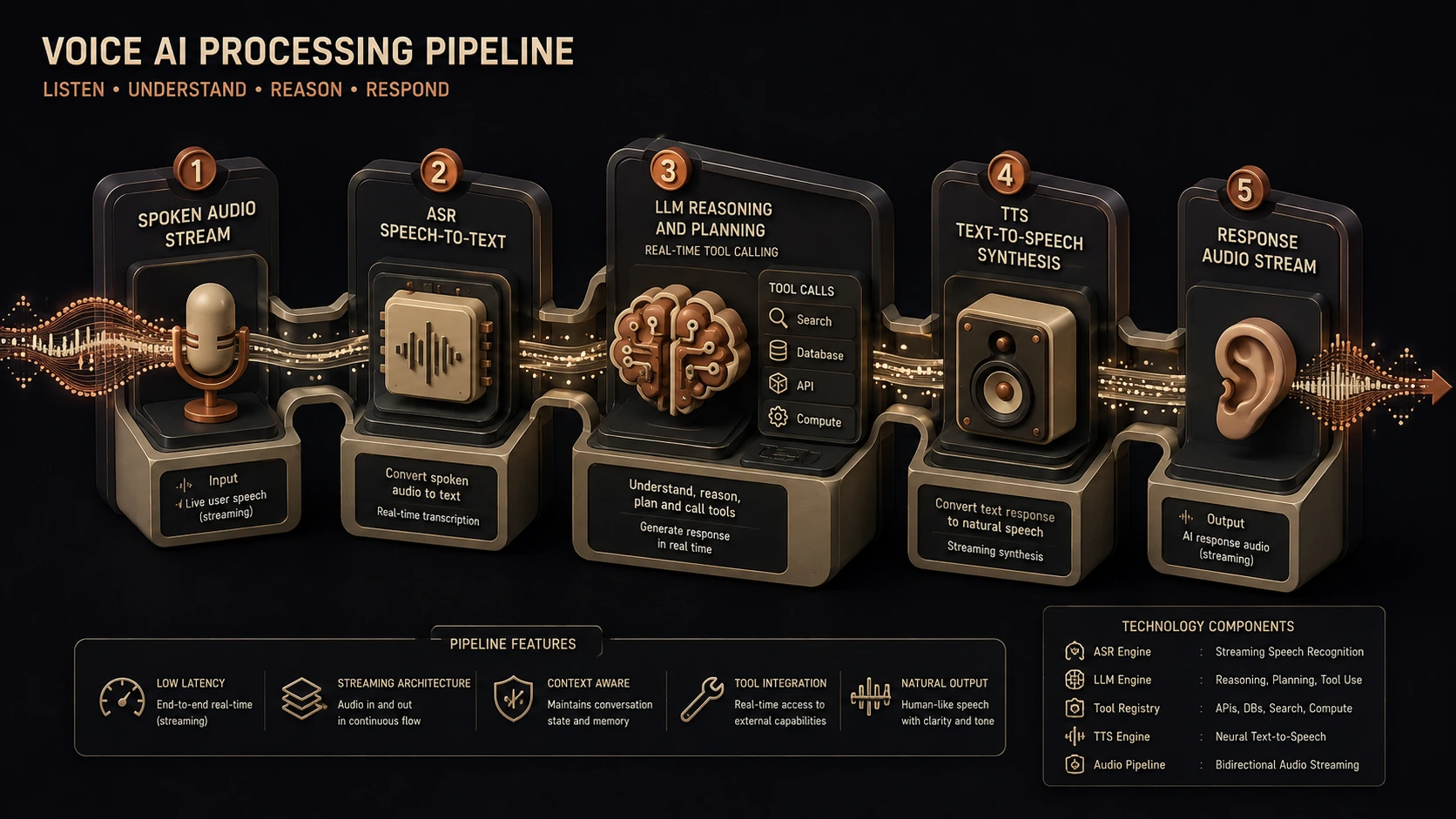
Real-time bidirectional voice pipeline showing speech-to-text (ASR), agent planning, and text-to-speech (TTS) synthesis.
Automatic Speech Recognition (ASR) converts spoken language into text suitable for downstream processing.
Enterprise ASR systems should support:
- ◆Multiple accents
- ◆Domain-specific terminology
- ◆Real-time transcription
- ◆Background noise handling
- ◆Streaming audio
- ◆Speaker identification
- ◆High transcription accuracy
The quality of speech recognition significantly influences the overall conversational experience.
Intent Understanding
Speech transcription alone does not identify user objectives.
Voice AI Agents interpret the underlying intent.
For example:
*"I need to change my appointment."*
The system determines:
- ◆User objective
- ◆Required enterprise systems
- ◆Relevant business policies
- ◆Missing information
- ◆Appropriate workflow
Intent understanding transforms natural speech into structured business actions.
Enterprise Knowledge Retrieval
Voice AI Agents frequently require organizational knowledge before responding.
Typical knowledge sources include:
- ◆Product documentation
- ◆Customer records
- ◆Internal policies
- ◆Knowledge bases
- ◆Technical manuals
- ◆Pricing information
- ◆Service documentation
- ◆Operational procedures
Retrieval-Augmented Generation (RAG) allows voice systems to ground responses using trusted enterprise information rather than relying solely on model knowledge.
Real-Time Reasoning
Unlike static voice assistants, modern Voice AI Agents reason continuously throughout conversations.
Reasoning activities include:
- ◆Planning
- ◆Context evaluation
- ◆Task decomposition
- ◆Clarification requests
- ◆Decision support
- ◆Workflow coordination
Reasoning occurs while conversations remain active, allowing responses to adapt dynamically as new information becomes available.
Tool Calling
Voice AI becomes substantially more valuable when integrated with enterprise systems.
Examples include:
- ◆CRM platforms
- ◆ERP systems
- ◆Scheduling software
- ◆Healthcare systems
- ◆IT service platforms
- ◆Inventory databases
- ◆Payment systems
- ◆Knowledge repositories
Rather than simply answering questions, Voice AI Agents execute business operations through secure enterprise integrations.
Conversation Memory
Long conversations require persistent context.
Typical conversational memory includes:
- ◆Previous questions
- ◆Customer preferences
- ◆Active workflow state
- ◆Retrieved knowledge
- ◆Business decisions
- ◆Authentication status
- ◆Session history
Maintaining structured memory prevents users from repeating information unnecessarily while improving conversational continuity.
Speech Synthesis
After reasoning and execution, the response must be delivered naturally.
Modern Text-to-Speech (TTS) systems emphasize:
- ◆Natural pronunciation
- ◆Conversational pacing
- ◆Emotional consistency
- ◆Low latency
- ◆Streaming output
- ◆Multilingual support
- ◆Voice personalization
Speech synthesis should feel conversational rather than mechanically reading generated text.