Introduction
The evolution of enterprise AI is entering a new phase.
The first generation of AI adoption focused on conversational interfaces. Organizations integrated large language models into chat applications, internal knowledge systems, support portals, and productivity tools.
The next phase is significantly more complex.
Enterprises are now building agentic systems capable of planning tasks, retrieving information, executing workflows, interacting with software platforms, coordinating with other agents, and supporting business operations.
As the number of AI agents increases, a fundamental challenge emerges: interoperability.
Just as HTTP standardized communication across the web and REST standardized service integration, organizations increasingly require a consistent mechanism for connecting AI models with enterprise systems, tools, data sources, workflows, and external services.
This requirement has accelerated interest in the Model Context Protocol (MCP).
MCP is emerging as a standardized framework that allows AI systems to discover capabilities, access context, invoke tools, retrieve information, and interact with external resources through a structured protocol.
Many architects now view MCP as an important building block in the development of what is increasingly described as the Agent Internet.
Industry Background
Enterprise software has historically evolved through standardization.
Organizations adopted:
- ◆TCP/IP for networking
- ◆HTTP for web communication
- ◆REST for service integration
- ◆OAuth for authorization
- ◆OpenAPI for API specifications
- ◆GraphQL for flexible data access
These standards reduced integration complexity and accelerated ecosystem growth.
AI systems currently face a similar challenge.
Many AI integrations remain custom implementations.
Common approaches include:
- ◆Proprietary tool integrations
- ◆Application-specific connectors
- ◆Custom APIs
- ◆Vendor-specific workflows
- ◆Manual context injection
While functional, these approaches create operational overhead and limit portability.
As organizations deploy multiple AI models, agent frameworks, orchestration platforms, and enterprise applications, the need for a common communication layer becomes increasingly apparent.
The Business Problem
Enterprise AI initiatives often encounter integration bottlenecks.
A typical AI assistant may need access to:
- ◆CRM systems
- ◆ERP platforms
- ◆Knowledge bases
- ◆Internal APIs
- ◆File repositories
- ◆Databases
- ◆Ticketing systems
- ◆Collaboration tools
Without standardization, every integration requires custom development.
This creates several challenges.
| Challenge | Business Impact |
|---|---|
| Custom integrations | Increased development effort |
| Vendor lock-in | Reduced flexibility |
| Security inconsistencies | Governance risks |
| Context fragmentation | Lower AI effectiveness |
| Operational complexity | Higher maintenance costs |
| Limited interoperability | Slower innovation |
As enterprises move toward multi-agent architectures, these issues multiply.
Each new agent may require access to the same systems, creating duplicated integration efforts across the organization.
Understanding the Technology
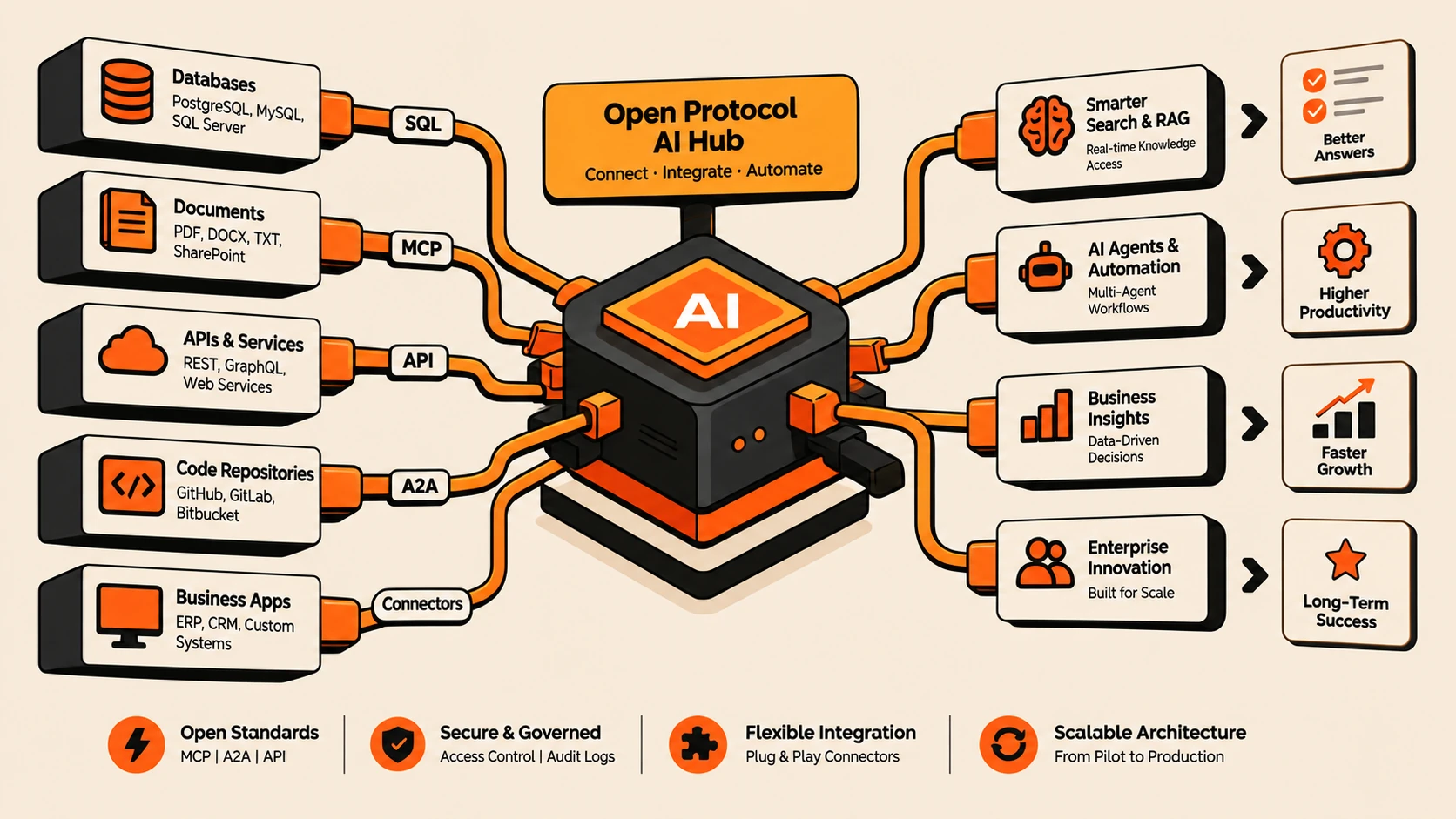
Model Context Protocol (MCP) is a protocol designed to standardize how AI models interact with external systems, tools, resources, and contextual information.
At a high level, MCP establishes a structured communication model between:
- ◆AI applications
- ◆Language models
- ◆Agent frameworks
- ◆Data providers
- ◆Tool providers
- ◆Enterprise systems
Rather than requiring custom integrations for every use case, MCP defines a common method for discovering and accessing capabilities.
A useful way to understand MCP is to view it as a connector layer between intelligence and execution.
The protocol focuses on enabling AI systems to access relevant context while maintaining clear communication boundaries.
What Is the Agent Internet?
The term Agent Internet describes an ecosystem where autonomous and semi-autonomous AI agents interact with:
- ◆Enterprise applications
- ◆External services
- ◆Knowledge systems
- ◆Data platforms
- ◆Business workflows
- ◆Other agents
In this environment, agents require mechanisms for:
- ◆Capability discovery
- ◆Context sharing
- ◆Tool invocation
- ◆Information retrieval
- ◆Workflow coordination
MCP helps address these requirements by providing a standardized interaction model.
Just as browsers communicate with websites through established internet protocols, AI agents can use MCP to interact with resources in a predictable and structured manner.
Core Architecture
A typical MCP implementation consists of several architectural components.
MCP Client
The client is usually the AI application or agent requesting information or capabilities.
Examples include:
- ◆Enterprise copilots
- ◆AI assistants
- ◆Agent orchestration platforms
- ◆Multi-agent systems
MCP Server
The server exposes capabilities and resources.
Examples include:
- ◆Database access services
- ◆Document repositories
- ◆Business applications
- ◆Internal APIs
- ◆Workflow platforms
Resources
Resources represent information available to AI systems.
Examples include:
- ◆Documents
- ◆Files
- ◆Knowledge articles
- ◆Structured data
- ◆Configuration information
Tools
Tools enable actions.
Examples include:
- ◆Create tickets
- ◆Update records
- ◆Execute workflows
- ◆Generate reports
- ◆Trigger automation processes
Context Layer
The context layer provides the information required for accurate reasoning and decision making.
Key Features
MCP introduces several capabilities important for enterprise AI environments.
Standardized Integration
Organizations can reduce custom integration development by adopting common interaction patterns.
Capability Discovery
Agents can identify available tools and resources dynamically.
Context Access
AI systems gain structured access to information required for reasoning.
Tool Invocation
Models can interact with external systems through defined interfaces.
Interoperability
Different AI platforms can communicate with resources using consistent mechanisms.
Extensibility
New tools and resources can be introduced without redesigning the entire architecture.
How It Works
Consider an enterprise support agent.
A user asks:
"Show all unresolved critical incidents affecting payment systems and create an executive summary."
The workflow may proceed as follows:
- 1.The agent receives the request.
- 2.MCP discovers available resources.
- 3.The incident management system exposes relevant data.
- 4.The agent retrieves incident records.
- 5.Additional documentation is retrieved from internal knowledge repositories.
- 6.The model analyzes findings.
- 7.The reporting tool is invoked.
- 8.A summary is generated.
- 9.Results are returned to the user.
Without a common protocol, each integration would require custom implementation.
MCP simplifies the interaction model by providing a standardized framework for discovery and execution.
Enterprise Use Cases
Enterprise Knowledge Systems
Organizations use MCP to connect AI systems with:
- ◆Knowledge bases
- ◆Documentation repositories
- ◆Internal portals
- ◆Content management platforms
IT Operations
Agents can access:
- ◆Monitoring platforms
- ◆Incident systems
- ◆Service management tools
- ◆Infrastructure dashboards
Software Engineering
Development workflows increasingly involve:
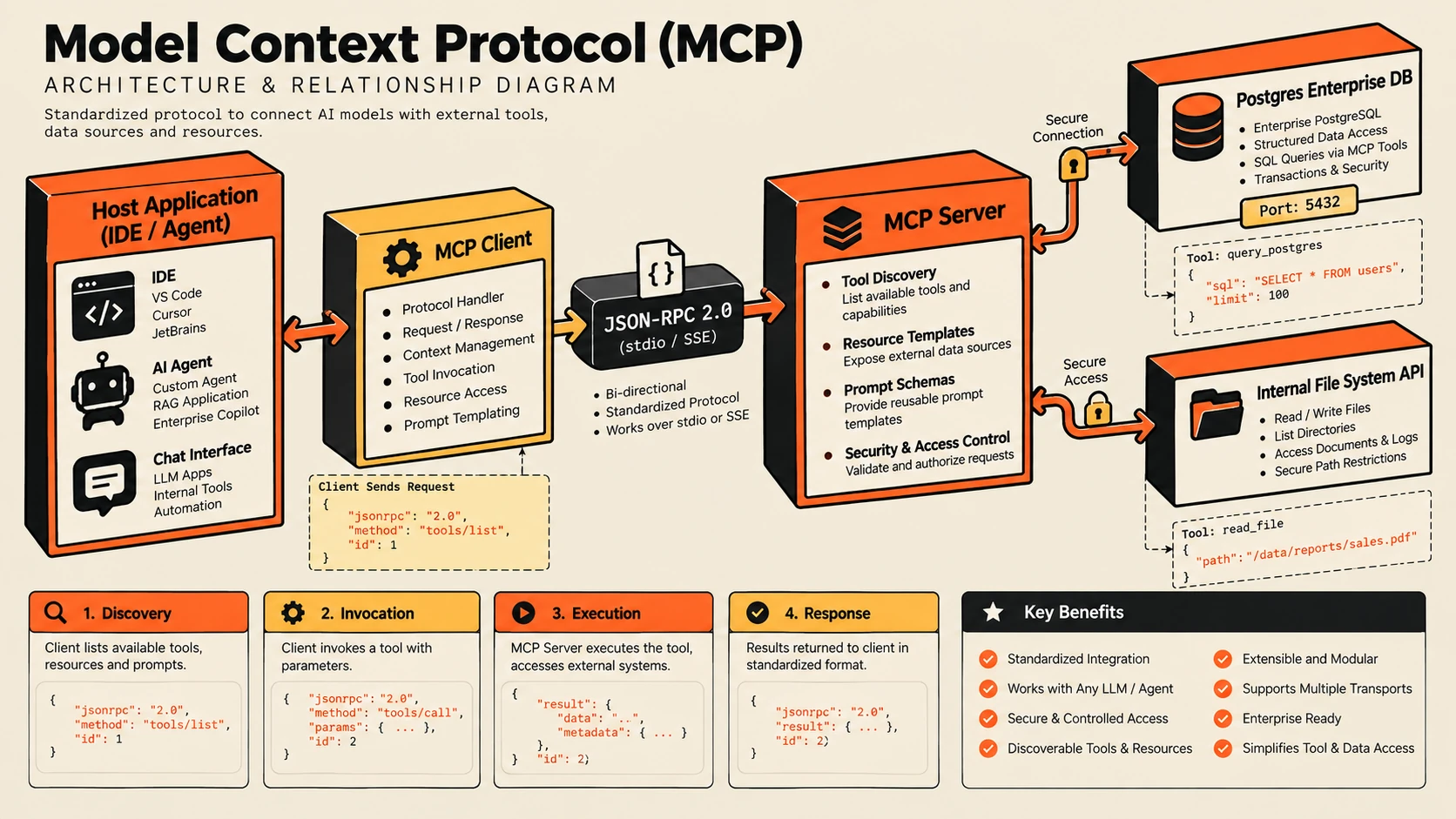
MCP architecture showing JSON-RPC 2.0 communication between Host Client, MCP Client, and modular MCP Servers.
- ◆Source code repositories
- ◆CI/CD platforms
- ◆Documentation systems
- ◆Issue tracking applications
MCP provides a structured approach for connecting these resources.
Customer Support
Support agents can interact with:
- ◆CRM systems
- ◆Ticketing platforms
- ◆Customer records
- ◆Knowledge repositories
Business Process Automation
Organizations can orchestrate workflows across multiple systems through standardized tool interfaces.
Performance Considerations
Performance remains critical in enterprise deployments.
Architects should evaluate:
Discovery Overhead
Capability discovery should not introduce excessive latency.
Context Size
Large context transfers can increase token consumption and processing time.
Tool Execution Latency
External systems often become the primary source of delays.
Caching Strategies
Frequently accessed resources may benefit from caching layers.
Resource Optimization
Only relevant context should be retrieved and transmitted.
Efficient context management is often one of the most important factors affecting overall system performance.
Security Considerations
Security is a foundational requirement for MCP adoption.
Enterprise AI systems frequently access sensitive information.
Authentication
Every interaction should be authenticated.
Authorization
Access controls must enforce least-privilege principles.
Audit Logging
Organizations should maintain records of:
- ◆Resource access
- ◆Tool usage
- ◆Agent actions
- ◆Administrative changes
Data Governance
Context provided to AI systems should comply with organizational policies.
Encryption
Data should remain protected during transmission and storage.
Human Oversight
Critical actions should include approval mechanisms where appropriate.
Scalability
Scalability becomes increasingly important as organizations deploy large numbers of agents.
MCP supports scalable architectures through:
- ◆Distributed resource access
- ◆Modular integration patterns
- ◆Reusable tool definitions
- ◆Service-oriented designs
- ◆Multi-agent interoperability
Organizations can expose capabilities once and allow multiple AI systems to consume them through standardized interfaces.
This approach reduces duplication and improves operational efficiency.
Best Practices
Start with High-Value Integrations
Focus on systems that provide immediate business value.
Define Governance Policies Early
Security and compliance requirements should be established before large-scale deployment.
Standardize Tool Design
Consistent interfaces improve maintainability.
Minimize Context Exposure
Only provide information required for task completion.
Implement Observability
Monitor:
- ◆Tool execution
- ◆Resource utilization
- ◆Context retrieval
- ◆Failure rates
Design for Reuse
Reusable MCP services accelerate future integrations.
Common Mistakes
Exposing Excessive Context
Providing unnecessary information increases cost and security risk.
Ignoring Governance
Agent access requires the same controls applied to traditional applications.
Overcomplicating Integrations
Not every workflow requires extensive orchestration.
Missing Observability
Limited visibility makes troubleshooting difficult.
Treating MCP as a Complete Agent Framework
MCP facilitates communication and context access.
It does not replace orchestration, workflow management, governance, or business logic.
Technology Comparison
Traditional API Integration vs MCP
| Characteristic | Traditional Integration | MCP-Based Integration |
|---|---|---|
| Development Effort | Higher | Lower |
| Standardization | Limited | High |
| Capability Discovery | Manual | Structured |
| Reusability | Moderate | High |
| Agent Compatibility | Variable | Improved |
| Integration Scalability | Moderate | High |
MCP vs Direct Tool Calling
| Factor | Direct Tool Calling | MCP |
|---|---|---|
| Portability | Limited | Higher |
| Discovery | Manual | Standardized |
| Resource Access | Custom | Structured |
| Ecosystem Growth | Slower | Faster |
| Enterprise Governance | Variable | More Consistent |
Adoption Strategy
Phase 1: Assessment
Identify systems most frequently accessed by AI applications.
Phase 2: Pilot Implementation
Deploy MCP for a limited number of tools and resources.
Phase 3: Governance Integration
Implement authentication, authorization, auditing, and compliance controls.
Phase 4: Enterprise Expansion
Extend protocol adoption across departments and business domains.
Phase 5: Multi-Agent Enablement
Support broader agent ecosystems through shared resources and standardized integrations.
This phased approach minimizes risk while allowing organizations to develop operational expertise.
Limitations
MCP addresses many integration challenges but does not eliminate all architectural concerns.
Current considerations include:
- ◆Adoption maturity across ecosystems
- ◆Governance complexity
- ◆Context management challenges
- ◆Security requirements
- ◆Operational overhead
- ◆Protocol implementation effort
Organizations should evaluate MCP within the broader context of enterprise architecture rather than viewing it as a complete AI platform.
Looking Ahead
As of October 2026, enterprise AI is rapidly evolving from isolated assistants toward interconnected agent ecosystems. The need for standardized communication between models, tools, resources, and enterprise systems is becoming increasingly apparent.
Model Context Protocol is emerging as a practical approach for addressing interoperability challenges in this environment. By providing a structured framework for context access, capability discovery, and tool interaction, MCP helps reduce integration complexity while supporting more scalable and maintainable AI architectures.
For enterprise architects, the significance of MCP extends beyond individual integrations. Its broader value lies in establishing common foundations for the growing ecosystem of AI agents, enterprise applications, knowledge systems, and automation platforms that together form the early stages of the Agent Internet.