Introduction: Coding AI Has a Longer Job to Do
For years, AI coding models have been evaluated on their ability to generate correct code, solve programming problems and complete short development tasks. These measurements remain useful, but they do not fully represent the work performed by professional software engineering teams.
Real engineering is rarely a single prompt followed by a correct answer. A developer may spend hours understanding an unfamiliar repository, tracing a production defect, identifying dependencies, modifying several files, running tests, investigating failures and reviewing the final changes.
The challenge is not simply generating code. It is maintaining correctness and direction throughout a long sequence of dependent actions.
This is the problem behind the growing interest in long-horizon engineering.
On November 18, 2026, Google introduced Gemini 4 Neon, positioning it for complex coding, analytical reasoning and production-grade enterprise workflows. Google emphasizes long-running agent workflows, tool-heavy execution, repository-level debugging and refactoring, context management and coordination with other agents through Google Antigravity.
The launch highlights an important change in AI coding evaluation: a model must be judged not only by how well it solves an isolated programming problem, but also by how reliably it completes an extended engineering task.
For CTOs, software architects and engineering managers, this distinction is becoming increasingly important. A model that produces impressive snippets but loses context during a multi-hour task may be less useful than a model that consistently manages a complete workflow.
1. What Is Gemini 4 Neon?
Gemini 4 Neon is Google's model for complex coding, analytical reasoning and production-oriented workflows. It is positioned between two other models in the Gemini 4 family:
- ◆Gemini 4 Carbon: Designed for the hardest, long-horizon projects.
- ◆Gemini 4 Neon: Designed to balance reasoning depth, execution speed and cost for complex, frequent workflows.
- ◆Gemini 4 Hydrogen: Designed for fast everyday execution.
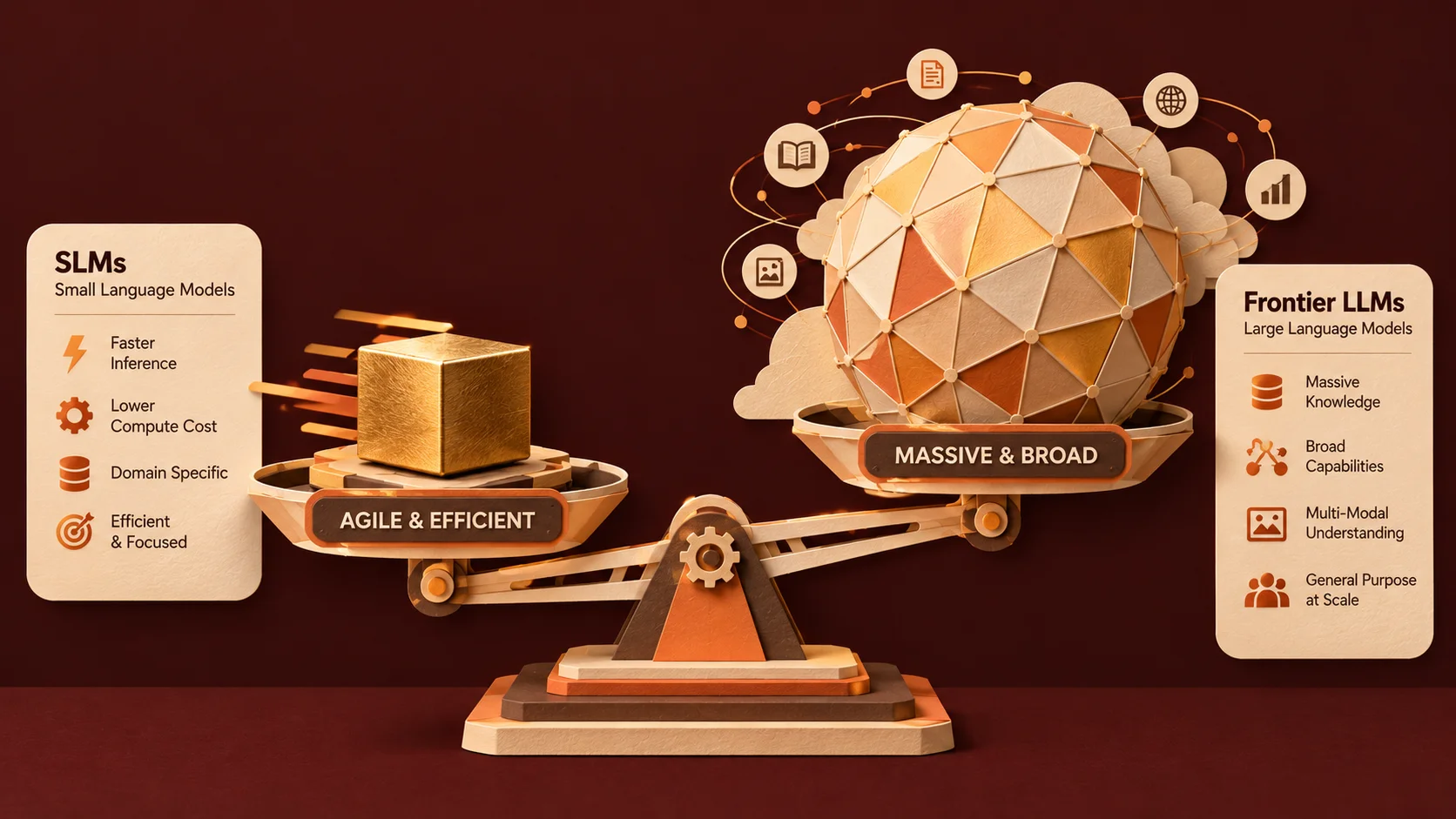
This family structure reflects a practical model-selection strategy. Not every development task requires the same level of reasoning, and not every operation should consume the resources of the largest available model.
Google describes Neon as suitable for:
- ◆Long-running agent workflows.
- ◆Complex tasks involving multiple tools.
- ◆Iterative repository coding and debugging.
- ◆Multi-file refactoring.
- ◆Secure code generation and vulnerability analysis.
- ◆Orchestrating parallel subagents.
- ◆Enterprise knowledge work involving multiple document formats.
The model also supports a context window of up to one million tokens, according to Google's announcement.
A large context window can help an agent work with extensive documentation, source files and task history. However, context capacity alone does not guarantee that the model will consistently identify and use the most relevant information. Retrieval, summarization, context management and reasoning quality remain essential.
Source: Google — Introducing Gemini 4 Neon, November 18, 2026.
2. Why Long-Horizon Engineering Is a Different Problem
Consider a typical enterprise task: investigate and fix an intermittent failure in a multi-tenant SaaS application.
A developer cannot solve this reliably by generating one function. The work may require:
- 1.Understanding the application architecture.
- 2.Inspecting logs and error traces.
- 3.Identifying the affected tenant and request path.
- 4.Tracing API, service and database interactions.
- 5.Reproducing the failure.
- 6.Identifying the root cause.
- 7.Modifying multiple files.
- 8.Creating regression tests.
- 9.Running the test suite.
- 10.Reviewing the final changes for security and compatibility.
Each step depends on information discovered in earlier steps.
A model can perform well on a short coding benchmark and still struggle with this workflow. It might forget an earlier constraint, modify an unrelated component, misinterpret a test failure or repeat an investigation that has already been completed.
Long-horizon engineering therefore requires several capabilities working together.
Persistent task understanding
The model must retain the original objective and constraints throughout the task.
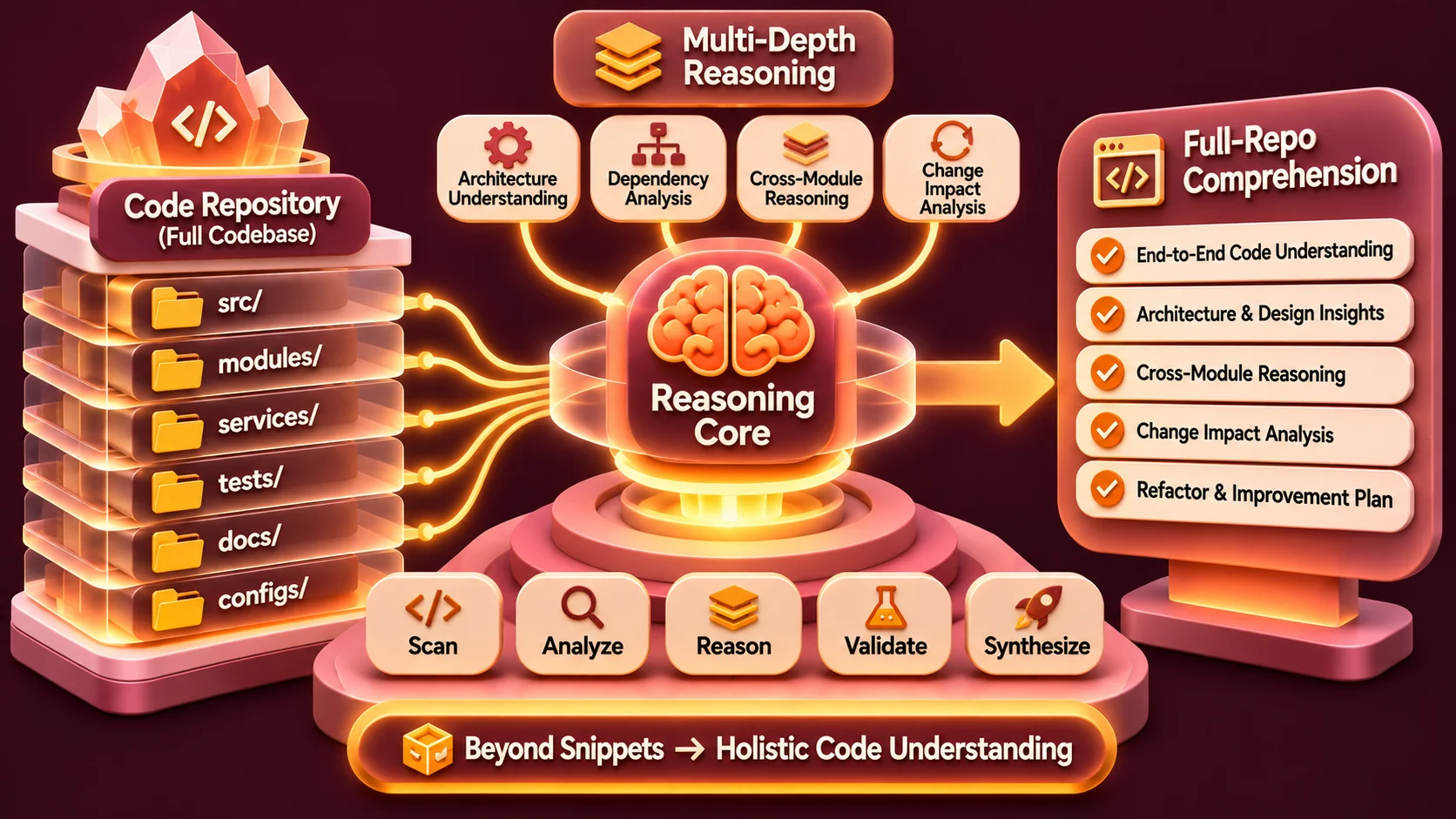
Repository-level reasoning
It must understand relationships between files, modules, interfaces, dependencies and tests.
Tool-use reliability
It must operate terminals, inspect files, execute tests and interpret tool output correctly.
Context management
It must preserve important findings while avoiding unnecessary repetition as the interaction grows.
Error recovery
It must recognize failed approaches, revise its plan and continue without compounding earlier mistakes.
Controlled autonomy
It must know when to continue, when to ask for clarification and when an action requires human approval.
These capabilities are more representative of production engineering than isolated code generation alone.
3. Gemini 4 Neon's Long-Running Agent Capabilities
Google's announcement identifies several engineering capabilities that are especially relevant to extended agent workflows.
3.1 Repository-Level Debugging and Refactoring
Neon is designed to work across repositories, including multi-file debugging and refactoring with targeted changes.
This matters because production software is interconnected. A change to an API contract can affect controllers, service classes, database queries, frontend clients, tests and documentation.
A useful coding agent must understand these relationships before making changes.
For example, consider an ASP.NET Core application where a customer-facing API returns incorrect subscription limits.
A repository-level workflow might require the model to inspect:
- ◆API controllers and request models.
- ◆Subscription and tenant services.
- ◆Database entities and queries.
- ◆Authorization policies.
- ◆Frontend API consumers.
- ◆Existing unit and integration tests.
The goal is not to rewrite every related file. It is to identify the smallest correct change that fixes the problem without breaking existing behavior.
Google describes this approach as targeted, surgical editing across repositories.
3.2 Reliable Context Compaction
Long-running tasks generate substantial context: file contents, command output, test results, plans, errors and intermediate decisions.
Sending all previous information to the model indefinitely is inefficient and eventually impractical.
Context compaction addresses this problem by reducing accumulated interaction history while preserving information needed for the next steps.
A useful engineering summary should preserve:
- ◆The original task and acceptance criteria.
- ◆Important architecture decisions.
- ◆Files already inspected or modified.
- ◆Tests already executed.
- ◆Confirmed findings and unresolved hypotheses.
- ◆Known failures and rejected approaches.
- ◆Remaining tasks and constraints.
Google says Neon handles context compaction reliably during long sessions and reduces redundant file reads.
This is significant because repeated investigation wastes both time and model resources. However, compacted context must be evaluated for information loss. If an important business rule disappears from the working summary, the agent may make an incorrect implementation decision later.
3.3 Progress Visibility
Long-running agents should not behave like a black box that returns a result only after an extended period.
Google highlights progress sharing during execution.
For enterprise teams, useful progress reporting includes:
- ◆Current task and subtask.
- ◆Files or systems being inspected.
- ◆Decisions already made.
- ◆Tests completed.
- ◆Current blockers.
- ◆Actions awaiting approval.
- ◆Remaining work.
Progress visibility allows engineers to identify incorrect assumptions before they become expensive implementation mistakes.
3.4 Orchestrating Parallel Subagents
Neon can also act as an orchestrator directing parallel Gemini 4 Hydrogen subagents in Google Antigravity.
This introduces a different execution pattern.
Instead of asking one agent to perform every activity sequentially, an orchestrator can delegate independent work to specialized subagents.
For example:
- ◆One subagent investigates backend behavior.
- ◆Another analyzes frontend dependencies.
- ◆A third examines test coverage.
- ◆Another reviews potential security implications.
The orchestrator combines findings and coordinates implementation.
Parallel execution can reduce elapsed time when tasks are genuinely independent. It can also introduce overhead when agents duplicate investigations, modify shared files or produce conflicting recommendations.
The quality of orchestration is therefore as important as the number of agents.
4. Gemini 4 Neon Benchmark Results: What the Numbers Show
Google published several coding and agentic evaluation results alongside the model launch.
The following figures are from Google's November 2026 announcement and model card. They should be interpreted as reported evaluation results rather than guarantees of equivalent performance on every production repository.
| Benchmark | Gemini 4 Neon result | What it evaluates |
|---|---|---|
| --- | ---: | --- |
| Artificial Analysis Coding Agent Index | 58.6 | Overall coding-agent performance index reported by Google |
| CursorBench 4.1 | 65.4% | Agentic coding tasks |
| Terminal-Bench 4.1 | 65.2% | Terminal-based agent execution, cheating-adjusted accuracy |
| FrontierCode 2.0 | 46.2% | Coding performance at the reported default high setting |
| SWE-sweep, Google Antigravity harness | 39.0% | Repository-level software engineering tasks |
| Mini-SWE harness | 12.8% | Smaller software engineering task evaluation |
One particularly notable result is the 39.0% SWE-sweep score reported using Google's Antigravity harness. Google says this is more than three times its reported mini-SWE harness result of 12.8%.
The difference illustrates an important point: model performance can be affected by the surrounding agent harness, execution environment and workflow design.
A benchmark result is not always a property of the model in isolation. It can reflect the interaction between the model, tools, context management, orchestration and evaluation setup.
Comparing selected results
Google's published comparison includes Claude Opus 5.5 and GPT-6.2 Sol for selected benchmarks.
| Benchmark | Gemini 4 Neon | Claude Opus 5.5 | GPT-6.2 Sol |
|---|---|---|---|
| --- | ---: | ---: | ---: |
| Terminal-Bench 4.1 | 65.2% | 65.8% | 61.5% |
| FrontierCode 2.0 | 46.2% | 47.3% | 43.8% |
| SWE-sweep, provider harness | 39.0% | 10.1% | 8.3% |
| Mini-SWE harness | 12.8% | 3.6% | 11.6% |
These figures should not be treated as a universal ranking. Different harnesses, configurations and evaluation conditions can produce substantially different results.
For enterprise adoption, the more useful question is whether a model can complete the organization's own representative tasks reliably, securely and economically.
Sources: Google's Gemini 4 Neon announcement and Gemini 4 Neon model card.
5. Why the Agent Harness Matters as Much as the Model
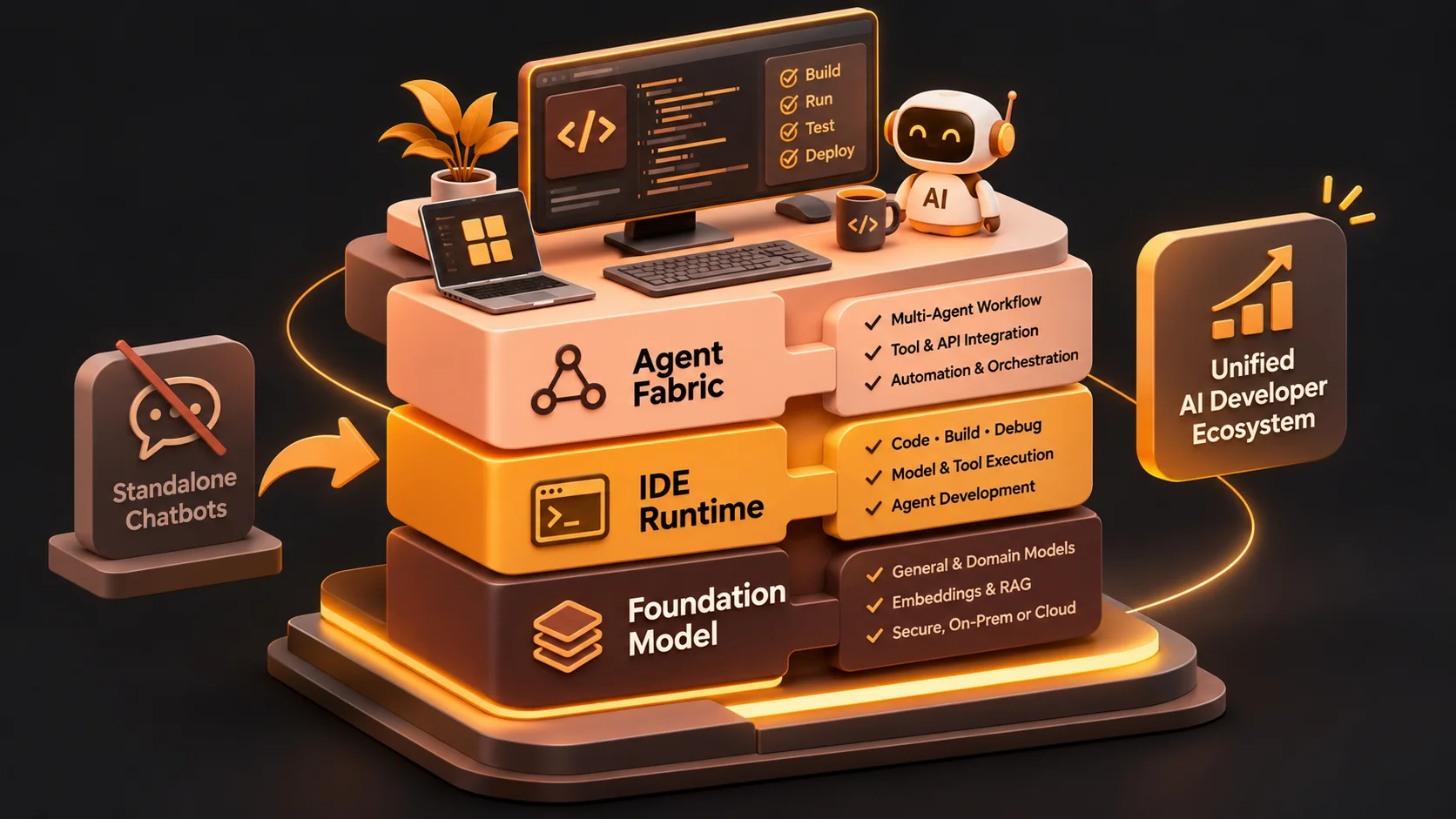
A coding model does not operate in isolation when it is used as an autonomous engineering agent.
It depends on an environment that provides repository access, tool execution, test feedback, task state and safety controls.
This environment is commonly called an agent harness or agent runtime.
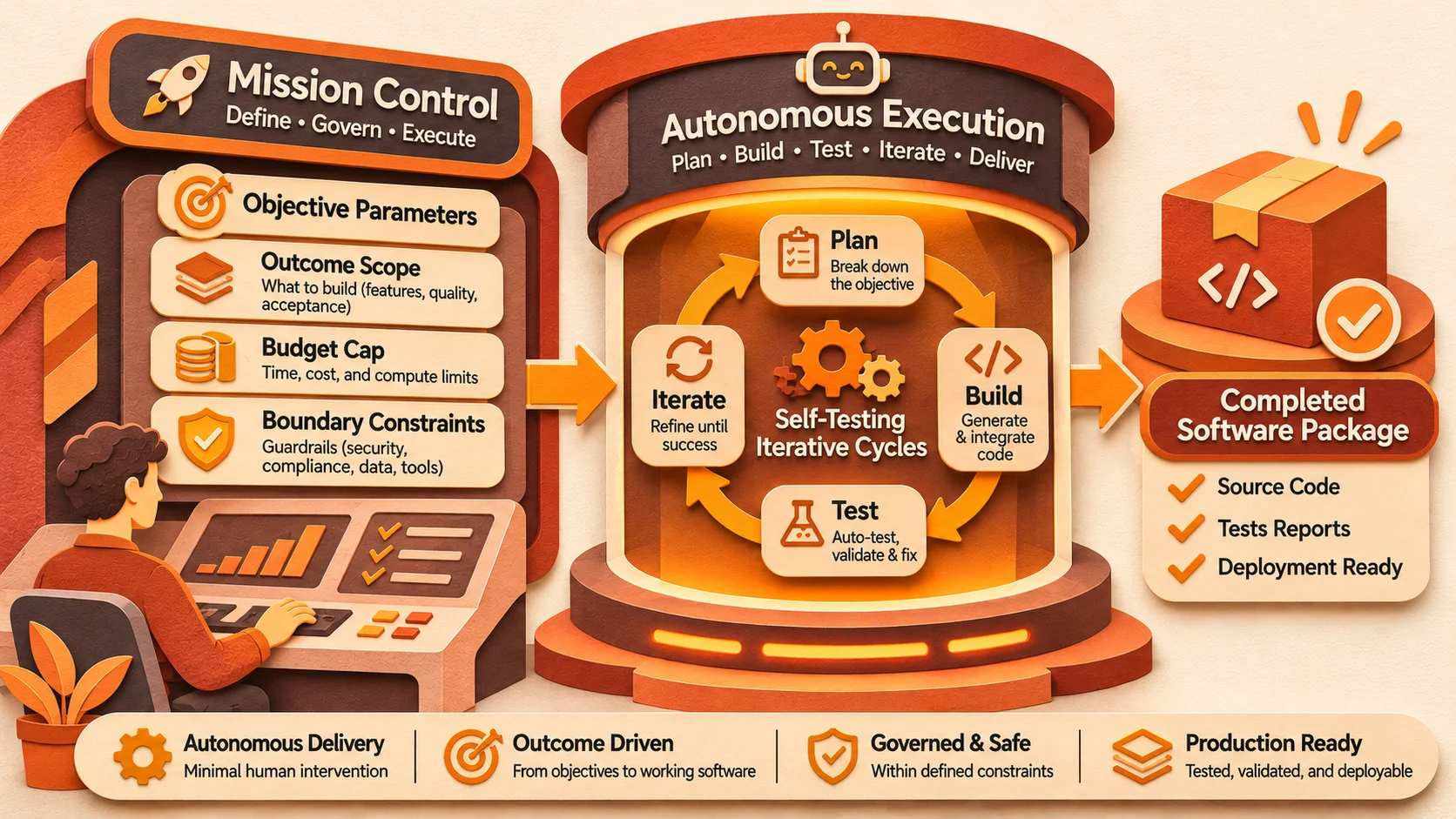
A typical coding-agent harness includes:
- 1.Task interpretation and planning.
- 2.Repository navigation and file retrieval.
- 3.Terminal and development-tool access.
- 4.Command execution and result capture.
- 5.Context and memory management.
- 6.Error handling and retries.
- 7.Progress reporting.
- 8.Validation and completion checks.
Imagine two teams evaluating the same model.
Team A provides a basic chat interface and asks the model to fix a repository issue.
Team B provides repository indexing, controlled terminal access, test execution, structured task state, progress summaries and a validation loop.
Even with the same underlying model, the second environment may enable a more complete workflow.
This is why the Antigravity SWE-sweep result deserves careful attention. Google's reported difference between harness configurations suggests that evaluation infrastructure can materially affect the outcome.
For CTOs, this means model procurement and agent-platform evaluation should be separate but connected decisions.
A strong model in a weak runtime may produce disappointing results. A capable runtime cannot fully compensate for a model that misunderstands the task.
6. A Reference Architecture for Long-Horizon AI Engineering
Enterprise teams building long-running coding agents should design the system as a managed engineering workflow rather than a model connected directly to a repository.
A practical architecture contains seven layers.
Layer 1: Developer Interface
Developers submit tasks through an IDE, developer portal, issue tracker or coding-agent interface.
The interface should capture the objective, constraints, priority and expected result.
Layer 2: Task and Planning Engine
The planning engine converts the request into smaller activities and establishes dependencies.
It should maintain a structured task state so that the agent can distinguish completed work from unresolved assumptions.
Layer 3: Model Gateway
A model gateway selects the appropriate model based on task complexity, latency, cost and risk.
For example, a smaller model can classify a test failure or summarize a file, while a stronger reasoning model handles a complex architectural investigation.
Layer 4: Agent Orchestrator
The orchestrator manages the primary agent and any specialized subagents.
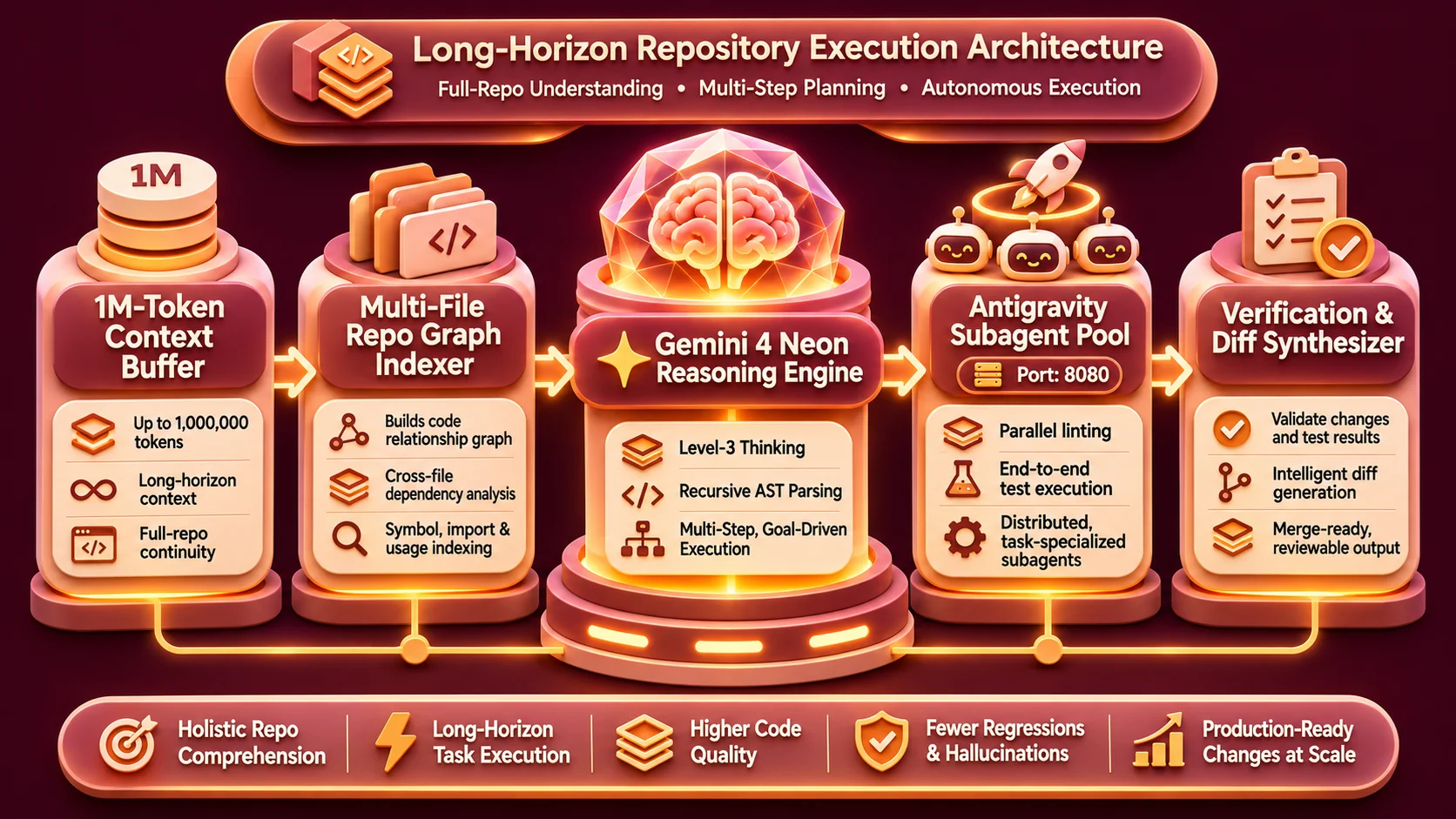
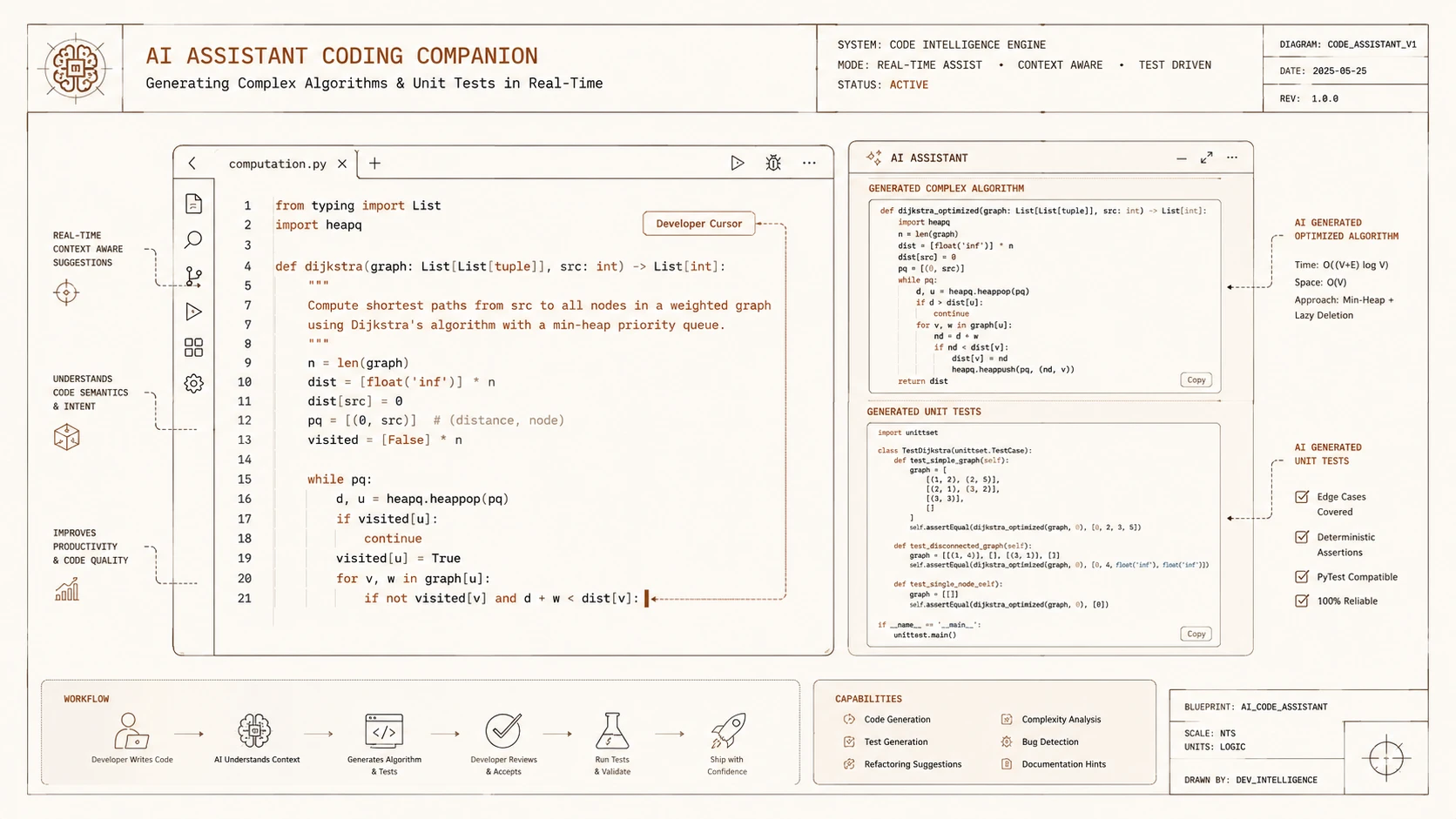
Long-horizon software engineering architecture featuring 1M-token repository ingestion, recursive AST reasoning, and subagent orchestration.
It controls task assignment, shared context, execution order, retries and escalation.
Layer 5: Controlled Tool Environment
Agents use approved tools for repository access, file changes, terminal commands, builds, tests and documentation.
The tool layer should enforce permissions independently of the model's instructions.
Layer 6: Memory and Context Management
The system stores important task findings, decisions, file references and execution history.
Context summaries should be structured and recoverable rather than relying entirely on an ever-growing conversation transcript.
Layer 7: Validation and Governance
The final layer checks the work through automated tests, static analysis, security scanning, human review and audit logging.
Reference workflow
Developer / Issue Tracker
          |
          v
   Task Specification
          |
          v
   Planning and Decomposition
          |
          v
      Model Gateway
          |
          v
    Agent Orchestrator
          |
    +-----+-------+
    |     |       |
    v     v       v
 Backend Frontend Testing
 Agent   Agent   Agent
    |     |       |
    +-----+-------+
          |
          v
 Shared Task State and Memory
          |
          v
 Controlled Tool Environment
          |
    +-----+-------+
    |     |       |
    v     v       v
   Git  Terminal  Test Runner
          |
          v
   Validation Pipeline
          |
     +----+----+
     |         |
     v         v
   Pass     Failure
     |         |
     v         v
 Human      Re-plan and
 Review     Re-execution
     |
     v
 Approved Change

Security, Permissions, Cost and Audit
         Across Every Layer
The architecture is a reference design, not a description of Google's complete internal implementation.
7. Long-Horizon Engineering in a Real Enterprise Scenario
Consider a legacy .NET application with several services, a SQL Server database and an Angular frontend.
The business wants to migrate a group of APIs to a more maintainable architecture without changing existing customer behavior.
A short coding prompt is not enough. The task requires investigation, planning, implementation and verification.
Step 1: Understand the existing system
The agent inspects project files, API contracts, database entities, service dependencies and available tests.
It produces an architecture summary and identifies areas that require clarification.
Step 2: Establish a migration plan
The agent identifies migration boundaries, compatibility requirements, affected services and test scenarios.
The developer reviews the plan before implementation begins.
Step 3: Delegate independent analysis
Specialized agents can investigate API dependencies, database behavior, frontend usage and existing test coverage.
The orchestrator combines their findings into a shared implementation plan.
Step 4: Implement controlled changes
Agents modify selected modules, update tests and preserve compatibility requirements.
Changes are isolated through branches or workspaces to reduce conflicts.
Step 5: Execute validation
The system runs unit tests, integration tests, API contract checks, static analysis and security scans.
Failures are recorded with enough context to support targeted correction.
Step 6: Review and accept
A human engineer reviews architectural decisions, business logic and security-sensitive changes before merging.
The final deliverable includes the implementation, test evidence, unresolved issues and a change summary.
This workflow demonstrates why long-horizon engineering is more demanding than code generation. The model must preserve the original migration objective across many interdependent actions.
8. Cost and Efficiency: Intelligence Per Completed Task
Google positions Neon as a model that balances frontier-level intelligence with execution efficiency.
The announced API pricing is:
| Token type | Published price |
|---|---|
| --- | ---: |
| Input tokens | $3 per million tokens |
| Cached input tokens | $0.15 per million tokens |
| Output tokens | $15 per million tokens |
Google also reports a one-million-token context window.
These prices are a snapshot of Google's published pricing at launch and should be checked against the current API pricing page before procurement.
For long-running agent workflows, token price alone is not a sufficient measure of cost.
A task may involve repeated file reads, planning cycles, tool calls, context summaries, test execution and retries.
The total cost of a completed engineering task should include:
- ◆Model input and output usage.
- ◆Cached context usage.
- ◆Agent runtime and compute.
- ◆Repository indexing and retrieval.
- ◆Build and test execution.
- ◆External tool usage.
- ◆Developer review time.
- ◆Rework caused by incorrect changes.
A more useful enterprise metric is cost per accepted engineering outcome.
For example, if a model completes a task quickly but requires extensive human correction, its effective cost may be higher than a slower model that produces a reliable implementation.
Engineering leaders should therefore compare models using representative tasks and measure the complete delivery process.
9. Security and Governance for Long-Running Coding Agents
Long-horizon agents create security risks because they interact with more systems and execute more actions than simple code-completion tools.
A coding agent may inspect source code, read documentation, execute commands, install packages and modify repositories.
If it has excessive permissions, a mistake or malicious instruction can create significant consequences.
Least-Privilege Access
Give agents access only to the repositories, files and tools needed for their assigned task.
Avoid providing unrestricted production credentials.
Sandboxed Execution
Run commands inside isolated environments with controlled network access and resource limits.
Human Approval Gates
Require approval for destructive commands, production deployment, permission changes, external communications and sensitive data operations.
Prompt-Injection Protection
Treat repository content, web pages, issue descriptions and external documents as untrusted input.
A malicious instruction embedded in a file should not be able to override the agent's actual task or security policy.
Auditability
Record model requests, tool invocations, file changes, approvals, test results and deployment actions.
Independent Security Validation
Use static analysis, dependency scanning, secret detection and security testing in addition to model-based review.
Google's model card describes safety evaluations and known limitations, including the possibility of hallucinations. These safeguards are useful, but they do not eliminate the need for enterprise controls.
Source: Google DeepMind — Gemini 4 Neon Model Card.
10. What the Benchmarks Do Not Tell You
Even strong coding-agent results cannot answer every question an enterprise needs to ask.
Does the model preserve business logic?
A model may implement a technically valid change that violates an undocumented business rule.
Does it handle a large proprietary codebase?
Public benchmarks may not represent the architecture, conventions and dependencies of an organization's actual systems.
Does it recover from ambiguous requirements?
A production task may contain missing information or conflicting requirements. A useful agent should ask for clarification rather than inventing assumptions.
Can it avoid unnecessary changes?
A model that modifies many files may appear productive while introducing unnecessary complexity.
Can it prove that the change is correct?
Passing available tests is valuable, but tests may not cover every edge case or operational condition.
Can the workflow be reproduced?
Enterprises need to understand what changed, why it changed and which evidence supports accepting the result.
These questions require internal evaluations. Public benchmarks are a starting point, not a substitute for production testing.
11. How CTOs Should Evaluate Long-Horizon Coding Models
A useful evaluation program should test complete engineering workflows rather than only asking models to solve isolated programming problems.
Create a representative task set covering:
- ◆Multi-file bug fixes.
- ◆Repository-wide refactoring.
- ◆API contract changes.
- ◆Database migration tasks.
- ◆Test generation and repair.
- ◆Dependency upgrades.
- ◆Security vulnerability investigation.
- ◆Documentation updates.
- ◆Production incident analysis.
For every task, measure the following dimensions.
| Evaluation dimension | What to measure |
|---|---|
| Task completion | Percentage of tasks completed against acceptance criteria |
| Correctness | Test pass rate and independent review results |
| Repository understanding | Accuracy of dependency and architecture analysis |
| Tool reliability | Successful command and tool execution rate |
| Context retention | Ability to preserve requirements and findings over time |
| Change quality | Relevance and minimality of code modifications |
| Recovery | Ability to diagnose and correct failed approaches |
| Safety | Policy violations and unauthorized actions |
| Efficiency | Time and total cost per accepted task |
| Human effort | Review and correction time required |
The evaluation should use repeatable tasks, fixed environments and clearly documented acceptance criteria.
Where possible, compare models using the same repository snapshots, tool permissions and test suites.
This produces a more realistic picture of engineering value than a leaderboard score alone.
12. The Future of AI Coding: From Prompt Engineering to Engineering Operations
The next phase of AI development is likely to involve increasingly sophisticated agent workflows.
Developers will continue to use assistants for everyday programming, but larger engineering objectives will increasingly be delegated to systems that can plan, investigate, execute and validate multiple steps.
This will change the responsibilities of engineering teams.
Developers will become supervisors of execution. They will define objectives, review plans and evaluate generated changes.
Architects will define agent boundaries. They will decide which systems agents can access, which operations are safe to automate and where human approval is required.
Engineering managers will measure outcomes. They will compare delivery quality, cost, reliability and maintenance rather than counting generated lines of code.
Platform teams will build agent infrastructure. They will manage model gateways, tool permissions, shared memory, execution environments and observability.
Security teams will govern autonomous actions. They will treat agents as operational identities with explicit privileges and audit requirements.
The competitive advantage will increasingly come from combining capable models with well-designed engineering systems.
Conclusion: The Real Benchmark Is Completing the Engineering Job
Gemini 4 Neon highlights a significant change in the AI coding landscape.
The focus is moving beyond short programming tasks toward long-running engineering workflows that require repository understanding, tool use, context management, debugging, refactoring and validation.
Its reported benchmark results are notable, but the more important story is Google's emphasis on sustained execution and its integration with the Antigravity agent environment.
For enterprise teams, the lesson is clear: do not select coding models based only on how well they generate code in isolation.
Evaluate whether they can understand a real repository, preserve requirements, make controlled changes, recover from failures and deliver a result that passes independent verification.
A model that writes a function is useful. A model that can reliably navigate an engineering task from investigation to acceptance is much more consequential.
The real AI coding benchmark is no longer just how much code a model can write. It is whether the complete agent system can finish the engineering job correctly, safely and economically.