# Small Language Models (SLMs) vs LLMs: When to Use What in 2026
Enterprise AI architecture is entering a new phase. The question is no longer simply which large language model offers the strongest capabilities. Engineering teams must now decide which model is appropriate for each workload, where inference should run, how much a completed task should cost, and what level of reliability the application requires.
A customer-support classification service processing 100,000 tickets per day has different requirements from an AI system analyzing a complex contract, planning a multistep workflow, or assisting a developer with an unfamiliar codebase. Using the same large model for every operation can introduce unnecessary latency and expense. Using a small model for every operation can create quality problems that outweigh its efficiency benefits.
This is where Small Language Models (SLMs) become important.
Modern SLMs can perform many focused language tasks with comparatively modest compute requirements. Depending on the model and deployment configuration, they can run on local servers, private infrastructure, edge devices, or resource-constrained environments. Large Language Models (LLMs), meanwhile, remain valuable for broad knowledge, complex reasoning, open-ended generation, and tasks that require stronger generalization.
For enterprise architects, the most useful strategy is often neither SLM-only nor LLM-only. It is a workload-aware architecture that uses smaller models for predictable tasks, larger models for demanding reasoning, and deterministic software for operations that do not require generative AI.
This guide explains the differences, trade-offs, deployment patterns, and practical selection criteria that engineering teams should consider in 2026.
1. What Are Small Language Models and Large Language Models?
Both SLMs and LLMs are language models trained to process and generate text or, depending on their architecture, other types of input and output. The primary distinction is their scale, although model size alone does not determine actual capability, cost, or efficiency.
There is no universally accepted parameter-count threshold separating SLMs from LLMs. Definitions vary across research papers, vendors, and deployment contexts. For practical enterprise discussions, SLMs commonly refer to compact models that can operate within comparatively limited compute and memory budgets. LLMs generally refer to larger models designed to support broader and more demanding workloads.
The distinction is therefore best understood through both model characteristics and deployment requirements.
Small Language Models
SLMs are designed or selected for environments where inference efficiency, focused capability, and deployment flexibility are important.
Depending on the model, they may be suitable for:
- ◆Text classification and routing.
- ◆Structured information extraction.
- ◆Document categorization.
- ◆Short-form summarization.
- ◆Intent detection and sentiment analysis.
- ◆Domain-specific question answering.
- ◆Local AI assistants and edge inference.
- ◆Narrow tool-selection and agent-support tasks.
Smaller models can also be fine-tuned or adapted to improve performance on particular tasks. However, fine-tuning does not automatically make a model reliable, and a specialized model can still fail when its input differs substantially from its training and evaluation data.
Large Language Models
LLMs generally have broader capabilities and may be better suited to tasks that require extensive contextual understanding, complex reasoning, sophisticated generation, or flexible handling of unfamiliar requests.
Typical applications include:
- ◆Complex code generation and debugging.
- ◆Multidocument synthesis.
- ◆Open-ended analytical tasks.
- ◆Complex planning and problem decomposition.
- ◆Detailed technical writing.
- ◆Advanced conversational assistance.
- ◆Difficult information-synthesis tasks.
- ◆Agentic workflows involving ambiguous goals.
These are general tendencies rather than guarantees. A specialized SLM can outperform a larger model on a narrowly defined benchmark, while an LLM can still fail at a task that appears straightforward.
The key principle: choose a model based on measured workload performance, not parameter count or marketing labels alone.
2. SLM vs LLM: Enterprise Comparison for 2026
The following comparison summarizes common architectural trade-offs. Actual outcomes depend on the model, hardware, serving configuration, workload, and evaluation criteria.
| Evaluation criterion | Small Language Models | Large Language Models |
|---|---|---|
| Model capacity | More limited overall capacity, often effective for focused tasks | Generally broader capacity and generalization |
| Inference resources | Often lower memory and compute requirements | Usually higher compute and memory requirements |
| Latency | Can be lower for suitable workloads and deployment configurations | Can be higher, depending on model size, serving, and output length |
| Inference cost | Potentially lower, especially for high-volume, well-optimized workloads | Can be higher, particularly for long contexts and complex outputs |
| Complex reasoning | May struggle with difficult or unfamiliar tasks | Often a stronger starting point for demanding reasoning |
| Domain specialization | Can benefit significantly from focused fine-tuning and curated data | Can support specialized tasks through prompting, retrieval, and fine-tuning |
| Local deployment | Often easier on constrained or private infrastructure | Possible for some models, but resource requirements can be substantial |
| Edge deployment | Suitable for many offline and resource-constrained scenarios | Depends heavily on model size and available hardware |
| Data control | Local inference can reduce the need to send data to an external model provider | Hosted inference may require external data processing; self-hosting is also possible |
| Operational complexity | Requires model serving, updates, evaluation, and infrastructure management when self-hosted | Managed APIs can simplify infrastructure, while self-hosted large models can be operationally demanding |
| Output reliability | Can be consistent on narrow tasks but may fail outside its capability range | Can handle broader tasks but can also hallucinate or produce invalid outputs |
| Best fit | High-volume, narrow, measurable workloads | Complex, flexible, or open-ended workloads |
Two qualifications are important.
First, smaller does not automatically mean cheaper. A self-hosted model may require hardware, maintenance, monitoring, and engineering time. A managed LLM API may be less expensive for a low-volume application than operating dedicated inference infrastructure.
Second, smaller does not automatically mean faster. Quantization, batching, context length, hardware utilization, output length, and serving software can significantly affect latency and energy consumption. A recent 2026 IJCAI study comparing more than 70 SLMs found that model size alone was not a reliable predictor of performance or energy efficiency. Task-aware benchmarking is essential.
3. When Should You Use a Small Language Model?
SLMs are strongest when the workload is sufficiently narrow, the output can be evaluated, and the operational advantages justify the deployment effort.
3.1 High-volume classification
Suppose an enterprise processes 100,000 customer-support tickets every day. Each ticket must be classified into a category such as billing, delivery, account access, technical support, or refund request.
A well-selected SLM may classify these tickets without invoking a larger model for every request. The output can be constrained to a predefined set of labels, making evaluation and automated validation relatively straightforward.
The architecture might look like this:
Incoming Support Ticket
          |
          v
Input Validation
          |
          v
Small Language Model
          |
          v
Validate Classification Schema
          |
          +---- Valid and confident ---> Ticket Queue
          |
          +---- Ambiguous ------------> Larger Model or Human Review
This pattern is especially attractive when the organization can maintain a representative evaluation dataset and measure the consequences of classification errors.
3.2 Structured information extraction
Businesses frequently need to extract fields from invoices, purchase orders, forms, resumes, support messages, and operational documents.
An SLM can identify candidate values and return them in a predefined JSON structure. Application code should then validate types, required fields, business rules, and cross-field consistency.
For example, an invoice extraction workflow might return:
{
  "invoice_number": "INV-10428",
  "supplier_name": "Example Components Ltd.",
  "currency": "INR",
  "total_amount": 48500.00,
  "requires_review": false
}
The values above are illustrative. A production application should not treat syntactically valid JSON as proof that the extracted information is correct. Compare the result with the source document and use deterministic calculations or business-system checks wherever possible.
3.3 Local and private AI applications
Organizations handling confidential documents may prefer inference within their own infrastructure or a controlled private environment.
A suitable SLM can reduce dependence on an external inference endpoint and make network isolation easier. This may be useful for internal document processing, industrial operations, private knowledge assistants, and applications deployed in restricted environments.
However, local inference does not automatically guarantee privacy or regulatory compliance. Logs, model inputs, embeddings, backups, telemetry, and access controls must still be governed. The organization must also evaluate its complete data-processing architecture.
3.4 Edge and offline inference
Applications running in remote facilities, industrial environments, mobile devices, or locations with unreliable connectivity may benefit from a compact model that operates locally.
Potential examples include:
- ◆Equipment troubleshooting assistance.
- ◆Offline document classification.
- ◆Local voice-command interpretation.
- ◆On-device text suggestions.
- ◆Industrial inspection support.
- ◆Field-service knowledge retrieval.
The model must fit the available memory, compute, power, and latency constraints. Offline deployment also introduces model-update, device-security, and data-synchronization requirements.
3.5 Domain-specific automation
An organization may have a repetitive workflow with stable inputs, a narrow vocabulary, and clearly defined expected outputs. A model adapted to that domain can be more economical than a general-purpose LLM if it achieves the required accuracy and reliability.
Examples include product categorization, policy-topic classification, routine ticket summarization, and extraction of standard contract metadata.
The decision should follow evaluation. If a smaller model requires frequent correction or escalates most requests, the expected cost advantage may disappear.
4. When Should You Use a Large Language Model?
LLMs remain important when the task demands capabilities that are difficult to constrain to a narrow input-output mapping.
4.1 Complex reasoning and ambiguous requests
Consider a request to investigate why customer churn increased across multiple regions, compare possible explanations, analyze supporting evidence, and recommend an action plan.
The system must synthesize information, distinguish evidence from assumptions, account for competing explanations, and generate a coherent response. A capable LLM is often a better starting point for this type of work.
The application should still ground the analysis in approved data and validate important calculations using deterministic systems.
4.2 Complex software engineering
Tasks such as debugging a distributed application, reviewing an unfamiliar codebase, designing a migration strategy, or analyzing interactions across multiple services may require broad contextual understanding and multistep reasoning.
A larger model can be valuable for investigating unfamiliar patterns, developing hypotheses, and proposing changes. Smaller models may still handle bounded subtasks, such as code classification, test-case labeling, or routine documentation updates.
A hybrid architecture can therefore use an LLM for investigation and an SLM for repetitive supporting operations.
4.3 Multidocument synthesis
An enterprise assistant may need to compare policies, technical documentation, incident reports, contracts, and project notes before producing a decision brief.
The challenge is not simply retrieving a document. It is synthesizing conflicting information, maintaining relevant context, and explaining the implications of the evidence.
An LLM may be better suited to the synthesis stage, while smaller models can classify documents, extract metadata, or identify candidate passages.
4.4 Open-ended content generation
Detailed technical articles, strategic proposals, complex customer communications, and long-form reports often benefit from the broader generation capabilities of an LLM.
An SLM can still produce useful drafts for constrained formats, particularly when style, structure, and domain requirements are stable. The correct choice depends on the quality threshold and the amount of human editing required.
4.5 Complex agent planning
An agent that must interpret an unfamiliar goal, determine dependencies, choose among many tools, recover from failures, and adapt its plan may benefit from a more capable reasoning model.
However, a larger model should not be granted unrestricted authority. Planning capability and execution permission are separate concerns. Tools must enforce authorization, and consequential actions should follow explicit approval policies.
5. The Best Enterprise Strategy: Hybrid SLM and LLM Architecture
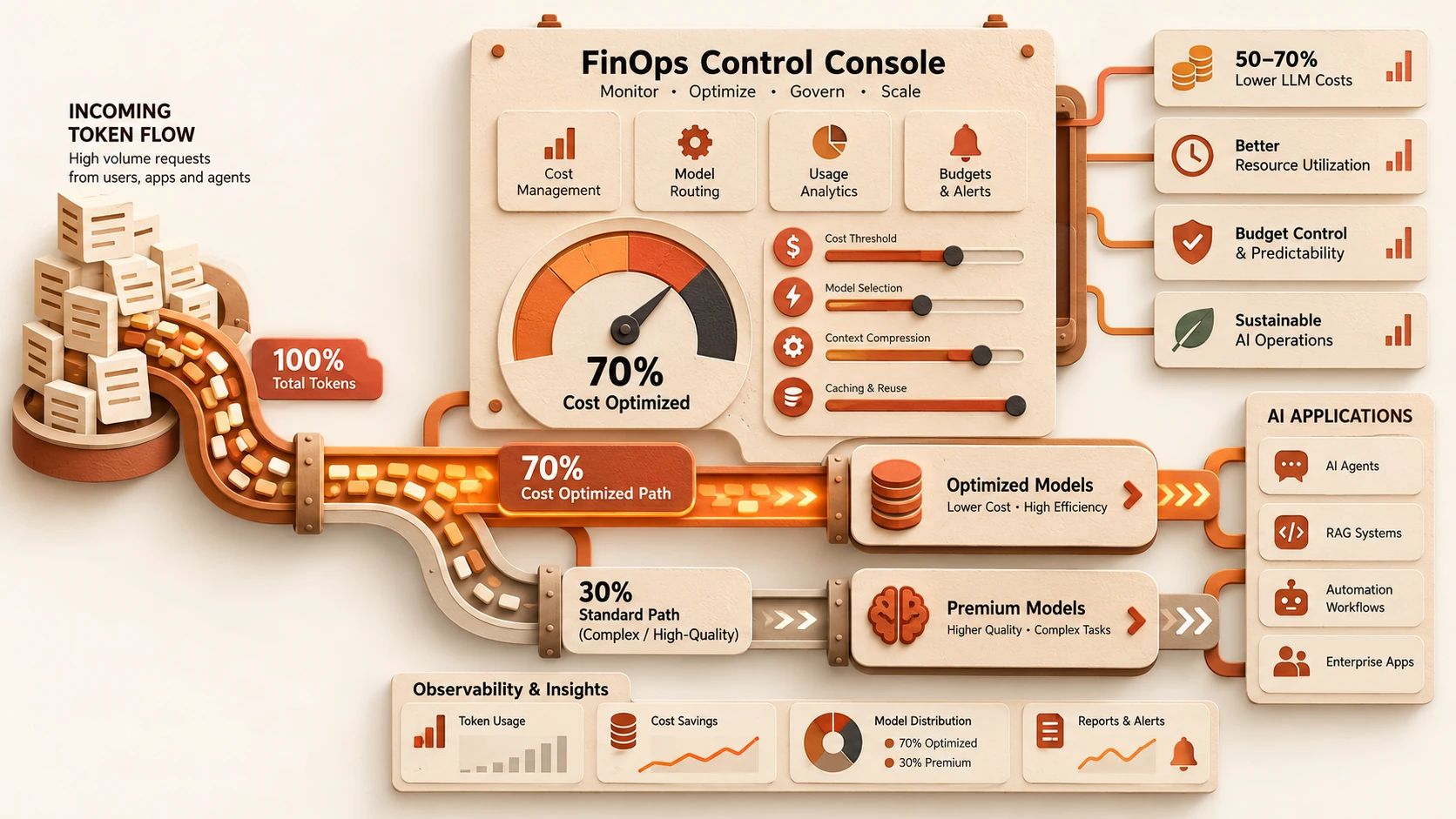
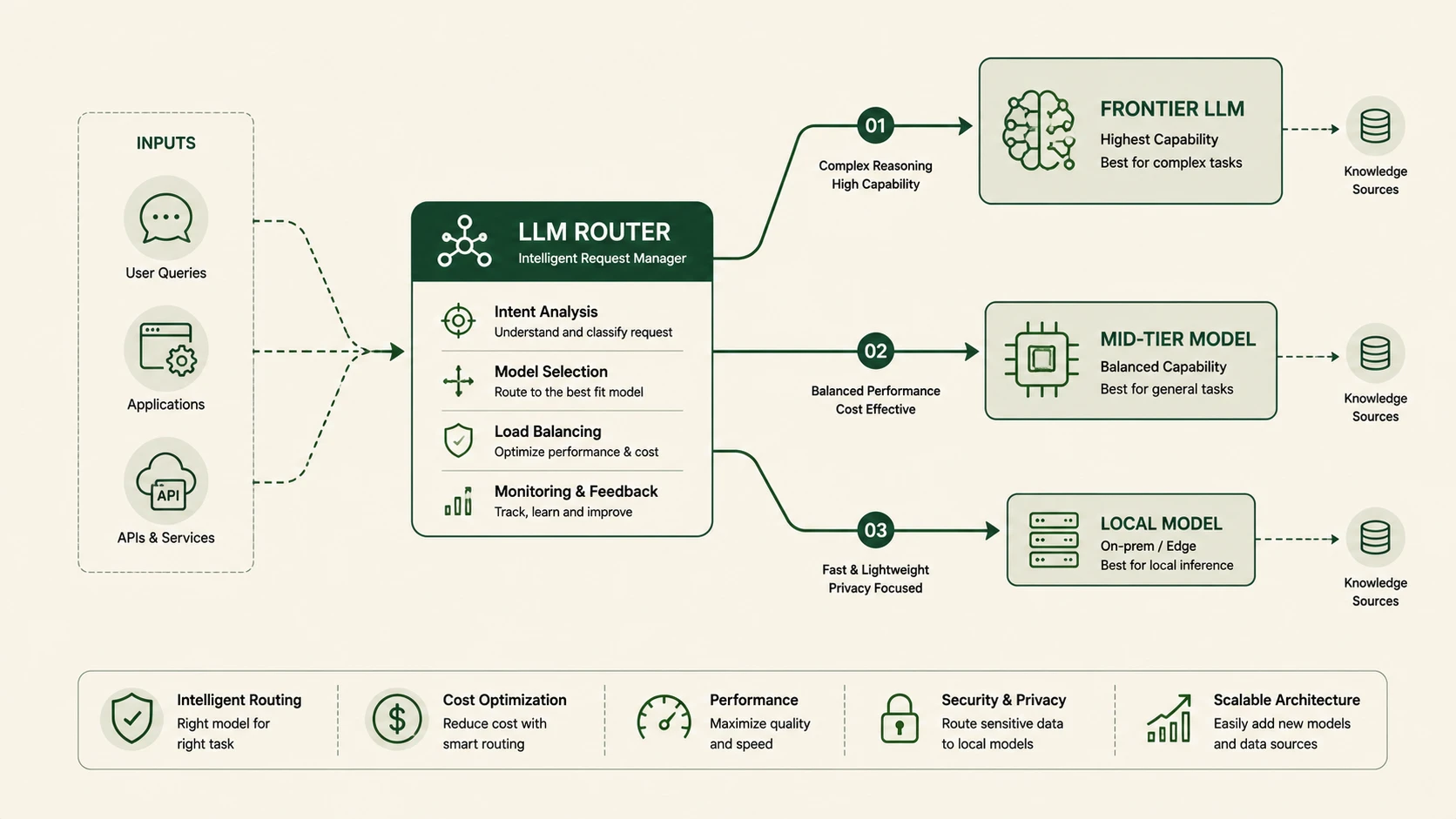
For many enterprises, the most effective design is a hybrid model architecture that routes work according to complexity, risk, and measured capability.
Instead of choosing one model for the entire application, the platform selects the appropriate execution path for each task.
A reference architecture looks like this:
                  User Request
                       |
                       v
             Application API Layer
                       |
                       v
            Input and Policy Validation
                       |
                       v
                 Task Router
                       |
          +------------+-------------+
          |            |             |
          v            v             v
      SLM Path      LLM Path     Deterministic
   Classification   Complex       Business Logic
   Extraction       Reasoning     Calculations
   Short Summary    Synthesis      Validation
          |            |             |
          +------------+-------------+
                       |
                       v
             Output Validation
                       |
                       v
          Confidence and Risk Evaluation
                       |
          +------------+-------------+
          |                          |
          v                          v
   Return Validated Result      Escalate or Review
                       |
                       v
              Audit and Metrics
The router can combine deterministic rules, metadata, a lightweight classifier, and model-based selection. Not every request needs another LLM call just to determine which model should handle it.
Route by task, not by user identity alone
The same user may submit a simple classification request followed by a complex analytical question. Model selection should reflect the actual task and its requirements, not merely the user's department or subscription level.
Define escalation rules
The platform should escalate when the smaller model produces invalid output, lacks required information, falls below a validated confidence threshold, or encounters a request outside its supported scope.
Confidence scores must be calibrated against actual task outcomes. A model's self-reported confidence or fluent response is not sufficient evidence of correctness.
Preserve traceability
Record which routing rule was applied, which model version executed, which validation checks passed, whether escalation occurred, and what the final outcome was. Avoid opaque routing decisions that cannot be investigated later.
Control repeated escalation
A hybrid system can become inefficient if every task repeatedly moves between models. Set explicit limits on retries and escalation, and measure the percentage of requests that require a larger model or human intervention.
6. Model Routing Strategies for Production Systems
There are several ways to implement SLM and LLM routing. The appropriate strategy depends on workload predictability and the consequences of incorrect routing.
Strategy 1: Rule-based routing
Use deterministic rules when the request type is known and the conditions are easy to define.
For example:
- ◆Known document classification tasks go to an SLM.
- ◆Standard arithmetic goes to a calculation service.
- ◆Complex synthesis requests go to an LLM.
- ◆Restricted transactions require a dedicated approval workflow.
Rule-based routing is transparent and easy to test, but it may not handle ambiguous or unfamiliar requests well.
Strategy 2: Classifier-based routing
A lightweight classifier predicts the task category and selects an approved execution path.
This approach is useful when the application receives large volumes of requests that fall into a known set of categories. Evaluate false routing, missed categories, and distribution changes as production traffic evolves.
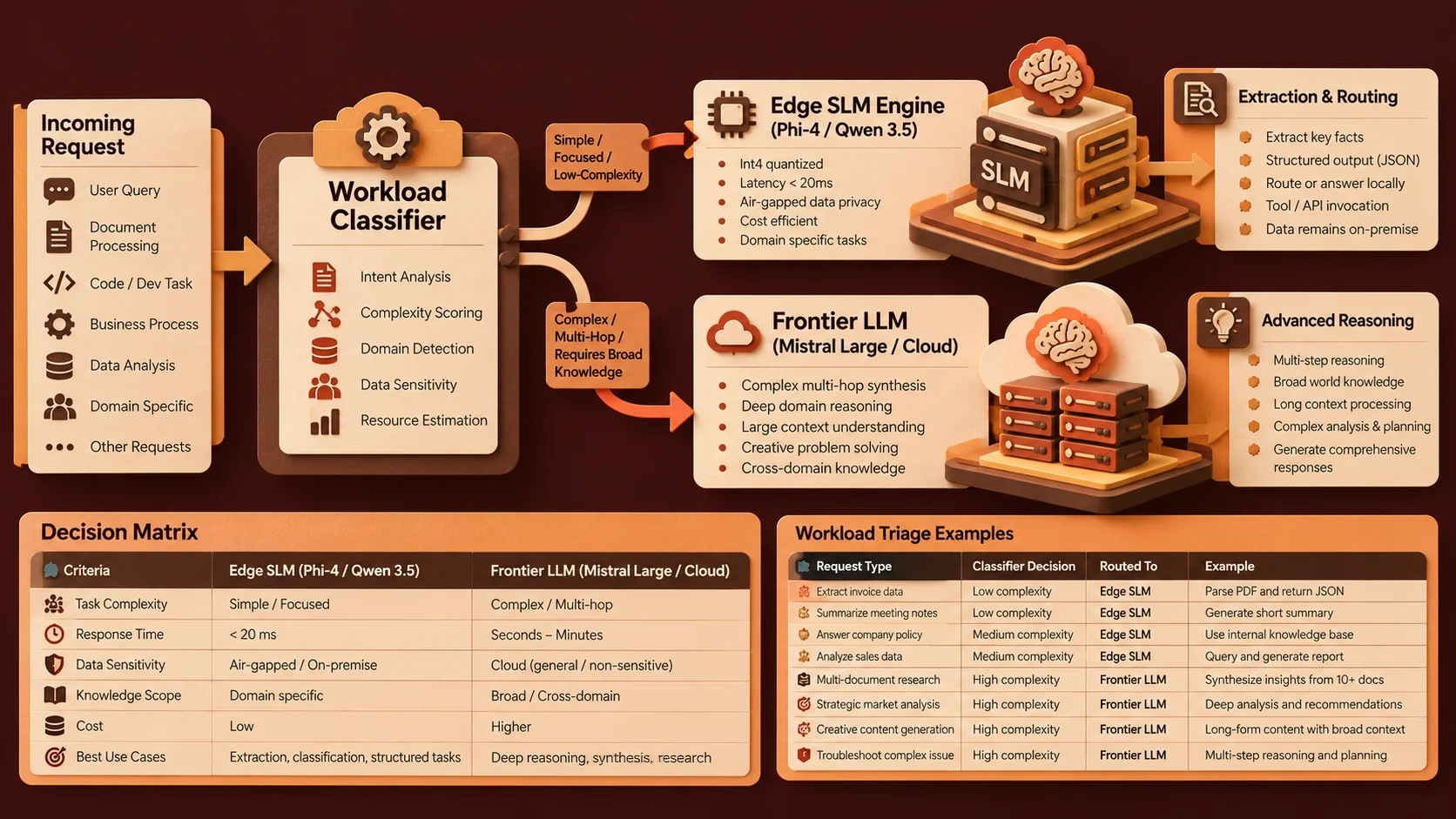
Enterprise workload decision matrix routing latency-sensitive tasks to local SLMs and complex reasoning to frontier LLMs.
Strategy 3: SLM-first with LLM fallback
The platform first attempts a suitable task using an SLM. If the result fails validation or the request is outside the SLM's demonstrated capability, the platform escalates to an LLM or human reviewer.
This can reduce average cost, but the architecture must account for the extra latency and expense of failed first attempts.
Strategy 4: LLM planning with SLM execution
A larger model decomposes a complex task into bounded subtasks. Smaller models handle suitable classification, extraction, or transformation operations, while deterministic services perform authoritative calculations and transactions.
This strategy can improve resource utilization, but only if the orchestration overhead does not exceed the savings from smaller-model execution.
Strategy 5: Quality-based model selection
Maintain evaluation results for each model against the actual workload. Route tasks only to models that meet the required quality, latency, privacy, and operational constraints.
A more expensive model should not automatically win every comparison. A less expensive model that consistently meets the acceptance criteria may be the better production choice.
7. Fine-Tuning, RAG, or a Larger Model?
When a small model underperforms, increasing model size is only one possible solution.
The engineering team should first identify why the task fails.
Use prompt engineering for instruction problems
If the model has the necessary capability but receives ambiguous instructions, a better prompt, clearer examples, or a stricter output schema may solve the problem.
Prompt changes should be evaluated for regression and unintended behavior rather than assumed to improve performance.
Use Retrieval-Augmented Generation for missing knowledge
If the model lacks access to current or organization-specific information, RAG may be more appropriate than increasing model size.
A retrieval pipeline can search approved documents, filter results by access policy, and provide relevant evidence to the model. Retrieval quality and source freshness remain critical.
Use fine-tuning for stable task patterns
Fine-tuning can improve performance when the application has representative examples and a stable task definition. It may help the model follow a domain-specific output format, recognize specialized terminology, or perform a repeated transformation more reliably.
Fine-tuning is not a substitute for retrieving changing facts, enforcing permissions, or validating business transactions.
Use a larger model when capability is the limiting factor
If the task requires complex reasoning, flexible planning, or generalization that a smaller model cannot reliably deliver, a larger model may be the correct choice.
The decision process should be evidence-driven:
- 1.Define the failure precisely.
- 2.Check input quality and task instructions.
- 3.Evaluate whether retrieval can supply missing information.
- 4.Test structured output and deterministic validation.
- 5.Compare fine-tuning where appropriate.
- 6.Benchmark a larger model if the capability gap remains.
This process helps prevent unnecessary infrastructure spending while avoiding the assumption that every model limitation can be solved through prompt engineering.
8. Total Cost of Ownership: Beyond the Price per Token
Comparing models only by advertised inference pricing produces an incomplete picture.
A self-hosted SLM may require GPU or CPU infrastructure, deployment engineering, capacity planning, monitoring, model updates, security controls, and incident response. A managed LLM API may have higher per-request costs but lower operational overhead.
A practical cost model should include:
- ◆Model inference or API charges.
- ◆Compute and memory infrastructure.
- ◆Storage and retrieval costs.
- ◆Network transfer and observability.
- ◆Engineering and operational labor.
- ◆Evaluation and quality-assurance expenses.
- ◆Retries, fallback calls, and failed tasks.
- ◆Human review and correction.
- ◆Availability and recovery requirements.
A useful metric is cost per successful task rather than cost per model invocation.
Consider an illustrative example involving 100,000 tasks per month. Assume an SLM handles the first attempt for every task, with 15% of requests escalated to a larger model.
If the average SLM cost is ₹0.02 per task and the average fallback cost is ₹0.80 per escalated task, the estimated inference cost is:
- ◆SLM first-pass cost: 100,000 × ₹0.02 = ₹2,000.
- ◆LLM fallback cost: 15,000 × ₹0.80 = ₹12,000.
- ◆Total hybrid inference cost: ₹14,000 per month.
If an LLM-only design costs ₹0.80 per task under the same hypothetical assumptions, its monthly inference cost would be ₹80,000.
The illustrative hybrid design would therefore reduce inference spending by 82.5% before accounting for infrastructure, orchestration, validation, and human-review costs.
These numbers are examples, not market prices or a forecast of actual savings. Real outcomes depend on model pricing, hardware utilization, task length, fallback rates, and quality requirements. The correct comparison includes the full production cost of achieving the same successful outcome.
9. Privacy, Security, and Governance Considerations
Model selection affects the security architecture, but it does not replace it.
A locally deployed SLM may keep inference within a controlled environment. A hosted LLM may simplify infrastructure management while introducing additional vendor, data-transfer, and contractual considerations.
The appropriate choice depends on the data classification, regulatory obligations, threat model, and available deployment options.
Data minimization
Send each model only the information necessary for its task. A classification model generally does not need the complete customer record if a small set of authorized fields is sufficient.
Access control
Enforce user, workload, and resource permissions outside the model. A model should not be able to bypass authorization by generating a different tool call or requesting a different record identifier.
Logging and retention
Review prompts, responses, retrieval traces, embeddings, and debugging output for sensitive information. Apply appropriate retention and access controls to the full processing pipeline.
Model supply chain
For self-hosted models, validate model provenance, artifact integrity, dependencies, runtime configuration, and update procedures. For hosted services, evaluate contractual commitments, available security controls, and applicable data-processing terms.
Output validation
Use deterministic checks for critical values, structured data, permissions, and business rules. Require human review for high-impact actions when the use case demands it.
Regulatory suitability
Organizations should assess the actual deployment against applicable laws and contractual requirements. Neither a smaller model nor local inference automatically makes an application compliant.
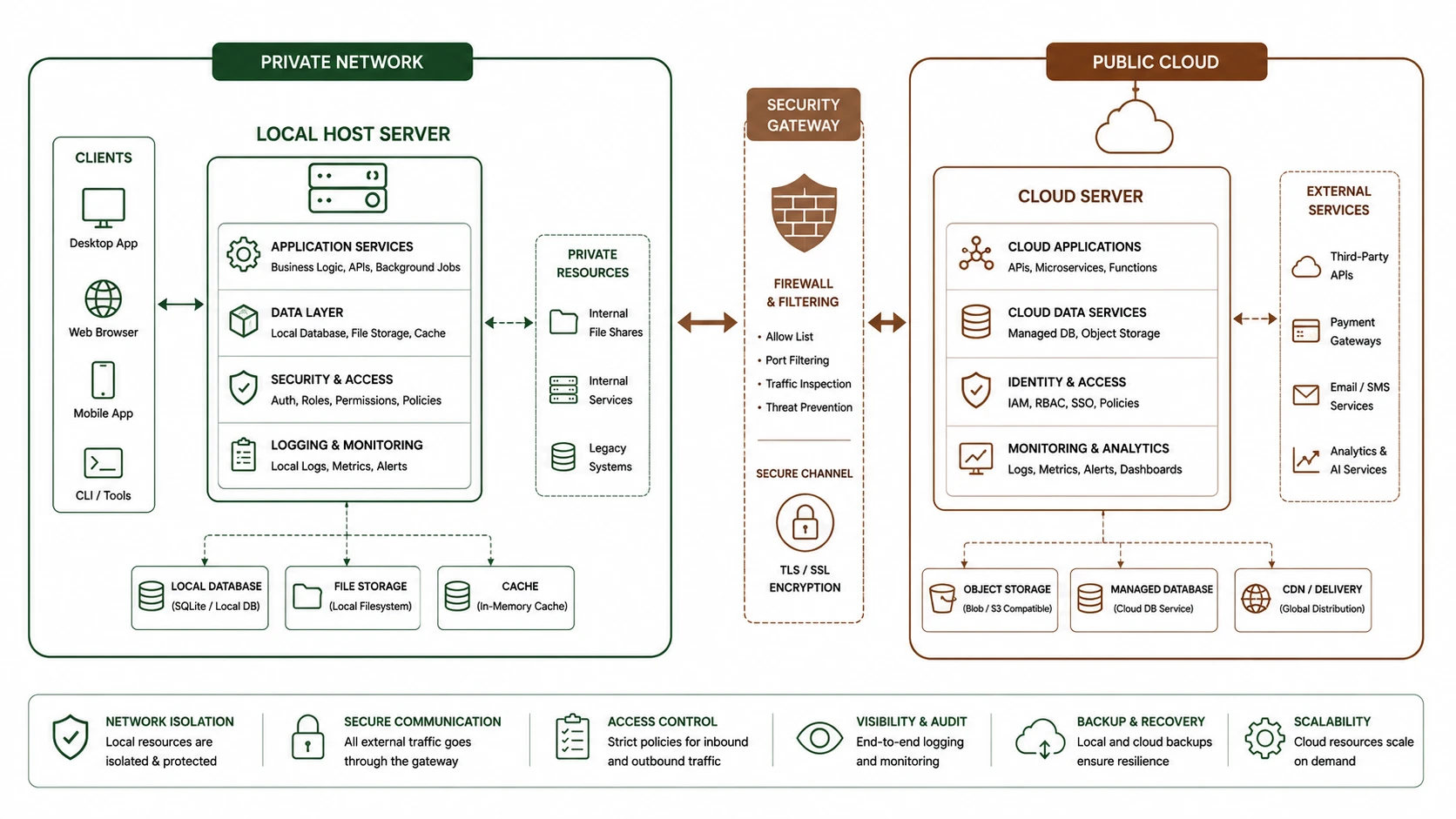
10. Model Deployment Options: Cloud, Private Infrastructure, and Edge
SLMs and LLMs can be deployed in different environments. Model size influences deployment feasibility, but the hosting topology should be selected based on the workload and operational requirements.
Managed cloud inference
Managed endpoints can reduce the burden of provisioning and maintaining model-serving infrastructure. They may offer elastic capacity and integrated monitoring, but introduce service-provider dependencies and usage-based costs.
Self-hosted inference
Self-hosting provides greater control over runtime configuration, infrastructure placement, and model lifecycle management. It also requires teams to operate serving infrastructure, manage capacity, apply security updates, and maintain reliability.
Private cloud or on-premises deployment
Organizations with specific data-residency, connectivity, or control requirements may prefer private or on-premises inference. The decision must account for infrastructure cost, availability, and the skills needed to maintain the environment.
Edge deployment
Edge inference can support offline or low-latency use cases. However, device constraints, software distribution, model updates, and endpoint security become important operational concerns.
The best architecture may combine these approaches. For example, an SLM could classify requests locally, while a cloud-hosted LLM handles approved complex requests that require broader reasoning.
11. A Practical SLM vs LLM Decision Framework
Enterprise teams should evaluate each workload against a consistent set of criteria.
| Question | Favors an SLM | Favors an LLM |
|---|---|---|
| Is the task narrow and repeatable? | Yes | No or highly variable |
| Can the output be validated automatically? | Often | Sometimes, but may require more sophisticated evaluation |
| Does the task require broad reasoning? | Usually not | Often |
| Is inference volume high? | Potentially, if local economics are favorable | Potentially, if managed serving and quality justify the cost |
| Must inference operate offline? | Often a strong candidate | Possible with sufficiently capable local hardware |
| Is context extensive and complex? | Depends on model context and task | Often a stronger candidate |
| Is the data sensitive? | Local SLM may help, but controls remain necessary | Hosted or self-hosted options must be evaluated individually |
| Is the workload safety-critical? | Only if validated for the intended use | Only if validated for the intended use |
A practical selection workflow is:
Step 1: Define the task. Specify inputs, outputs, business objectives, error tolerance, and prohibited behavior.
Step 2: Establish a baseline. Test a capable model against a representative evaluation dataset to understand the achievable quality level.
Step 3: Test smaller candidates. Evaluate SLMs using the same data, metrics, and acceptance criteria.
Step 4: Measure operational performance. Compare latency, throughput, cost, memory, infrastructure utilization, and escalation requirements.
Step 5: Test failure modes. Include malformed inputs, missing context, ambiguous requests, adversarial inputs, and distribution shifts.
Step 6: Select the lowest-cost option that meets all requirements. Do not optimize cost at the expense of necessary quality, security, or reliability.
Step 7: Monitor continuously. Reevaluate the model when workload patterns, model versions, data sources, or business requirements change.
Microsoft's Azure Architecture Center similarly recommends evaluating models against workload-specific requirements and planning for model changes over time. Model choice should be treated as a lifecycle decision rather than a permanent architectural commitment.
12. Common Mistakes When Choosing Between SLMs and LLMs
Choosing by parameter count alone
Parameter count does not fully determine quality, latency, memory use, or energy consumption. Benchmark the actual model and serving configuration against the target workload.
Assuming local means free
Local inference still consumes compute, electricity, storage, and engineering time. Include infrastructure utilization and maintenance in the cost model.
Using an SLM for every task
If complex requests frequently fail or escalate, the apparent savings may disappear. Choose models based on demonstrated capability.
Using an LLM for deterministic operations
Calculations, permission checks, schema validation, and state transitions are often better handled by ordinary application code. Generative AI should not replace deterministic logic without a clear reason.
Treating a fluent answer as a correct answer
Both small and large models can generate incorrect information. Validate important outputs against trusted data and deterministic rules.
Ignoring model lifecycle management
A model that performs well today may become unsuitable as data, traffic, or requirements change. Track versions, maintain regression tests, and establish a replacement process.
Ignoring the fallback rate
A hybrid architecture is not automatically efficient. If most SLM requests escalate to an LLM, the extra model call may increase latency and cost. Monitor successful first-pass completion and cost per successful task.
Conclusion: Use the Smallest Suitable Model, Not Simply the Smallest Model
The SLM-versus-LLM decision is ultimately a workload-design problem.
Small Language Models can be excellent choices for focused, high-volume tasks where quality can be measured, deployment constraints matter, and lower inference requirements create a genuine operational advantage. Large Language Models remain valuable for demanding reasoning, broad contextual understanding, complex synthesis, and flexible problem-solving.
For many enterprises, a hybrid architecture provides the best balance. It routes routine tasks to suitable smaller models, reserves larger models for complex requests, and relies on deterministic services for calculations, authorization, and authoritative business operations.
The engineering objective is not to maximize model size or minimize it at any cost. It is to meet the required quality, security, latency, and reliability targets with the most appropriate overall architecture.
Start with the workload. Define measurable acceptance criteria. Benchmark realistic alternatives. Calculate total cost of ownership. Then deploy the model that satisfies the requirements—not the model with the most parameters.
In 2026, effective enterprise AI engineering is increasingly about model selection, orchestration, evaluation, and governance. Choosing the right model for each task is one of the most important architectural decisions an organization can make.
References
- ◆Microsoft Learn — Choose the Right AI Model for Your Workload
- ◆Microsoft Cloud Blog — Key Differences Between Small Language Models and Large Language Models
- ◆Gartner — Organizations Will Use Small, Task-Specific AI Models Three Times More Than General-Purpose LLMs by 2027
- ◆IJCAI 2026 — Mapping the Efficiency Landscape of Small Language Models
- ◆TechTarget — SLM vs. LLM: Rightsize Data Architecture to Optimize AI Use