Introduction
Web applications have steadily evolved from simple document viewers into sophisticated software platforms capable of supporting enterprise dashboards, Computer-Aided Design (CAD) systems, financial analytics, media processing, scientific visualization, gaming engines, and productivity suites. As these workloads become increasingly computationally intensive, browser developers have sought ways to improve execution performance while preserving the web's security model.
WebAssembly (Wasm) has already established itself as a compact binary instruction format capable of executing code at near-native speeds inside modern browsers. Languages such as C and C++ can now target WebAssembly, allowing existing software components to run on the web with predictable performance characteristics.
One remaining limitation has been efficient utilization of modern multi-core processors. Traditional JavaScript execution is intentionally constrained by a single-threaded programming model, with asynchronous execution coordinated through the event loop. Although Web Workers provide isolated background execution, they do not inherently allow shared memory.
WebAssembly Threads extend the execution model by combining SharedArrayBuffer and Atomics, enabling multiple workers to cooperate through shared memory while maintaining deterministic synchronization primitives.
As of January 2019, browser vendors continue deploying security mitigations associated with speculative execution vulnerabilities while restoring support for shared memory capabilities required by multithreaded WebAssembly applications.
Industry Background
Modern browser applications increasingly perform:
- ◆Image processing
- ◆Video encoding
- ◆Three-dimensional rendering
- ◆Scientific computation
- ◆Computer-aided design
- ◆Geographic information systems
- ◆Machine learning inference
- ◆Financial modeling
Many of these workloads benefit from parallel execution across multiple processor cores.
Historically, such workloads often required native desktop software. WebAssembly aims to narrow this gap while maintaining browser portability.
The Business Problem
Enterprise web applications frequently encounter:
- ◆CPU-intensive computations
- ◆Long-running rendering tasks
- ◆Large engineering datasets
- ◆Single-thread execution limitations
- ◆Underutilization of multi-core processors
- ◆Complex client-side processing pipelines
Organizations increasingly require browser technologies capable of supporting computational workloads previously reserved for native applications.
Understanding WebAssembly Threads
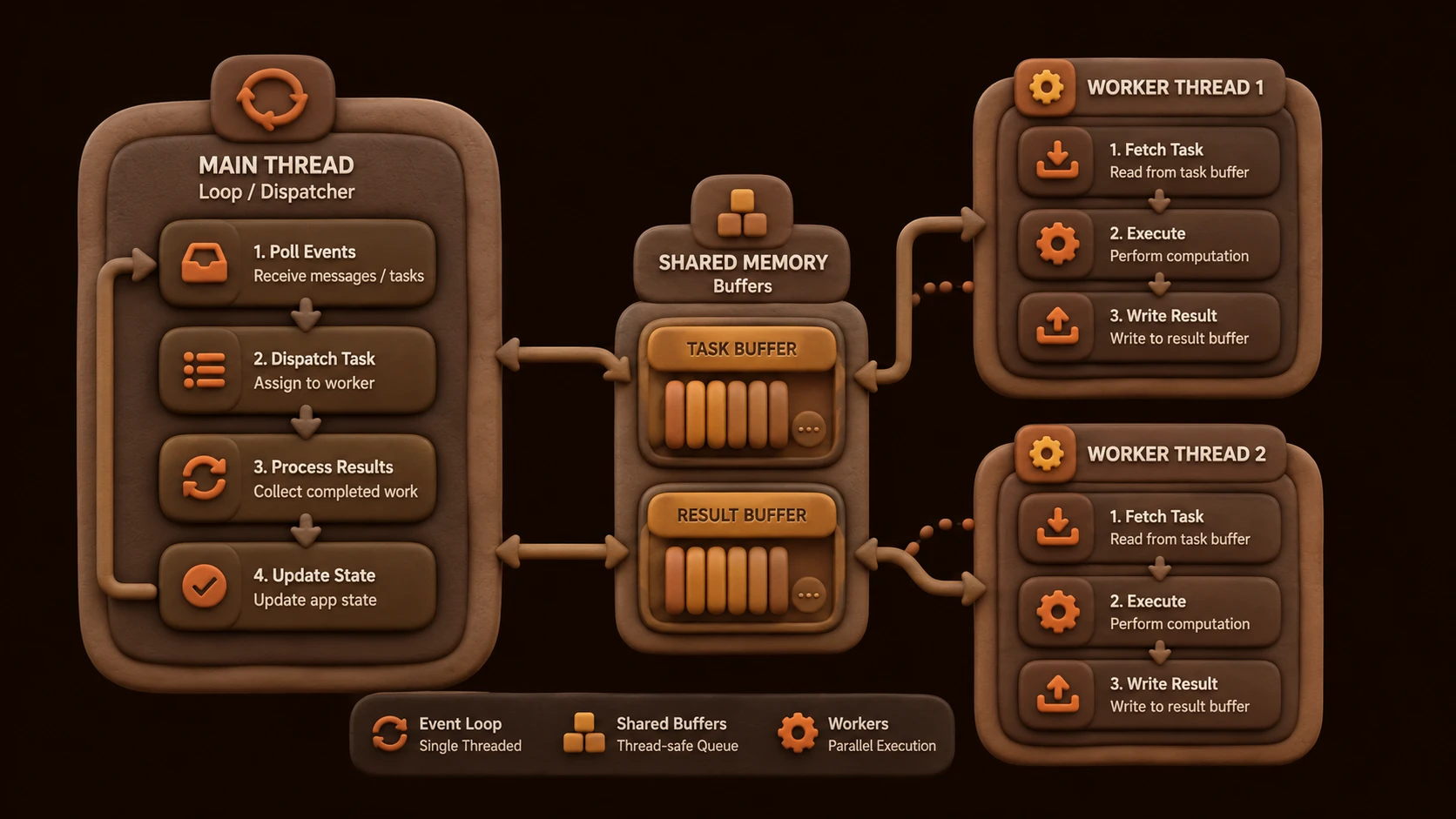
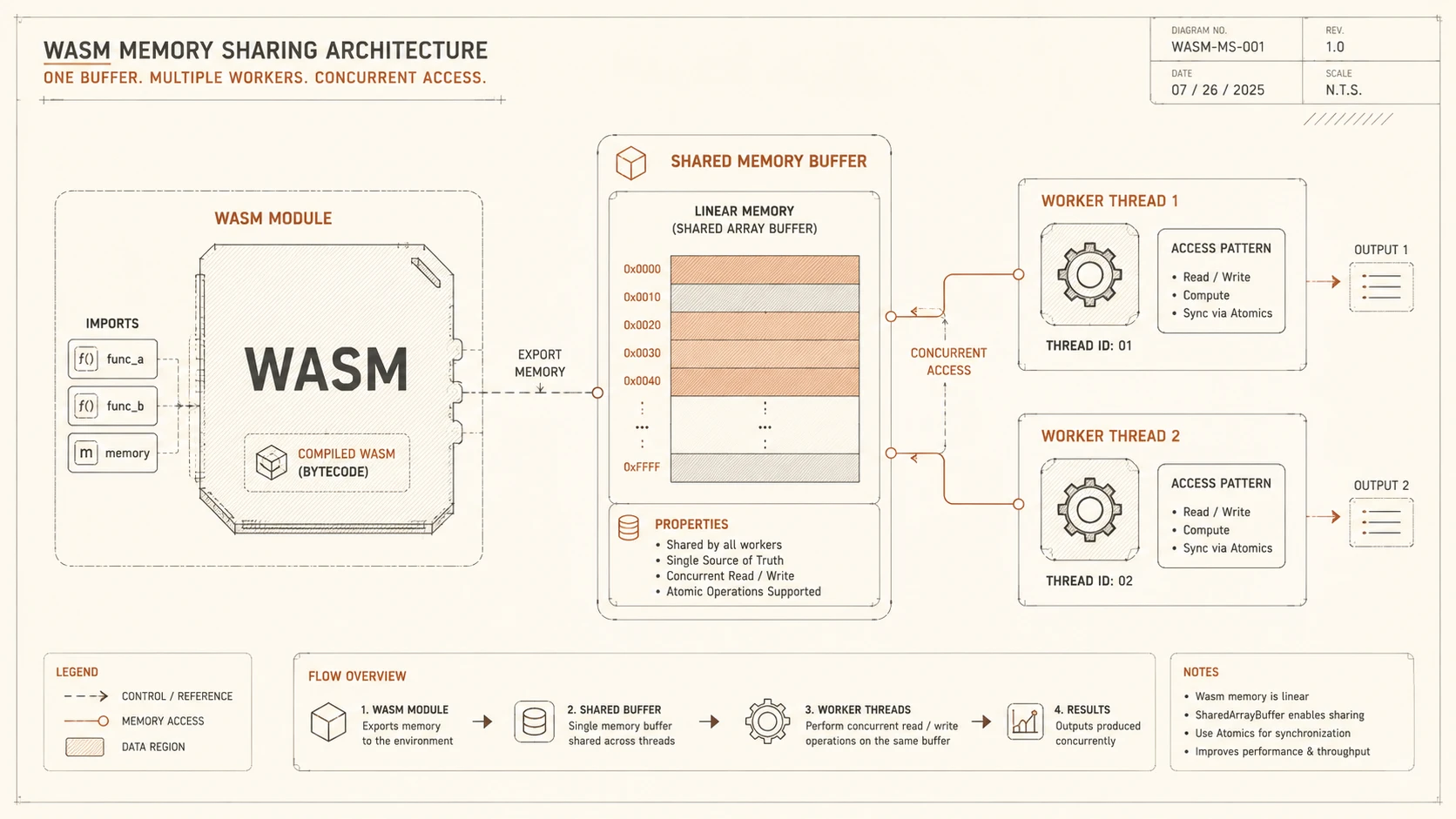
WebAssembly Threads provide a standardized mechanism for executing WebAssembly code concurrently across multiple workers.
Rather than sharing JavaScript execution directly, workers coordinate using shared memory backed by SharedArrayBuffer.
Major components include:
- ◆WebAssembly modules
- ◆Web Workers
- ◆SharedArrayBuffer
- ◆Atomics
- ◆Browser scheduler
This architecture enables parallel computation while preserving browser isolation boundaries.
Core Architecture
| Component | Responsibility |
|---|---|
| WebAssembly Module | Executes compiled application code |
| Main Browser Thread | Coordinates user interface |
| Web Workers | Execute background computation |
| SharedArrayBuffer | Provides shared memory |
| Atomics | Synchronizes concurrent access |
| JavaScript Runtime | Coordinates browser interaction |
Each worker executes independently while cooperating through shared memory when appropriate.
SharedArrayBuffer
SharedArrayBuffer enables multiple execution contexts to access the same memory region.
Unlike ordinary ArrayBuffer instances, which transfer ownership between workers, SharedArrayBuffer allows concurrent access by multiple participants.
Potential enterprise scenarios include:
- ◆Shared numerical arrays
- ◆Graphics buffers
- ◆Simulation data
- ◆Computational models
- ◆Machine learning tensors
Shared memory reduces unnecessary data copying while enabling efficient collaboration between workers.
Atomics
Concurrent memory access introduces synchronization challenges.
The Atomics API provides standardized operations that coordinate access to shared memory.
Typical responsibilities include:
- ◆Atomic reads
- ◆Atomic writes
- ◆Compare-and-exchange operations
- ◆Synchronization primitives
- ◆Thread coordination
Atomics help ensure consistent application behavior despite concurrent execution.
Relationship with Web Workers
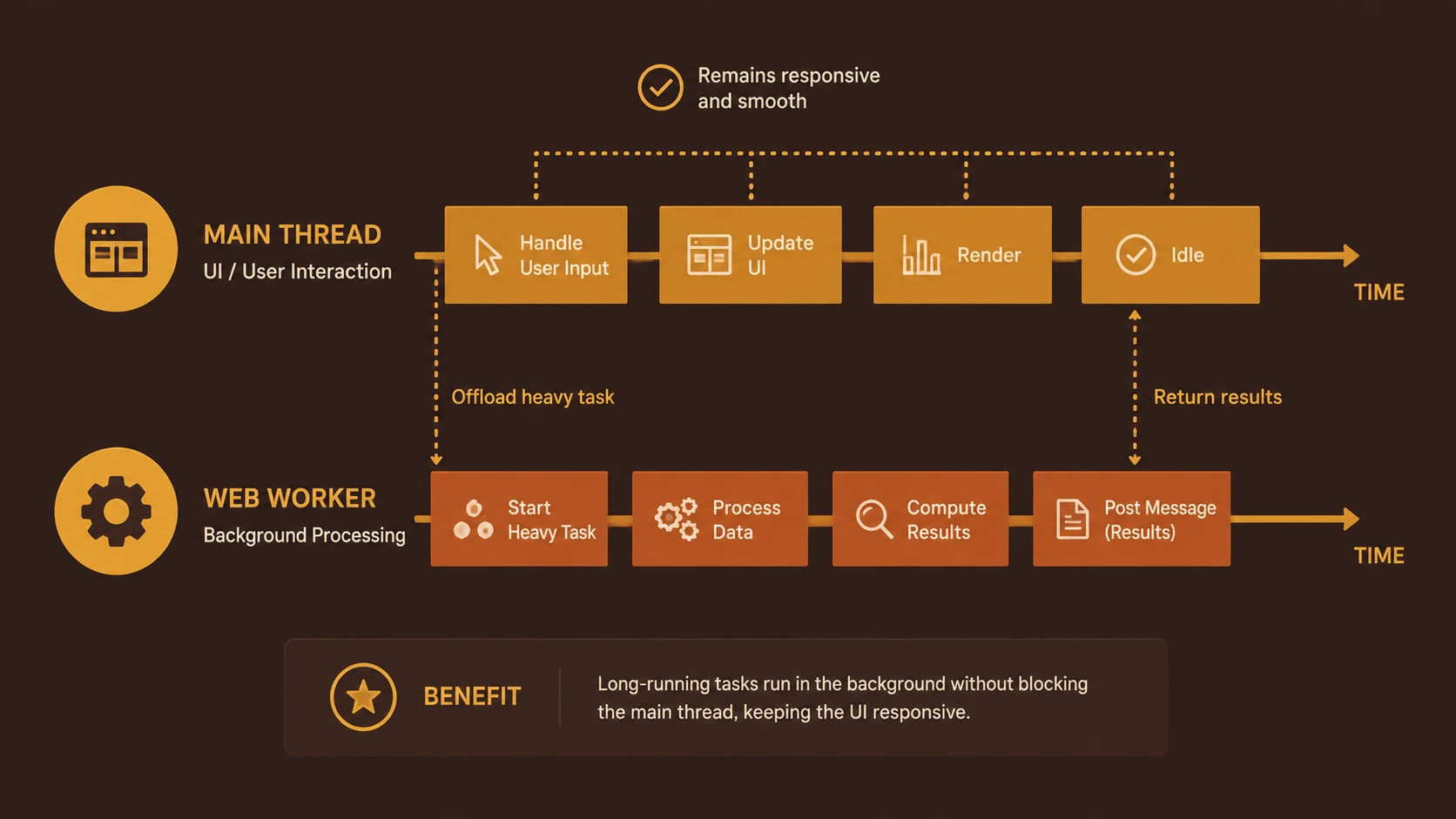
WebAssembly Threads build upon the existing Web Worker model.
A typical execution flow includes:
- 1.The browser loads a WebAssembly module.
- 2.Worker threads are created.
- 3.Shared memory is allocated.
- 4.Computational tasks are distributed.
- 5.Workers synchronize using Atomics.
- 6.Results are aggregated and presented to the user.
The user interface remains responsive while computation proceeds in parallel.
Browser Security Considerations
SharedArrayBuffer availability has been influenced by industry-wide security responses following the disclosure of speculative execution vulnerabilities.
Browser vendors have introduced mitigations designed to reduce timing-based side-channel attacks while evaluating the safe reintroduction of shared memory capabilities.
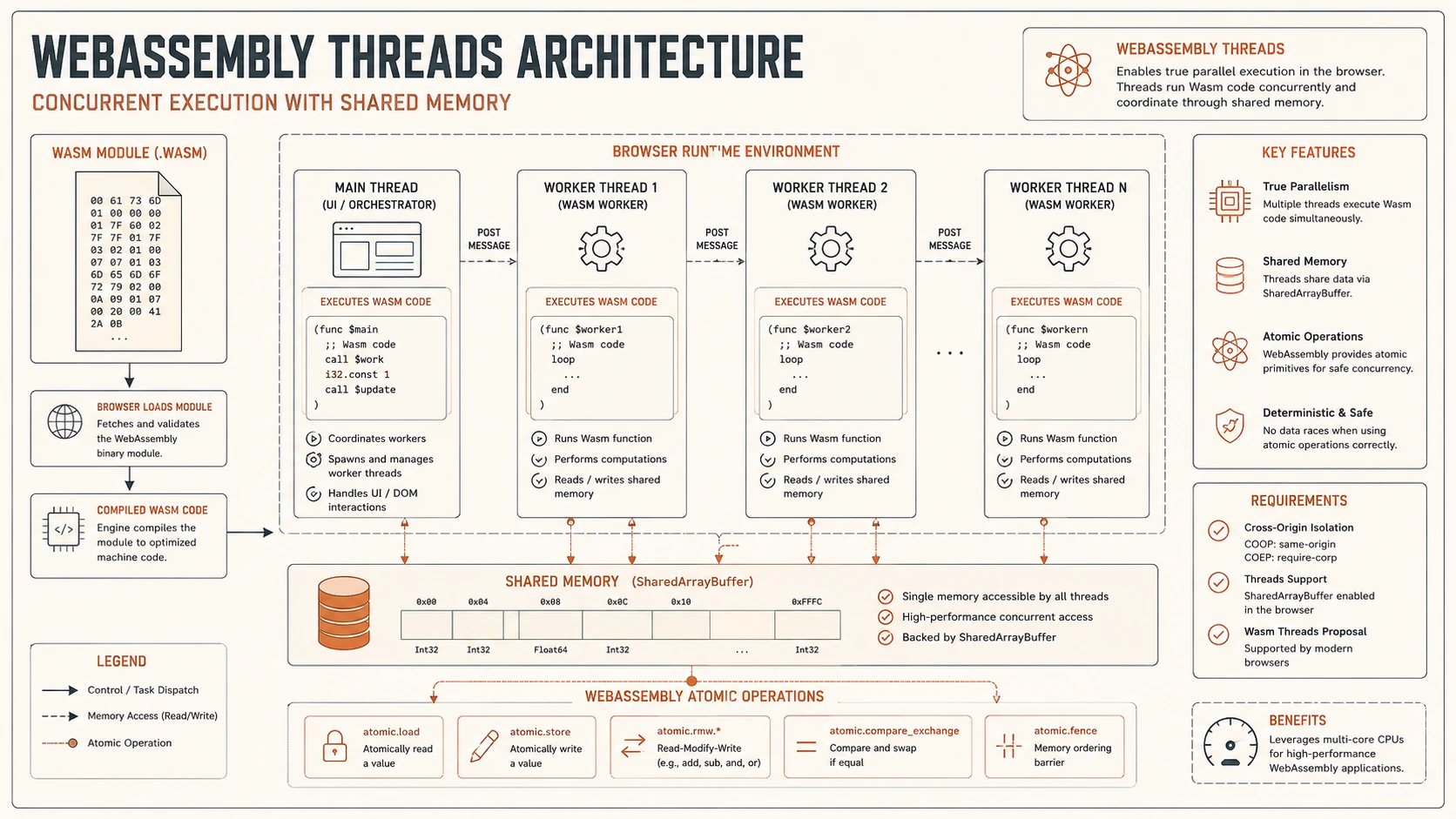
System architecture diagram and conceptual workflow layout for WebAssembly Threads.
Organizations should:
- ◆Follow browser vendor guidance.
- ◆Deploy current browser versions.
- ◆Review browser security policies.
- ◆Validate application behavior across supported environments.
Browser security remains the primary consideration for shared memory deployment.
Enterprise Use Cases
| Scenario | Benefit |
|---|---|
| CAD Applications | Parallel geometric computation |
| Scientific Visualization | Multi-core processing |
| Image Editing | Concurrent filtering |
| Financial Analytics | Numerical computation |
| GIS Platforms | Spatial processing |
| Engineering Simulation | Shared computational models |
Applications performing substantial client-side computation stand to benefit most from multithreaded execution.
Performance Considerations
WebAssembly Threads improve the ability to utilize multiple processor cores, but performance depends on application architecture.
Development teams should evaluate:
- ◆Thread creation overhead
- ◆Synchronization costs
- ◆Memory contention
- ◆Cache locality
- ◆Task partitioning
- ◆Browser scheduling behavior
Well-designed parallel algorithms generally outperform implementations that introduce excessive synchronization.
Performance optimization should be guided by representative workload testing.
Security Considerations
Organizations should continue implementing:
- ◆Browser updates
- ◆Secure transport through HTTPS
- ◆Content Security Policy where appropriate
- ◆Dependency management
- ◆Secure application deployment
- ◆Continuous security monitoring
Shared memory capabilities should be deployed alongside current browser security recommendations.
Scalability
WebAssembly Threads improve scalability for computational workloads through:
- ◆Multi-core utilization
- ◆Parallel execution
- ◆Reduced memory copying
- ◆Efficient synchronization
- ◆Background processing
Scalability gains depend upon application workload characteristics rather than thread count alone.
Best Practices
Organizations evaluating WebAssembly Threads should:
- ◆Use shared memory only where measurable performance benefits exist.
- ◆Minimize synchronization frequency.
- ◆Partition workloads evenly across workers.
- ◆Benchmark representative production scenarios.
- ◆Keep the user interface responsive.
- ◆Monitor browser compatibility.
- ◆Validate security requirements before deployment.
- ◆Continue profiling application performance after implementation.
Thoughtful parallel algorithm design produces better results than simply increasing worker counts.
Common Mistakes
Development teams should avoid:
- ◆Assuming every workload benefits from parallel execution.
- ◆Excessive synchronization between workers.
- ◆Sharing mutable state unnecessarily.
- ◆Ignoring browser compatibility.
- ◆Creating more workers than available computational resources justify.
- ◆Optimizing without production measurements.
Parallel programming should be introduced where computational workloads clearly justify additional architectural complexity.
Technology Comparison
| Capability | Traditional JavaScript | WebAssembly Threads |
|---|---|---|
| Parallel Computation | Limited through isolated workers | Yes |
| Shared Memory | No | Yes (SharedArrayBuffer) |
| Synchronization | Message passing | Atomics |
| CPU-Intensive Processing | Limited | Improved |
| Multi-Core Utilization | Limited | Enhanced |
| Numerical Computing | Moderate | Stronger support |
WebAssembly Threads complement existing browser programming models by enabling efficient parallel execution for suitable workloads.
Adoption Strategy
Organizations should approach adoption incrementally.
A practical strategy includes:
- 1.Identify computational bottlenecks.
- 2.Evaluate browser compatibility requirements.
- 3.Prototype multithreaded implementations.
- 4.Benchmark against existing solutions.
- 5.Validate browser security requirements.
- 6.Monitor production resource utilization.
- 7.Expand deployment after measurable performance improvements.
Incremental adoption minimizes operational risk while allowing engineering teams to validate scalability gains.
Limitations
As of January 2019, several considerations remain.
Current observations include:
- ◆Browser implementation status continues evolving.
- ◆Shared memory availability depends on browser security policies.
- ◆Existing JavaScript applications may not require multithreading.
- ◆Parallel programming introduces additional synchronization complexity.
Organizations should evaluate WebAssembly Threads according to workload characteristics rather than treating them as a universal optimization.
Looking Ahead
WebAssembly Threads represent an important milestone in the evolution of browser computing by enabling efficient parallel execution through SharedArrayBuffer and Atomics. Together, these capabilities allow browser applications to better utilize modern multi-core processors while supporting increasingly sophisticated computational workloads.
As of January 2019, enterprise architects should evaluate WebAssembly Threads for applications involving significant client-side computation, particularly where responsiveness and parallel processing provide measurable operational benefits. Organizations that combine disciplined concurrency design, careful performance measurement, and ongoing browser compatibility validation will be well positioned to leverage this emerging capability as WebAssembly continues to mature.