Why Healthcare Platforms Need a Modern Hospital Operating System
Healthcare organizations are rapidly modernizing their digital infrastructure to improve patient care, streamline clinical workflows, and meet increasingly strict regulatory requirements. Traditional hospital systems are often fragmented, relying on disconnected Electronic Health Records (EHRs), laboratory software, billing platforms, and medical devices that struggle to exchange information securely.
A modern Hospital Operating System (Hospital OS) unifies these systems into a centralized, secure platform while ensuring compliance with the Health Insurance Portability and Accountability Act (HIPAA). Rather than simply storing patient records, it becomes the digital backbone that connects every department, application, and healthcare workflow.
Architecture Principle: Every system handling Protected Health Information (PHI) should be designed with security, compliance, interoperability, and resilience as foundational requirements rather than optional features.
---
Understanding HIPAA Requirements
HIPAA establishes standards for protecting sensitive patient information across healthcare organizations.
A HIPAA-compliant Hospital OS should provide:
- ◆End-to-end encryption
- ◆Strong identity management
- ◆Role-based access control
- ◆Audit logging
- ◆Secure data storage
- ◆Secure API communication
- ◆Automatic session management
- ◆Disaster recovery capabilities
Compliance is not achieved through a single security feature. It requires an architecture where every component contributes to protecting patient information.
---
Core Components of a Hospital OS
A modern Hospital Operating System integrates multiple clinical and administrative systems into a unified platform.
Typical modules include:
- ◆Electronic Health Records (EHR)
- ◆Patient Management
- ◆Appointment Scheduling
- ◆Laboratory Information System (LIS)
- ◆Radiology & PACS
- ◆Pharmacy Management
- ◆Billing & Insurance
- ◆Clinical Decision Support
- ◆Telemedicine
- ◆Healthcare Analytics
- ◆AI Clinical Assistant
Each module communicates securely through standardized healthcare APIs.
---
Reference Architecture
A scalable Hospital OS commonly follows a layered architecture.
Patient Portal
        │
        ▼
Authentication & MFA
        │
API Gateway
        │
Hospital OS Core Platform
        │
────────────────────────────────
│ EHR │ FHIR │ HL7 │ AI Engine │
│ PACS │ Pharmacy │ Billing │
│ Laboratory │ Scheduling │
────────────────────────────────
        │
Encrypted Database
        │
Audit Logs & Monitoring
        │
Cloud Infrastructure
This architecture isolates responsibilities while simplifying maintenance and security management.
🔍 Case Study Showcase: Hospital OS We engineered this exact layered reference architecture for [Hospital OS](/work/hospital-os), our premium, HIPAA-compliant clinical operating system, resolving concurrency challenges across EHR and scheduling systems.
---
Security by Design
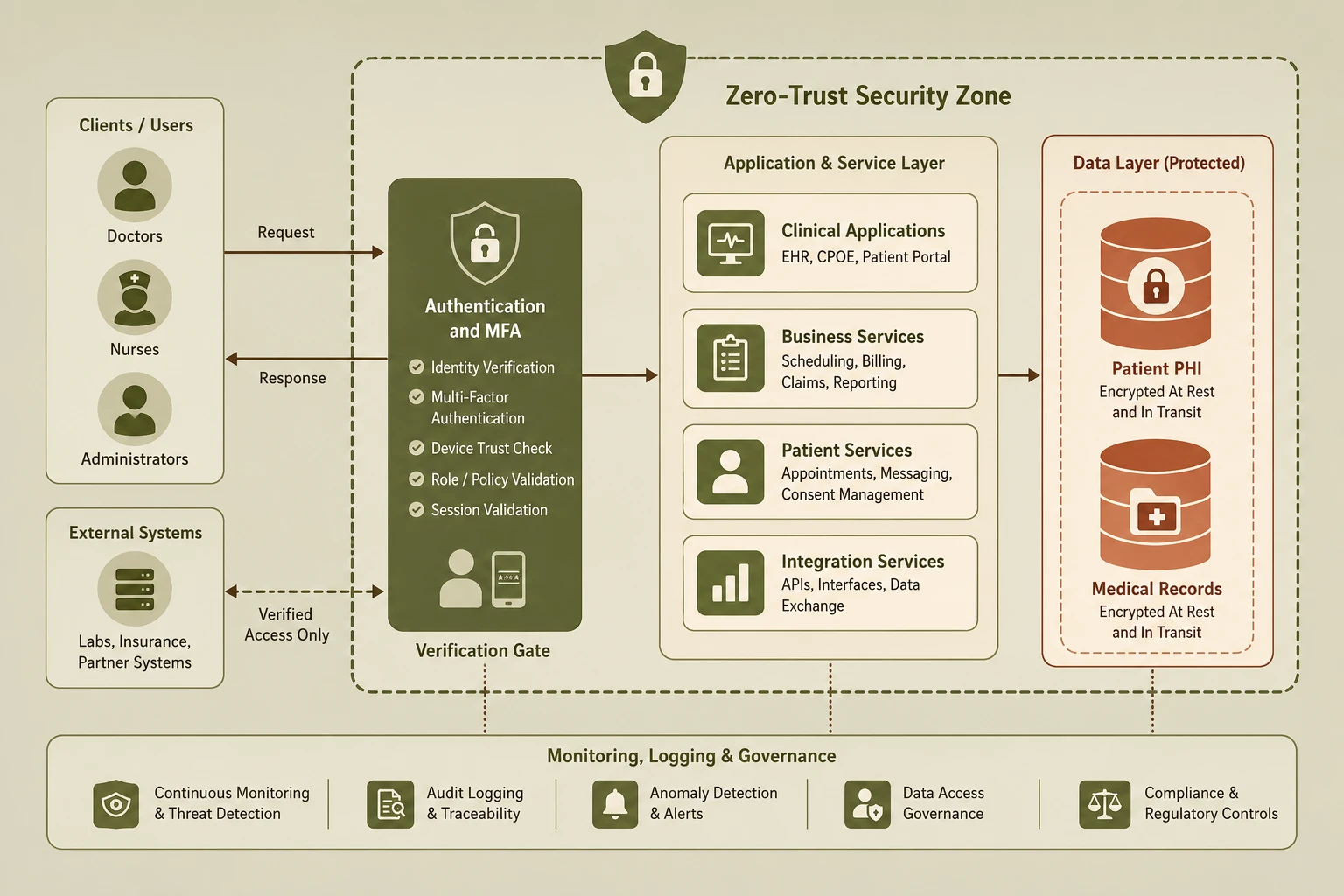
Healthcare platforms must assume that cyber threats are constant. Every request should be authenticated, authorized, and audited.
Essential security controls include:
- ◆Multi-factor authentication (MFA)
- ◆Role-Based Access Control (RBAC)
- ◆Zero Trust Architecture
- ◆TLS encryption
- ◆Database encryption
- ◆Secure secrets management
- ◆API authentication
- ◆Continuous monitoring
- ◆Threat detection
- ◆Security incident response
These controls protect both patient privacy and healthcare operations.
---
Protecting Patient Data
Protected Health Information (PHI) is among the most sensitive forms of personal data. A Hospital OS must safeguard PHI throughout its lifecycle.
Recommended practices include:
- ◆AES-256 encryption at rest
- ◆TLS 1.3 encryption in transit
- ◆Database field-level encryption
- ◆Secure backups
- ◆Tokenization of sensitive identifiers
- ◆Data masking for non-production environments
- ◆Automatic key rotation
- ◆Immutable audit trails

Data flow isolation and encryption parameters for HIPAA-compliant clinical systems.
These measures significantly reduce the risk of unauthorized disclosure.
---
Healthcare Interoperability
Modern hospitals rely on numerous specialized systems. Interoperability standards allow these systems to exchange information consistently.
Common healthcare standards include:
- ◆HL7
- ◆FHIR APIs
- ◆DICOM
- ◆ICD-10
- ◆SNOMED CT
- ◆LOINC
FHIR has become the preferred standard for cloud-native healthcare applications because it enables secure REST-based communication between systems.
---
Identity and Access Management
Not every healthcare worker should access every patient record.
Access policies should consider:
- ◆Clinical role
- ◆Department
- ◆Assigned patients
- ◆Time of access
- ◆Device trust
- ◆Geographic location
- ◆Emergency override procedures
Fine-grained authorization minimizes unnecessary exposure of sensitive information.
---
Audit Logging and Compliance
HIPAA requires organizations to maintain detailed records of access to protected health information.
Every significant event should be logged, including:
- ◆User authentication
- ◆Patient record access
- ◆Record modifications
- ◆Prescription updates
- ◆Laboratory requests
- ◆Administrative actions
- ◆API requests
- ◆Security events
Centralized logging supports compliance audits and forensic investigations.
---
Cloud-Native Hospital Architecture
Many healthcare organizations are migrating to cloud platforms while maintaining strict compliance.
A cloud-native Hospital OS commonly includes:
- ◆Kubernetes orchestration
- ◆Containerized microservices
- ◆API Gateway
- ◆Identity Provider
- ◆Secure object storage
- ◆Managed databases
- ◆Continuous monitoring
- ◆Disaster recovery automation
This approach improves scalability without compromising security.
---
Enterprise Best Practices
Organizations building healthcare platforms should adopt the following architectural principles:
| Area | Best Practice |
|---|---|
| Security | Zero Trust Architecture |
| Authentication | Multi-Factor Authentication |
| Authorization | Role-Based Access Control |
| Data Protection | AES-256 Encryption |
| APIs | OAuth 2.0 + FHIR |
| Compliance | Continuous Audit Logging |
| Infrastructure | Cloud-Native Microservices |
| Availability | High Availability & Disaster Recovery |
---
Future of Digital Healthcare Platforms
Hospital Operating Systems are evolving beyond traditional health information systems. Artificial intelligence, predictive analytics, clinical automation, and interoperable cloud services are becoming integral parts of modern healthcare infrastructure.
Building a HIPAA-compliant Hospital OS requires thoughtful architectural decisions from the beginning. By prioritizing security, interoperability, compliance, and scalability, healthcare organizations can deliver trusted digital experiences while protecting patient privacy and supporting future innovation.