The healthcare industry stands on the precipice of a profound transformation, driven by the rapid advancements in Artificial Intelligence. From automating administrative tasks to assisting in complex clinical diagnostics, AI agents promise unprecedented efficiencies and improved patient outcomes. Yet, this transformative potential collides head-on with one of the most stringent regulatory frameworks in the world: the Health Insurance Portability and Accountability Act (HIPAA).
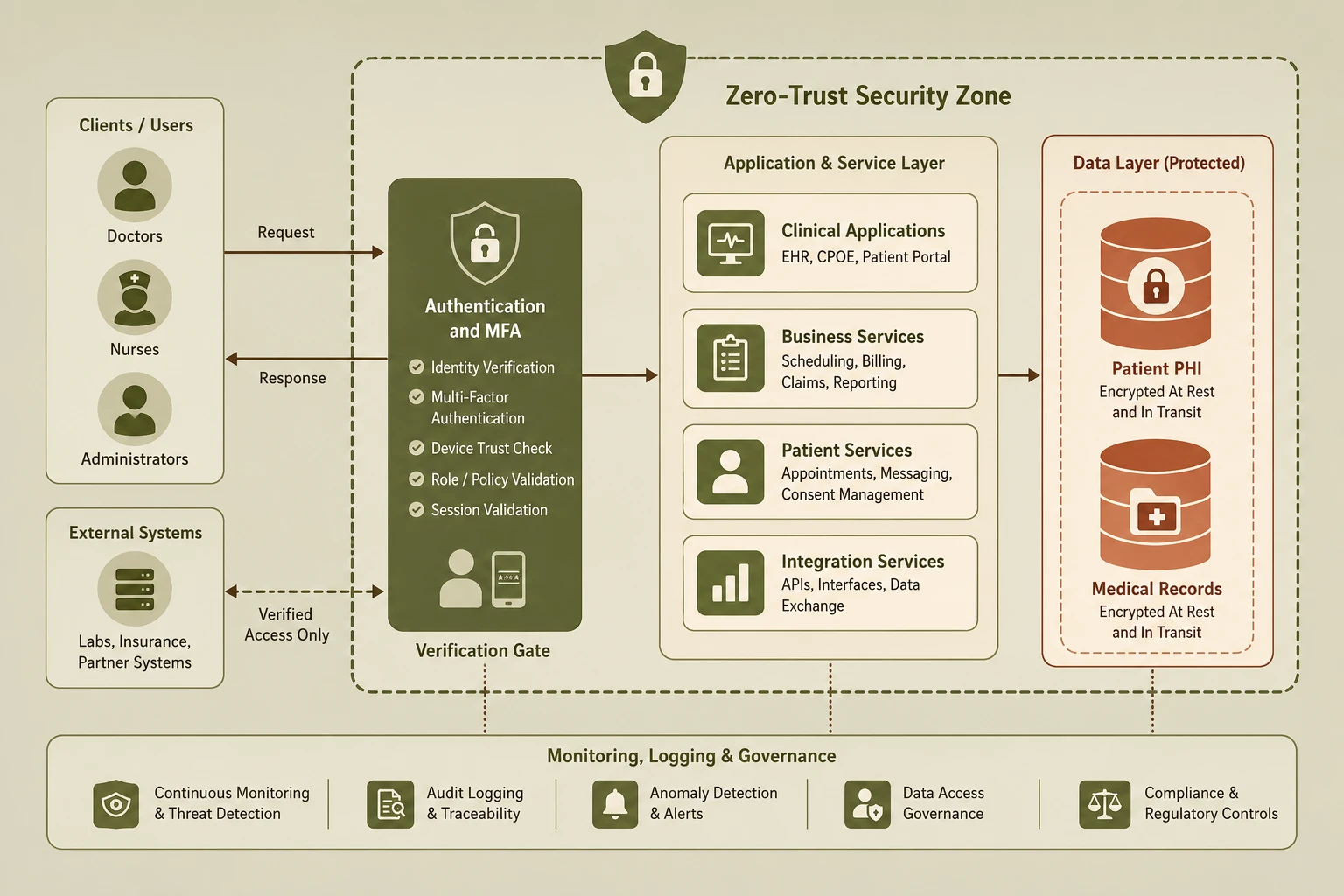
For healthcare CTOs, the critical question isn't *if* to adopt AI, but *how* to do so while ensuring ironclad HIPAA compliance. Safeguarding Protected Health Information (PHI) at every interaction is not merely a regulatory hurdle; it's an architectural imperative. This guide provides a critical governance framework and architectural blueprint for deploying secure and HIPAA-compliant AI agents.
The Imperative: Why HIPAA Compliance Defines Healthcare AI Success
The proliferation of sophisticated Large Language Models (LLMs) and the increasing capability of autonomous AI agents means these systems are no longer theoretical. They are being deployed, often at an accelerated pace, into environments where PHI is ubiquitous. The dynamic nature of AI agents, which actively interpret, synthesize, and generate information, creates new vectors for potential PHI exposure if not meticulously designed and governed.
Failing to establish robust governance for HIPAA-compliant AI agents can lead to catastrophic data breaches, severe financial penalties, irreparable reputational damage, and a complete erosion of patient trust. For CTOs, understanding and mitigating these risks through a privacy-by-design approach is paramount to unlocking AI's full potential in healthcare responsibly.
Navigating the Regulatory Labyrinth: HIPAA, PHI, and AI Agents
HIPAA establishes national standards to protect sensitive patient health information, particularly ePHI (electronic Protected Health Information). It defines:
- ◆Protected Health Information (PHI): Any individually identifiable health information transmitted or maintained by a covered entity or its business associate, in any form or medium.
- ◆Covered Entities: Health plans, healthcare clearinghouses, and healthcare providers who transmit health information electronically.
- ◆Business Associates (BAs): Persons or entities that perform functions or activities on behalf of, or provide services to, a covered entity, involving PHI. This is where many AI agent vendors, including LLM providers and vector database services, often fit in.

How to Build HIPAA-Compliant AI Agents: A Governance Checklist for Healthcare CTOs
When an AI agent processes, stores, or transmits PHI, it (or its underlying service provider) becomes subject to HIPAA's Security Rule and Privacy Rule. The challenge with AI agents lies in their dynamic processing. Unlike static databases, these systems actively interpret, synthesize, and generate information, creating new vectors for potential PHI exposure through context windows, logs, or unsecure integrations. A single prompt injection attack or an unvetted tool call could lead to a devastating breach, making robust governance for HIPAA-Compliant AI Agents absolutely non-negotiable.
Core Architectural Pillars for Secure AI Agent Deployment
Building HIPAA-compliant AI agents requires a "privacy-by-design" architectural approach, baked into every layer of the system rather than being an afterthought.
Data Minimization and De-identification by Default
The less PHI an AI agent handles, the lower the risk. This principle should guide your entire data strategy:
- ◆Aggressive De-identification: Before PHI ever reaches the core LLM or agent memory, it must be de-identified. This involves
pseudonymization(replacing direct identifiers with artificial ones) oranonymization(irreversibly removing identifiers). - ◆Context Window Control: Ensure that raw PHI is never directly injected into the LLM's context window unless absolutely necessary and with explicit, auditable controls.
Retrieval-Augmented Generation (RAG)architectures are ideal here, allowing agents to query de-identified knowledge bases rather than directly processing raw PHI. - ◆Purpose Limitation: Restrict the AI agent's access to PHI only for the specific, approved purpose it was designed for.
Consider this Python example for basic de-identification using a simple redaction strategy (note: production systems require robust NLP models and secure tokenization):
import re

def deidentify_phi(text: str) -> str:
    """Removes common PHI patterns from text."""
    # Example: Redact names (simple pattern, needs robust NLP for production)
    text = re.sub(r'Dr\\. [A-Z][a-z]+', '[REDACTED_DOCTOR]', text)
    text = re.sub(r'Ms\\. [A-Z][a-z]+', '[REDACTED_PATIENT]', text)

    # Example: Redact Social Security Numbers (SSN)
    text = re.sub(r'\\d{3}-\\d{2}-\\d{4}', '[REDACTED_SSN]', text)

    # Example: Redact dates of birth (DD/MM/YYYY or YYYY-MM-DD)
    text = re.sub(r'\\d{2}/\\d{2}/\\d{4}|\\d{4}-\\d{2}-\\d{2}

**How To Build Hipaa-Compliant Ai Agents: A Governance Checklist For Healthcare Ctos** plays a vital role in modern IT and AI-driven digital transformation.