In the blink of an eye, Artificial Intelligence has transformed from academic curiosity into an indispensable enterprise capability. Large Language Models (LLMs) are no longer just research projects; they are the new computational primitives, poised to redefine how businesses operate. However, integrating these powerful models into robust, scalable, and secure enterprise applications is far from trivial. This challenge has given rise to sophisticated orchestration frameworks, designed to manage the complexity of prompt engineering, memory, tool use, and agentic behavior.
For enterprise .NET teams, this evolution presents a critical architectural decision: which framework will serve as the bedrock for their AI initiatives? Two prominent contenders have emerged, each with unique strengths and ecosystems: Microsoft's Semantic Kernel and the widely adopted LangChain.NET. The question isn't just about technical features; it's about developer productivity, operational costs, security posture, and the long-term strategic direction of your AI journey. As we approach 2026, making the right choice now can define the success of your digital transformation.
Why LLM Orchestration is Critical for Enterprise .NET
While direct LLM API calls suffice for simple, one-off tasks, real-world enterprise applications demand far more. Consider a customer support agent needing to retrieve information from a CRM, summarize a complex document, and then draft a personalized email, all while maintaining conversational context and adhering to business rules. This requires a sophisticated orchestration layer that goes beyond mere API invocation.
The business impact of effective LLM orchestration is profound. It enables faster time-to-market for intelligent features, significantly reduces the likelihood of LLM hallucinations through controlled tool use and retrieval-augmented generation (RAG), and ensures consistency and compliance in AI-driven interactions. Without a dedicated orchestration framework, developers face the daunting task of manually managing:
- ◆Prompt Engineering: Dynamically constructing effective and context-aware prompts.
- ◆Context Management: Maintaining conversational history and relevant data across turns.
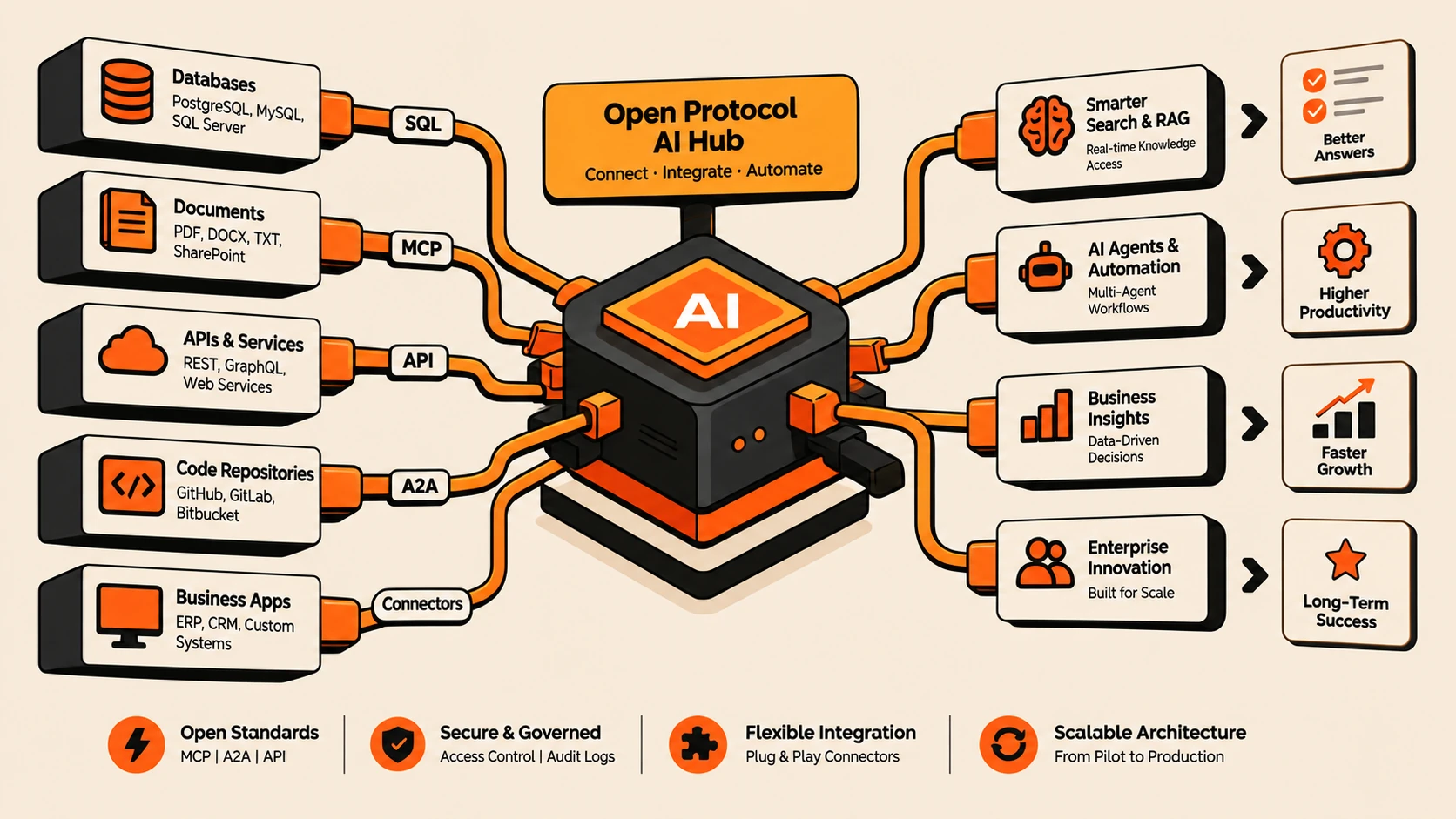
- ◆Tool Use (Function Calling): Enabling LLMs to interact reliably with external systems (APIs, databases, legacy services).
- ◆Memory: Storing and retrieving both short-term conversational history and long-term user preferences or knowledge.
- ◆Chaining/Agents: Sequencing multiple LLM calls and tool uses for complex, multi-step tasks.
- ◆Error Handling & Retries: Ensuring robustness and graceful degradation in unpredictable AI interactions.
These inherent complexities underscore why frameworks like Semantic Kernel and LangChain are not just helpful, but essential for building enterprise-grade AI solutions that deliver tangible business value.
Semantic Kernel: Microsoft's .NET-First AI Orchestrator
Imagine your LLM applications leveraging the full power and familiarity of the .NET ecosystem, seamlessly integrating with existing enterprise services. Semantic Kernel (SK) is Microsoft's open-source SDK that allows developers to integrate LLMs with conventional programming languages like C#, Python, and Java. Its design philosophy is deeply rooted in the concept of combining AI capabilities with existing code and services, making it a natural fit for enterprises already invested in Microsoft technologies and Azure.
Architecture Overview
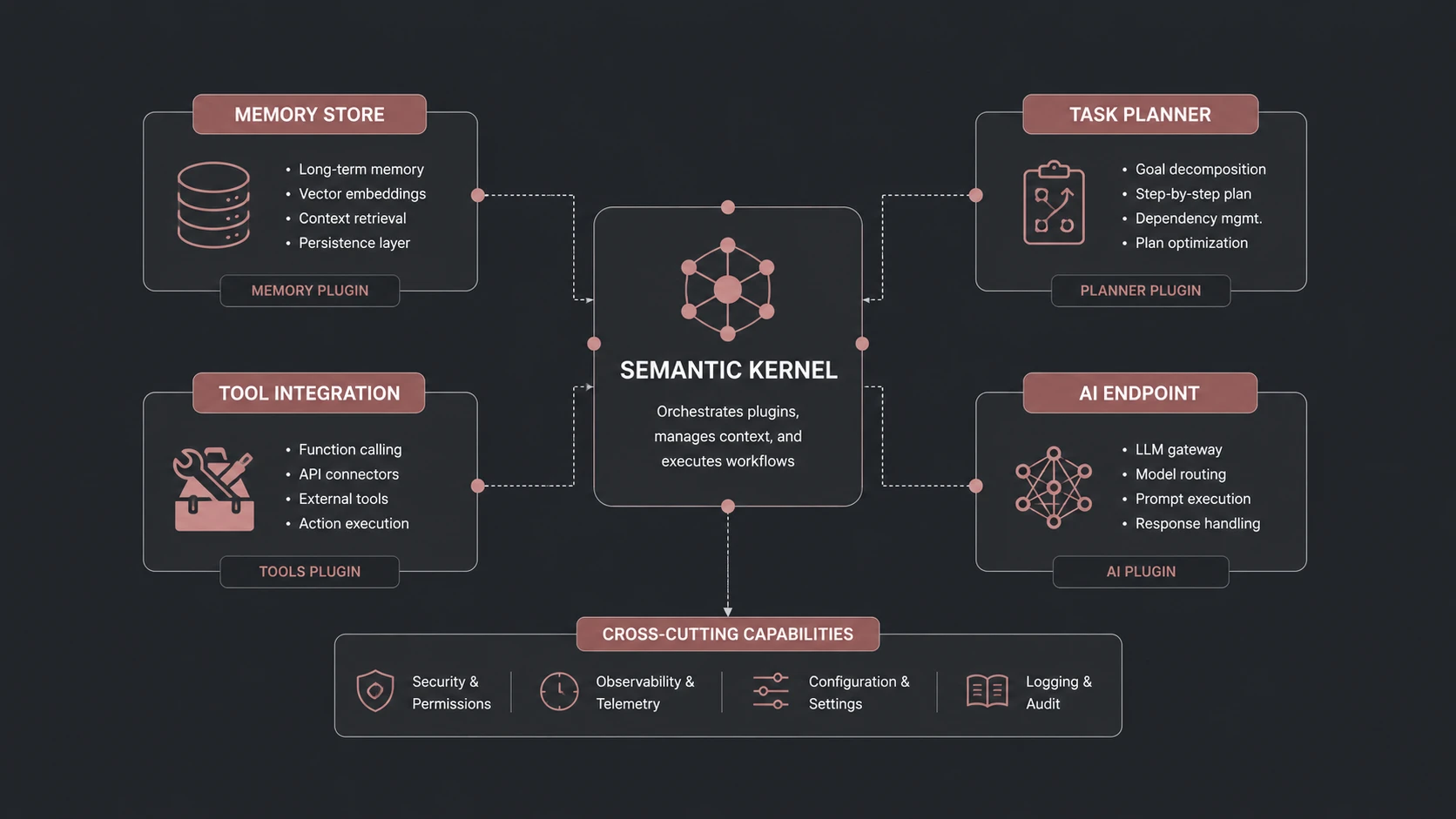
Semantic Kernel's architecture is built around a few core, highly cohesive concepts:
- ◆Kernel: The central orchestrator. It manages AI services, plugins, and the execution flow of AI operations. Think of it as the brain coordinating all AI tasks.
- ◆Plugins (formerly Skills): These are the fundamental building blocks of AI capabilities within SK. Plugins are collections of native C# functions or semantic functions (pre-defined prompts) that the AI can call. They allow LLMs to interact with external systems, perform specific computations, or access proprietary business logic.
- ◆Connectors: These components facilitate integration with various AI services, including Azure OpenAI, OpenAI, and Hugging Face models, abstracting away the underlying API complexities.
- ◆Planners: A crucial differentiator, planners are AI components that can reason about a user's goal and automatically create a sequence of plugins (a "plan") to achieve that goal. This enables sophisticated, multi-step AI agents.
- ◆Memory: Provides both short-term (volatile) and long-term (persistent, often via vector databases) memory to the AI, allowing it to recall past interactions and contextual information.
This plugin-first, planner-driven approach enables developers to expose existing business logic and APIs as AI-callable tools, fostering a powerful synergy between traditional software engineering and generative AI within a familiar .NET paradigm.
.NET-Native Integration and Strengths

Semantic Kernel vs LangChain: Which Framework Wins for Enterprise .NET Teams in 2026?
Semantic Kernel's primary strength for .NET teams lies in its native C# implementation. This means developers can utilize familiar patterns, strong typing, and the extensive tooling of Visual Studio. Integration with Azure OpenAI Service is seamless, offering enterprise-grade security, compliance, and scalability directly within the Azure cloud platform. SK's design promotes maintainability, testability, and performance, which are paramount for production-grade systems in regulated industries.
Consider a simple plugin that retrieves stock information. The C# code showcases how easily a regular class method can be exposed as an AI-callable KernelFunction, complete with Description attributes for the LLM to understand its purpose and parameters:
using Microsoft.SemanticKernel;
using Microsoft.SemanticKernel.Connectors.OpenAI;
using System.ComponentModel;

public class StockPlugin
{
    [KernelFunction, Description("Gets the current stock price for a given ticker symbol.")]
    public async Task<string> GetStockPrice([Description("The stock ticker symbol (e.g., MSFT).")] string ticker)
    {
        // In a real application, this would call a financial API.
        // For demonstration, we return a mock price.
        if (ticker.ToUpperInvariant() == "MSFT")
        {
            return "Microsoft stock price is $420.69.";
        }
        else if (ticker.ToUpperInvariant() == "GOOG")
        {
            return "Google stock price is $175.30.";
        }
        return $"Could not find stock price for {ticker}.";
    }

    [KernelFunction, Description("Analyzes the sentiment of a stock.")]
    public async Task<string> AnalyzeStockSentiment([Description("The stock ticker symbol.")] string ticker)
    {
        // Simulate sentiment analysis
        return $"Sentiment for {ticker} is generally positive based on recent news.";
    }
}

// Usage example:
public static async Task RunSemanticKernelExample()
{
    var builder = Kernel.CreateBuilder();
    // Ensure OPENAI_API_KEY environment variable is set
    builder.AddOpenAIChatCompletion("gpt-4", Environment.GetEnvironmentVariable("OPENAI_API_KEY")!);
    // Or builder.AddAzureOpenAIChatCompletion for Azure deployment
    Kernel kernel = builder.Build();

    kernel.Plugins.AddFromType<StockPlugin>();

    var prompt = "What is the stock price of MSFT and what is its sentiment?";
    var result = await kernel.InvokePromptAsync(prompt);
    Console.WriteLine(result);

    // Example of direct plugin invocation
    var price = await kernel.InvokeAsync("StockPlugin", "GetStockPrice", new() );
    Console.WriteLine(price);
}
This tight integration with .NET types and attributes is a significant advantage for developer productivity and code clarity within a C# codebase.
LangChain.NET: Bridging the Python AI Ecosystem to C#
What if your enterprise needs access to the vast, rapidly evolving open-source AI ecosystem, but your primary development stack is .NET? LangChain, originally a Python framework, exploded in popularity due to its modular design and extensive integrations with a multitude of LLMs, data sources, and tools. LangChain.NET is a community-driven port that brings much of this power and conceptual framework to C# developers, allowing them to leverage the LangChain paradigm without leaving the .NET environment.
Architecture Overview
LangChain's architecture, whether in Python or .NET, revolves around several key abstractions designed for composability:
- ◆LLMs: Standardized interfaces for interacting with various language models (OpenAI, Hugging Face, Anthropic, etc.), providing a consistent API.
- ◆Prompt Templates: Tools to manage dynamic prompt construction, making it easier to inject variables and structure prompts effectively.
- ◆Chains: Sequences of calls to LLMs or other utilities. These are the workhorses for multi-step tasks, linking components together in a defined flow.
- ◆Agents: LLMs that use tools to decide what actions to take. Agents can dynamically chain calls based on observations, enabling more complex, adaptive workflows.
- ◆Retrievers: Components for fetching relevant documents or data from a knowledge base, most commonly used in Retrieval-Augmented Generation (RAG) patterns to ground LLMs with specific information.
- ◆Memory: Stores and manages conversational state, allowing agents and chains to remember past interactions.
- ◆Tools: Functions that agents can call to interact with the outside world, similar in concept to Semantic Kernel's plugins.
LangChain's strength lies in its modularity and the ability to compose these components into complex, flexible workflows. The LangChain.NET project aims to mirror this flexibility within the .NET ecosystem, providing C# bindings for these powerful abstractions.
Community-Driven Versatility and Strengths
LangChain.NET benefits immensely from the innovation and community contributions of its Python counterpart. This means a wider array of integrations (e.g., with various vector databases, obscure LLMs, or specialized tools) often becomes available faster than in more tightly controlled ecosystems. For teams with diverse AI requirements, those needing to bridge between Python and .NET services, or those prioritizing access to the bleeding edge of open-source AI, LangChain.NET offers a compelling solution. Its model-agnostic approach provides significant flexibility in choosing and switching between different LLM providers.
Here’s a basic example of constructing an LLM chain in LangChain.NET:
using LangChain.Chains.LLM;
using LangChain.Providers.OpenAI;
using LangChain.Providers.OpenAI.ChatModels;
using LangChain.Schema;

public static async Task RunLangChainDotNetExample()
{
    // Initialize the chat model (e.g., OpenAI's GPT-4)
    var model = new OpenAIChatModel(new OpenAIConfiguration
    {
        ApiKey = Environment.GetEnvironmentVariable("OPENAI_API_KEY")! // Ensure API key is set
    });

    // Create a simple LLM chain with a prompt template
    var promptTemplate = new PromptTemplate(
        "You are a helpful assistant. Answer the following question: {question}"
    );

    var chain = new LlmChain(new LlmChainInput(model, promptTemplate));

    // Invoke the chain with a specific question
    var result = await chain.CallAsync(new ChainValues(new Dictionary<string, object>
    {
        { "question", "What is the capital of France?" }
    }));

    Console.WriteLine($"Result: {result["text"]}");

    // Conceptual example: Agent with tools (requires more extensive setup)
    // LangChain.NET agents would involve defining 'Tools' (e.g., a calculator, a search engine),
    // creating an 'AgentExecutor' (which uses an LLM to decide which tool to use),
    // and then running the agent with an input that requires tool interaction.
    // This showcases LangChain's modularity in composing complex behaviors.
}

**Semantic Kernel Vs Langchain: Which Framework Wins For Enterprise .Net Teams In 2026?** plays a vital role in modern IT and AI-driven digital transformation.