Introduction
Healthcare organizations are increasingly evaluating AI systems that can do more than generate text. AI agents can retrieve information from approved systems, coordinate administrative workflows, summarize clinical documentation, identify missing information, and invoke application functions through defined tools. These capabilities introduce a significant architectural question: how can an organization allow AI agents to interact with sensitive healthcare information while maintaining appropriate privacy, security, and accountability controls?
The Health Insurance Portability and Accountability Act of 1996 (HIPAA) establishes requirements governing protected health information (PHI), including the Security Rule for electronic protected health information (ePHI), the Privacy Rule, and the Breach Notification Rule. Covered entities and business associates must implement safeguards appropriate to their regulatory responsibilities and operating environments. The Security Rule emphasizes the confidentiality, integrity, and availability of ePHI. <Cite refs={[ "turn368055search0", "turn368055search1" ]}/>
A HIPAA-aligned AI agent architecture is a governed system in which every interaction with protected health information is controlled through documented policies, authenticated identities, authorized operations, risk management, and auditable execution. Using an AI model that advertises enterprise security features is not, by itself, sufficient to establish compliance.
The governance challenge is particularly important for agentic systems because an agent may perform multiple operations in a single workflow. It can retrieve a patient record, interpret a document, select another tool, and initiate a downstream request. Every additional operation creates another opportunity for unauthorized disclosure, excessive access, incorrect execution, or insufficient auditability.
This article presents a practical enterprise architecture for healthcare AI agents, covering system boundaries, identity, data protection, tool governance, clinical oversight, monitoring, deployment, and a phased adoption strategy.
Industry Background
Healthcare information systems contain highly sensitive information distributed across electronic health record (EHR) platforms, laboratory systems, pharmacy applications, revenue-cycle platforms, patient portals, and health information exchanges. These systems frequently use different APIs, authorization models, data formats, and operational controls.
AI agents add an orchestration layer that can interpret a request and coordinate operations across several systems. For example, an administrative agent might retrieve an appointment, check an approved scheduling service, and prepare a patient communication. A clinical support agent might assemble relevant laboratory results and summarize documented information for review by a clinician.
These workflows can reduce repetitive information gathering, but they also create risks that traditional point-to-point integrations may not encounter in the same form. Model-generated tool arguments can be incorrect, retrieved documents may contain malicious instructions, and a sequence of individually permitted operations may collectively expose more information than the task requires.
HIPAA does not establish a general certification that makes an AI agent compliant merely because it uses a particular architecture or technology. Compliance depends on the regulated organization's activities, applicable obligations, safeguards, contracts, policies, and actual system behavior. Healthcare organizations must assess the entire environment in which ePHI is created, received, maintained, or transmitted. <Cite refs={[ "turn368055search1", "turn368055search8" ]}/>
The Business Problem
Healthcare AI governance must address several connected risks.
Excessive data access: An agent with broad EHR permissions may retrieve records unrelated to the user's request. Even when the information remains inside an organization's network, inappropriate access can violate internal policy and applicable privacy requirements.
Uncontrolled tool execution: A model may select a write-capable function when a read-only operation would have been sufficient. Without independent authorization checks, an erroneous tool selection can alter patient records, schedule appointments, or trigger financial transactions.
Unclear responsibility: Healthcare organizations need to establish which party controls the application, model service, cloud infrastructure, integration layer, and downstream processing. Responsibilities may be distributed across covered entities, business associates, and subcontractors.
Incomplete audit trails: A conventional application log may show that an API request occurred without recording the initiating user, purpose, policy decision, approval, or relationship between the request and subsequent agent actions.
Untrusted clinical content: Clinical notes, uploaded documents, messages, and retrieved web content may contain inaccurate information or instructions designed to manipulate an agent. Retrieved content must not be treated as a trusted source of authorization.
Clinical safety and accountability: A plausible AI-generated explanation is not necessarily medically accurate. Clinical decisions require appropriate professional judgment, and organizations must define the permitted role of the AI system.
The architectural objective is to control these risks without preventing useful automation. That requires separating model reasoning from identity verification, data access, business authorization, and transaction execution.
Understanding HIPAA Responsibilities
Before selecting a model or designing a deployment, the organization should determine which HIPAA roles apply to each participant and service.
A covered entity may be a health plan, healthcare clearinghouse, or healthcare provider conducting covered electronic transactions. A business associate may perform certain functions or services involving PHI on behalf of a covered entity or another business associate. The specific relationship depends on the activities performed and applicable regulatory definitions. <Cite refs={[ "turn368055search1", "turn368055search12" ]}/>
The following distinctions are important for architecture decisions:
| Requirement area | Architectural implication |
|---|---|
| Privacy Rule | Define permitted uses and disclosures, access purposes, and applicable limitations on PHI use. |
| Security Rule | Implement appropriate administrative, physical, and technical safeguards for ePHI. |
| Breach Notification Rule | Maintain processes for assessing incidents and fulfilling applicable notification obligations. |
| Business associate arrangements | Determine whether service providers and subcontractors require appropriate agreements and safeguards. |
| Organizational policies | Document acceptable use, access approvals, retention, incident response, and clinical oversight. |
A business associate agreement (BAA) is particularly important when a service provider creates, receives, maintains, or transmits PHI on behalf of a regulated organization in circumstances covered by HIPAA. Organizations should assess the actual service arrangement rather than assume that every software supplier has the same regulatory role. Cloud services that maintain ePHI may require a BAA even when the provider cannot view the encrypted data. <Cite refs={[ "turn368055search8", "turn368055search11" ]}/>
A BAA does not replace a risk analysis, technical safeguards, workforce training, or ongoing oversight. Likewise, a vendor's statement that its platform supports HIPAA-regulated workloads does not establish that a particular application deployment is compliant.
Core Governance Architecture
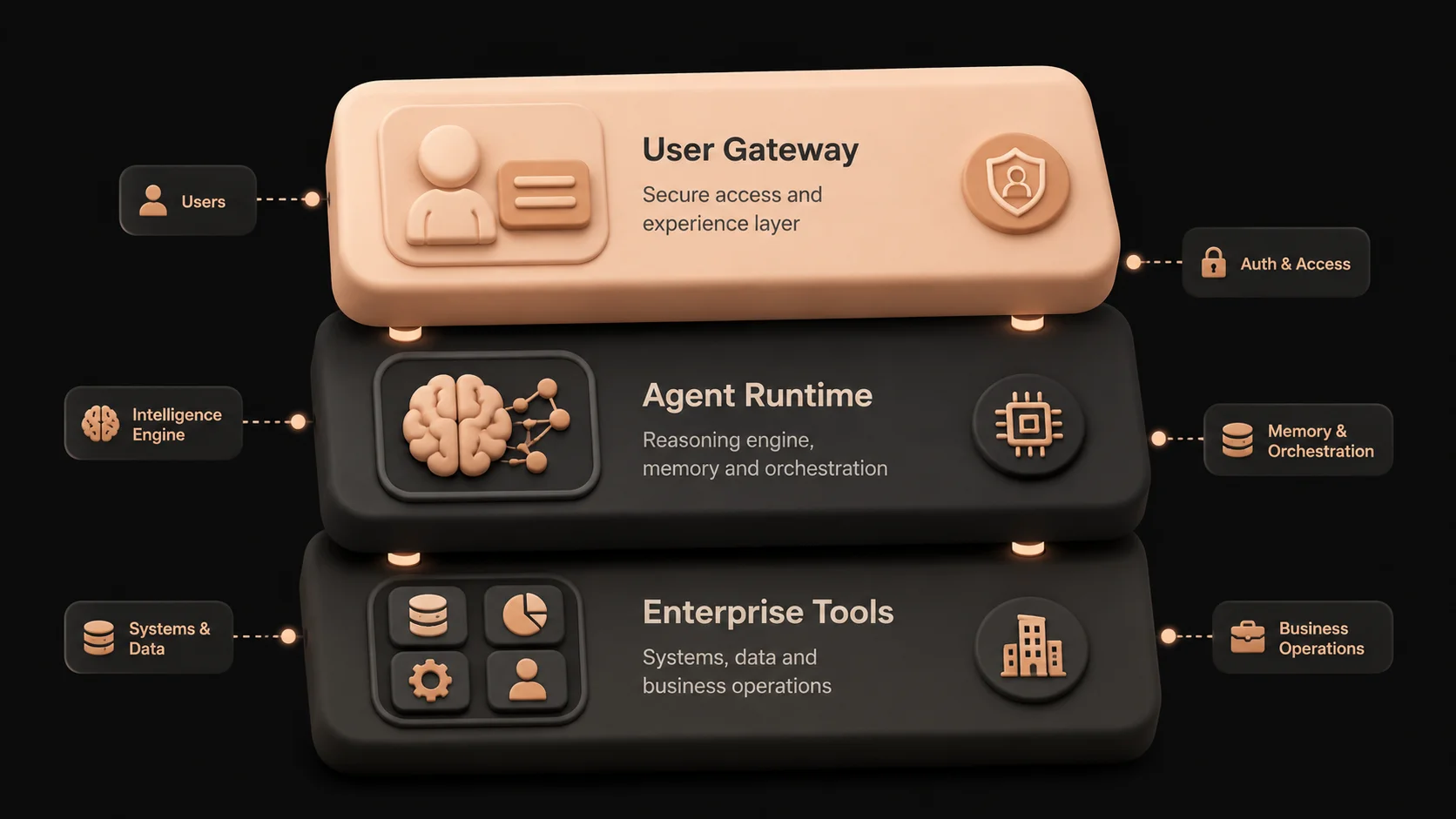
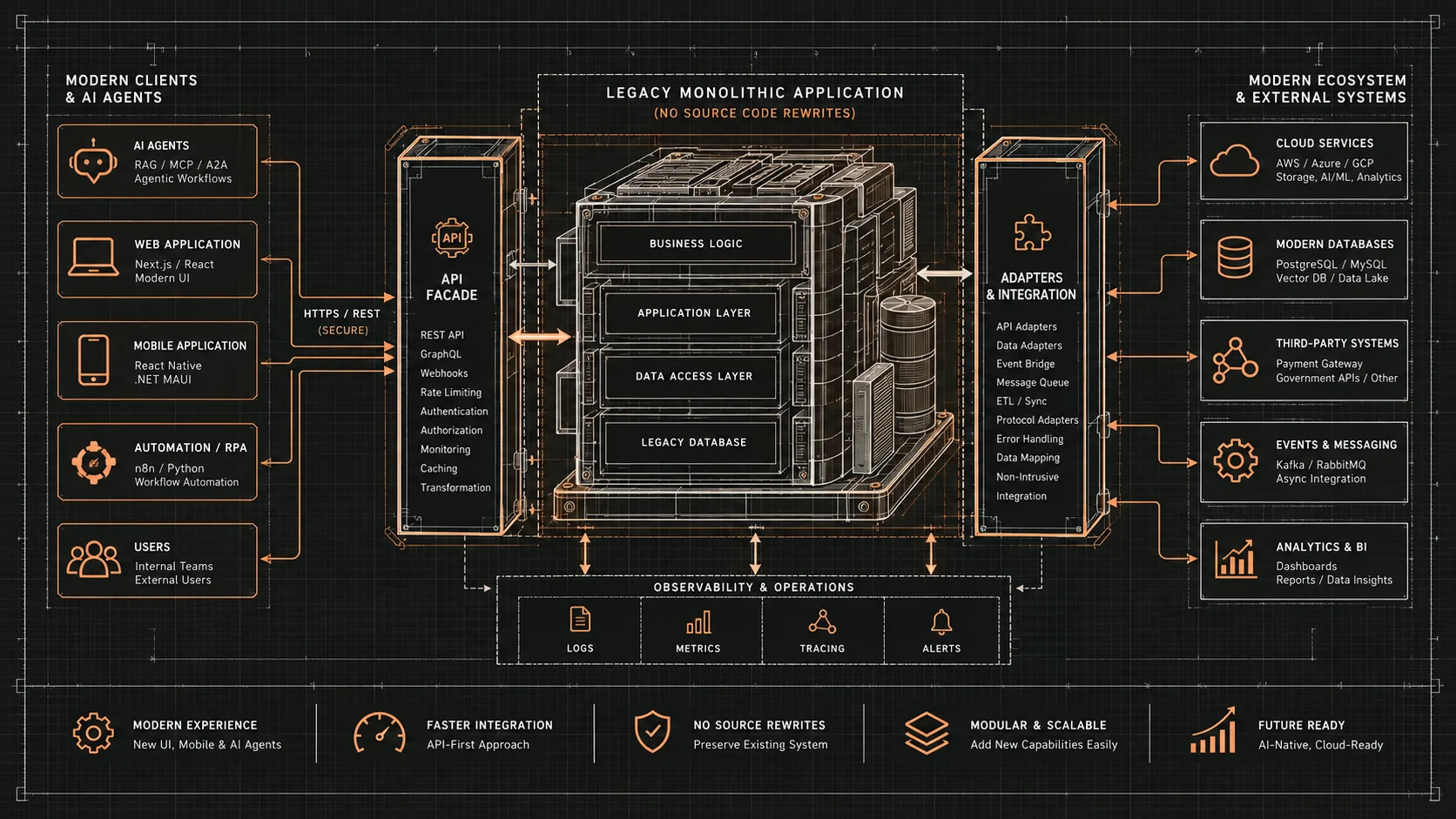
A defensible architecture separates the user-facing application, agent orchestration, policy enforcement, healthcare data services, and audit infrastructure. These components may be deployed in different combinations, but their responsibilities should remain explicit.
1. User and Identity Layer
The identity layer authenticates the person or service initiating a workflow. It establishes the user's role, organizational affiliation, and permitted access context before the agent receives a request.
Enterprise identity providers can support single sign-on, multifactor authentication, and role or attribute claims. The application should associate each workflow with a verified initiating identity and propagate the appropriate authorization context to downstream services.
A shared agent service identity should not automatically inherit the broadest permissions available to the application. Delegated access, where supported, should preserve the user's relevant privileges and restrictions. If a workflow uses a service identity, the service must enforce a narrow, documented permission scope and appropriate purpose restrictions.
2. Agent Orchestration Layer
The orchestration layer interprets the task, manages model interaction, selects approved tools, and tracks workflow state. It may use a framework such as Microsoft Semantic Kernel or another orchestration platform.
The orchestration layer must not serve as the sole security boundary. Model-generated decisions are probabilistic, and instructions supplied through prompts or retrieved content can be manipulated. The agent can propose a tool call, but a separate policy enforcement component must determine whether that call is permitted.
3. Policy Enforcement Layer
The policy layer validates each operation before execution. It evaluates the authenticated identity, requested action, resource, applicable permissions, purpose, sensitivity, and any required approval.
For example, an agent may be permitted to retrieve a patient's next appointment when acting on an authorized scheduling request but denied access to unrelated behavioral health notes. A policy engine can evaluate such constraints independently of the language model.
Policy decisions should be enforced at the API or service boundary, not only through instructions embedded in the agent prompt.
4. Healthcare Data Integration Layer
This layer provides controlled access to EHR systems, FHIR APIs, laboratory services, scheduling platforms, and other approved healthcare applications.
FHIR resources can provide structured representations of healthcare information, but FHIR does not automatically establish HIPAA compliance or guarantee correct authorization. The integration layer must enforce the applicable access controls, validate resource references, minimize returned data, and preserve the source system's authoritative status.
Where possible, the agent should receive a purpose-specific response rather than an unrestricted patient record. A scheduling workflow may need appointment availability and contact preferences without needing an entire clinical history.
5. Audit and Monitoring Layer
The audit layer records the sequence of significant operations across the identity provider, agent runtime, policy engine, integration APIs, and underlying systems.
A useful audit event identifies the initiating principal, workflow, tool, target resource where appropriate, policy outcome, approval reference, execution status, timestamp, and correlation identifier. Audit records should be protected against unauthorized modification and access.
This design enables investigators to distinguish a user request, a model-proposed action, an approved operation, and the actual downstream transaction.
Reference Architecture
A typical controlled workflow follows this path:
- 1.An authenticated workforce member submits a task through an approved application.
- 2.The application validates the user's identity and establishes the permitted workflow context.
- 3.The agent runtime receives only the information necessary to begin the task.
- 4.The model proposes an approved tool call using a defined input schema.
- 5.The policy enforcement layer evaluates identity, permissions, purpose, resource scope, and approval requirements.
- 6.The healthcare integration service retrieves or updates the permitted resource.
- 7.The integration service validates the response and removes unnecessary fields before returning data to the agent.
- 8.The runtime generates a result or requests additional authorized information.
- 9.The application records the outcome and presents the result to the user, with human review where required.
For a high-impact operation, the workflow includes an approval checkpoint before the write-capable tool executes. The approval must refer to the specific operation and its material parameters. A general approval to use an agent should not be treated as authorization for every action the agent might later propose.
The architecture should also include a reliable mechanism for stopping execution when authorization fails, required data is missing, the downstream service becomes unavailable, or the task exceeds its configured limits.
Protecting PHI Across the AI Lifecycle
PHI protection must cover more than the primary EHR database. Healthcare information can enter the system through prompts, retrieved documents, model inputs, generated outputs, tool arguments, application caches, tracing systems, backups, and support diagnostics.
Data Minimization
The agent should receive the minimum information reasonably necessary for its authorized purpose, consistent with applicable HIPAA requirements and exceptions. A system that summarizes medication history should not automatically retrieve unrelated billing records or complete patient histories.
Data minimization should be implemented in the integration service before the response reaches the model. Asking the model to ignore unnecessary information after receiving it does not prevent the initial disclosure.
Encryption and Key Management
Use appropriate encryption in transit and at rest, with managed key access, defined rotation procedures, and restricted administrative privileges. Encryption is one component of a broader safeguard strategy, not a replacement for authorization, monitoring, or risk management.
Prompt and Output Controls
Prompts and model outputs should be handled according to their data classification. Avoid placing unnecessary direct identifiers in model context, and validate generated outputs before they are stored in clinical or administrative systems.
Where feasible, keep long-term conversation state free of unnecessary PHI. If session state must contain sensitive information, define its access controls, retention, deletion, and audit requirements explicitly.
Logging and Telemetry
Application monitoring should avoid indiscriminately recording full prompts, complete clinical records, access tokens, or model responses containing patient information. Prefer structured events that capture workflow identifiers, resource categories, policy decisions, status codes, and latency.
When detailed content is needed to investigate an incident, use a controlled mechanism with appropriate permissions and retention rules. Logging systems and observability vendors must be included in the organization's data-flow and service-provider assessment.
Retention and Deletion
Define how long prompts, generated outputs, workflow state, audit records, and backups are retained. Deletion must account for the actual storage architecture, including replicas, cached data, and recovery systems, subject to applicable retention obligations.
Agent Tool Governance
An AI agent's tool catalog is part of the application's security surface. Every registered function should have an owner, a defined purpose, a documented permission model, and a clear failure contract.
| Tool category | Example | Recommended governance |
|---|---|---|
| Read-only clinical | Retrieve an authorized laboratory result | Verify identity, patient scope, purpose, and minimum necessary access. |
| Administrative read | Retrieve appointment details | Restrict access to relevant scheduling information. |
| Reversible administrative write | Request an appointment change | Validate inputs and confirm relevant details before execution. |
| Clinical record write | Draft or update a clinical note | Use approved workflows, preserve attribution, and require review where appropriate. |
| High-impact transaction | Submit a prescription or initiate a financial adjustment | Apply specialized authorization, safeguards, and explicit approval where required. |
| Destructive operation | Delete or irreversibly alter protected records | Restrict strongly and apply documented retention, authorization, and review requirements. |
The categories above are governance recommendations, not universal legal classifications. The required control depends on the operation, the application, the clinical context, and the organization's policies.
Each function should validate its own inputs and enforce authorization independently. Function descriptions can help the model select an appropriate operation, but they cannot prevent a malicious or incorrect call.
Avoid general-purpose tools such as arbitrary SQL execution, unrestricted filesystem access, unrestricted URL retrieval, or a generic function that accepts arbitrary service names. Narrow operations are easier to test, authorize, monitor, and explain.
Security Threats and Mitigations

HIPAA-compliant governance architecture showing PHI de-identification, zero-retention runtime, and tamper-evident audit logging.
Prompt Injection
A retrieved clinical document or external message may contain instructions intended to override the agent's normal behavior. Treat document contents as untrusted data. Separate instructions from retrieved evidence, constrain tool access, validate every operation, and test with adversarial content.
Cross-Patient Data Exposure
An incorrect patient identifier or improperly scoped retrieval can expose information from another patient's record. Resolve patient identity through trusted application context, validate resource ownership, and enforce patient-level authorization in the healthcare integration service.
Excessive Agency
An agent may chain permitted operations in an unexpected way. Apply workflow-level limits, tool allowlists, bounded iterations, transaction constraints, and approval gates for consequential actions.
Credential Abuse
An exposed service token may allow access beyond the original user's permissions. Use short-lived credentials where practical, narrow scopes, secret-management controls, and monitoring for anomalous activity.
Data Leakage Through External Services
A model provider, logging platform, analytics tool, or support service may receive PHI as part of the workflow. Map every destination, evaluate its role and contractual requirements, and prevent unapproved transfers through network and application controls.
Unauthorized Changes
Model-generated updates can contain incorrect values or unintended modifications. Validate data against trusted rules, preserve the identity of the actual author or approver, and maintain appropriate change history and recovery procedures.
No single control eliminates these risks. The architecture should use multiple independent safeguards so that a model error does not automatically become a security incident or an unsafe clinical action.
Clinical Oversight and Human Approval
Healthcare AI governance must distinguish administrative assistance from clinical decision-making. Summarizing a documented appointment history is different from recommending treatment, modifying a medication order, or independently making a diagnostic decision.
Organizations should classify workflows according to clinical impact, reversibility, uncertainty, and potential harm. Low-impact administrative tasks may be eligible for more automation after validation. Higher-impact tasks should use appropriate clinician oversight, explicit authorization, and defined escalation procedures.
Human approval must be meaningful. Reviewers need sufficient context to understand the proposed action, inspect relevant source information, and reject or modify the result. A confirmation screen that hides material parameters or encourages automatic approval provides limited protection.
The system should preserve provenance by distinguishing source clinical data, model-generated summaries, proposed actions, and verified actions. AI-generated content must not be silently represented as a clinician-authored finding.
For clinical workflows, validation should include domain experts and representative scenarios. Test cases should cover incomplete records, conflicting information, unusual presentations, ambiguous instructions, and situations in which the correct response is to stop and escalate.
Compliance Monitoring and Auditability
Governance requires evidence that safeguards operate as intended. Healthcare organizations should maintain a documented risk analysis and risk management process, review access and security events, and update safeguards as systems and threats change. The HHS Security Rule guidance describes risk analysis, access control, audit controls, authentication, and transmission security as important elements of ePHI protection. <Cite refs={[ "turn368055search1", "turn368055search9" ]}/>
A mature AI audit framework should capture:
- ◆Initiating user or service identity.
- ◆Workflow and correlation identifiers.
- ◆Tool selected and requested operation.
- ◆Resource scope and relevant authorization outcome.
- ◆Approval requirement and approval evidence, where applicable.
- ◆Downstream system response and transaction status.
- ◆Policy denials, retries, timeouts, and exceptions.
- ◆Model and application configuration identifiers needed for investigation.
- ◆Incident classification and remediation references when relevant.
Audit design should not require copying complete PHI into every event. Use resource references and controlled access to sensitive details where appropriate. Protect audit records from tampering and restrict who can search or export them.
Operational dashboards should track unauthorized tool attempts, access denials, unusual retrieval volumes, policy overrides, repeated patient-identity failures, and unexpected outbound data transfers. Alerts should be tied to a documented response process rather than treated as a substitute for incident management.
The organization should also establish how suspected security incidents are investigated, escalated, documented, and evaluated under applicable breach notification requirements. Business associate contracts may impose additional incident reporting expectations, which should be reflected in operational procedures. <Cite refs={[ "turn368055search8", "turn368055search12" ]}/>
Performance, Reliability, and Scalability
Healthcare workflows must balance responsiveness with safety and availability. Agentic execution can introduce multiple model calls and service requests into a single task, making end-to-end latency less predictable than a conventional API request.
Measure the latency of model inference, policy evaluation, healthcare API calls, approval waits, and workflow persistence separately. Establish bounded deadlines and maximum tool-call counts so that an agent cannot continue indefinitely or overload a legacy EHR integration.
Use asynchronous processing for suitable network operations, but do not assume that every clinical task should run as a background job. User-facing operations need clear timeouts and status information; long-running administrative workflows may require durable state and resumable execution.
Reliability controls should include:
- ◆Circuit breakers and concurrency limits for downstream systems.
- ◆Bounded retries and exponential backoff where appropriate.
- ◆Idempotency or deduplication for retryable write operations.
- ◆Durable workflow state for operations that must survive restarts.
- ◆Dependency health checks and clear degradation behavior.
- ◆Recovery procedures for partial failures across multiple systems.
- ◆Capacity tests that reproduce realistic agent-generated request patterns.
Read-only operations may tolerate retries more readily than operations that change clinical or financial records. For non-idempotent actions, the system must determine whether the original transaction succeeded before deciding to retry.
Scale the agent runtime independently from data integration services when their resource requirements differ. Increasing agent concurrency without controlling EHR access can degrade the availability of systems used directly by clinicians. Performance engineering must protect the underlying healthcare service, not only optimize the AI response time.
Vendor and Cloud Governance
The selection of an AI model or cloud service should be treated as a security and compliance decision rather than a model-quality comparison alone.
Evaluate whether the proposed service can support the organization's required contractual arrangements, access controls, data-handling restrictions, retention policies, auditability, incident response, and availability requirements. Confirm the scope of the vendor's commitments for the specific product, region, configuration, and features being used.
Review whether prompts, completions, embeddings, vector indexes, evaluation datasets, and diagnostic traces are retained or used for additional purposes. The data flow may include more components than the primary model endpoint, especially when retrieval-augmented generation, external tools, and third-party observability platforms are involved.
A private deployment can reduce certain exposure pathways but does not automatically satisfy HIPAA obligations. A public-cloud deployment may be appropriate when its configuration, contractual arrangements, risk analysis, and safeguards support the intended use. HHS cloud guidance emphasizes evaluating the relevant configuration, business associate arrangements, and risks to ePHI. <Cite refs={[ "turn368055search8" ]}/>
Organizations should maintain a service inventory and reassess providers when features, data flows, contracts, or system configurations change. Procurement approval should be connected to technical implementation so that developers cannot unknowingly route PHI to an unapproved endpoint.
Implementation Roadmap
Phase 1: Inventory and Risk Assessment
Identify the proposed use cases, data sources, users, vendors, tool permissions, data destinations, and clinical consequences. Map where PHI enters, moves through, and leaves the workflow. Determine the applicable HIPAA roles and contractual responsibilities.
Perform and document the relevant risk analysis before introducing production PHI into the system. Establish baseline security controls, identify high-risk actions, and define measurable acceptance criteria.
Phase 2: Establish the Governance Boundary
Implement identity propagation, a policy enforcement layer, a narrow healthcare API, and structured audit events. Separate read-only tools from write-capable tools. Define approval requirements and establish a controlled process for changing tool permissions.
Test authorization at the service boundary, including cases where a user attempts to access an unauthorized patient record or invoke a tool outside the permitted scope.
Phase 3: Launch a Limited Read-Only Pilot
Start with a bounded administrative or information-retrieval workflow that does not independently modify clinical records. Use synthetic or appropriately de-identified test data during development whenever feasible, and verify the applicable requirements before using production data in testing.
Evaluate accuracy against authoritative source records, access-control effectiveness, data minimization, latency, failure handling, and audit completeness. Include privacy, security, clinical, and operational stakeholders in the review.
Phase 4: Introduce Controlled Write Operations
Add write-capable tools only after the relevant controls have been validated. Use typed contracts, transaction validation, explicit approval, and reliable recording of the initiating user and actual action. Confirm that retries cannot inadvertently duplicate transactions.
For clinical record changes, preserve appropriate attribution and review workflows. For high-impact operations, define the conditions under which the system must refuse execution or escalate to an authorized human.
Phase 5: Operate and Reassess Continuously
Monitor access patterns, security events, model behavior, downstream errors, and changes in service-provider configurations. Review incidents and near misses, update tests, and reassess risks when a new data source, tool, model, or workflow is introduced.
Maintain rollback and shutdown procedures that can disable agent-driven execution without unnecessarily disrupting conventional healthcare operations. Document ownership for incident response, policy changes, vendor review, and ongoing clinical validation.
Common Governance Mistakes
Assuming a BAA guarantees compliance: A BAA addresses contractual responsibilities, but it does not replace the organization's risk analysis, access controls, workforce policies, or operational safeguards.
Treating encryption as complete protection: Encrypted data can still be disclosed through an authorized but excessively privileged application, a compromised credential, or an improperly configured integration.
Trusting the model to enforce privacy: Prompt instructions cannot reliably substitute for authorization checks implemented in application code and service policies.
Logging every prompt and response: Full-content logging may create additional stores of PHI with unnecessary access and retention risks. Auditability should be designed with data minimization in mind.
Giving all agents the same service account: Shared, broad permissions undermine least privilege and make it harder to attribute actions to the correct initiating identity.
Automating clinical actions before validating read-only workflows: High-impact automation should follow evidence from representative testing, clinical review, security assessment, and operational readiness checks.
Treating a successful demonstration as production validation: Production readiness requires repeatable tests, documented risk decisions, failure recovery, monitored behavior, and clear accountability.
Technology and Control Comparison
| Architecture choice | Benefits | Limitations and required safeguards |
|---|---|---|
| Direct model-to-EHR access | Fewer apparent integration components | Difficult to constrain and audit; generally avoid unrestricted direct access. |
| Governed API facade | Narrow contracts and centralized authorization | Requires adapter maintenance and careful policy design. |
| Retrieval-augmented generation | Provides task-specific context from approved sources | Requires source-level access controls, retrieval filtering, and retention safeguards. |
| Agent with read-only tools | Reduces risk from unintended record modifications | Can still expose PHI through excessive retrieval or generated output. |
| Agent with write-capable tools | Supports end-to-end workflow automation | Requires stronger authorization, validation, transaction safeguards, and appropriate approval. |
| Private model deployment | Greater control over some infrastructure and data flows | Does not automatically provide HIPAA compliance or eliminate operational risk. |
| Managed model service | Can reduce infrastructure-management burden | Requires service-specific contract, configuration, data-handling, and risk assessment. |
The preferred design depends on the healthcare use case, data sensitivity, integration environment, and operational requirements. In most cases, a governed API facade with narrowly scoped tools offers a more defensible starting point than unrestricted model access to clinical systems.
Looking Ahead
Healthcare organizations evaluating agentic AI should expect governance requirements to remain an ongoing engineering responsibility as models, orchestration frameworks, and integration patterns evolve. New capabilities can increase the range of tasks an agent can perform, but they do not remove the need for clear authorization boundaries, reliable system behavior, and documented accountability.
The most durable architecture decisions are those that remain useful across model providers: explicit identity, narrow API contracts, data minimization, independently enforced policies, controlled execution, and observable outcomes. These controls allow organizations to evaluate new models without redesigning their entire healthcare data-access architecture each time the orchestration layer changes.
Healthcare teams should also monitor applicable regulatory developments and confirm the requirements in force for their deployment date. Technical planning should distinguish binding regulations from proposed rules, agency guidance, industry practices, and internal policy decisions.
Conclusion
HIPAA-aligned AI agents require more than a secure model endpoint. They require an end-to-end governance architecture that controls how identities, models, tools, data sources, and human decisions interact.
A practical enterprise design places a policy enforcement layer between agent reasoning and healthcare operations. It minimizes the PHI available to each workflow, verifies authorization at the service boundary, protects data throughout its lifecycle, records meaningful audit events, and applies stronger approval controls to high-impact operations.
Healthcare organizations should begin with clearly scoped, read-only use cases, validate the architecture against documented risks, and expand gradually as operational evidence supports additional automation. By treating governance as a core system capability rather than a final compliance checklist, engineering teams can develop AI-assisted healthcare workflows that are more secure, accountable, and maintainable.