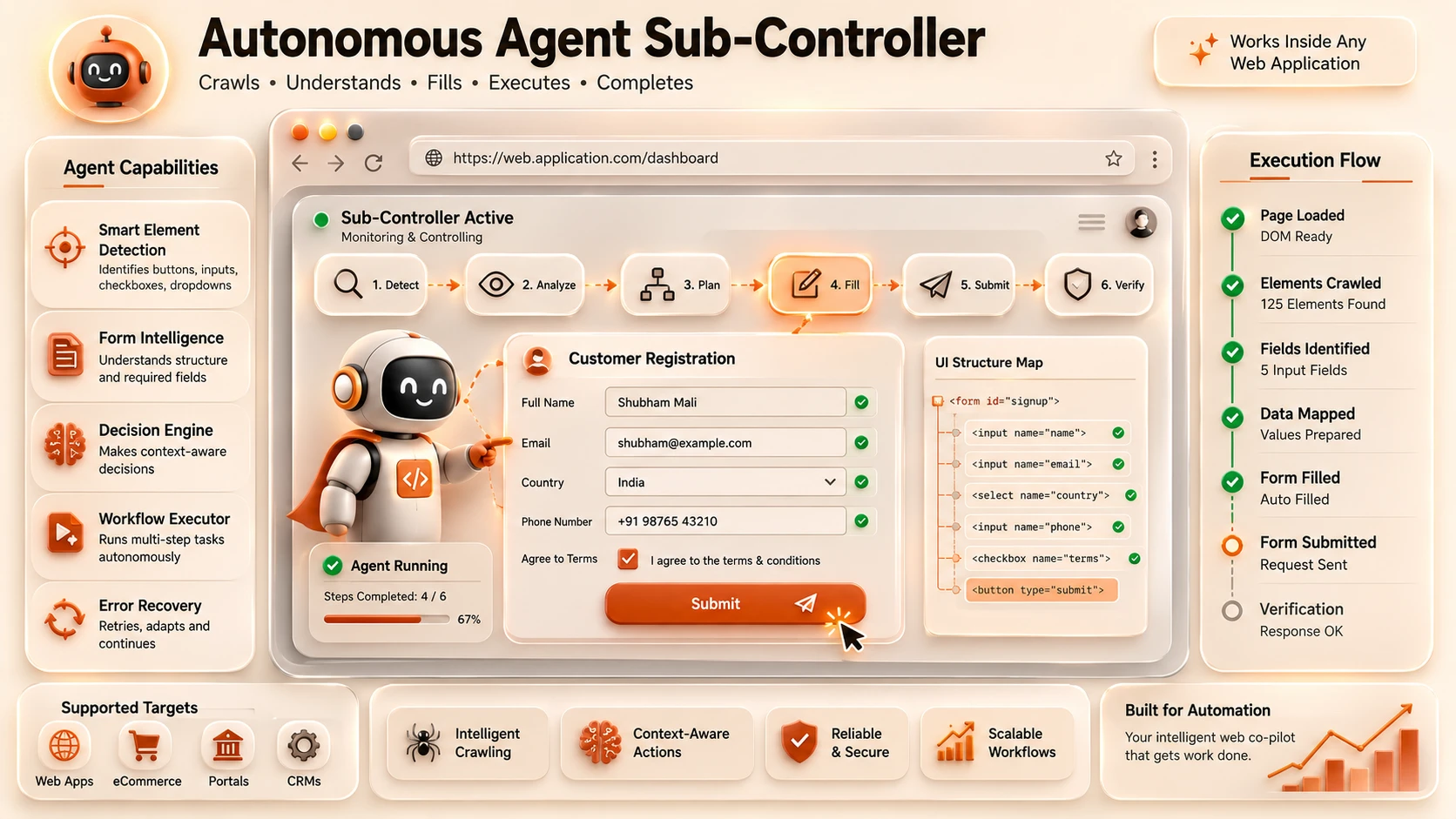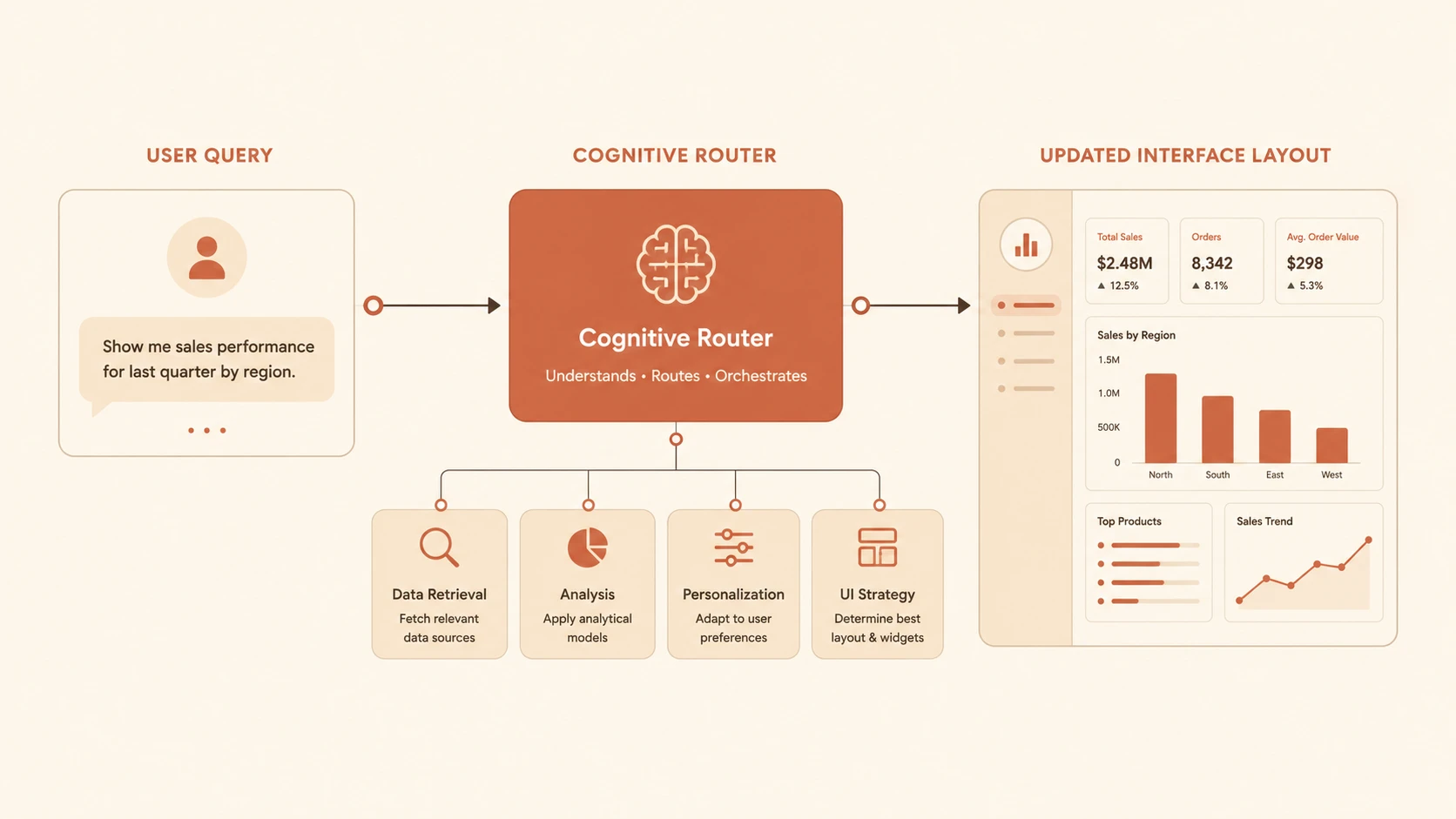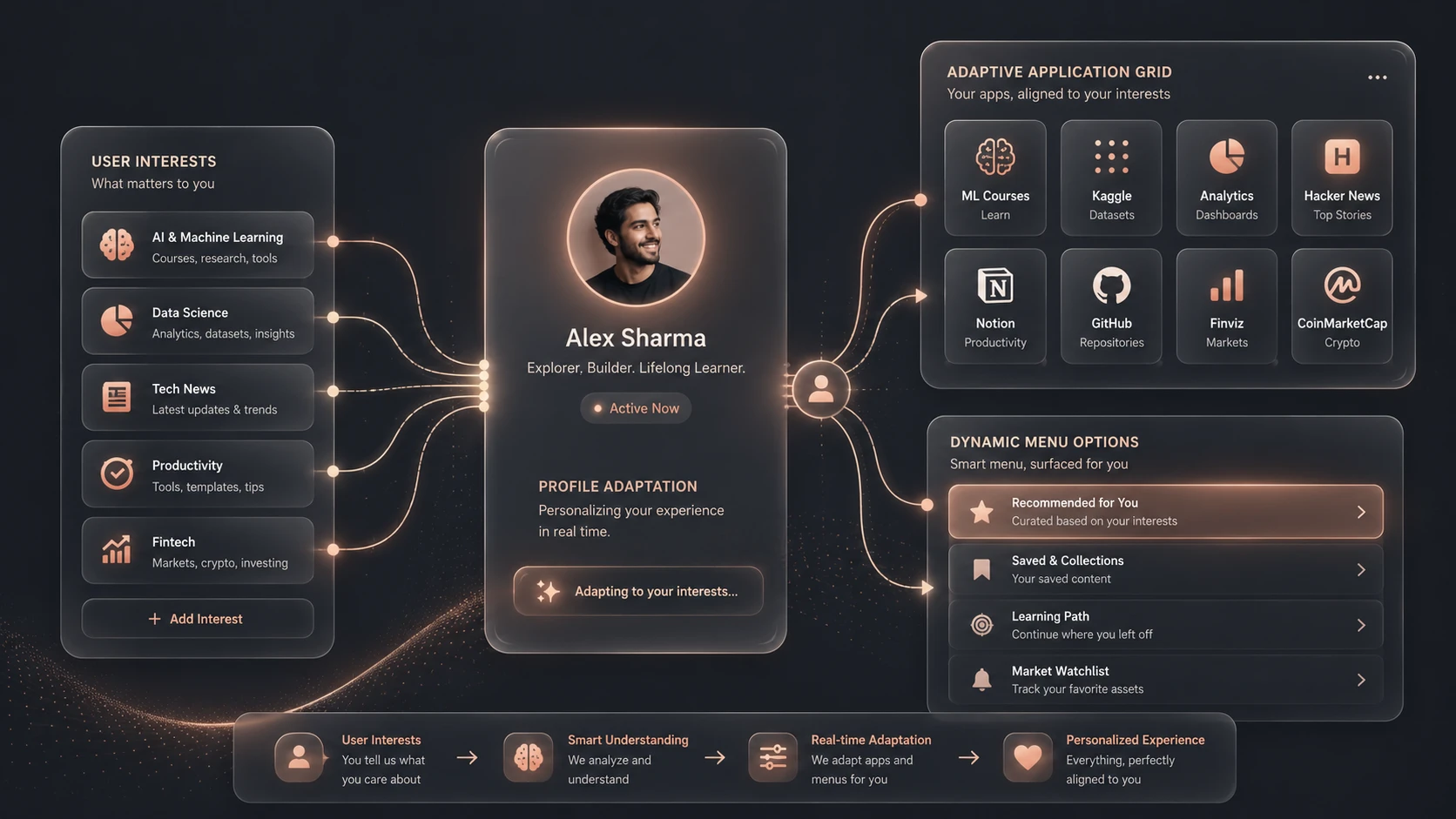
Introduction
Enterprise software has entered a transformative phase where Artificial Intelligence is no longer confined to chatbots, recommendation engines, or analytics dashboards. Instead, AI is becoming a foundational capability integrated across every architectural layer. Modern applications increasingly understand user intent, optimize infrastructure automatically, generate code, detect security threats, personalize interfaces, and continuously improve operational efficiency through learning systems.
The traditional software stack treated intelligence as an application feature. Databases stored information, APIs processed requests, frontends rendered interfaces, and infrastructure executed workloads. Decision-making remained largely deterministic, relying on business rules explicitly written by developers.
By February 2025, this model is rapidly evolving. Enterprises are designing AI-First Full Stack platforms where every layer contributes intelligence. Frontends adapt dynamically to user behavior, APIs orchestrate AI reasoning, data platforms continuously enrich knowledge, infrastructure predicts failures, observability systems recommend remediation, and developer platforms automate software delivery.
Rather than viewing AI as a standalone service, organizations increasingly architect software where learning becomes an intrinsic capability of the entire technology stack.
Industry Background
Modern enterprise platforms increasingly combine:
- ◆Large Language Models (LLMs)
- ◆AI Agents
- ◆Retrieval-Augmented Generation (RAG)
- ◆Platform Engineering
- ◆Cloud-Native Infrastructure
- ◆Kubernetes
- ◆OpenTelemetry
- ◆Event-Driven Architectures
- ◆Vector Databases
- ◆AI Development Platforms
These technologies collectively enable applications that continuously adapt to users, workloads, and operational environments.
The Business Problem
Traditional software architectures frequently encounter:
- ◆Static business logic
- ◆Manual operational processes
- ◆Fragmented AI initiatives
- ◆Repetitive engineering tasks
- ◆Slow decision-making
- ◆Limited automation
- ◆Siloed enterprise knowledge
Organizations increasingly require software capable of learning from operational data while improving user experiences and engineering productivity.
Understanding the AI-First Full Stack
The AI-First Full Stack embeds intelligence throughout every architectural layer rather than isolating AI into individual services.
Primary objectives include:
- ◆Continuous learning
- ◆Intelligent automation
- ◆Adaptive user experiences
- ◆AI-native infrastructure
- ◆Knowledge-driven applications
- ◆Autonomous operations
- ◆Developer acceleration
Instead of adding AI after applications are built, intelligence becomes a core architectural principle from the beginning.
Core Architecture
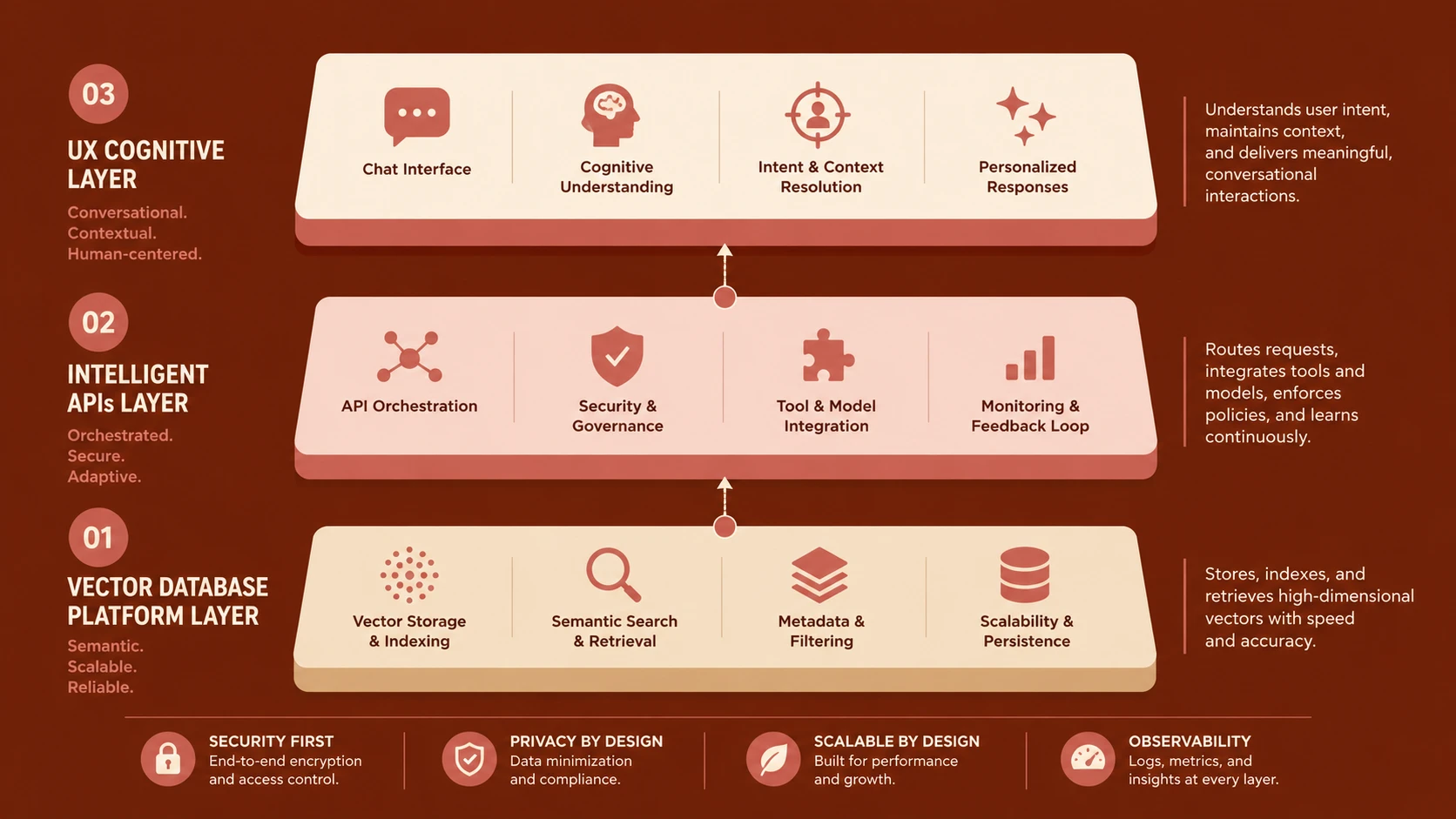
| Layer | AI Capability |
|---|---|
| User Experience | Personalized interfaces and conversational interactions |
| API Layer | AI orchestration and intelligent routing |
| Business Services | Context-aware decision making |
| Data Platform | Vector search, semantic retrieval, and knowledge enrichment |
| AI Platform | LLMs, AI agents, inference services, and model orchestration |
| Infrastructure | Predictive scaling and intelligent scheduling |
| Observability | AI-powered anomaly detection and autonomous remediation |
| Security | Threat detection and adaptive policy enforcement |
| Developer Platform | AI-assisted development and automated engineering workflows |
Together these layers establish an enterprise architecture where every component contributes to intelligent decision-making.
How an AI-First Stack Works
- 1.Users interact using natural language, traditional interfaces, or multimodal inputs.
- 2.AI-powered frontends interpret user intent and personalize experiences.
- 3.Intelligent APIs orchestrate enterprise services, AI agents, and external systems.
- 4.Knowledge platforms retrieve organizational context using semantic search.
- 5.Large Language Models generate recommendations, summaries, and reasoning.
- 6.Infrastructure dynamically optimizes resources based on workload predictions.
- 7.Observability platforms continuously monitor system health and recommend or execute remediation.
- 8.Feedback from users, operations, and business metrics continuously improves the entire platform.
This architecture creates a closed learning loop across application, infrastructure, and operations.
AI-Native User Experiences
Modern interfaces increasingly function as collaborative workspaces.
Capabilities include:
- ◆Context-aware personalization
- ◆Conversational workflows
- ◆Intelligent search
- ◆Dynamic content generation
- ◆Predictive recommendations
- ◆AI-assisted productivity
Rather than navigating static menus, users interact with adaptive systems that understand goals and provide proactive assistance.
Intelligent APIs and Agent Orchestration
Enterprise APIs increasingly act as orchestration layers for AI services.
Responsibilities include:
- ◆Routing requests to specialized AI models
- ◆Coordinating multiple AI agents
- ◆Integrating enterprise knowledge
- ◆Applying governance policies
- ◆Executing business workflows
- ◆Managing human approval steps
This approach separates AI reasoning from core business systems while preserving scalability and governance.
AI-Ready Data Platforms
Enterprise data has become the foundation for intelligent applications.
Modern platforms increasingly support:
- ◆Vector databases
- ◆Semantic indexing
- ◆Metadata enrichment
- ◆Knowledge graphs
- ◆Streaming analytics
- ◆Feature stores
High-quality data enables more accurate reasoning, recommendations, and automation.
Learning Infrastructure
Infrastructure itself is becoming intelligent.
Emerging capabilities include:
- ◆Predictive autoscaling
- ◆AI-assisted workload placement
- ◆Energy-aware scheduling
- ◆Capacity forecasting
- ◆Automated resource optimization
- ◆Self-healing infrastructure
These capabilities improve both operational efficiency and application reliability.
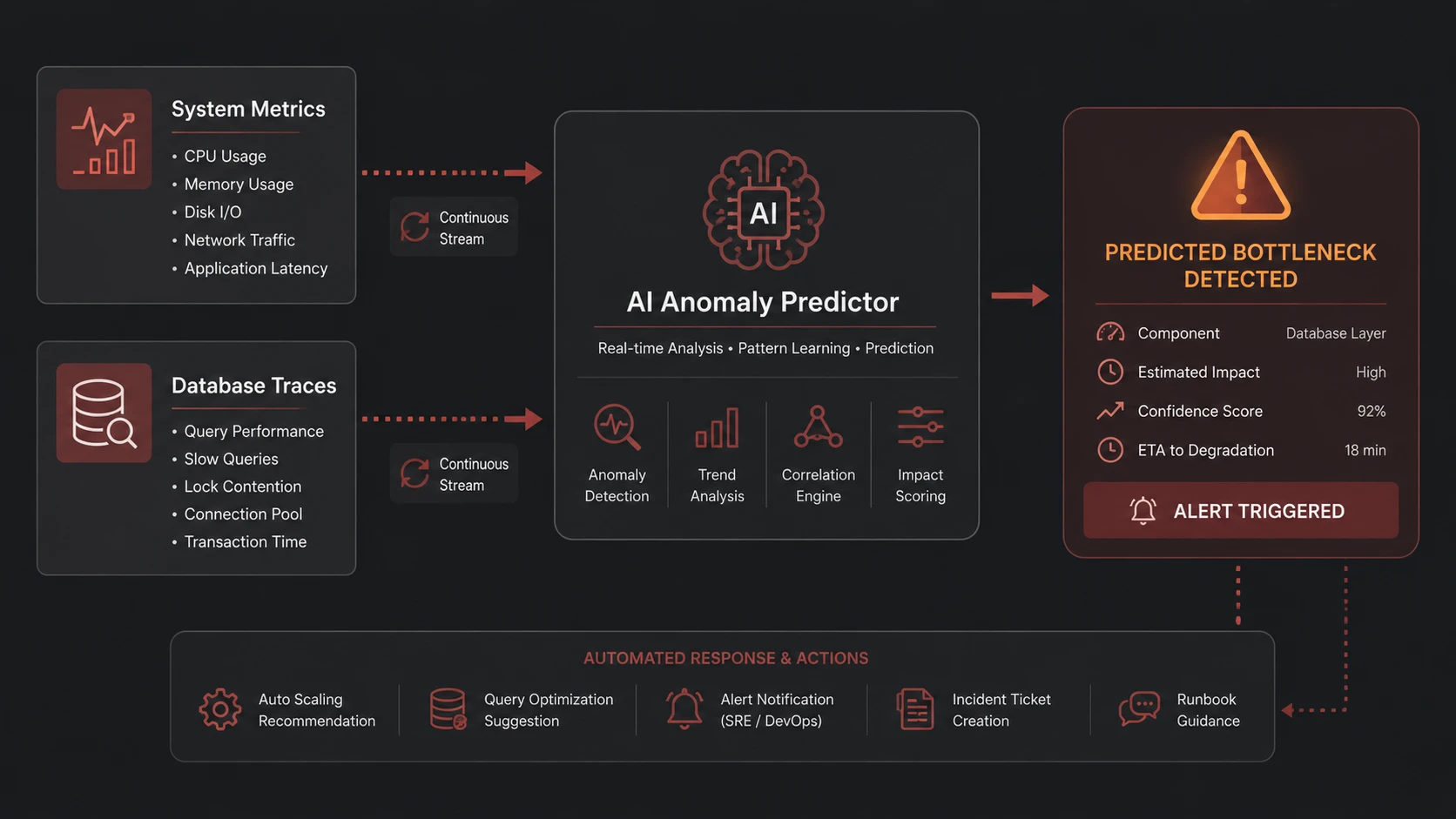
Autonomous Observability
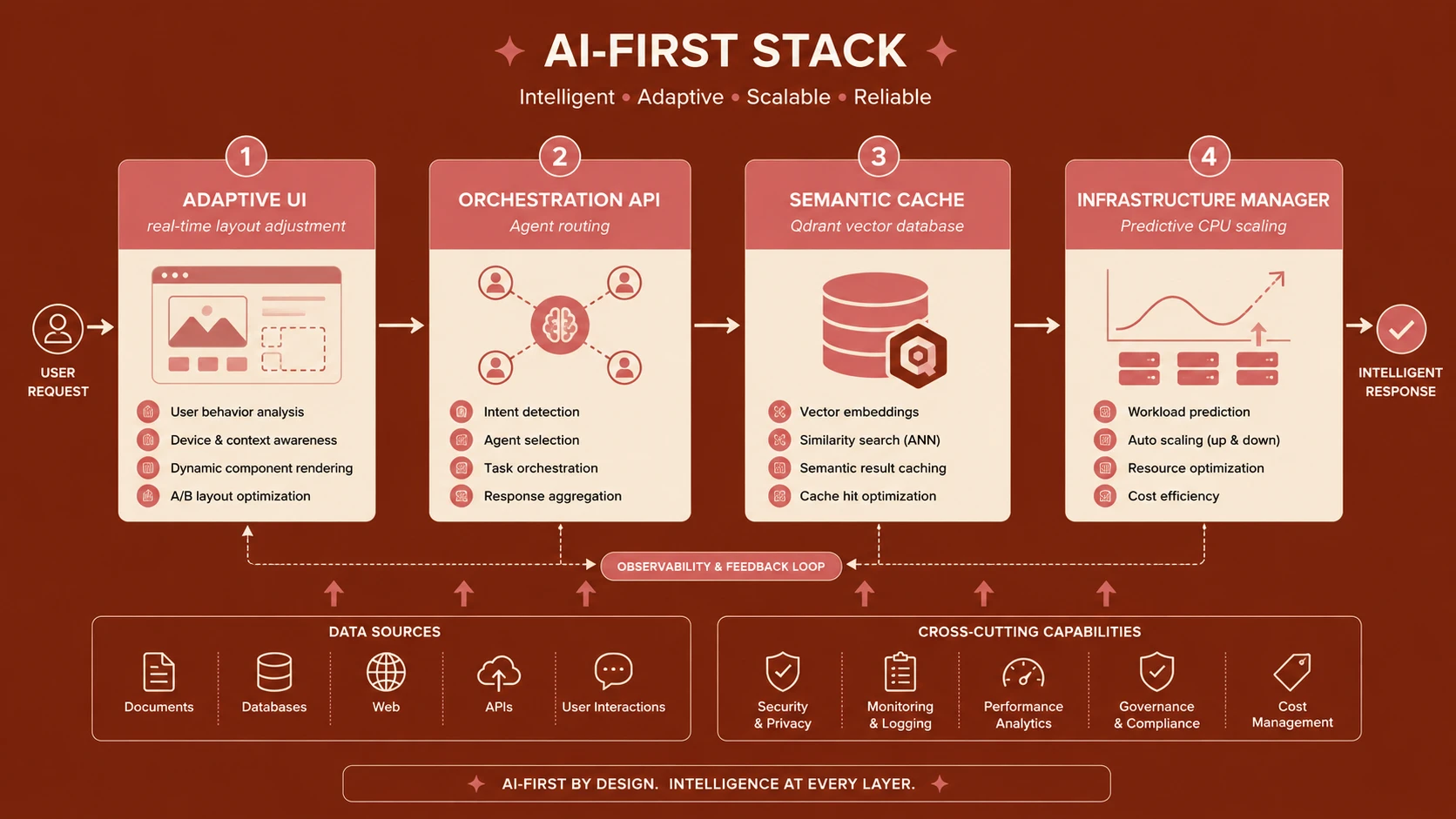
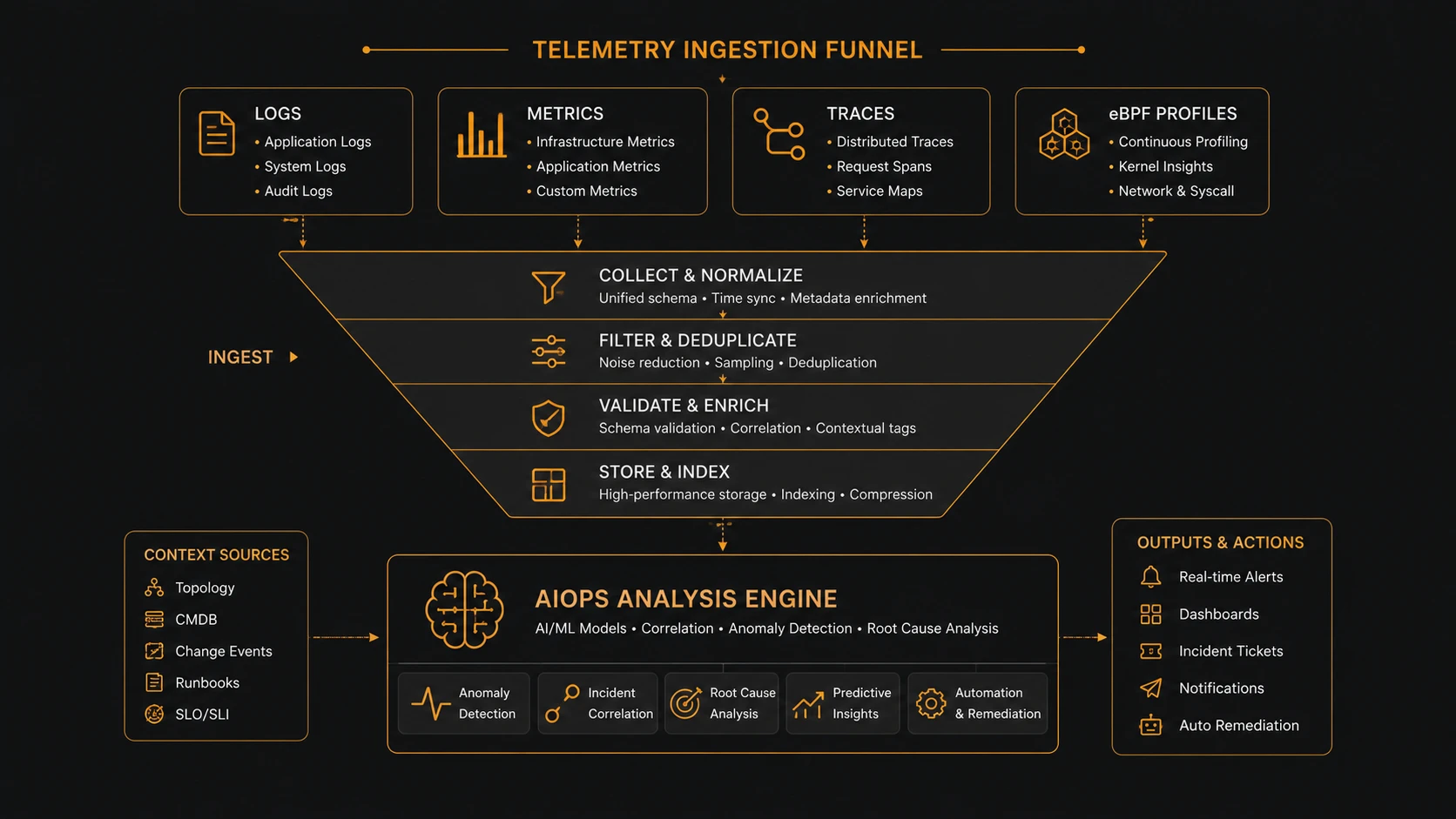
System architecture diagram and conceptual workflow layout for AI-First Full Stack.
Observability platforms increasingly move beyond dashboards.
AI enables:
- ◆Root cause analysis
- ◆Incident prediction
- ◆Intelligent alert correlation
- ◆Automated remediation
- ◆Performance optimization
- ◆Business impact analysis
Operations teams receive actionable insights instead of overwhelming telemetry.
AI-Assisted Software Engineering
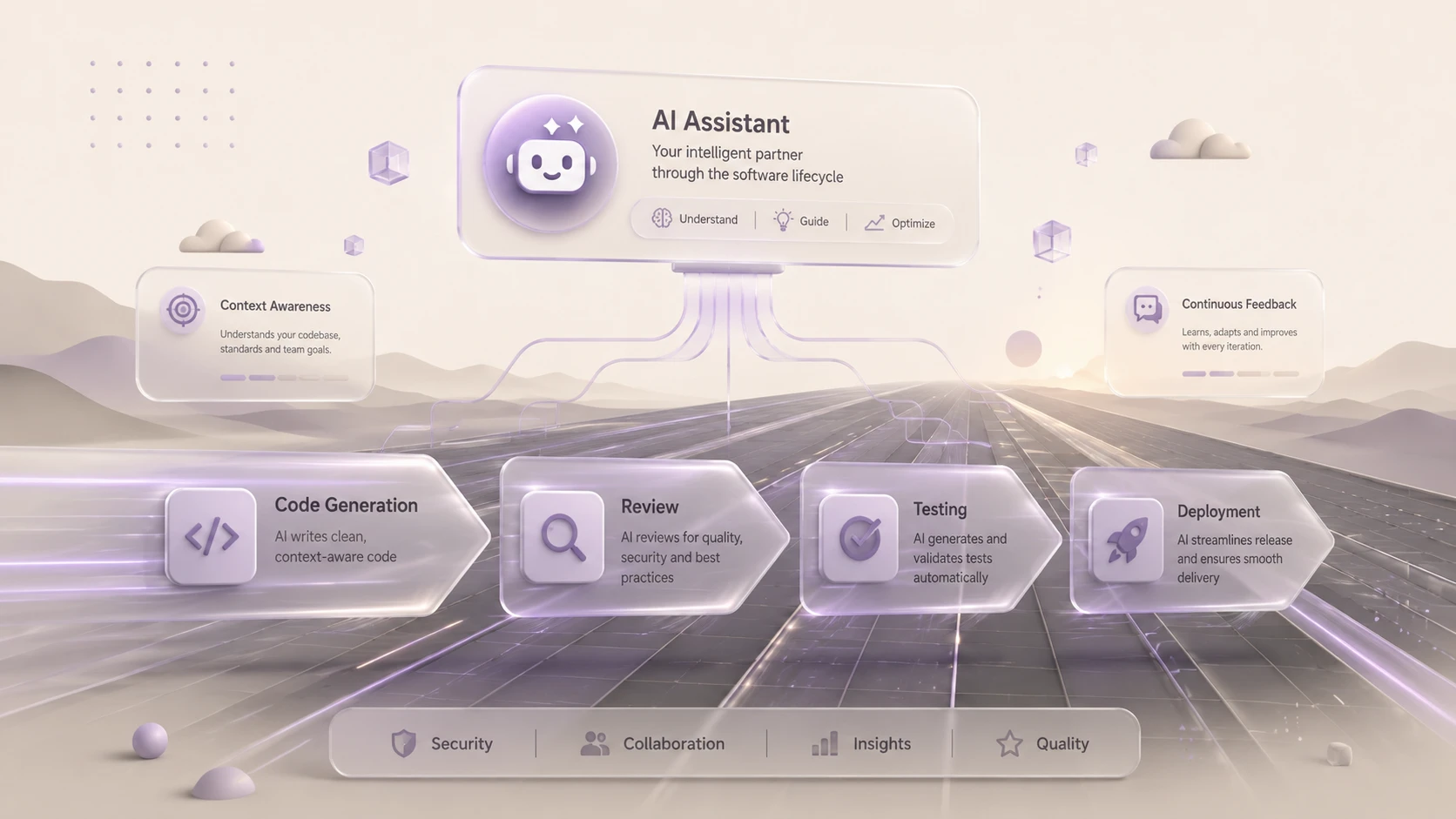
Developer platforms increasingly integrate AI throughout the software lifecycle.
Examples include:
- ◆Code generation
- ◆Architecture recommendations
- ◆Documentation creation
- ◆Test generation
- ◆Security analysis
- ◆CI/CD optimization
Developers remain responsible for architectural decisions while AI accelerates implementation.
Enterprise Use Cases
Financial Services
Deploy intelligent banking platforms capable of personalized financial guidance, fraud detection, AI-assisted operations, and predictive infrastructure management.
Healthcare
Support clinicians with AI-assisted diagnostics, knowledge retrieval, documentation generation, and operational optimization while maintaining regulatory compliance.
Manufacturing
Integrate production analytics, IoT telemetry, predictive maintenance, and autonomous operational decision support into unified AI-driven platforms.
SaaS Platforms
Deliver adaptive user experiences, intelligent automation, AI copilots, and self-optimizing cloud infrastructure through a unified architecture.
Retail
Combine recommendation engines, conversational commerce, inventory intelligence, demand forecasting, and autonomous operations to improve customer experiences and operational efficiency.
Performance Considerations
Organizations should monitor:
- ◆AI inference latency
- ◆Context retrieval performance
- ◆Token utilization
- ◆Infrastructure efficiency
- ◆Recommendation accuracy
- ◆Agent execution time
- ◆Application responsiveness
Performance optimization should balance intelligence with responsiveness and operational cost.
Security Considerations
AI-first architectures require comprehensive governance.
Organizations should implement:
- ◆Zero Trust Architecture
- ◆AI identity and access controls
- ◆Prompt security validation
- ◆Model governance
- ◆Secure Retrieval-Augmented Generation
- ◆Encryption in transit and at rest
- ◆AI audit logging
- ◆Continuous compliance monitoring
Every AI-enabled workflow should remain subject to enterprise security and regulatory policies.
Scalability
AI-First Full Stack architectures improve scalability through:
- ◆Cloud-native AI infrastructure
- ◆Distributed inference services
- ◆Event-driven processing
- ◆Autonomous workload optimization
- ◆Intelligent caching
- ◆Modular AI services
These capabilities enable enterprises to expand AI adoption without redesigning core business systems.
Best Practices
- ◆Treat AI as a platform capability rather than an isolated application feature.
- ◆Build reusable AI services shared across business domains.
- ◆Keep enterprise knowledge separate from language models using Retrieval-Augmented Generation.
- ◆Design AI systems with human oversight for high-impact decisions.
- ◆Standardize governance for models, prompts, and enterprise data.
- ◆Continuously evaluate model quality using operational metrics.
- ◆Measure business outcomes instead of focusing solely on model performance.
- ◆Architect applications so that AI enhancements complement deterministic business logic rather than replacing it.
Common Mistakes
| Mistake | Enterprise Impact |
|---|---|
| Embedding AI independently into every application | Increased operational complexity |
| Ignoring enterprise knowledge quality | Poor AI responses |
| Treating AI as a replacement for business rules | Reduced system reliability |
| Missing governance for AI agents | Security and compliance risks |
| Optimizing only model accuracy | Limited business value |
| Deploying AI without observability | Difficult operational management |
Technology Comparison
| Capability | Traditional Full Stack | AI-First Full Stack |
|---|---|---|
| User Experience | Static Interfaces | Adaptive and Context-Aware |
| APIs | Request Processing | Intelligent Orchestration |
| Data | Structured Storage | Semantic Knowledge Platform |
| Infrastructure | Reactive Scaling | Predictive and Autonomous |
| Operations | Manual Monitoring | AI-Driven Observability |
| Software Delivery | Developer-Centric | AI-Assisted Engineering |
Adoption Strategy
- 1.Assess current AI maturity across applications and infrastructure.
- 2.Build a centralized enterprise AI platform supporting shared models and governance.
- 3.Modernize data platforms to support semantic search, vector indexing, and Retrieval-Augmented Generation.
- 4.Introduce AI-assisted workflows incrementally across high-value business domains.
- 5.Standardize observability, security, and governance for AI services.
- 6.Integrate AI capabilities into developer platforms and CI/CD pipelines.
- 7.Measure operational efficiency, customer outcomes, and engineering productivity.
- 8.Expand AI-native capabilities iteratively while maintaining transparency, governance, and human oversight.
Limitations
As of February 2025, AI-First Full Stack architecture continues evolving alongside advances in foundation models, AI agents, multimodal reasoning, and cloud-native AI infrastructure. Although intelligence can significantly improve software capabilities, successful adoption depends on trusted enterprise data, responsible governance, scalable infrastructure, and experienced engineering teams. AI should augment deterministic software systems rather than replace critical business controls, compliance processes, or human judgment.
Looking Ahead
From the perspective of February 2025, the AI-First Full Stack represents the next major evolution of enterprise software architecture. Intelligence is no longer confined to individual features but embedded throughout the entire technology stack—from adaptive user interfaces and intelligent APIs to semantic data platforms, autonomous infrastructure, predictive observability, and AI-assisted software engineering. As reasoning models, AI agents, and enterprise knowledge systems continue advancing, organizations will increasingly build software ecosystems where every architectural layer learns continuously, collaborates intelligently, and improves autonomously, creating a new generation of resilient, adaptive, and business-aware digital platforms.