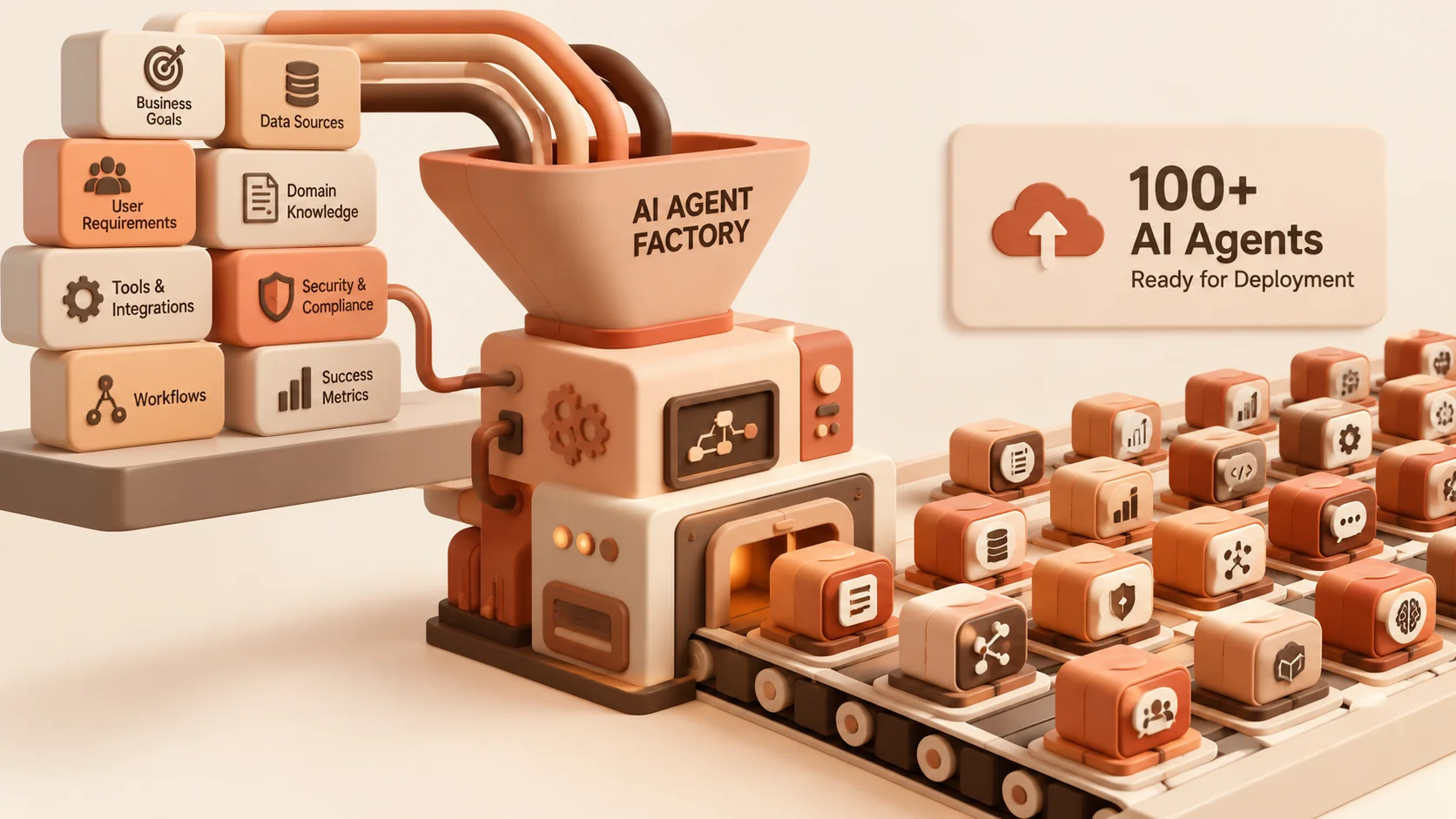
# The Agent Factory: How to Build 100+ Specialized AI Agents at Scale
Building an AI agent that answers questions or automates a single workflow is relatively straightforward. Building an enterprise ecosystem containing 100 or more specialized agents—with different responsibilities, tools, data permissions, performance requirements, and release schedules—is a fundamentally different engineering problem.
At this scale, the challenge is no longer simply prompt engineering. It is the design of a reusable platform capable of creating, registering, deploying, discovering, orchestrating, evaluating, and governing agents as managed software assets.
Consider a large enterprise that wants specialized agents for customer support, sales operations, software development, finance, procurement, security, human resources, analytics, and internal IT. Each domain may eventually require multiple agents with narrower responsibilities. A finance department might need separate agents for invoice extraction, payment reconciliation, expense-policy validation, and financial reporting.
Building each agent independently creates duplicated integrations, inconsistent security controls, fragmented observability, and expensive maintenance. A centralized Agent Factory takes a different approach: it provides shared infrastructure and standardized engineering patterns while allowing individual agents to remain specialized.
The central principle is to industrialize how agents are built and governed—not to create one enormous agent that attempts to do everything.
This article presents an enterprise architecture for building and operating 100+ specialized AI agents, including the factory control plane, agent registry, runtime architecture, routing strategies, reusable capabilities, security boundaries, automated evaluation, and a practical implementation roadmap.
1. What Is an Agent Factory?
An Agent Factory is a platform that standardizes the complete lifecycle of AI agents, from initial specification to production deployment and retirement.
Instead of treating every agent as a standalone application, the factory treats agents as independently defined, versioned, testable, and governed components that use shared platform services.
A mature factory typically provides:
- ◆Agent templates: Reusable definitions for common agent patterns, instructions, configuration, and workflow structures.
- ◆Agent registry: A searchable catalog of available agents, capabilities, versions, owners, permissions, and deployment status.
- ◆Creation pipeline: Automated validation, packaging, testing, and deployment of new agent definitions and implementations.
- ◆Discovery and routing: Mechanisms for identifying which agent or agents can handle a particular request.
- ◆Shared tool infrastructure: Approved integrations with enterprise APIs, databases, document repositories, and operational systems.
- ◆Governance controls: Identity, authorization, data-access restrictions, approval policies, and lifecycle requirements.
- ◆AgentOps: Monitoring, evaluation, cost management, incident response, versioning, and continuous improvement.
The factory separates the concerns of building an agent from the concerns of running it.
For example, adding an invoice-validation agent should not require developers to rebuild the authentication platform, create another independent logging system, or implement a new deployment pipeline. The new agent should reuse the existing platform while supplying its own domain-specific instructions, tools, evaluation cases, and business rules.
This approach is consistent with scalable agent architectures described in the Microsoft Azure Architecture Center's guidance on dynamic AI agents at scale, which discusses agent registries, dynamic selection, factory-based instantiation, and support for hundreds of agents.
2. Why 100 Independent Agents Become an Operational Problem
The number of agents is not, by itself, the most important architectural variable. The complexity comes from the relationships among agents, their tools, their data, and the systems that manage them.
2.1 Integration duplication
Suppose 100 agents each implement their own authentication, database connectivity, telemetry, retry behavior, and external API clients. Even if the implementations begin similarly, they will gradually diverge.
One agent may log every tool call, another may omit failure details, and a third may handle API rate limits incorrectly. Security fixes must be repeated across multiple implementations, increasing the probability that one is missed.
A factory centralizes common capabilities and makes the approved implementation the default path for new agents.
2.2 Uncontrolled agent discovery
A system with five agents can often select an appropriate function using a relatively simple routing strategy. With hundreds of agents, presenting every available capability to the model becomes inefficient and can make selection less reliable.
The system needs a discovery mechanism that narrows the candidate set using metadata, semantic matching, permissions, and workflow context.
2.3 Inconsistent quality
An agent that performs well on a few demonstration prompts may fail when it encounters ambiguous instructions, missing data, unusual document formats, or unavailable tools.
Without standardized evaluation, teams cannot reliably compare agent versions or determine whether a change has improved production behavior.
2.4 Security and permission sprawl
An agent may need access to customer records, payment systems, source repositories, or internal documents. If every agent receives broad credentials, the factory creates a large and difficult-to-audit attack surface.
The platform must enforce authorization independently of the language model and grant each agent only the capabilities required for its assigned task.
2.5 Operational overhead
One hundred agents may require different model configurations, release schedules, latency targets, scaling policies, and data-retention rules.
The factory must provide centralized visibility without forcing every agent into an identical execution model.
The objective is therefore not maximum centralization. It is standardized infrastructure with independently governed specialization.
3. Reference Architecture: The Six Layers of an Agent Factory
A practical enterprise Agent Factory can be divided into six logical layers.
Layer 1: Agent development and specification
This layer defines what an agent is supposed to do and how its behavior is configured.
An agent specification should include:
- ◆Unique identifier and human-readable name.
- ◆Business domain and purpose.
- ◆Supported tasks and explicit non-goals.
- ◆Input and output schemas.
- ◆Required tools and data sources.
- ◆Identity and permission requirements.
- ◆Model and inference configuration.
- ◆Human approval requirements.
- ◆Evaluation datasets and acceptance criteria.
- ◆Responsible team and operational owner.
- ◆Version and lifecycle status.
Simple agents may be defined declaratively using validated YAML or JSON. More complex agents may require code modules or workflow graphs. The factory should support multiple implementation types behind a consistent interface rather than forcing every agent into a single abstraction.
Layer 2: Agent registry and discovery
The registry is the authoritative catalog of agents that can be considered for execution.
It stores metadata about each agent, including its capabilities, version, owner, dependencies, allowed tools, deployment state, and evaluation results.
Discovery services use this information to answer questions such as:
- ◆Which agents support invoice reconciliation?
- ◆Which agents can operate on a particular business system?
- ◆Which version has passed the required evaluations?
- ◆Which agents are available to the current user?
- ◆Which agents are healthy enough to receive new requests?
The registry should distinguish between an agent being defined, approved, deployed, and currently available. An agent's presence in the catalog must not automatically make it executable.
Layer 3: Factory and deployment pipeline
The factory converts an approved specification or implementation into a validated, deployable agent version.
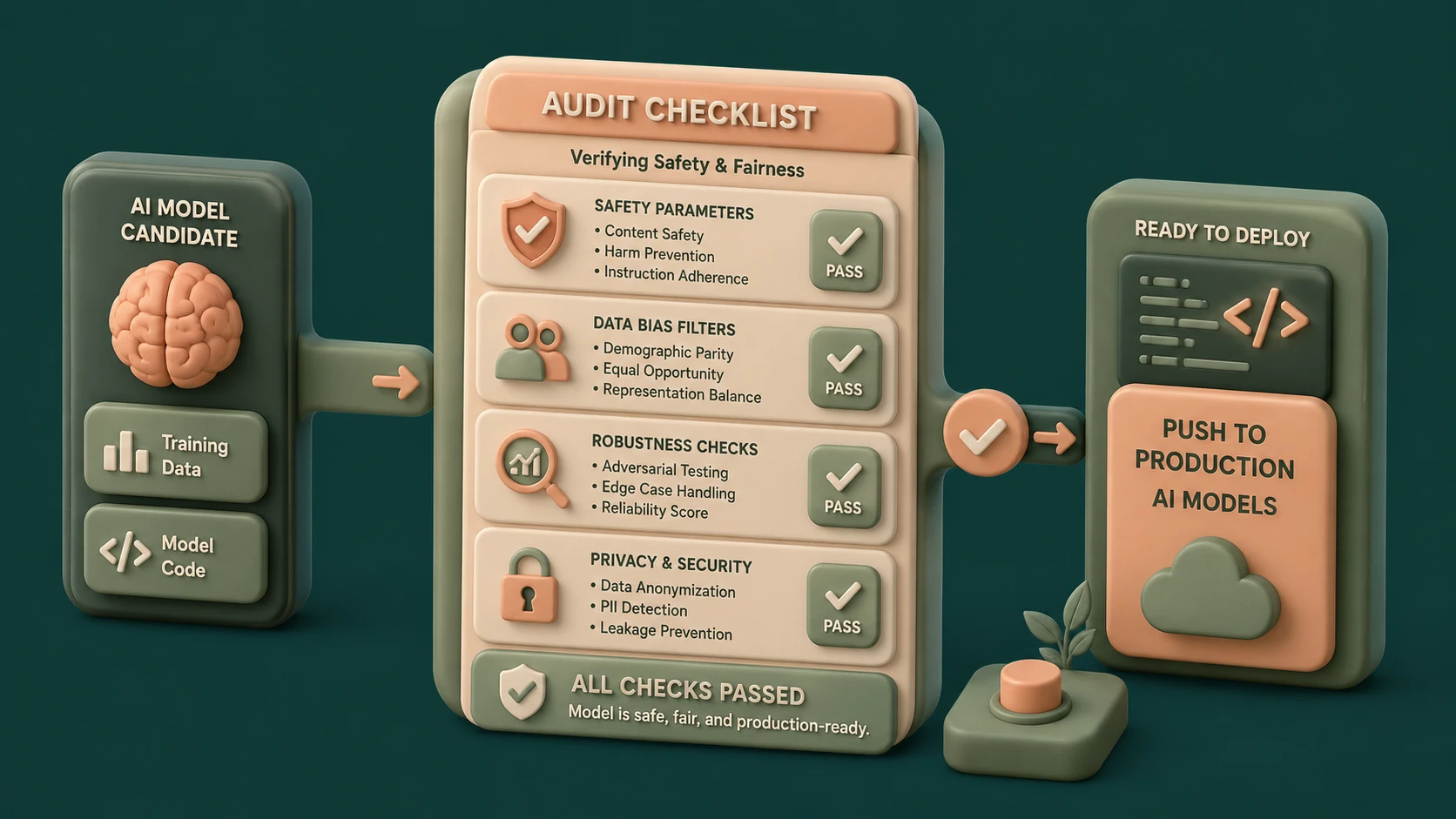
Its responsibilities include schema validation, dependency checks, security-policy verification, automated testing, artifact creation, deployment, and rollback support.
The factory should reject invalid definitions before they reach production. For example, an agent that requests an unapproved tool, omits a responsible owner, or fails a required security test should not become production-eligible merely because its configuration parses successfully.
Layer 4: Runtime and orchestration
The runtime executes agent tasks, manages state, invokes tools, coordinates workflows, and applies timeouts and resource limits.
The orchestration layer determines whether a request should be handled by one agent, several agents in a controlled sequence, or a deterministic workflow that invokes AI only for selected steps.
It should also handle retries, duplicate requests, cancellation, timeouts, and failures without allowing an agent to continue executing indefinitely.
Layer 5: Enterprise tools and data
This layer exposes approved business capabilities through APIs, integration adapters, document retrieval services, and other controlled interfaces.
Agents should access enterprise systems through authorized tools rather than receiving unrestricted access to databases, credentials, or infrastructure.
Tool definitions should include explicit input schemas, authorization requirements, output contracts, rate limits, and failure behavior.
Layer 6: Governance and AgentOps
The governance layer spans the entire factory. It manages identity, access policies, evaluation requirements, audit trails, model and agent versions, operational monitoring, and incident response.
AgentOps extends conventional application and model operations to account for agent-specific behavior, including tool selection, multistep execution, changing context, and model-dependent outcomes.
Together, these six layers provide a repeatable path from an agent idea to a controlled production service.
4. Build Agents from Reusable Blueprints
A factory becomes valuable when creating a new agent requires configuration and domain-specific implementation—not rebuilding the platform.
The first step is to identify recurring agent patterns.
4.1 Retrieval and knowledge agents
These agents search approved knowledge sources, retrieve relevant material, and produce grounded answers.
Examples include policy assistants, technical documentation agents, internal knowledge agents, and product-information assistants.
A reusable blueprint should provide retrieval interfaces, access filtering, source references, context-size limits, and evaluation for answer grounding.
4.2 Extraction and transformation agents
These agents convert unstructured information into structured data.
Examples include invoice extraction, contract metadata extraction, resume parsing, and support-ticket classification.
The blueprint should define a strict output schema, validation rules, confidence handling, and a path for ambiguous or incomplete results.
4.3 Workflow agents
Workflow agents coordinate a defined sequence of actions, often involving multiple business systems.
Examples include employee onboarding, purchase-order preparation, customer onboarding, and software release coordination.
These agents need explicit workflow states, retry rules, idempotency controls, approval checkpoints, and recovery behavior.
4.4 Analytical agents
Analytical agents interpret approved datasets, generate summaries, or propose explanations for observed patterns.
Examples include financial variance analysis, sales-performance analysis, and operational reporting.
Their blueprint should define data permissions, calculation validation, provenance requirements, and restrictions on unsupported conclusions.
4.5 Engineering and code agents
Engineering agents can review code, generate tests, investigate build failures, or prepare changes for human review.
Because their tools may modify repositories or execute commands, their runtime should use scoped credentials, isolated workspaces, restricted network access, and explicit approval requirements for sensitive actions.
These categories are starting points, not rigid classifications. Some agents combine multiple patterns, but reusable blueprints help ensure that common operational requirements are implemented consistently.
5. Design a Declarative Agent Specification
A standardized specification makes agents easier to create, validate, compare, and operate.
Consider the following illustrative YAML definition:
apiVersion: agentfactory.example.com/v1
kind: Agent
metadata:
  name: invoice-validation-agent
  version: 1.2.0
  owner: finance-automation
  domain: finance

spec:
  purpose: Validate invoice data against approved purchase orders.

  capabilities:
    - extract_invoice_fields
    - retrieve_purchase_order
    - validate_invoice_totals

  inputs:
    schema: invoice-validation-request-v1

  outputs:
    schema: invoice-validation-result-v1

  model:
    profile: structured-extraction
    temperature: 0

  tools:
    - invoice-document-reader
    - purchase-order-read-api

  permissions:
    access_profile: finance-invoice-validation
    write_access: false

  execution:
    timeout_seconds: 45
    max_tool_calls: 8
    retry_policy: bounded

  governance:
    human_approval_required_for_payment: true
    evaluation_suite: invoice-validation-v3
    audit_profile: business-transaction

  lifecycle:
    status: candidate
This example illustrates a possible internal schema; it is not a standardized vendor format. A real implementation should validate the definition against a versioned schema and map each field to enforceable runtime behavior.
Several design principles matter here.
First, metadata is not enforcement. A field declaring write_access: false is useful only if the runtime and tool adapters actually reject write operations.
Second, version the contract. Changes to input schemas, output schemas, permissions, or tool behavior may affect downstream workflows. Compatibility must be tested rather than assumed.
Third, separate policy from natural-language instructions. A prompt may describe what the agent should do, while deterministic policy services establish what it is allowed to do.
Fourth, make ownership explicit. Every production agent should have a responsible team and a defined process for support, upgrades, and retirement.
6. Build an Agent Registry That Supports Reliable Discovery
A registry containing 100 agents should not be a flat list of names and descriptions. It should represent the capabilities and constraints that determine whether an agent is suitable for a request.
A practical registry can maintain three complementary forms of metadata.
Structured capability metadata
This includes domain, supported operations, required inputs, output types, dependencies, permissions, and supported languages or regions where relevant.
Structured filters eliminate agents that cannot legally or technically handle the request.
Semantic descriptions and examples
Natural-language descriptions and representative user requests support semantic retrieval.
For example, an invoice agent might be associated with phrases such as "check this supplier invoice," "compare invoice totals with the purchase order," and "identify discrepancies in the billing document."
Use diverse examples that cover the agent's actual capabilities, but do not treat embedding similarity as proof of authorization or suitability.
Operational metadata
The registry should also record deployment health, approved versions, recent evaluation status, service-level objectives, and relevant cost characteristics.
A candidate that matches the user's request but is unavailable, unapproved, or unauthorized should not be selected for execution.
A two-stage discovery pipeline
For a large catalog, use two stages:
- 1.Candidate retrieval: Apply structured filters and retrieve a small set of semantically relevant agents.
- 2.Candidate selection: Evaluate the shortlist against the request, required inputs, permissions, and routing policy.
The selection stage may use deterministic rules, a model-based classifier, or a combination. High-confidence, narrowly defined requests can use deterministic routing. Ambiguous or compound requests may require an additional interpretation step.
The important principle is that the model should select only from an approved candidate set, not invent an arbitrary agent identity and cause it to execute.
7. Route Requests Without Sending Every Agent to the Model
When the registry grows, routing becomes a platform capability of its own.
Sending all 100 agent definitions and all their tool descriptions to the model for every request can increase context size, cost, latency, and selection complexity.
A scalable router narrows the candidate set before asking a model to make a decision.
A simplified routing pipeline looks like this:
Incoming Request
      |
      v
Authentication and Context Validation
      |
      v
Intent and Required-Input Analysis
      |
      v
Registry Filters
(domain, permissions, status, capabilities)
      |
      v
Semantic Candidate Retrieval
      |
      v
Candidate Ranking and Confidence Check
      |
      +---- High confidence ----> Invoke approved specialist
      |
      +---- Multiple intents ----> Build controlled workflow
      |
      +---- Low confidence -----> Clarify or escalate
      |
      v
Validate Tool Calls and Enforce Policies
      |
      v
Verify Result and Record Audit Events
      |
      v
Return Outcome
The confidence threshold should be established through representative evaluation rather than chosen arbitrarily. False-positive routing can be more damaging than asking a user for clarification.
For compound requests, the system should determine whether the requested actions can be decomposed safely. A request to prepare a purchase order and notify a supplier might involve separate procurement and communication agents. The orchestration layer should preserve dependencies and prevent the notification from being sent before the purchase order reaches the required state.
Do not assume that every request benefits from multiple agents. A simple lookup may be cheaper and more reliable with one specialist or a deterministic API call.
8. Keep the Orchestrator Thin and the Specialists Focused
A common mistake is to build a large coordinator that gradually accumulates business logic, domain knowledge, and special cases for every agent.
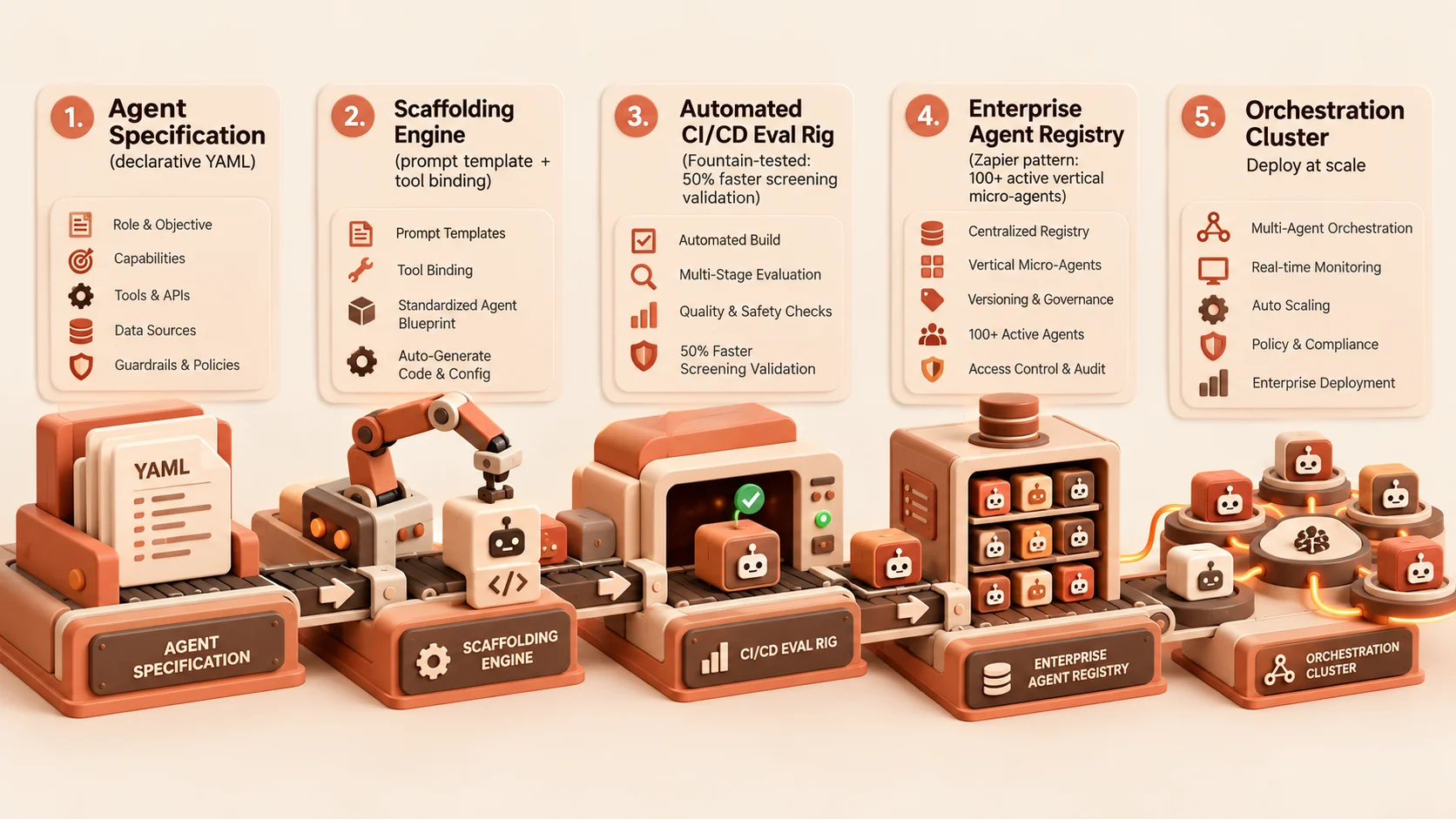
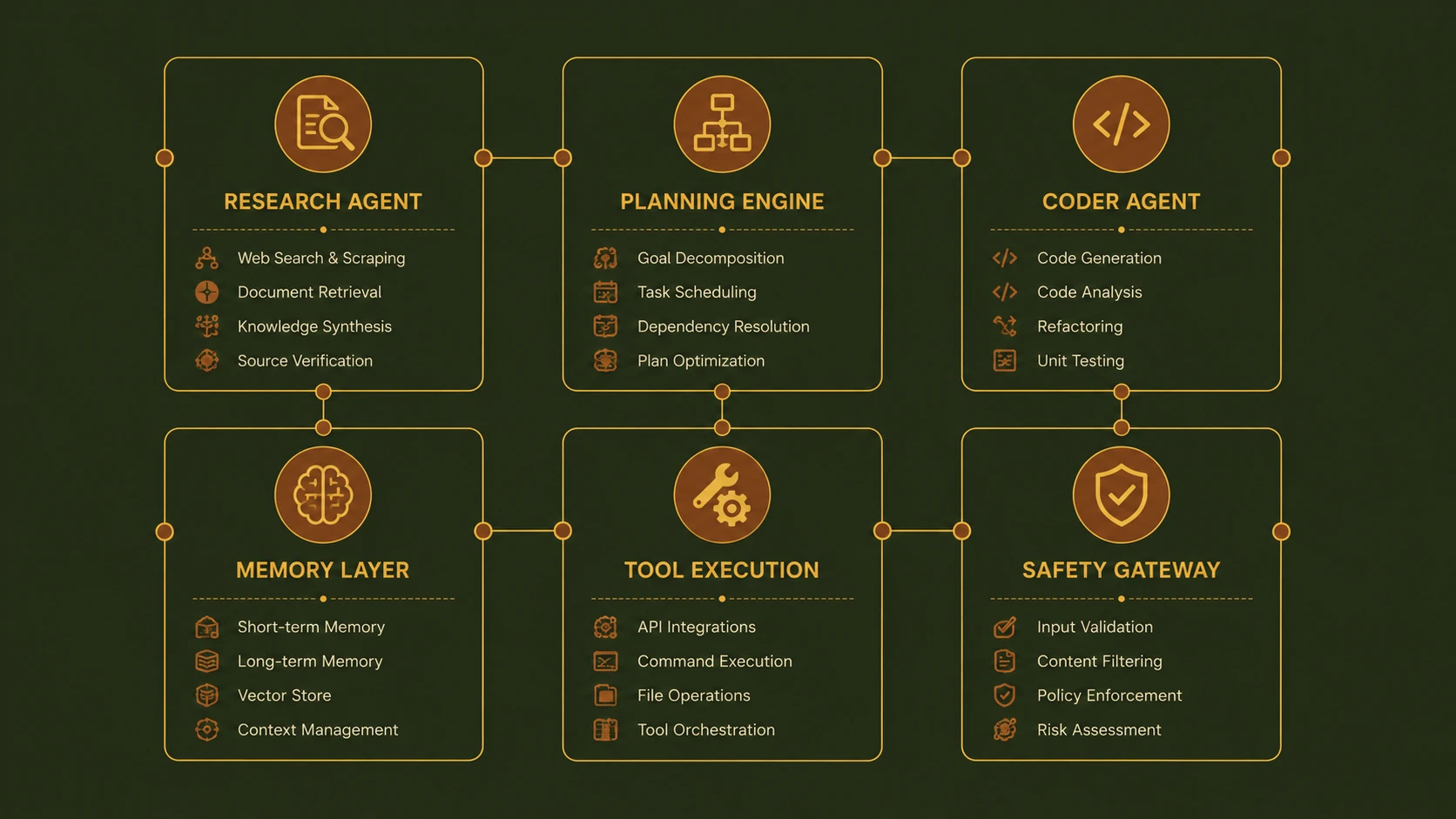
Agent Factory synthesis pipeline transforming declarative YAML specifications into tested vertical AI micro-agents.
The coordinator then becomes a new monolithic application, only with an LLM in the execution path.
A better architecture gives the orchestrator a limited set of responsibilities:
- ◆Interpret or normalize the request.
- ◆Identify the appropriate workflow or specialist.
- ◆Gather missing required inputs.
- ◆Enforce workflow sequencing and global limits.
- ◆Check authorization and approval requirements.
- ◆Validate results and handle failures.
- ◆Return the final outcome with relevant provenance.
Domain reasoning belongs in the appropriate specialist or deterministic business service.
For example, the finance coordinator should not independently implement every accounting rule. It should route an invoice to the invoice-validation agent and rely on approved financial services for authoritative calculations and transaction state.
This separation improves testability because the coordinator can be tested for routing and workflow behavior while each specialist is evaluated against its own domain requirements.
It also limits the impact of changes. Updating the invoice-validation agent should not require rewriting the sales-support agent or the central routing logic unless their shared contracts have changed.
9. Reusable Tools Are More Valuable Than Reusable Prompts Alone
A factory can standardize prompts, but prompts are only one part of an agent's behavior.
Enterprise agents frequently need the same underlying capabilities: search a document repository, retrieve an authorized customer record, create a ticket, query an inventory service, or prepare a draft email.
Implement these capabilities as reusable, versioned tools with explicit contracts.
A well-designed tool should define:
- ◆Its business purpose and allowed operations.
- ◆Input and output schemas.
- ◆Authentication and authorization requirements.
- ◆Data classification and permitted use.
- ◆Timeout, retry, and rate-limit behavior.
- ◆Idempotency requirements for mutations.
- ◆Error codes and recovery guidance.
- ◆Logging and audit requirements.
- ◆Versioning and compatibility expectations.
For instance, a create_support_ticket tool should validate the requester, permitted queue, required fields, and duplicate-submission behavior. It should not trust the model to enforce those requirements through a prompt.
Integration protocols such as the Model Context Protocol (MCP) can help standardize how compatible clients discover and invoke tools. However, protocol-level interoperability does not automatically provide correct authorization, safe tool behavior, or business-policy enforcement. Those controls must be implemented in the surrounding platform and tool services.
The resulting architecture allows different agents to reuse approved capabilities without sharing unrestricted credentials or duplicating integration code.
10. Security: Treat Agents as Governed Workload Identities
An agent factory can amplify security weaknesses if it creates new agents faster than the organization can govern their permissions.
The solution is to treat each deployed agent, execution, and tool invocation as part of an explicit identity and authorization model.
Identity and least privilege
Assign workload identities or service identities appropriate to the deployment environment. Give each agent access only to the resources required for its assigned tasks.
Where practical, separate read and write permissions, isolate sensitive workflows, and use short-lived credentials or delegated authorization mechanisms.
Authorization at execution time
Validate the requesting user's permissions, the agent's allowed capabilities, and the target resource before each sensitive operation.
A user being authorized to view a customer record does not necessarily mean the user may initiate a refund, change an account owner, or export an entire customer dataset.
Isolation and sandboxing
Agents that execute code, access repositories, or interact with external systems may need isolated execution environments, resource limits, restricted network access, and controlled file-system access.
Do not give a code-generation agent unrestricted access to production infrastructure simply because it is part of an approved factory.
Prompt-injection resistance
Treat retrieved documents, web pages, emails, and tool outputs as potentially untrusted data. They may contain instructions designed to influence the agent's behavior.
Use explicit tool allowlists, strict input validation, data-access filters, output checks, and server-side policy enforcement. Do not allow content retrieved by an agent to override system-level permissions.
Secrets and data protection
Store credentials in approved secrets-management systems rather than prompts, agent definitions, or source-control repositories. Apply appropriate encryption, retention, and access controls to prompts, retrieved content, execution state, and audit records.
Security should be enforced by the platform, not left to the discretion of each agent's prompt author.
11. Automated Evaluation Before Production Deployment
At 100+ agents, manual testing is not a sustainable release strategy.
Every agent should have an evaluation suite tied to its intended use, supported capabilities, and risk classification.
Functional evaluations
Test representative tasks, required inputs, output schemas, expected tool calls, and normal error conditions.
For a data-extraction agent, compare the generated structured fields against labeled examples. For a support agent, evaluate whether the response follows approved policy and correctly identifies when information is missing.
Routing evaluations
Test whether the registry and router select the appropriate specialist for different phrasings, ambiguous requests, compound tasks, and requests outside the agent's scope.
Measure both false-positive routing and missed routing. The correct fallback may be to ask a clarifying question or route the request to a human rather than invoke the closest available agent.
Security evaluations
Test unauthorized resource access, tool misuse, prompt injection, malformed inputs, excessive execution, and attempts to bypass policy restrictions.
A passing result should demonstrate that the enforcement layer blocks prohibited operations even when the model produces an unsafe request.
Regression evaluations
Run representative tests whenever prompts, model versions, tool contracts, retrieval indexes, policies, or agent definitions change.
Use versioned test data and acceptance thresholds so that a deployment decision can be reproduced and reviewed.
Production evaluation
Offline tests are necessary but not sufficient. Monitor real-world outcomes, policy denials, user corrections, escalation rates, latency, and cost. Use privacy-appropriate sampling and access controls when reviewing production traces.
An agent should not be promoted to production simply because it produces fluent answers. It should demonstrate that it completes the intended task within defined quality, security, and operational boundaries.
12. AgentOps: Manage the Full Lifecycle
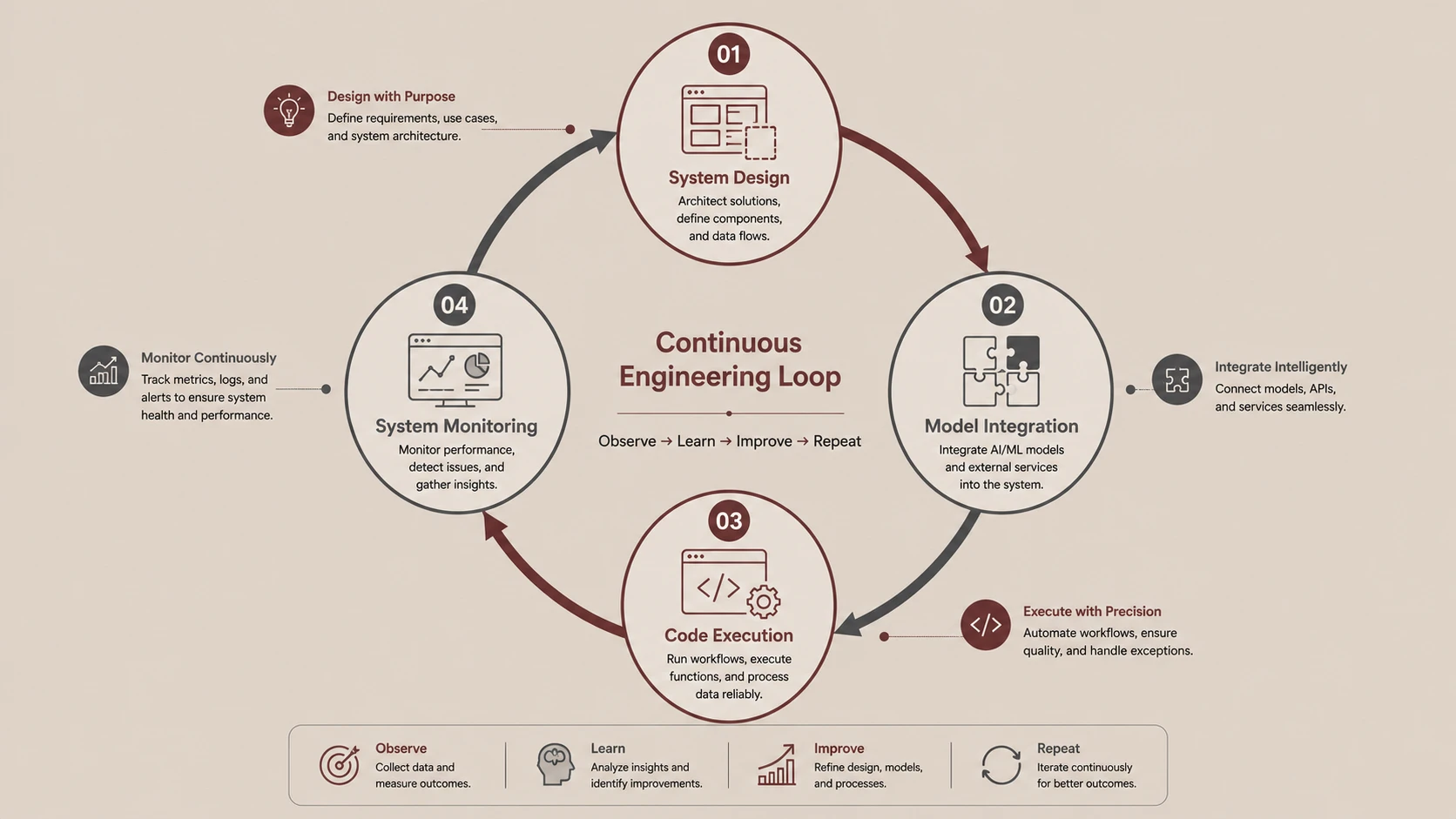
An agent registry tells the platform what exists. AgentOps ensures that the deployed ecosystem remains reliable as it changes.
A mature lifecycle includes the following stages.
1. Draft: Define the business purpose, owner, supported tasks, and constraints.
2. Validate: Check the specification, dependencies, tool permissions, and required metadata.
3. Evaluate: Run functional, routing, security, and regression tests.
4. Approve: Obtain the required technical, security, business, or risk-owner approval.
5. Deploy: Release a version through the approved delivery pipeline.
6. Observe: Monitor availability, task outcomes, policy denials, latency, and cost.
7. Improve: Analyze failures, refine the implementation, and rerun the required evaluations.
8. Retire: Disable routing, revoke unnecessary credentials, archive required audit information, and remove obsolete runtime resources.
Agent definitions, code, prompts, tool contracts, evaluation suites, and policy versions should be tracked in version control or an equivalent governed artifact system.
Use staged deployments or canary releases where appropriate. If a new agent version produces unexpected behavior, the platform should support routing back to an approved version while preserving the audit trail.
Retirement deserves particular attention. Removing an agent from a user-facing interface is not enough if its credentials, scheduled tasks, webhooks, or external permissions remain active.
13. Cost and Performance Optimization Across 100 Agents
A large agent ecosystem can generate unnecessary costs when every task uses the same expensive model, the same context size, and the same runtime configuration.
The factory should support workload-specific optimization.
Model routing
Use a model appropriate to the task's complexity, accuracy requirements, latency target, and data constraints. Simple classification or extraction may not require the same model configuration as complex planning or ambiguous analysis.
Model selection should be validated against task-specific evaluations rather than based solely on price or benchmark reputation.
Context management
Retrieve only relevant information and pass only the context required by the current task. Large prompts containing every tool description and every available document can increase latency and reduce clarity.
Caching
Cache results only when the operation is safe to reuse. Static policy documents or stable reference data may be suitable candidates, while personalized or rapidly changing information may require identity-aware cache keys, strict invalidation, or no caching at all.
Never let a shared cache return one user's protected or confidential information to another user.
Concurrency and resource limits
Use queues, concurrency controls, quotas, and backpressure to prevent a burst of requests from overwhelming shared model endpoints or enterprise APIs.
Long-running tasks should support cancellation, timeout handling, and recovery from transient failures.
Measure cost per successful task
Track model usage, tool calls, retries, runtime consumption, and the cost of human review. A cheap agent that repeatedly fails and requires manual correction may be more expensive than a higher-quality implementation.
Useful measurements include cost per completed task, success rate, escalation rate, and latency at relevant percentiles.
14. A Practical Roadmap to 100+ Agents
The safest path is incremental. Start by proving the factory's shared capabilities, then increase the number and diversity of agents.
Phase 1: Build the platform foundation
Choose one business domain and two or three well-defined workflows. Implement the agent specification, registry, tool interface, runtime, basic policy enforcement, and audit events.
Establish a clear separation between agent configuration, domain-specific logic, and shared infrastructure.
Phase 2: Establish reusable blueprints
Identify repeated patterns such as retrieval, extraction, analysis, and workflow automation. Convert them into validated templates with standard testing and deployment requirements.
Do not create a new blueprint for every agent. Create a new blueprint when the execution pattern or control requirements genuinely differ.
Phase 3: Automate the delivery pipeline
Add schema validation, dependency checks, automated evaluation, security testing, artifact versioning, deployment approval, and rollback support.
Make the pipeline the standard path for production releases.
Phase 4: Introduce dynamic discovery and routing
Populate the registry with well-defined capabilities and representative examples. Implement candidate filtering, semantic retrieval, ranking, and low-confidence fallbacks.
Measure routing accuracy before expanding to a large catalog.
Phase 5: Scale through domain teams
Allow domain teams to develop and maintain specialized agents using approved templates and tools. Keep shared platform responsibilities centralized while making business ownership explicit.
For example, finance owns financial validation logic, customer support owns its response policies, and the platform team owns runtime reliability and shared integration standards.
Phase 6: Introduce governed multi-agent workflows
Start coordinating multiple agents only where decomposition provides a measurable benefit. Define workflow dependencies, shared state, approval boundaries, failure recovery, and duplicate-action prevention.
Phase 7: Operate the ecosystem continuously
Monitor aggregate performance, cost, security events, agent health, evaluation status, and version drift. Review underused agents and overlapping capabilities. Retire agents that no longer have a clear owner or business purpose.
A catalog of 100 agents is an inventory milestone—not proof of business value. Measure completed workflows and operational outcomes rather than the number of agent definitions created.
15. Common Mistakes When Building an Agent Factory
Creating an agent for every prompt
Not every user request needs a separate agent. Excessive specialization increases registry complexity and operational overhead. Begin with business capabilities and introduce separate agents when distinct responsibilities, permissions, evaluation needs, or scaling requirements justify the separation.
Treating the registry as a security boundary
A registry can identify approved agents, but it cannot independently enforce every resource permission. Authorization must also be checked by the runtime and underlying tool services.
Making the orchestrator a second monolith
A coordinator that accumulates domain rules becomes difficult to test and change. Keep it focused on routing, workflow control, and global policy enforcement.
Allowing agents to call one another without controls
Unrestricted agent-to-agent delegation can create execution loops, unexpected data movement, and unclear responsibility. Require explicit delegation policies, bounded call depth, permission checks, and traceable workflow state.
Measuring success by answer quality alone
An agent may produce a convincing response while using the wrong data, exceeding its permissions, or failing to complete the requested transaction. Evaluate task correctness, authorization, reliability, and business outcomes together.
Scaling before ownership is established
Every production agent needs an owner, supported purpose, evaluation criteria, and retirement process. An agent with no accountable owner becomes a long-term operational and security liability.
Conclusion: Build a Factory, Not a Collection of Bots
Building 100 specialized AI agents is achievable when the architecture standardizes the work that should be shared and isolates the behavior that should remain specialized.
The factory provides reusable templates, a governed registry, automated creation and deployment, controlled discovery, shared tools, centralized policy enforcement, and lifecycle observability. Individual agents contribute domain-specific expertise without independently reinventing the infrastructure required to operate safely.
The most important architectural decisions are not the number of agents or the sophistication of the underlying model. They are the boundaries between reasoning and execution, the contracts between agents and tools, the mechanisms that enforce permissions, and the evidence used to determine whether a deployment is ready for production.
Start with a small set of high-value workflows. Build the registry, runtime, security model, evaluation pipeline, and operational controls around them. Then let domain teams expand the catalog through standardized blueprints and governed delivery processes.
The goal is not to maximize the number of agents. It is to make each additional agent cheaper to build, easier to evaluate, safer to operate, and measurably useful to the business.
References
- ◆Microsoft Learn — Dynamic AI Agents at Scale Pattern
- ◆Salesforce Architects — Enterprise Agentic Architecture and Design Patterns
- ◆NVIDIA — Agentic AI in the Factory
- ◆McKinsey — Building the Foundations for Agentic AI at Scale