Introduction
React has become the foundation for many enterprise web applications, powering customer portals, SaaS platforms, e-commerce websites, administrative dashboards, and internal business systems. While React offers tremendous flexibility, production applications often require additional capabilities such as routing, server-side rendering, API development, code splitting, build optimization, and deployment automation.
Next.js has steadily evolved into one of the most widely adopted frameworks for addressing these requirements. Instead of forcing developers to assemble multiple technologies manually, Next.js provides an opinionated framework that combines routing, rendering strategies, production optimization, and deployment tooling.
The release of Next.js 9 introduces several major capabilities that significantly improve both developer productivity and application performance. Native API Routes allow backend endpoints to live alongside front-end code, Automatic Static Optimization enables eligible pages to be pre-rendered without configuration, and first-class TypeScript support simplifies enterprise adoption.
For software architects and engineering teams, Next.js 9 represents an important step toward a unified development model for modern React applications.
Industry Background
Modern enterprise web platforms increasingly deliver:
- ◆Customer self-service portals
- ◆Enterprise dashboards
- ◆SaaS applications
- ◆Progressive Web Apps
- ◆E-commerce storefronts
- ◆Marketing websites
- ◆Administrative portals
- ◆API-driven front-end applications
Organizations seek development platforms that reduce complexity while maintaining performance and scalability.
The Business Problem
Enterprise React projects frequently encounter:
- ◆Separate frontend and backend repositories
- ◆Complex routing configuration
- ◆Multiple deployment pipelines
- ◆Manual static site optimization
- ◆Difficult TypeScript configuration
- ◆Increasing build complexity
These challenges increase operational overhead and slow application delivery.
Understanding Next.js 9
Next.js 9 extends the framework with features designed to simplify full-stack application development while improving production performance.
Major objectives include:
- ◆Simplified backend development
- ◆Faster page delivery
- ◆Automatic rendering optimization
- ◆Improved developer productivity
- ◆Native TypeScript integration
- ◆Reduced application complexity
Rather than replacing React, Next.js continues to build upon it by providing production-ready application infrastructure.
Core Architecture
| Component | Responsibility |
|---|---|
| React | User Interface |
| Next.js Router | File-system routing |
| API Routes | Serverless backend endpoints |
| Automatic Static Optimization | Static page generation |
| Node.js Server | Application execution |
| Webpack | Application bundling |
| TypeScript | Static type checking |
Together these components provide a complete application platform for modern React development.
How Next.js 9 Works
- 1.Developers create React pages.
- 2.Next.js automatically maps pages to routes.
- 3.API endpoints are created inside the application.
- 4.The framework determines whether pages qualify for static optimization.
- 5.Webpack generates optimized production bundles.
- 6.Applications are deployed using a unified build process.
- 7.Users receive optimized HTML and JavaScript assets.
This workflow minimizes configuration while improving deployment consistency.
Native API Routes
// Express-like Serverless API Route in Next.js 9.0 (pages/api/users.ts)
import { NextApiRequest, NextApiResponse } from 'next';

interface User {
  id: number;
  name: string;
}

export default function handler(req: NextApiRequest, res: NextApiResponse) {
  if (req.method === 'GET') {
    const users: User[] = [
      { id: 1, name: 'Vijay Paliwal' },
      { id: 2, name: 'Shivam ITCS Agent' }
    ];
    return res.status(200).json(users);
  }

  res.setHeader('Allow', ['GET']);
  res.status(405).end(`Method ${req.method} Not Allowed`);
}
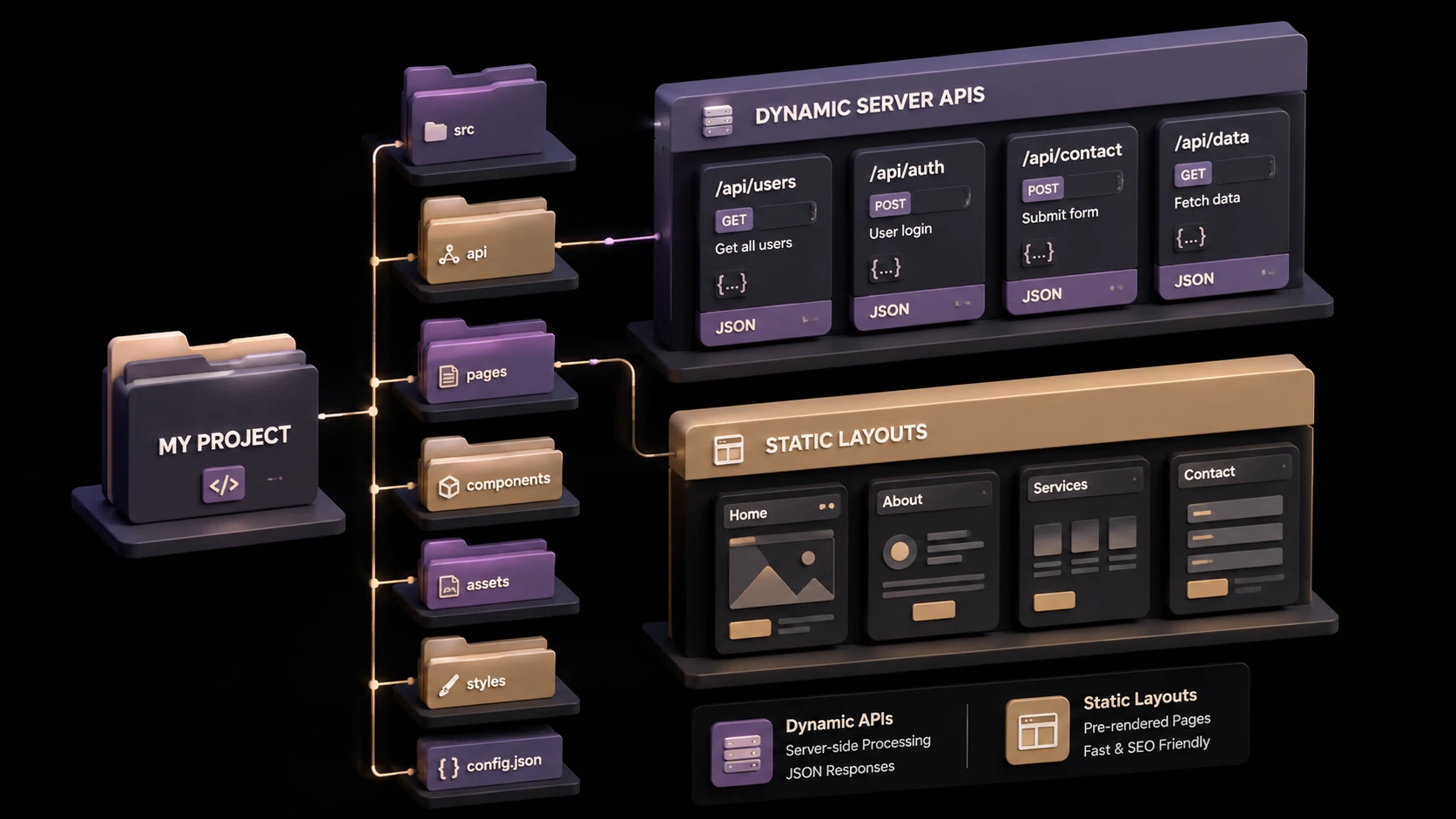
One of the most significant additions in Next.js 9 is Native API Routes.
Developers can now create backend HTTP endpoints directly within a Next.js application using the pages API directory structure.
Enterprise advantages include:
- ◆Reduced project complexity
- ◆Unified frontend and backend development
- ◆Shared deployment pipeline
- ◆Simplified authentication endpoints
- ◆Lightweight server-side functionality
API Routes are particularly useful for application-specific backend logic that complements the user interface.
Automatic Static Optimization
Next.js 9 automatically identifies pages that do not require server-side rendering.
Eligible pages are pre-rendered during the build process without requiring manual configuration.
Benefits include:
- ◆Faster page delivery
- ◆Reduced server workload
- ◆Improved scalability
- ◆Better caching opportunities
- ◆Lower infrastructure costs
Developers receive these optimizations automatically when application architecture allows.
Built-in TypeScript Support
// Dynamic routing page with getStaticProps and getStaticPaths in Next.js 9.0
import { GetStaticProps, GetStaticPaths } from 'next';

export const getStaticPaths: GetStaticPaths = async () => {
  return {
    paths: [
      { params: { id: '1' } },
      { params: { id: '2' } }
    ],
    fallback: false
  };
};

export const getStaticProps: GetStaticProps = async ({ params }) => {
  const id = params?.id;
  return {
    props: { userId: id }
  };
};
TypeScript adoption continues growing across enterprise development teams.
Next.js 9 simplifies project setup by providing built-in TypeScript support.
Advantages include:
- ◆Simplified configuration
- ◆Improved developer tooling
- ◆Better editor integration
- ◆Static type checking
- ◆Easier maintenance of large codebases
Organizations can adopt TypeScript without extensive framework customization.
Key Features
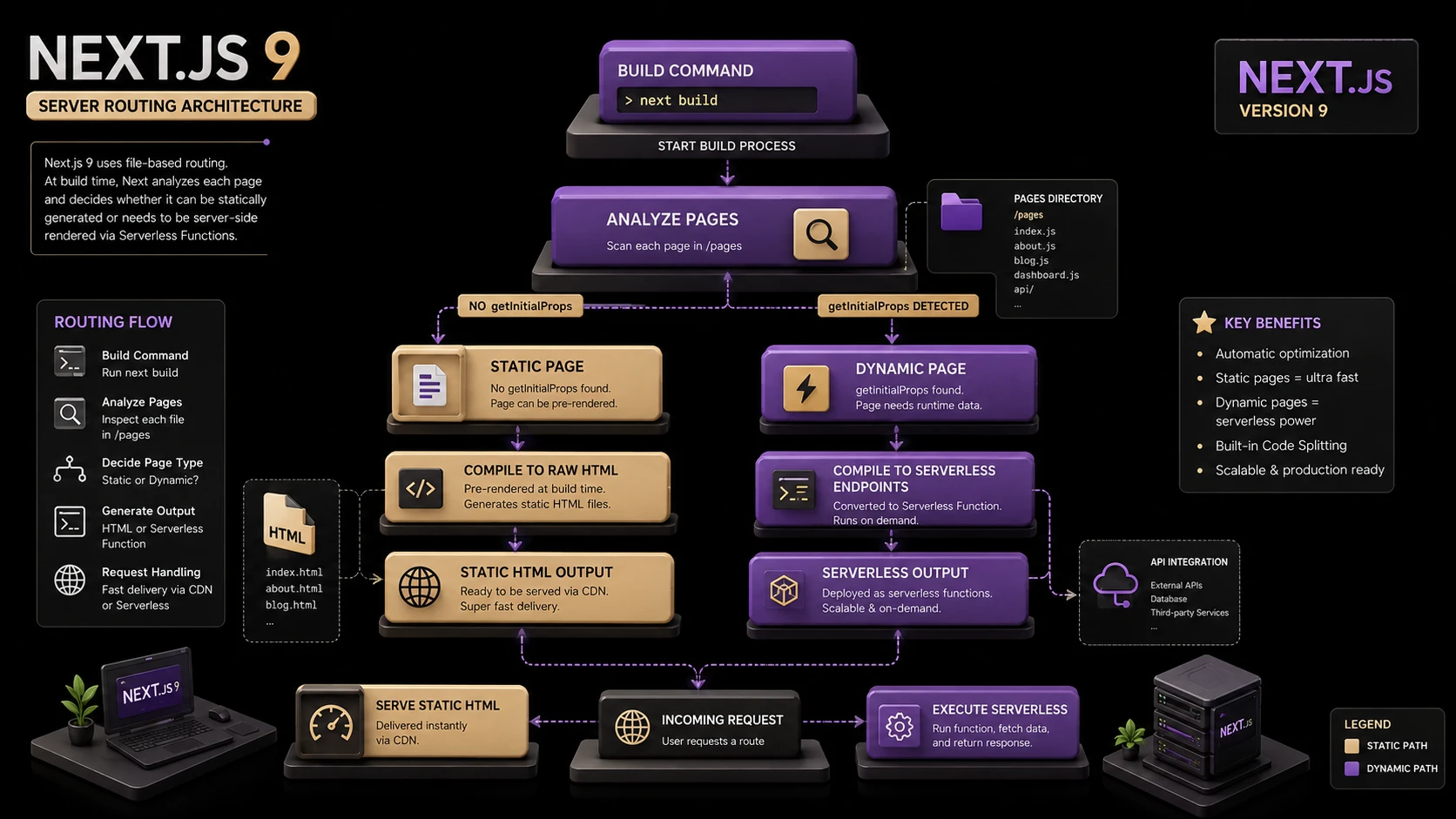
System architecture diagram and conceptual workflow layout for Next.js 9.0: Native API Routes, Automatic Static Optimization, and TypeScript Integration.
Native API Development
Backend endpoints can be implemented directly within Next.js projects.
Automatic Rendering Optimization
Static rendering is applied automatically whenever possible.
TypeScript Integration
Type-safe development becomes easier for enterprise teams.
Production Performance
Optimized bundles and efficient rendering improve application responsiveness.
Unified Development Experience
Frontend and lightweight backend development occur within a single framework.
Enterprise Use Cases
SaaS Platforms
API Routes simplify authentication, configuration, and lightweight backend services.
Enterprise Portals
Automatic Static Optimization improves performance for public-facing content.
E-commerce Applications
Static pages reduce infrastructure load while improving customer experience.
Internal Business Systems
Shared TypeScript models improve consistency between client and server logic.
Marketing Websites
Pre-rendered pages provide faster delivery and improved search engine indexing.
Performance Considerations
Organizations should evaluate:
- ◆Build duration
- ◆Initial page load
- ◆Static page generation
- ◆API response time
- ◆Bundle size
- ◆Server resource utilization
Performance improvements depend upon application architecture and rendering strategy.
Security Considerations
Enterprise deployments should continue implementing:
- ◆HTTPS
- ◆Authentication
- ◆Authorization
- ◆Input validation
- ◆Secure API design
- ◆Dependency management
API Routes should follow the same security practices as standalone backend services.
Scalability
Next.js 9 improves scalability through:
- ◆Automatic static generation
- ◆Efficient server-side rendering
- ◆Optimized production bundles
- ◆Unified deployment workflows
- ◆Reduced infrastructure complexity
These capabilities support applications serving large numbers of users.
Best Practices
- ◆Use API Routes for application-specific backend functionality.
- ◆Allow Automatic Static Optimization whenever pages do not require server-side rendering.
- ◆Adopt TypeScript for large codebases.
- ◆Organize pages into logical feature groups.
- ◆Keep API endpoints focused and maintainable.
- ◆Monitor production bundle size.
- ◆Automate build verification.
- ◆Benchmark application performance after deployment.
Common Mistakes
| Mistake | Enterprise Impact |
|---|---|
| Using server rendering for every page | Increased infrastructure cost |
| Placing complex business services inside API Routes | Reduced maintainability |
| Ignoring TypeScript adoption for large projects | Higher maintenance effort |
| Deploying without production optimization | Reduced performance |
| Creating oversized JavaScript bundles | Slower application startup |
| Skipping performance monitoring | Missed optimization opportunities |
Technology Comparison
| Capability | Next.js 8 | Next.js 9 |
|---|---|---|
| File-System Routing | Yes | Yes |
| Native API Routes | No | Yes |
| Automatic Static Optimization | No | Yes |
| Built-in TypeScript Support | Limited | Yes |
| Production Optimization | Strong | Improved |
| Developer Productivity | High | Higher |
Adoption Strategy
- 1.Review existing Next.js applications.
- 2.Upgrade to Next.js 9 in a development environment.
- 3.Migrate lightweight backend endpoints to API Routes where appropriate.
- 4.Enable TypeScript for new modules.
- 5.Measure Automatic Static Optimization coverage.
- 6.Benchmark production performance.
- 7.Validate deployment pipelines.
- 8.Roll out upgrades incrementally across production environments.
Limitations
As of July 2019, Native API Routes are best suited for lightweight application-specific backend functionality rather than large standalone service architectures. Organizations with extensive backend systems should evaluate how API Routes complement existing services. Automatic Static Optimization also depends on page behavior and may not apply to every application route.
Looking Ahead
From the perspective of July 2019, Next.js 9 represents one of the framework's most important releases to date. Native API Routes simplify full-stack development, Automatic Static Optimization improves application performance with minimal developer effort, and built-in TypeScript support strengthens enterprise adoption. Together these enhancements make Next.js an increasingly compelling platform for organizations building scalable, production-ready React applications while reducing development and deployment complexity.