Introduction: From Writing Code to Delivering Outcomes
For years, AI coding assistants have focused on helping developers work faster. They explain unfamiliar code, generate functions, suggest tests, fix errors and assist with repetitive programming tasks.
These capabilities have changed the development experience, but the underlying workflow has remained largely human-directed. A developer describes a task, reviews the generated code, asks for corrections and decides what happens next.
The next stage of AI-assisted engineering is different. Instead of asking an assistant to complete individual programming steps, organizations increasingly want to delegate complete outcomes.
This is the idea behind Replit Missions, announced on November 17, 2026. Replit describes Missions as a system that coordinates a swarm of AI agents to plan, build, test and iterate toward a defined goal within a budget and operational boundaries established by the user.
The distinction is significant. A coding assistant helps a developer perform work. An autonomous delivery system attempts to coordinate the work itself, while keeping people responsible for the objective, permissions and consequential decisions.
Replit Missions is therefore worth examining as more than another AI coding feature. It represents a shift toward outcome-oriented agent orchestration, where software delivery becomes a managed process involving multiple agents, measurable success criteria and controlled execution.
1. What Is Replit Missions?
Replit Missions is an agentic execution environment designed to handle complex, multi-step goals.
Rather than starting with a narrowly defined programming instruction, a user describes an outcome they want to achieve. Missions then helps clarify the objective, establish success criteria, agree on boundaries and coordinate agents to work toward the result.
Examples of potential missions include:
- ◆Build an internal application to replace an expensive SaaS subscription.
- ◆Improve the performance of an existing software platform.
- ◆Replace a legacy application or workflow.
- ◆Build a working product prototype.
- ◆Research potential enterprise customers and prepare sales materials.
- ◆Investigate and resolve a complex engineering problem.
The system is designed for work that requires multiple activities and iterations rather than a single response from an AI model.
How Missions differs from a traditional coding assistant
| Capability | Traditional AI coding assistant | Replit Missions |
|---|---|---|
| Starting point | Developer prompt or coding task | Defined outcome or mission |
| Work structure | Primarily interactive assistance | Multi-step execution plan |
| Agent model | Often one assistant or agent | Coordinated agent swarm |
| Execution | Developer directs most steps | Agents coordinate substantial execution |
| Testing | Developer requests or initiates validation | Testing is part of the mission workflow |
| Evaluation | Developer reviews the response | Independent AI judge evaluates agreed criteria |
| Budget | Depends on product usage and plan | Mission-level spending limit |
| Permissions | Product and workspace permissions | Mission-specific boundaries and approvals |
| Completion | Developer decides when the task is finished | Mission completion is evaluated against agreed criteria |
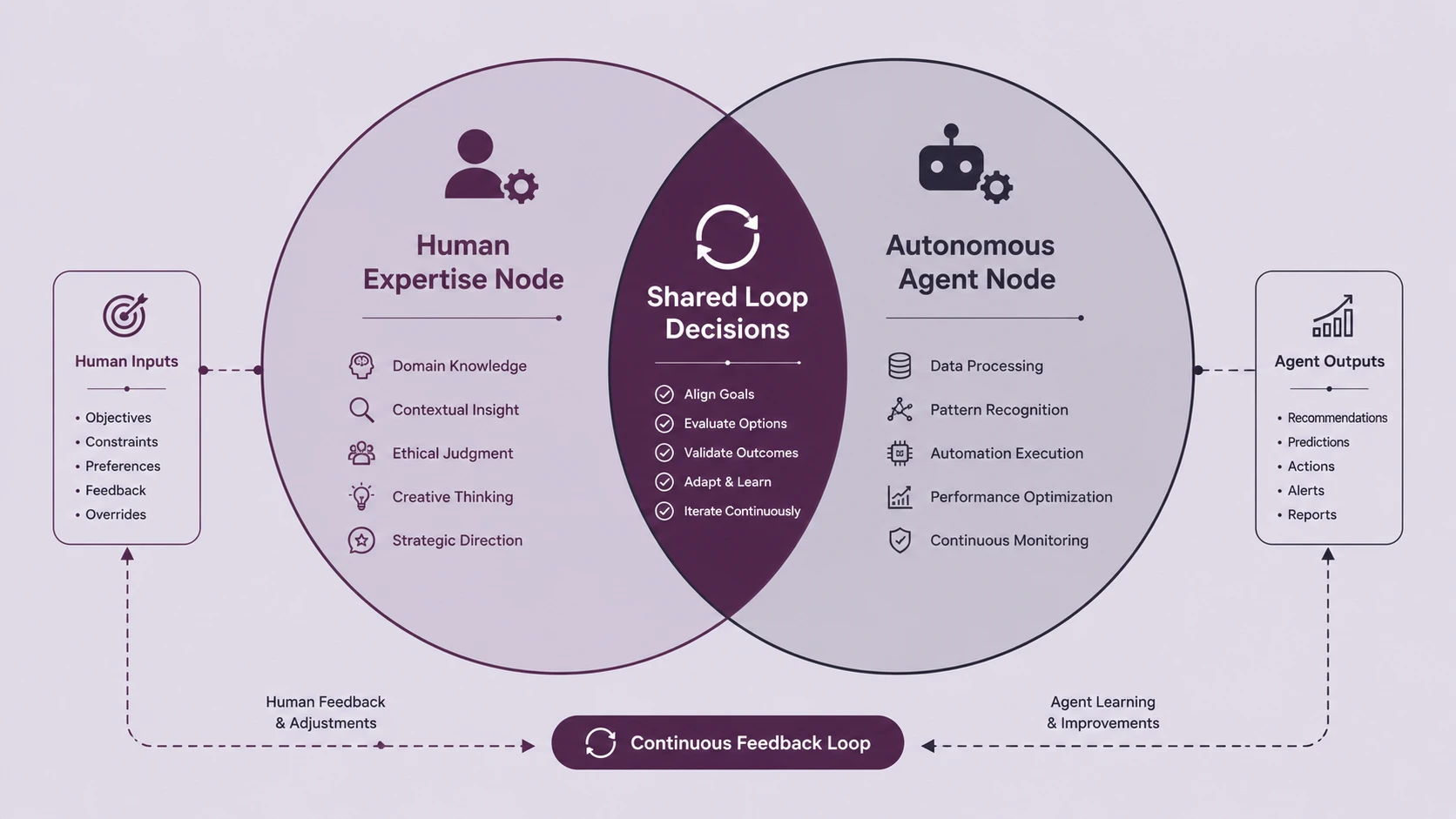
The difference is not that humans disappear from development. The difference is that humans move from directing every individual step toward defining objectives, reviewing decisions and accepting results.
Source: Introducing Replit Missions.
2. The Mission Contract: Define the Outcome Before Execution
One of the most important ideas in Replit Missions is that autonomous execution should begin with an agreement about what success means.
An ambiguous instruction such as "build a better customer management system" is not sufficient for a reliable autonomous workflow.
The system needs to understand:
- ◆What outcome is expected?
- ◆Which users or business processes are involved?
- ◆What functionality is required?
- ◆How will success be measured?
- ◆What resources can agents use?
- ◆Which actions require human approval?
- ◆What is the maximum acceptable spending limit?
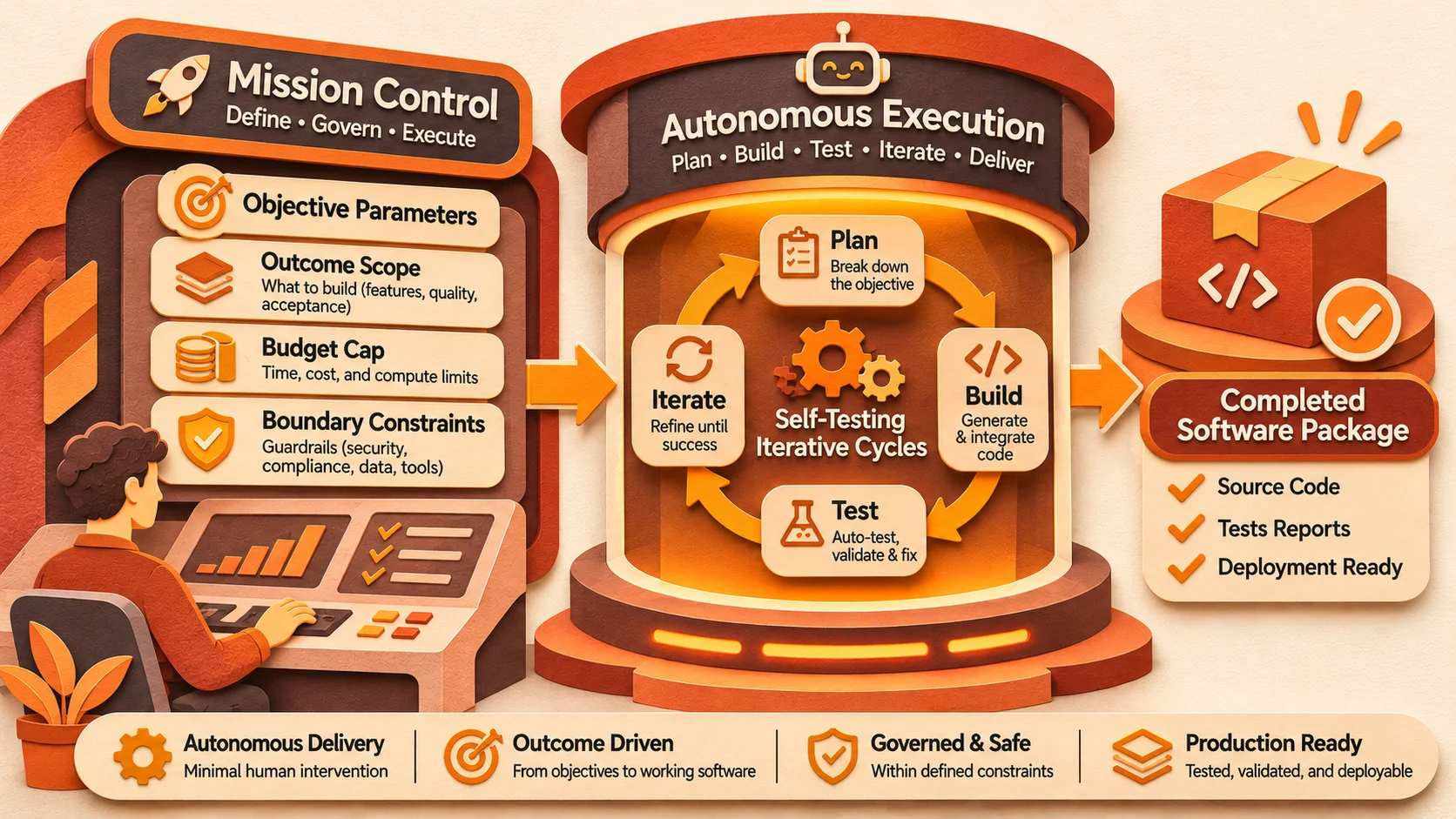
Replit's product describes an agreement covering the goal, budget, boundaries and completion criteria. The user can review and adjust the terms before execution begins.
This creates a practical distinction between an ordinary prompt and a mission specification.
A prompt communicates an instruction. A mission specification defines an objective, constraints and a method for determining whether the work is complete.
Example: Building an Internal Inventory Platform
Consider a company that wants to replace an existing inventory management tool.
A weak instruction would be:
"Build an inventory management application."
A more useful mission definition would be:
Objective: Build an internal inventory management application for three warehouse locations.
Required capabilities:
- ◆Product and SKU management.
- ◆Warehouse-level stock tracking.
- ◆Purchase and sales movement records.
- ◆Low-stock alerts.
- ◆Role-based access.
- ◆Inventory reporting.
- ◆Data import and export.
Success criteria:
- ◆All required workflows are implemented.
- ◆Automated tests cover critical inventory operations.
- ◆Stock calculations pass defined validation scenarios.
- ◆Users with different roles receive the correct permissions.
- ◆The application can be deployed to the approved environment.
Boundaries:
- ◆Use the approved repository and development environment.
- ◆Do not access production databases without authorization.
- ◆Require approval before purchasing external services.
- ◆Keep total mission spending within the agreed limit.
This level of definition gives agents a clearer target and gives reviewers a basis for evaluating the final result.
3. How Replit Missions Works: From Goal to Verified Result
Replit Missions can be understood as a sequence of connected stages.
Stage 1: Define the Mission
The user describes the intended outcome in natural language.
Missions asks clarifying questions where additional information is needed. These questions help establish the scope, acceptable tradeoffs and conditions for success.
For example, a request to acquire ten enterprise customers requires clarification about what qualifies as an enterprise customer. Does a paid pilot count? Must the customer sign an annual agreement? Is there a minimum contract value?
These details change how agents prioritize their work and how the final outcome is evaluated.
Stage 2: Establish Budget and Boundaries
Before execution, the user defines the spending limit and the actions that require permission.
For example, an enterprise sales mission might have a $1,000 budget and require explicit approval before agents contact prospects, send proposals, change customer-facing materials or make commercial commitments.
These boundaries are important because autonomous agents can perform actions that have financial, operational or reputational consequences.
A spending limit also provides a clear stopping condition. If the budget is exhausted before the success criteria are met, the mission stops with the outcome unresolved.
Stage 3: Plan and Delegate Work
Once the mission is agreed, agents break the objective into smaller activities.
A software engineering mission might involve separate workstreams for:
- ◆Repository analysis.
- ◆Architecture planning.
- ◆Backend implementation.
- ◆Frontend implementation.
- ◆Database changes.
- ◆Automated testing.
- ◆Performance evaluation.
- ◆Documentation.
Agents can work on independent activities in parallel where dependencies permit.
This is the foundation of an agent swarm: multiple agents contribute to a shared objective rather than operating as unrelated chat sessions.
Stage 4: Build, Test and Iterate
Agents execute their assigned work, share findings and use feedback to improve the result.
For software development, this can involve modifying files, building application components, running tests and investigating failures.
If an implementation does not meet a requirement, the system can use evaluation feedback to guide further work.
This iterative process is important because autonomous software delivery is not simply about generating a large amount of code. The system must establish whether the implementation satisfies the agreed requirements.
Stage 5: Independent Evaluation
Replit describes an independent AI judge that checks the results against the mission's agreed success criteria.
The judge evaluates the work and can provide feedback that agents use to refine their implementation.
A mission is marked complete when its criteria are met. If the spending limit is reached first, the mission stops without claiming that the desired outcome has been achieved.
This separation between implementation and evaluation is an important design principle. The system should not assume that an agent's statement that its work is finished is sufficient evidence of success.
However, an AI judge is not a replacement for every form of independent verification. Critical systems still require deterministic tests, security review, domain validation and human acceptance.
Stage 6: Review and Approve the Result
Users can inspect completed work, active tasks, next steps and items awaiting approval.
Replit's product documentation also describes reviewable files and pull-request-oriented engineering controls. Actions outside the agreed boundaries wait for human involvement.
The final responsibility for accepting consequential changes remains with the organization.
4. Why Agent Swarms Matter
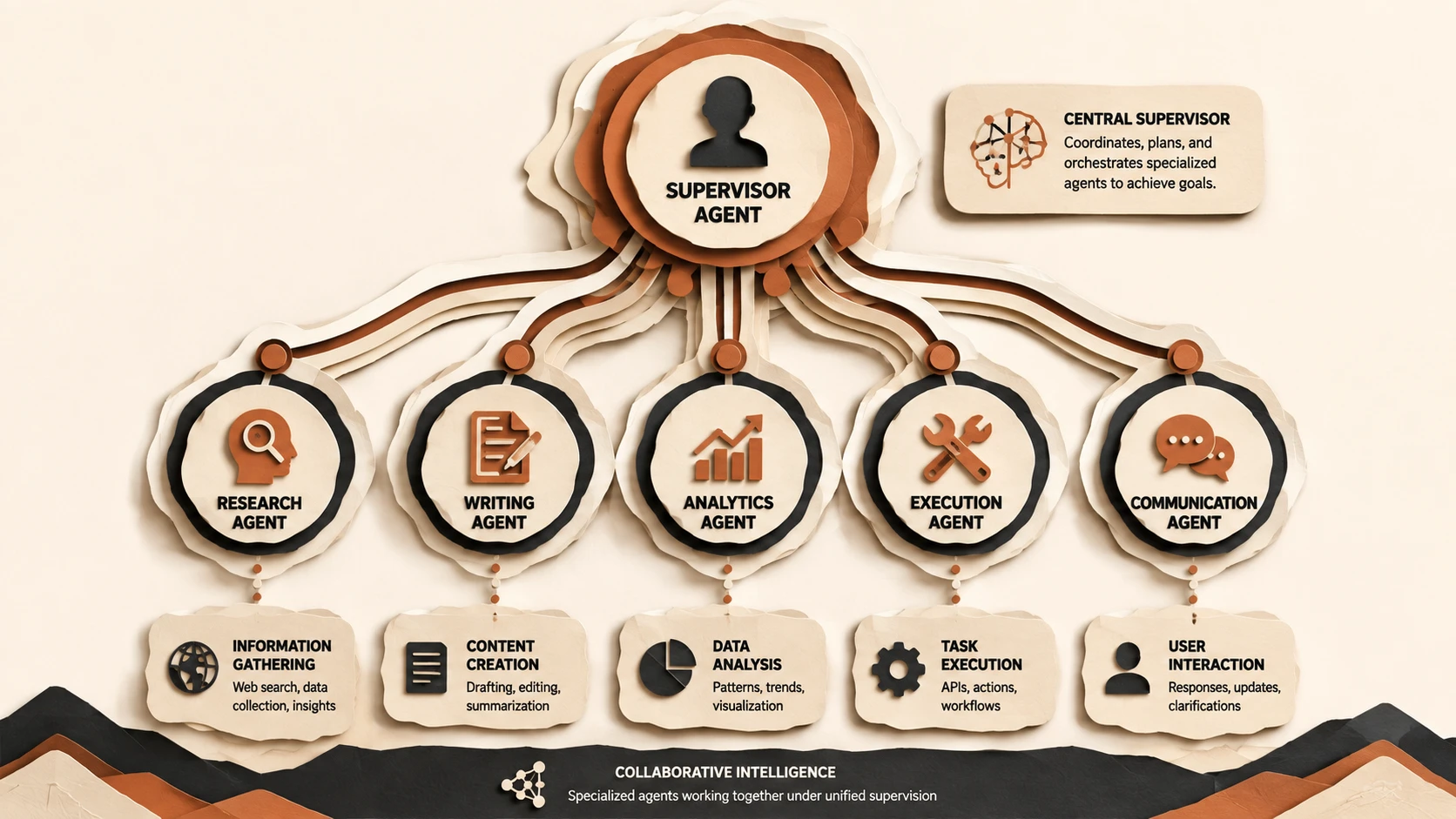
A single AI agent generally works through a task using its available context, tools and execution loop.
An agent swarm introduces multiple agents that can investigate different approaches or workstreams at the same time.
Consider a performance optimization task involving a large data-processing application.
A coordinated group could explore:
- ◆Algorithmic improvements.
- ◆Memory allocation patterns.
- ◆Database access strategies.
- ◆Parallel execution.
- ◆Caching opportunities.
- ◆Regression testing.
Each agent can investigate a different direction. Their findings can then inform further implementation and validation.
The advantage is not simply having more agents. It is increasing the number of useful approaches that can be explored without requiring a human engineer to manually coordinate every experiment.
Replit's NumPy Benchmark Example
In its launch announcement, Replit described an experiment across 13 representative NumPy benchmark tasks.
The company reported the following speedups:
| Agent configuration | Auto (Max) | Auto (Power) |
|---|---|---|
| --- | ---: | ---: |
| Single agent | Up to 4× | Up to 2× |
| 16-agent swarm | 17× | 7× |
| 32-agent swarm | 19× | 9× |
These are results reported by Replit for its selected benchmark tasks. They should not be interpreted as a guarantee that adding 32 agents will make every enterprise development project 19 times faster.
Actual performance depends on task decomposition, shared context, coordination overhead, available compute, dependencies and the ability to validate results.
The broader lesson is that parallel exploration can produce meaningful improvements when work can be divided into independent experiments.
5. DataCat: Replit's Real-World Missions Demonstration
Replit's most detailed launch example is DataCat, an application monitoring platform that the company says it built using Missions.
Replit wanted to bring application monitoring in-house to reduce costs and gain more control over its infrastructure.
Instead of treating the project as a series of individual coding prompts, the team defined the desired platform and allowed a swarm of agents to build and test it.
According to Replit, the platform was developed in two days within a capped budget of $3,000.
The resulting system included:
- ◆Monitoring dashboards.
- ◆Alerts.
- ◆Application tracing.
- ◆A monitoring agent for collecting server data.
- ◆Tracing libraries.
- ◆Support for multiple storage engines.
Testing the Monitoring Platform
Replit also described several validation activities.
| Test | Result reported by Replit |
|---|---|
| Build time and budget | 2 days, within a $3,000 cap |
| Deliberately introduced database bug | Alert raised in 38 seconds against a 60-second target |
| Three-hour load test | 26 million activity records and 4.4 million log entries stored without reported data loss |
| Data correctness and alert reliability | 51 of 51 checks passed |
| Monitoring efficiency in matched Node.js tests | 39% more requests handled with 51% less monitoring-related processor overhead |
| API compatibility | 51 of 56 checks passed on each DataCat storage engine |
| Application trace intake | 49,000 traces per second with Postgres in the reported comparison |
| Metric intake | 405,100 metric points per second with Postgres in the reported comparison |
Replit also compared DataCat with a separate monitoring-platform build produced using Claude Code. In the reported API compatibility test, DataCat passed 51 of 56 checks, compared with 45 of 56 for that build.
These results need context. Replit notes that the controlled tests do not establish performance against the original monitoring platform's hosted service or against Replit's production systems. The comparison used defined workloads and specific test configurations.
The example is nevertheless useful because it demonstrates the type of outcome-oriented work Missions is intended to coordinate: a working application, a controlled budget and measurable validation results.
Replit also announced that it was open-sourcing a self-hostable version of DataCat, giving teams an opportunity to inspect and customize the resulting platform.
Source: Introducing Replit Missions — DataCat case study.
6. The Architecture Behind Autonomous Software Delivery
Replit Missions illustrates a broader architectural pattern for enterprise agentic systems.
A production-ready autonomous delivery environment needs more than a collection of language models. It requires orchestration, shared context, execution environments, tools, evaluation and governance.
A useful conceptual architecture contains the following layers.
Layer 1: Mission Interface
This is where users define business or engineering outcomes.
It collects the objective, requirements, constraints, budget and success criteria.
The interface should make it easy to inspect the agreed scope and understand which decisions require approval.
Layer 2: Mission Planner
The planner translates the overall objective into a structured plan.
It identifies dependencies, proposes workstreams and determines which activities can run in parallel.
For a software project, the plan might separate API development, frontend implementation, database design and testing.
Layer 3: Agent Orchestrator
The orchestrator assigns work to specialized agents and coordinates their execution.
Its responsibilities may include:
- ◆Task assignment.
- ◆Dependency management.
- ◆Shared context management.
- ◆Progress tracking.
- ◆Conflict detection.
- ◆Retry handling.
- ◆Escalation when human input is required.
This layer is critical because multiple agents can create conflicting changes or duplicate work if their responsibilities are not clearly defined.
Layer 4: Model and Agent Layer
Different agents may use different models or configurations depending on their responsibilities.
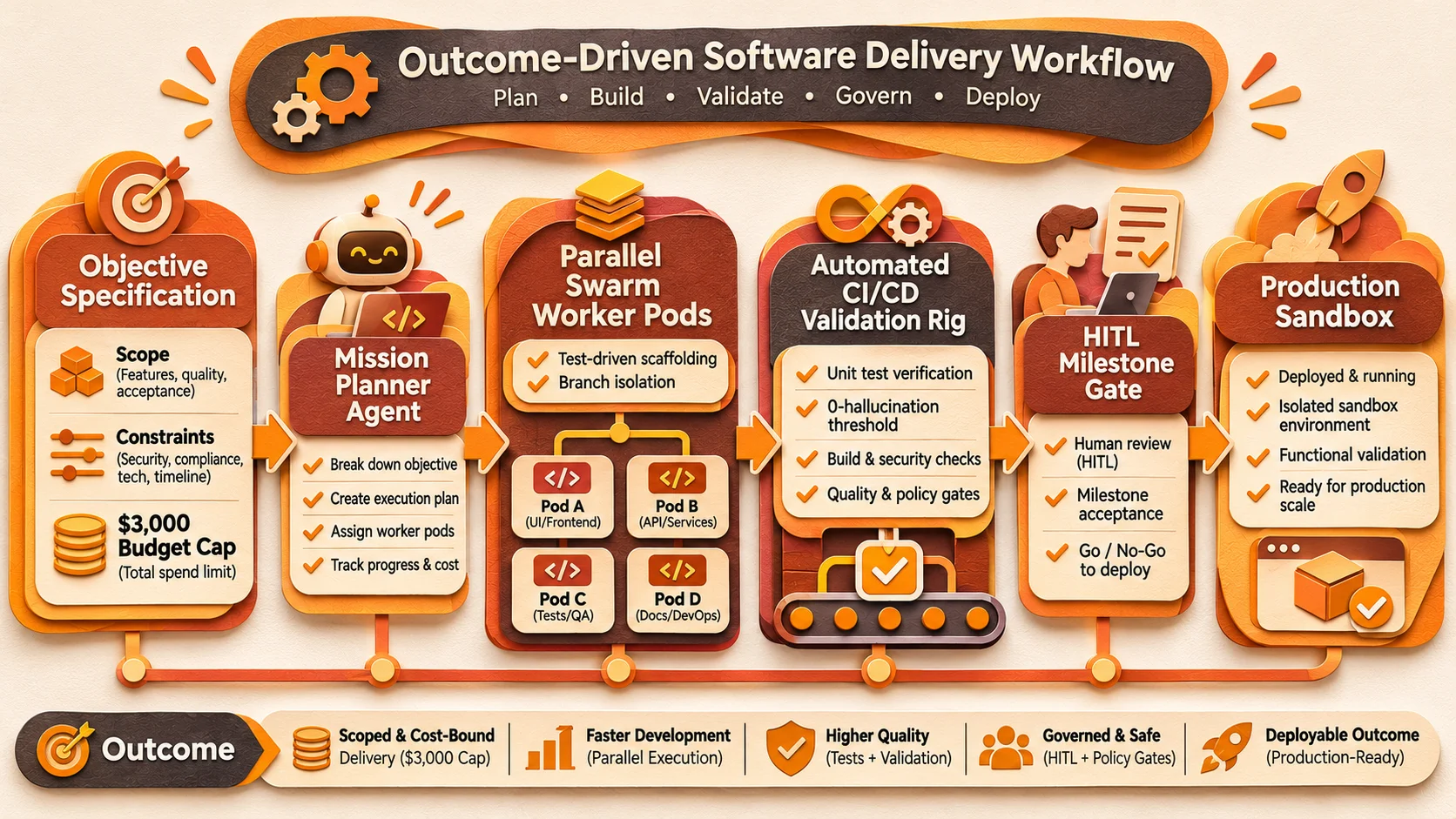
Replit Missions autonomous delivery pipeline illustrating budget-bounded planning, parallel worker swarm execution, and CI/CD validation.
For example:
- ◆A planning agent analyzes the mission.
- ◆A backend agent implements APIs.
- ◆A frontend agent builds user interfaces.
- ◆A testing agent creates and executes test cases.
- ◆A review agent checks implementation quality.
Specialization helps establish clear ownership, but it does not automatically guarantee better results. Agents still need shared definitions, reliable context and coordination rules.
Layer 5: Tool and Execution Layer
Agents need access to tools that allow them to perform real work.
For software delivery, these can include:
- ◆Git repositories.
- ◆File systems.
- ◆Terminals.
- ◆Build tools.
- ◆Test runners.
- ◆Package managers.
- ◆Issue trackers.
- ◆Documentation systems.
- ◆Deployment pipelines.
Execution should take place in controlled environments with explicit permissions.
Layer 6: Evaluation and Governance
The evaluation layer checks whether the work satisfies the agreed requirements.
Governance determines what agents can access, which actions require approval and how spending is controlled.
This layer should also capture logs, execution evidence, failures, approvals and final outcomes.
Reference Architecture
              Business Owner / CTO
                       |
                       v
                Mission Interface
                       |
             Goal + Budget + Rules
                       |
                       v
                 Mission Planner
                       |
                       v
               Agent Orchestrator
                       |
          +------------+------------+
          |            |            |
          v            v            v
      Backend       Frontend      Testing
       Agent         Agent         Agent
          |            |            |
          +------------+------------+
                       |
                       v
              Shared Context Layer
                       |
                       v
              Controlled Tool Layer
                       |
          +------------+------------+
          |            |            |
          v            v            v
       Git/Files     Build       Test Runner
          |            |            |
          +------------+------------+
                       |
                       v
               Evaluation Agent
                       |
                       v
             Success Criteria Check
                       |
              +--------+--------+
              |                 |
              v                 v
          Meets Goals       Needs Work
              |                 |
              v                 v
        Human Review       Agent Iteration
              |                 |
              v                 +-----> Re-evaluation
          Acceptance

       Budget, Permissions and Audit Controls
                Across All Layers
This is a conceptual reference architecture for autonomous software delivery, not a claim that Replit Missions exposes each component as a separately configurable service.
7. The New Economics of Software Delivery
Traditional software development costs are usually measured through engineering time, infrastructure, licenses and operational expenses.
AI-assisted development introduces another cost dimension: model and agent execution.
A complex mission may involve multiple agents performing research, implementation, testing and evaluation. Each activity can consume compute and model usage.
Without controls, a seemingly simple goal can create unpredictable spending.
Replit addresses this challenge through mission-level budgets and spending visibility.
Users can establish a maximum budget, inspect usage as work progresses and review requests to increase the limit. The mission can stop when its budget is exhausted.
This changes the way organizations should think about AI development costs.
Instead of evaluating only the price of a model call, teams should measure the cost of an accepted engineering outcome.
A More Useful Cost Model
A practical enterprise cost model should include:
Total mission cost = Model usage + Agent execution + Infrastructure + Tooling + Testing + Human review + Rework
The formula is a planning framework rather than a Replit pricing formula.
For example, an agent swarm might generate a working application quickly, but the project can still become expensive if developers spend significant time correcting incorrect assumptions or repairing generated code.
Useful metrics include:
- ◆Cost per accepted feature.
- ◆Cost per successfully completed mission.
- ◆Percentage of generated changes accepted without major rework.
- ◆Time from mission start to validated delivery.
- ◆Number of human approval interventions.
- ◆Defect rate after deployment.
- ◆Budget variance against the initial agreement.
These measurements help organizations distinguish genuine delivery improvements from faster code generation alone.
8. Replit Missions vs Traditional AI Coding Agents
The AI coding market includes tools that focus on interactive coding, repository-level execution and autonomous task completion.
These products are not necessarily direct substitutes. Their capabilities and operating models differ.
| Dimension | Interactive coding assistant | Autonomous coding agent | Replit Missions |
|---|---|---|---|
| Main interaction | Prompt and response | Delegate a coding task | Define an outcome or mission |
| Typical scope | Code suggestions and edits | Repository-level tasks | Broader multi-step objectives |
| Coordination | Developer-directed | Agent execution loop | Coordinated agent swarm |
| Validation | Developer-led or tool-assisted | Tests and tool feedback | Agreed criteria and AI judge |
| Budget control | Product-specific | Product-specific | Mission-level budget boundaries |
| Human involvement | Frequent direction | Review and intervention | Objective setting, approvals and acceptance |
The important distinction is the unit of delegation.
A coding assistant receives instructions about code. An autonomous coding agent receives a development task. A mission-oriented system receives an outcome and coordinates multiple activities toward it.
This is a change in workflow abstraction, not simply a larger context window or a more capable model.
9. What This Means for Enterprise CTOs and Engineering Leaders
The emergence of mission-based agent systems creates new opportunities, but it also changes the responsibilities of technology leadership.
Move From Task Delegation to Outcome Definition
Engineering leaders should become more precise about what successful delivery means.
A vague feature request creates ambiguity for both human developers and AI agents. A mission needs measurable acceptance criteria, known constraints and a clear owner.
Establish Agent Permissions
Agents should receive only the access needed to complete their assigned work.
A development agent may need repository access and permission to run tests. It should not automatically receive production credentials or unrestricted access to customer data.
Separate Implementation From Verification
The system that creates a solution should not be the only mechanism that declares it correct.
Use deterministic tests, security scanning, integration tests and human review alongside AI-based evaluation.
Define Budget Thresholds
Agent execution should have financial boundaries.
Set spending limits, define approval requirements for increases and monitor cost per accepted result.
Preserve Engineering Accountability
An autonomous system can perform implementation work, but the organization remains responsible for software quality, compliance, customer impact and operational reliability.
Human ownership must remain clear throughout the delivery process.
10. Risks and Limitations of Autonomous Software Delivery
Autonomous execution creates a different risk profile from ordinary AI assistance.
Incorrect Interpretation of Business Goals
An agent may satisfy a literal interpretation of a mission while missing the business intent behind it.
For example, improving response time by removing important validation could technically improve a benchmark while damaging application correctness.
Mission definitions must include constraints that prevent unacceptable tradeoffs.
Agent Coordination Overhead
Adding more agents does not always improve performance.
Agents can duplicate work, create conflicting changes or spend time communicating instead of making progress.
Effective orchestration requires task ownership, dependency management and shared context.
Incomplete or Misleading Evaluation
An AI judge may overlook edge cases or incorrectly assess whether a requirement has been satisfied.
Critical acceptance criteria should be backed by reproducible tests and independent review.
Security and Tool Abuse
Agents with access to terminals, repositories and external systems can make consequential changes.
Organizations should use isolated execution, least-privilege credentials, restricted network access and explicit approval gates.
Hidden Maintenance Costs
A working prototype is not automatically a production-ready enterprise system.
Long-term ownership requires documentation, monitoring, security updates, backups, incident response and a sustainable maintenance model.
Budget Does Not Guarantee Completion
A mission budget limits spending, but it does not guarantee that the desired outcome will be achieved within that limit.
Organizations should plan for unresolved missions, escalation and human takeover.
11. A Practical Adoption Strategy for Enterprise Teams
Organizations should not begin by delegating their most critical production systems to autonomous agents.
A controlled adoption strategy can reduce risk while establishing whether the technology creates measurable value.
Phase 1: Select a Bounded Problem
Start with a task that has clear requirements and limited external dependencies.
Examples include:
- ◆Building an internal reporting dashboard.
- ◆Creating a prototype for a new workflow.
- ◆Refactoring a self-contained module.
- ◆Generating test coverage for an existing service.
- ◆Replacing a small internal utility.
Phase 2: Define Acceptance Criteria
Document the expected functionality, performance requirements, security constraints and validation steps.
Make the criteria measurable wherever possible.
Phase 3: Set Permissions and Budget
Create a dedicated development environment with restricted credentials.
Define the spending limit and actions requiring human approval.
Phase 4: Run a Controlled Mission
Allow agents to execute the agreed work while monitoring progress, tool usage, blockers and spending.
Record where human intervention is required.
Phase 5: Independently Validate the Result
Run automated tests, security checks, performance evaluations and architecture reviews.
Compare the final implementation with the original requirements.
Phase 6: Measure Business Value
Compare the mission with a conventional delivery approach.
Measure engineering hours, total cost, accepted functionality, defects and maintenance effort.
Phase 7: Expand Gradually
Increase mission complexity only after the team has established reliable operating practices and clear accountability.
12. The Future: From AI Coding Assistants to the Self-Driving Company
Replit positions Missions as a step toward what it calls the Self-Driving Company.
The idea is not an organization without people. People continue to decide which problems matter, establish priorities, make tradeoffs and accept responsibility.
Agents increasingly coordinate the execution required to achieve those objectives.
This idea extends beyond software engineering.
A business goal such as entering a new market could involve research agents, product agents, sales agents and analysis agents. A software modernization objective could involve repository analysis, migration planning, implementation, testing and documentation.
The underlying pattern is similar: define the desired outcome, establish boundaries, coordinate specialized work and evaluate the result.
However, the long-term success of this approach will depend on more than agent capability. Organizations will need reliable orchestration, accurate evaluation, secure tool access, transparent economics and clear accountability.
The companies that benefit most will be those that redesign their operating processes around these capabilities instead of simply adding more AI tools to existing workflows.
Conclusion: The Unit of AI Work Is Becoming the Outcome
Replit Missions represents an important evolution in AI-assisted software development.
Traditional assistants help developers write code. Autonomous agents can take on larger development tasks. Mission-oriented systems go further by coordinating multiple agents around a defined outcome, with budgets, boundaries and success criteria.
The DataCat example illustrates the ambition: a coordinated agent swarm building and testing a working application within a specified budget and timeline.
For enterprise teams, the opportunity is substantial. Complex internal tools, performance improvements, prototypes and selected modernization projects may become easier to delegate.
But autonomous delivery does not eliminate the need for software engineering discipline. It makes architecture, testing, security, governance and acceptance criteria even more important.
The key shift is not that developers will stop writing code. It is that software teams will increasingly decide which outcomes to delegate, which boundaries to enforce and how to verify the work agents produce.
The next generation of AI development platforms will compete not only on how much code they can generate, but on how reliably they can deliver a measurable, accepted outcome.