Introduction
Single Page Applications (SPAs) have become a primary architecture for enterprise web applications. Organizations are increasingly building customer portals, Software as a Service (SaaS) platforms, administration consoles, analytics dashboards, and collaboration tools that demand responsive user interfaces capable of managing complex application state.
React has emerged as one of the most discussed JavaScript libraries because of its component-oriented architecture and Virtual DOM rendering model. Since becoming open source, React has attracted growing interest from development teams seeking an alternative to traditional MVC-style JavaScript frameworks.
React 0.13 represents another important step in the library's evolution. Rather than introducing an entirely new rendering engine, this release improves the programming model by embracing emerging ECMAScript 6 (ES6) language capabilities, refining component definitions, and encouraging clearer separation of application responsibilities.
For enterprise development teams evaluating long-term front-end architecture, React 0.13 provides an opportunity to modernize component design while preparing applications for the next generation of JavaScript.
Industry Background
The JavaScript ecosystem continues to evolve rapidly. Browser capabilities have expanded considerably through HTML5, CSS3, improved JavaScript engines, and modern developer tooling.
At the same time, ECMAScript 6 is approaching standardization, introducing language features such as:
- ◆Classes
- ◆Modules
- ◆Arrow functions
- ◆Template strings
- ◆Block scoping
- ◆Improved object syntax
Although browser support is still developing, transpilation tools are making it increasingly practical for developers to begin experimenting with modern JavaScript syntax.
React 0.13 aligns itself with this direction by improving support for ES6 class-based components while continuing to support existing component patterns.
The Business Problem
Large enterprise front-end applications commonly experience:
- ◆Growing component complexity
- ◆Duplicate rendering logic
- ◆Difficult state management
- ◆Large view hierarchies
- ◆Increasing maintenance effort
- ◆Slow onboarding of new developers
- ◆Tight coupling between presentation and business logic
As applications expand across multiple development teams, consistent component architecture becomes increasingly important.
React's evolving programming model seeks to improve maintainability without sacrificing rendering performance.
Understanding React 0.13
React remains a JavaScript library focused on building user interfaces through reusable components.
Applications are composed from small interface modules that describe how the user interface should appear for a given application state.
React continues to leverage:
- ◆Declarative rendering
- ◆Virtual DOM reconciliation
- ◆Component composition
- ◆One-way data flow through properties
Version 0.13 enhances the development experience by improving compatibility with ES6 class syntax and encouraging cleaner component organization.
Core Architecture
| Component | Responsibility |
|---|---|
| React Component | Encapsulates interface behavior |
| ES6 Class | Defines component implementation |
| Properties (Props) | Receive external data |
| State | Maintains internal component data |
| Virtual DOM | Represents UI in memory |
| Reconciliation Engine | Updates the browser DOM efficiently |
This architecture continues to separate interface definition from browser rendering.
ES6 Class Components
// Transitioning React Component declaration to ES6 Class syntax in React 0.13
import React from 'react';

export class UserCard extends React.Component {
  constructor(props) {
    super(props);
    this.state = { isClicked: false };
  }

  handleClick() {
    this.setState({ isClicked: !this.state.isClicked });
  }

  render() {
    return (
      <div onClick={() => this.handleClick()} className="card">
        <h3>{this.props.user.name}</h3>
        <p>{this.state.isClicked ? "Active Profile" : "Click to view details"}</p>
      </div>
    );
  }
}
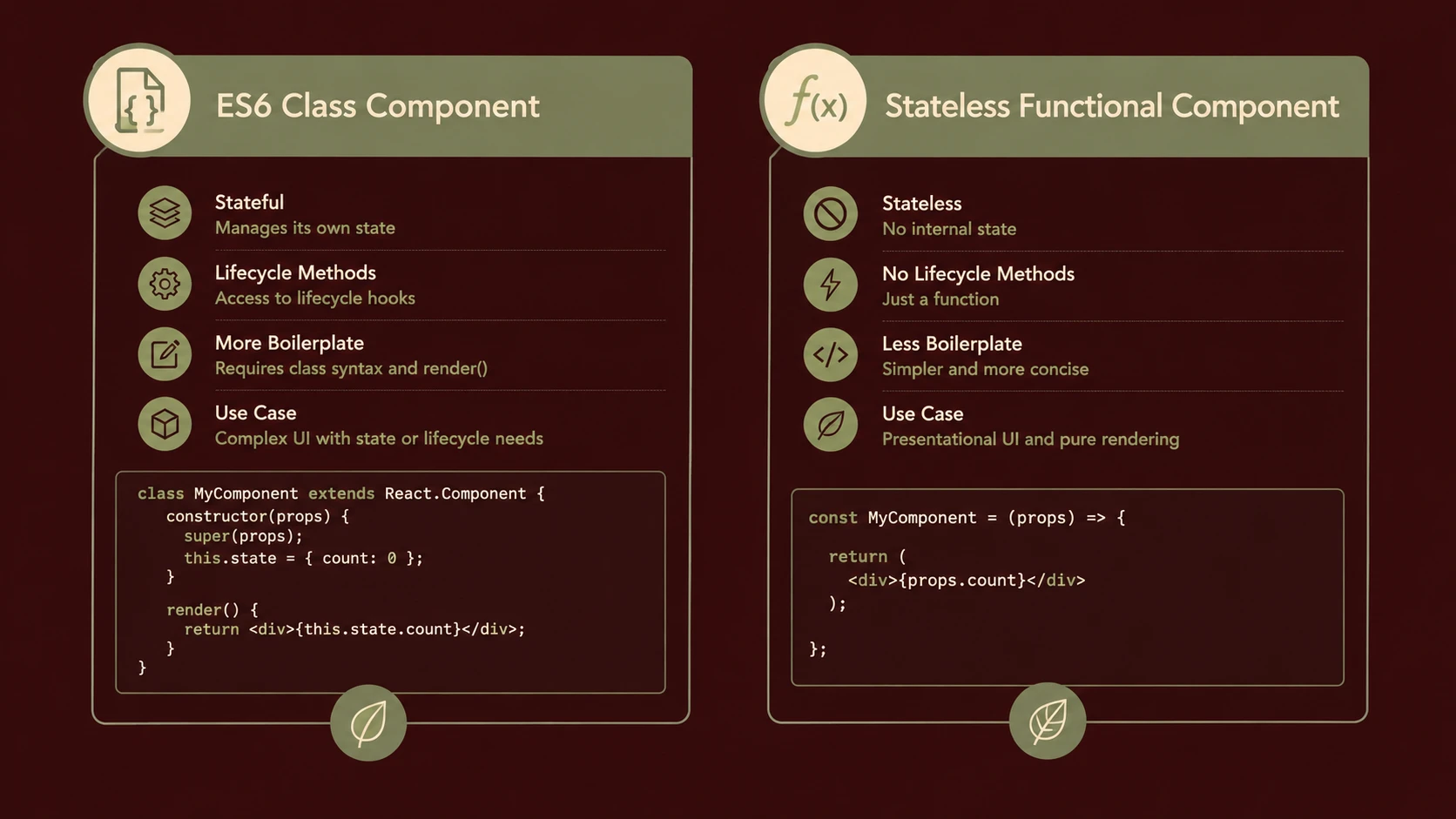
One of the most notable improvements in React 0.13 is better support for defining components using ES6 classes.
Rather than relying exclusively on React.createClass, developers can begin using JavaScript class syntax while preserving React's component model.
Potential advantages include:
- ◆Improved readability
- ◆Better alignment with future JavaScript development
- ◆Familiar object-oriented syntax
- ◆Cleaner component organization
- ◆Reduced dependence on framework-specific patterns
Organizations evaluating modern JavaScript development may find this transition particularly attractive.
Transitioning from React.createClass
Earlier React applications commonly define components using React.createClass.
React 0.13 introduces an alternative based on ES6 classes.
Both approaches remain available, allowing organizations to migrate incrementally.
A gradual transition minimizes disruption while enabling teams to gain familiarity with newer language features.
Stateless Components
As applications become larger, not every component requires internal state.
Many interface elements simply receive data through properties and render user interface elements.
Examples include:
- ◆Navigation links
- ◆Product summaries
- ◆User profile cards
- ◆Dashboard tiles
- ◆Table rows
- ◆Status indicators
Designing these components without unnecessary internal state simplifies testing and improves reuse.
Although the concept continues to evolve, React 0.13 encourages developers to distinguish between components responsible for application state and those focused solely on presentation.
Component Composition
React continues emphasizing composition rather than inheritance.
Complex user interfaces are constructed by combining smaller reusable components.
Examples include:
- ◆Dashboard widgets
- ◆Navigation systems
- ◆Search interfaces
- ◆Reporting panels
- ◆Form controls
- ◆Notification components
This modular approach reduces duplication while improving maintainability.
Properties and State
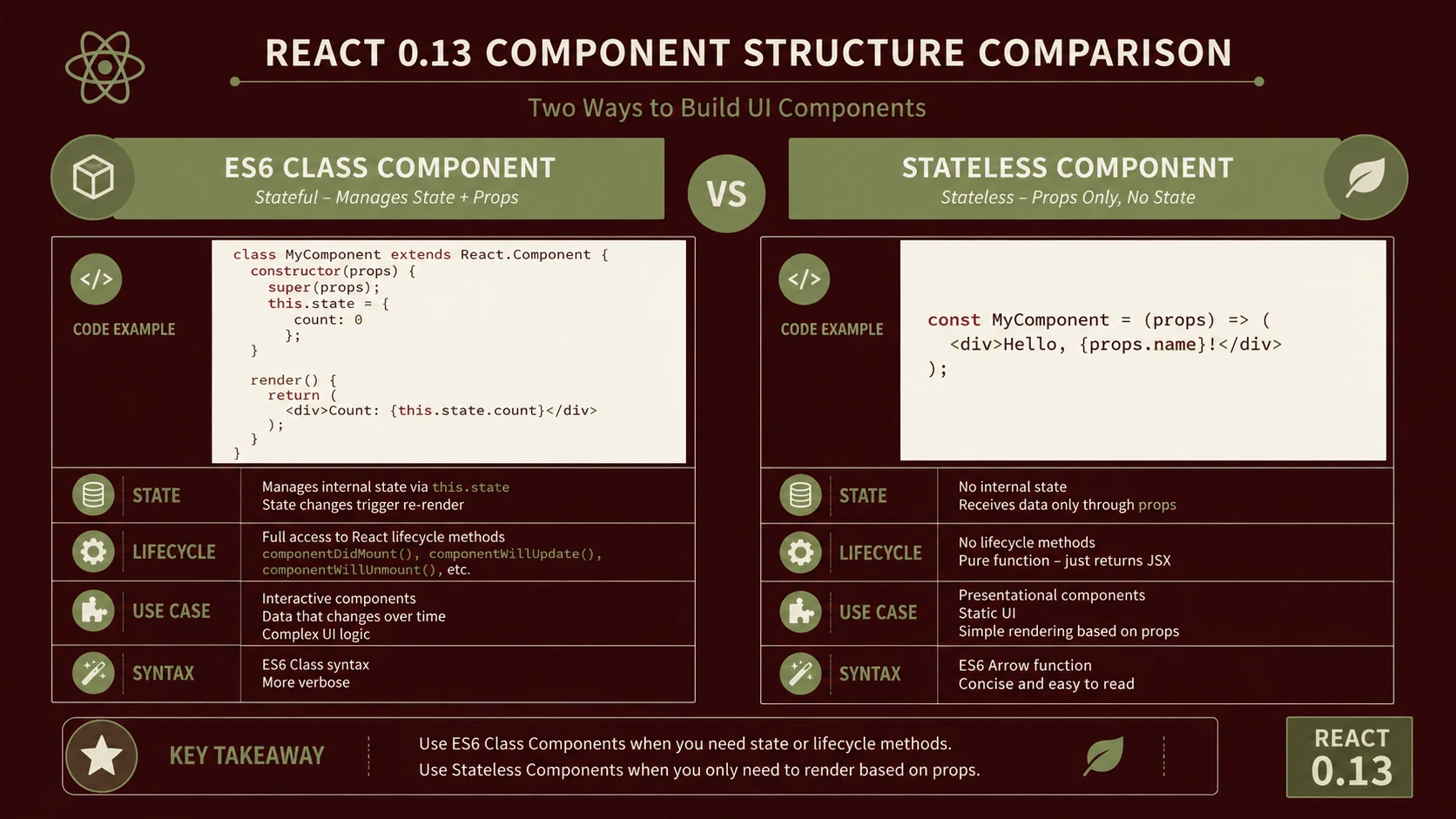
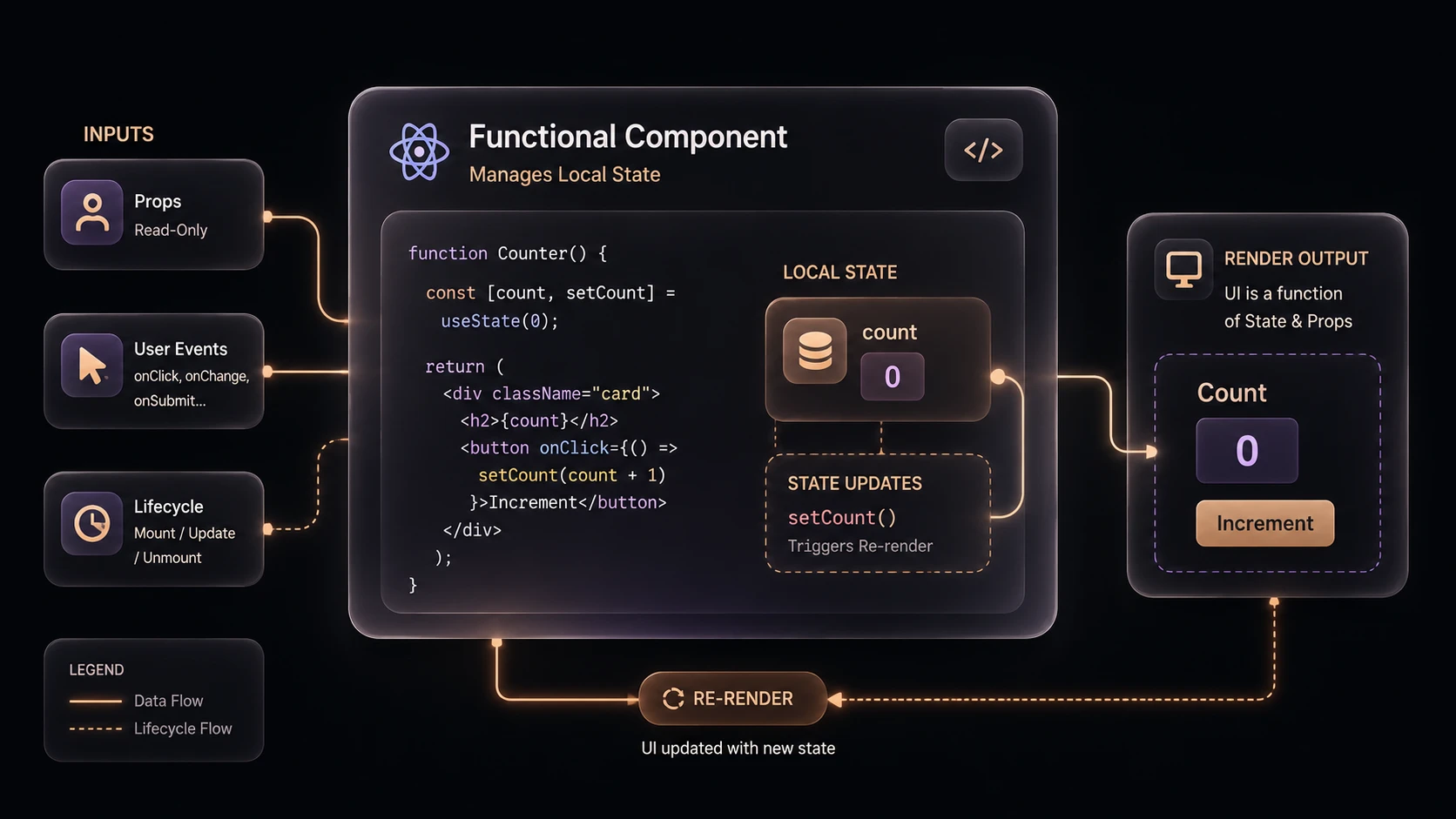
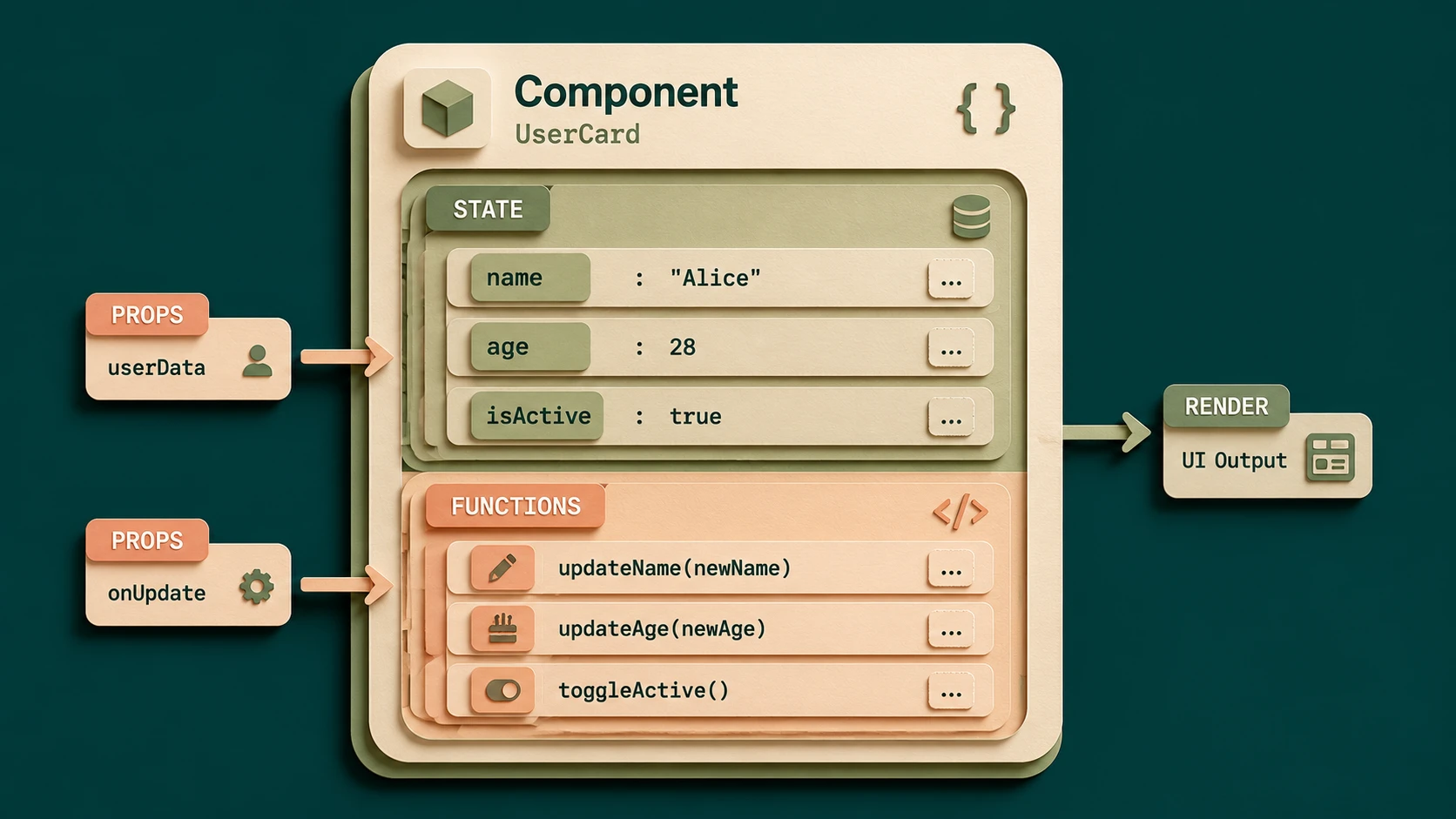
System architecture diagram and conceptual workflow layout for React 0.13: Transitioning to ES6 Classes and Stateless Components.
React applications generally separate external configuration from internal behavior.
Properties (props):
- ◆Configure components
- ◆Flow from parent components
- ◆Support predictable rendering
State:
- ◆Represents data managed internally by a component
- ◆Changes over time
- ◆Triggers interface updates
Maintaining this distinction contributes to cleaner application architecture.
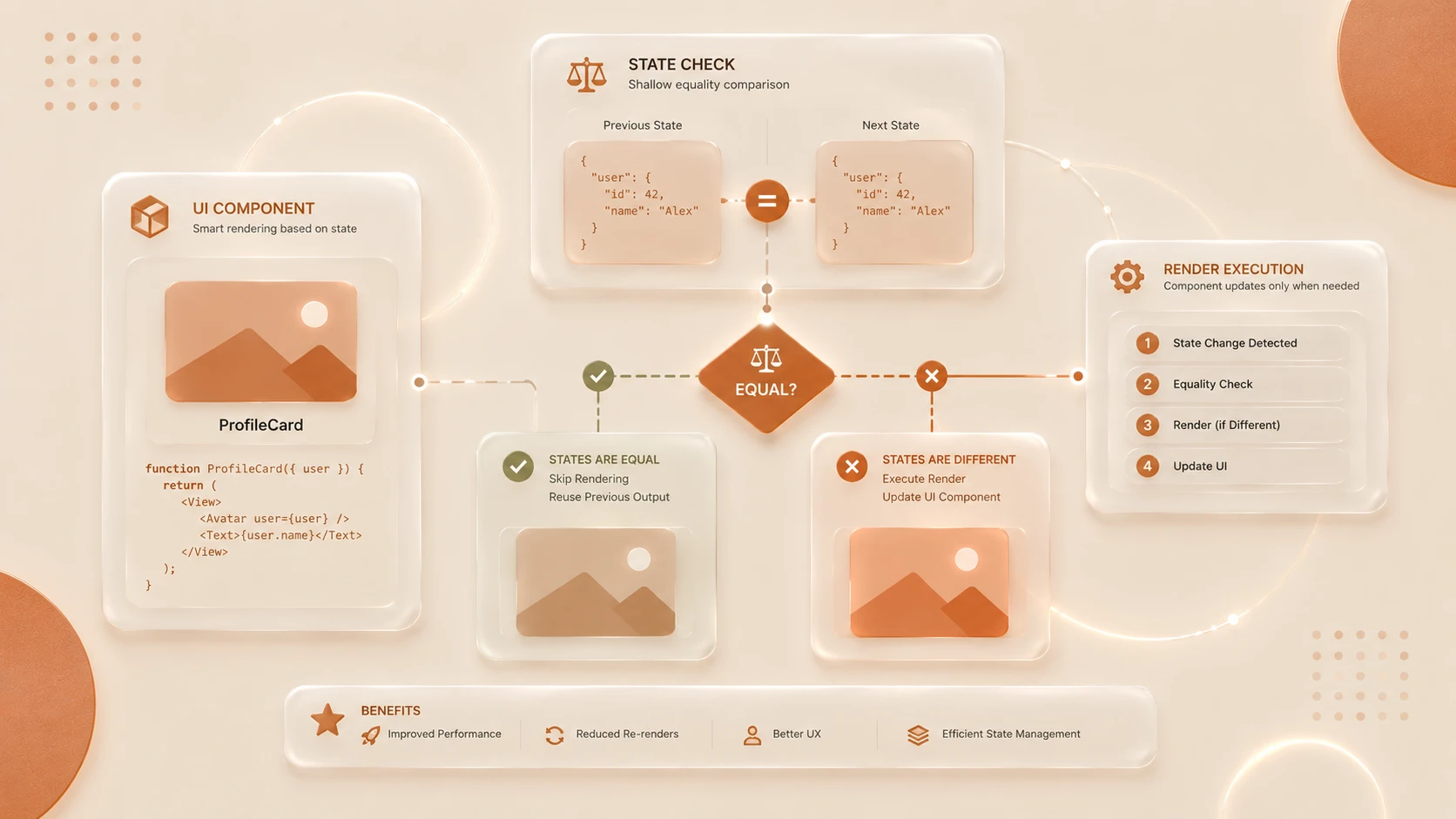
Virtual DOM Reconciliation
React continues using its Virtual DOM architecture to optimize rendering.
The rendering process typically follows these steps:
- 1.Application state changes.
- 2.Components generate updated Virtual DOM representations.
- 3.React compares previous and current trees.
- 4.Necessary browser DOM updates are identified.
- 5.The browser interface is updated efficiently.
Developers remain focused on describing interface state rather than manually manipulating DOM elements.
Enterprise Use Cases
| Scenario | Benefit |
|---|---|
| Enterprise dashboards | Modular widgets |
| SaaS platforms | Reusable components |
| CRM applications | Predictable rendering |
| Administration portals | Maintainable UI architecture |
| Reporting systems | Efficient updates |
| Customer portals | Component reuse |
Organizations building large browser applications benefit from React's modular architecture.
Performance Considerations
React's rendering performance continues to depend on thoughtful application design.
Teams should evaluate:
- ◆Component granularity
- ◆Rendering frequency
- ◆State organization
- ◆Browser memory usage
- ◆JavaScript execution time
The Virtual DOM reduces unnecessary DOM manipulation but does not eliminate the need for sound application architecture.
Security Considerations
React primarily addresses interface development rather than application security.
Organizations should continue implementing:
- ◆HTTPS
- ◆Authentication
- ◆Authorization
- ◆Server-side validation
- ◆Protection against cross-site scripting
Security remains the responsibility of the overall application architecture.
Scalability
React's component-oriented approach supports growing applications by encouraging:
- ◆Modular interface design
- ◆Reusable components
- ◆Separation of responsibilities
- ◆Independent feature development
- ◆Team collaboration
Consistent component conventions improve maintainability across large engineering organizations.
Best Practices
Development teams adopting React 0.13 should:
- ◆Prefer small, focused components.
- ◆Separate presentation from application logic.
- ◆Use ES6 classes for new components where appropriate.
- ◆Reuse components instead of duplicating markup.
- ◆Keep state localized where practical.
- ◆Document shared UI components.
- ◆Test components independently.
- ◆Establish coding standards for React development.
Consistent engineering practices simplify long-term maintenance.
Common Mistakes
Common implementation issues include:
- ◆Creating excessively large components.
- ◆Mixing business logic with rendering.
- ◆Introducing unnecessary component state.
- ◆Duplicating interface behavior.
- ◆Ignoring component reuse opportunities.
- ◆Assuming new language syntax alone improves architecture.
Successful React applications depend on disciplined component design rather than framework features alone.
Technology Comparison
| Capability | React.createClass | ES6 Class Components |
|---|---|---|
| Component Definition | React-specific API | JavaScript class syntax |
| Alignment with ECMAScript 6 | Limited | Improved |
| Readability | Good | Improved for many teams |
| Future JavaScript Compatibility | Moderate | Stronger alignment |
| Incremental Adoption | Existing applications | Supported alongside existing components |
React 0.13 allows organizations to modernize gradually without requiring complete application rewrites.
Adoption Strategy
Enterprise teams should approach React 0.13 incrementally.
A practical strategy includes:
- 1.Evaluate existing React components.
- 2.Introduce ES6 tooling within development environments.
- 3.Build new components using ES6 classes where appropriate.
- 4.Separate stateful and presentation-focused components.
- 5.Validate application behavior through automated testing.
- 6.Expand modern component patterns as development continues.
Gradual adoption reduces migration risk while preparing applications for future JavaScript development.
Limitations
As of January 2015, several considerations remain.
Current observations include:
- ◆ECMAScript 6 tooling continues to mature.
- ◆Existing applications may continue relying on
React.createClass. - ◆Organizations may require transpilation tools for modern JavaScript syntax.
- ◆Best practices for large-scale React applications continue to evolve.
Development teams should evaluate tooling alongside the framework itself.
Looking Ahead
React 0.13 represents an important milestone in aligning React with the broader evolution of the JavaScript language. By improving support for ES6 classes and encouraging clearer distinctions between stateful and presentation-oriented components, the library continues moving toward a cleaner and more maintainable programming model.
As of January 2015, organizations investing in enterprise web applications should view React 0.13 as an opportunity to establish modern component architecture while gradually adopting emerging ECMAScript 6 capabilities. A measured migration strategy allows teams to benefit from improved language features without disrupting existing React applications or development workflows.