Introduction
React has rapidly become one of the leading libraries for building modern web user interfaces. Enterprise dashboards, Software as a Service (SaaS) platforms, customer relationship management systems, analytics portals, and collaboration applications increasingly rely on React's component architecture to deliver responsive browser experiences.
As React applications mature, performance optimization becomes an increasingly important architectural concern. Large applications may contain hundreds or thousands of components, many of which receive frequent updates from user interactions, network responses, routing changes, or application state modifications.
Although React's Virtual DOM minimizes direct manipulation of browser elements, every component update still requires rendering work. Preventing unnecessary rendering therefore becomes an important optimization technique.
React 15.3 introduces React.PureComponent, providing developers with a simpler mechanism for avoiding unnecessary component updates by automatically performing shallow comparisons of properties and state. Rather than manually implementing update optimization logic in every component, developers gain a standardized approach that integrates naturally into React's rendering lifecycle.
As of July 2016, this addition represents an important refinement for organizations building increasingly sophisticated React applications.
Industry Background
Modern frontend applications increasingly emphasize:
- ◆Component-based architecture
- ◆Declarative rendering
- ◆Single Page Applications
- ◆Client-side routing
- ◆REST and GraphQL APIs
- ◆Reusable UI libraries
- ◆Rich browser interactions
As applications expand, rendering efficiency becomes an important factor in maintaining responsive user interfaces.
While browser performance continues improving, enterprise applications must still minimize unnecessary computation to provide consistent user experiences across supported devices.
The Business Problem
Large React applications frequently experience:
- ◆Unnecessary component rendering
- ◆Increased CPU utilization
- ◆Reduced UI responsiveness
- ◆Complex optimization logic
- ◆Duplicate rendering work
- ◆Difficult performance tuning
- ◆Maintenance challenges for manually optimized components
Applications require predictable optimization techniques that improve rendering efficiency without significantly increasing implementation complexity.
Understanding React Rendering
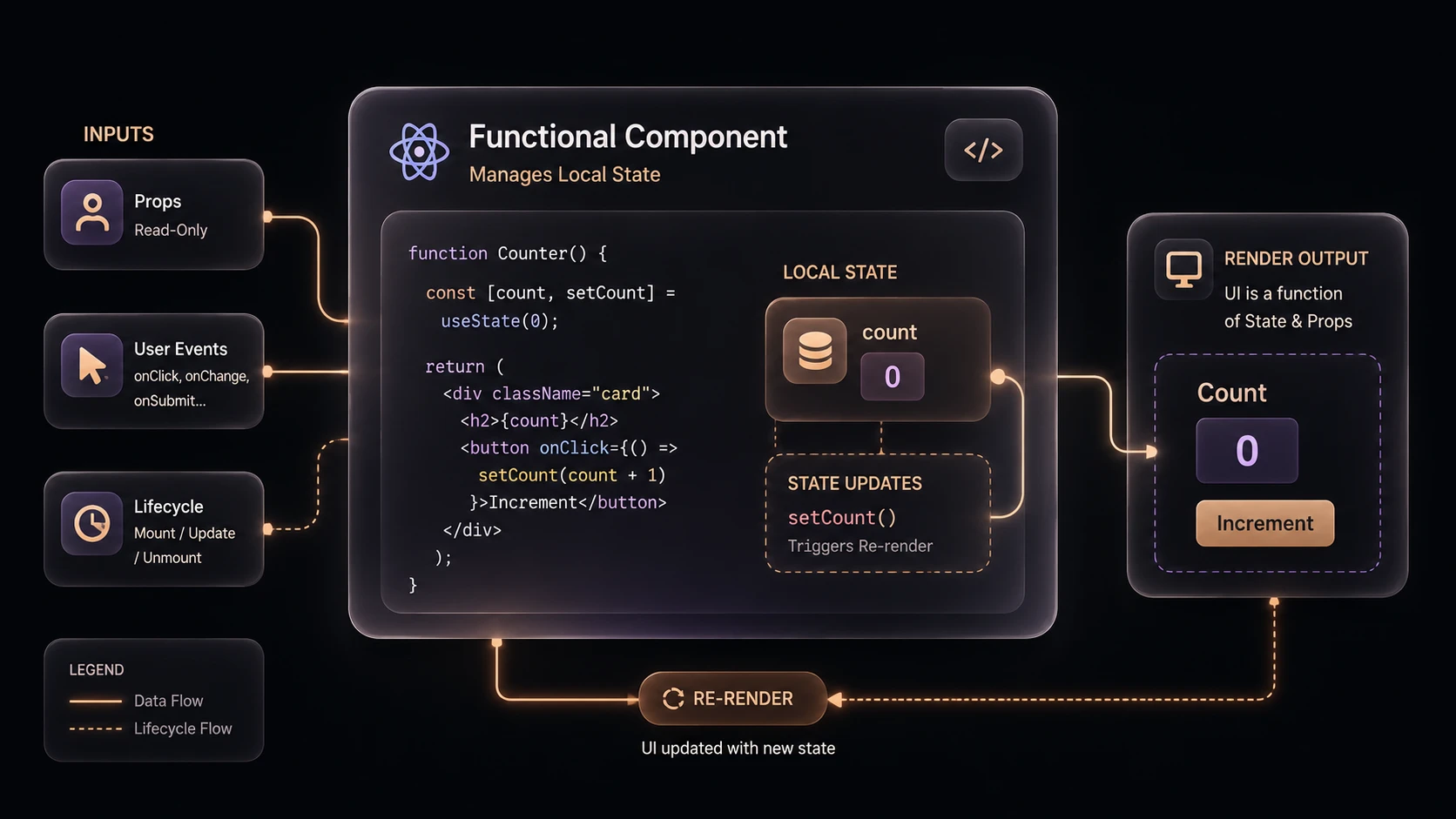
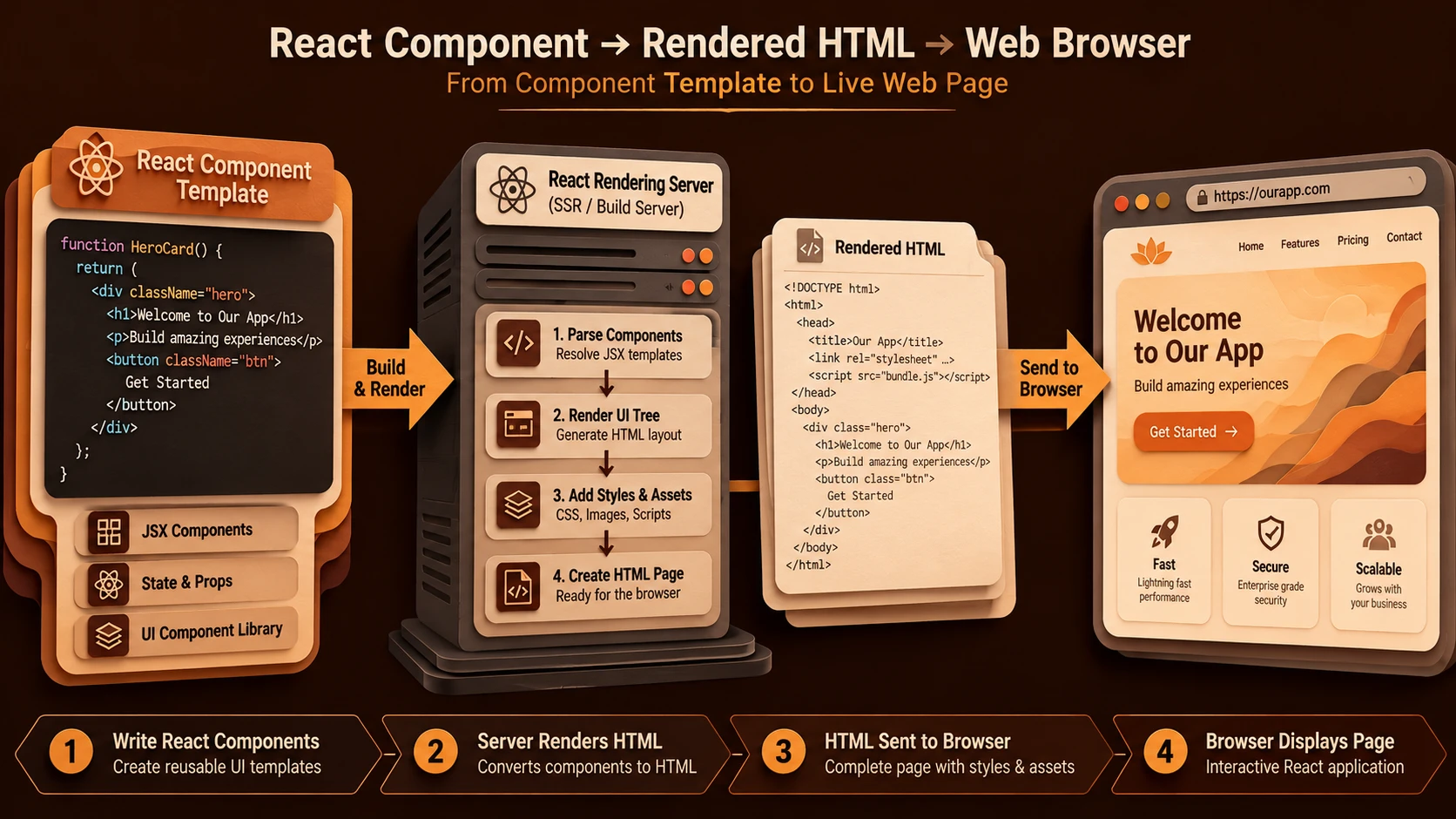
React updates the user interface by comparing the current component tree with a newly generated Virtual DOM representation.
Whenever a component receives new properties or updates its internal state, React determines whether rendering work is required.
Typical rendering stages include:
- 1.State or properties change.
- 2.React schedules a component update.
- 3.Rendering logic produces a new Virtual DOM.
- 4.React compares Virtual DOM representations.
- 5.Browser DOM updates are applied where necessary.
Reducing unnecessary rendering improves overall application responsiveness.
Core Architecture
| Component | Responsibility |
|---|---|
| Parent Component | Supplies properties |
| React.PureComponent | Performs shallow comparisons |
| Virtual DOM | Represents UI state |
| Reconciliation Engine | Determines required updates |
| Browser DOM | Applies visual changes |
| Application State | Drives rendering behavior |
This architecture separates rendering decisions from direct browser manipulation.
What is React.PureComponent?
// React.PureComponent declaration evaluating shallow props/state comparisons
import React from 'react';

export class ProductTitle extends React.PureComponent {
  render() {
    console.log('ProductTitle rendering...'); // Only runs if name prop changes
    return <h2>{this.props.name}</h2>;
  }
}
React.PureComponent extends the standard React component model by automatically implementing update optimization based on shallow comparison.
Rather than rendering every time new properties or state are received, React compares previous values with current values.
If no meaningful differences are detected, rendering can be skipped.
Benefits include:
- ◆Reduced rendering overhead
- ◆Simpler optimization
- ◆Cleaner component implementation
- ◆Improved consistency
This eliminates the need to manually implement common update comparison logic in many components.
Shallow Comparison
The optimization provided by React.PureComponent relies on shallow comparison.
Rather than recursively examining every nested object, React compares top-level property references and state values.
Typical comparisons include:
- ◆Primitive values
- ◆Object references
- ◆Array references
- ◆Function references
Because shallow comparison avoids deep object traversal, it remains computationally inexpensive while providing effective optimization for many application architectures.
Relationship with shouldComponentUpdate
Prior to React.PureComponent, developers commonly implemented rendering optimization through shouldComponentUpdate.
This lifecycle method allows developers to determine whether a component should render.
React.PureComponent provides a standardized implementation for many common scenarios.
Comparison:
| Approach | Characteristics |
|---|---|
| shouldComponentUpdate | Fully customizable update logic |
| React.PureComponent | Automatic shallow comparison |
Applications with specialized rendering requirements may still require explicit lifecycle implementations.
Immutable Data Patterns
React.PureComponent works most effectively when application data follows immutable update patterns.
Instead of modifying existing objects directly, applications create new object instances when values change.
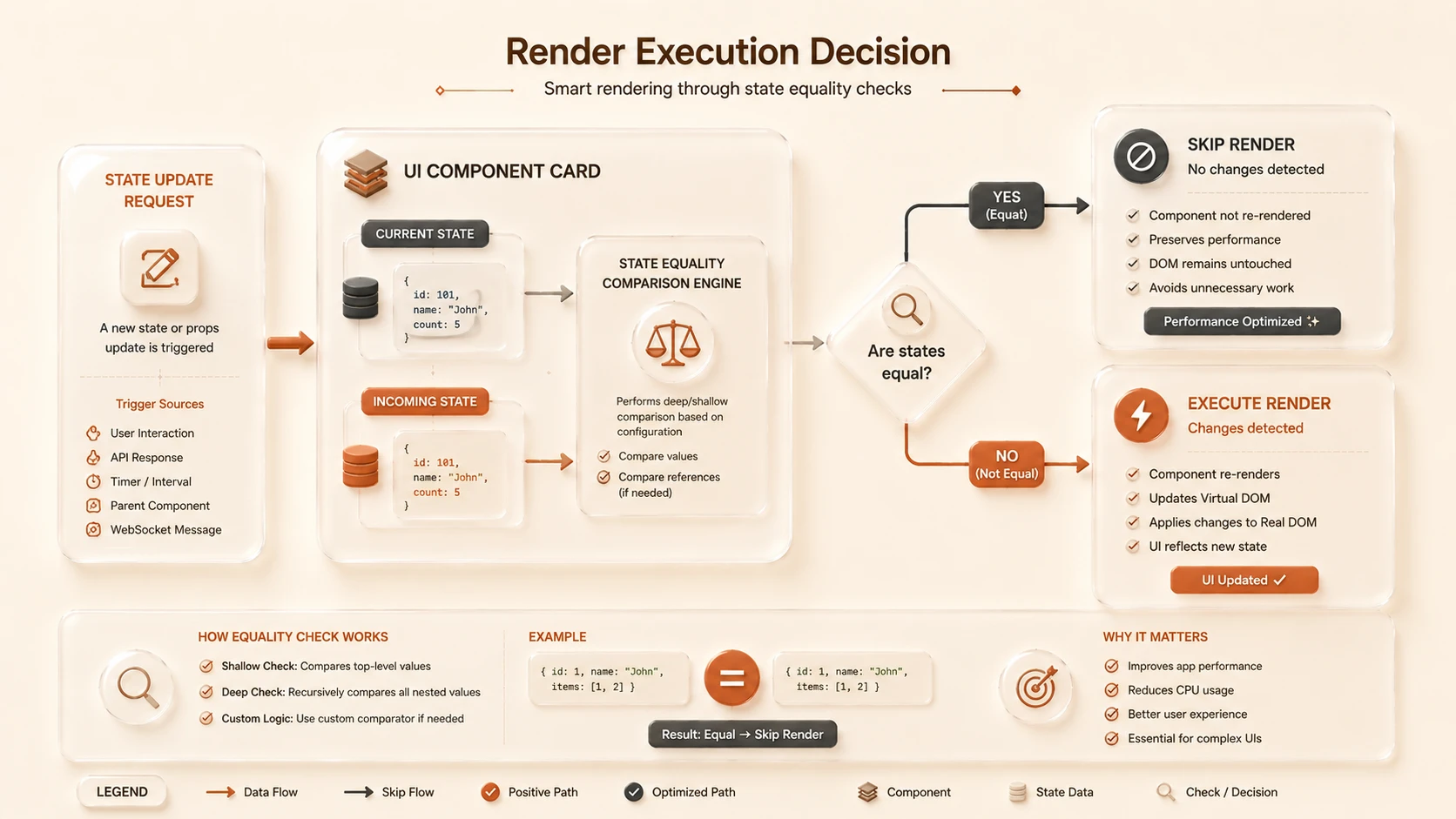
System architecture diagram and conceptual workflow layout for React 15.3: React.PureComponent and Shallow Component Comparators.
Advantages include:
- ◆Predictable comparisons
- ◆Easier debugging
- ◆Reliable rendering decisions
- ◆Improved application consistency
Immutable data structures complement shallow comparison by ensuring changed data produces new object references.
Component Design
Rendering optimization should not replace thoughtful component architecture.
Well-designed React applications generally emphasize:
- ◆Small reusable components
- ◆Clear property boundaries
- ◆Localized state
- ◆Separation of business logic
- ◆Declarative rendering
React.PureComponent becomes most effective within applications already following these design principles.
Enterprise Use Cases
| Scenario | Benefit |
|---|---|
| Enterprise Dashboards | Reduced widget rendering |
| SaaS Platforms | Faster interface updates |
| CRM Systems | Improved navigation responsiveness |
| Business Intelligence Applications | Efficient visualization rendering |
| Administrative Portals | Reduced CPU utilization |
| Component Libraries | Consistent optimization behavior |
Organizations maintaining large component hierarchies benefit from reducing unnecessary rendering work.
Performance Considerations
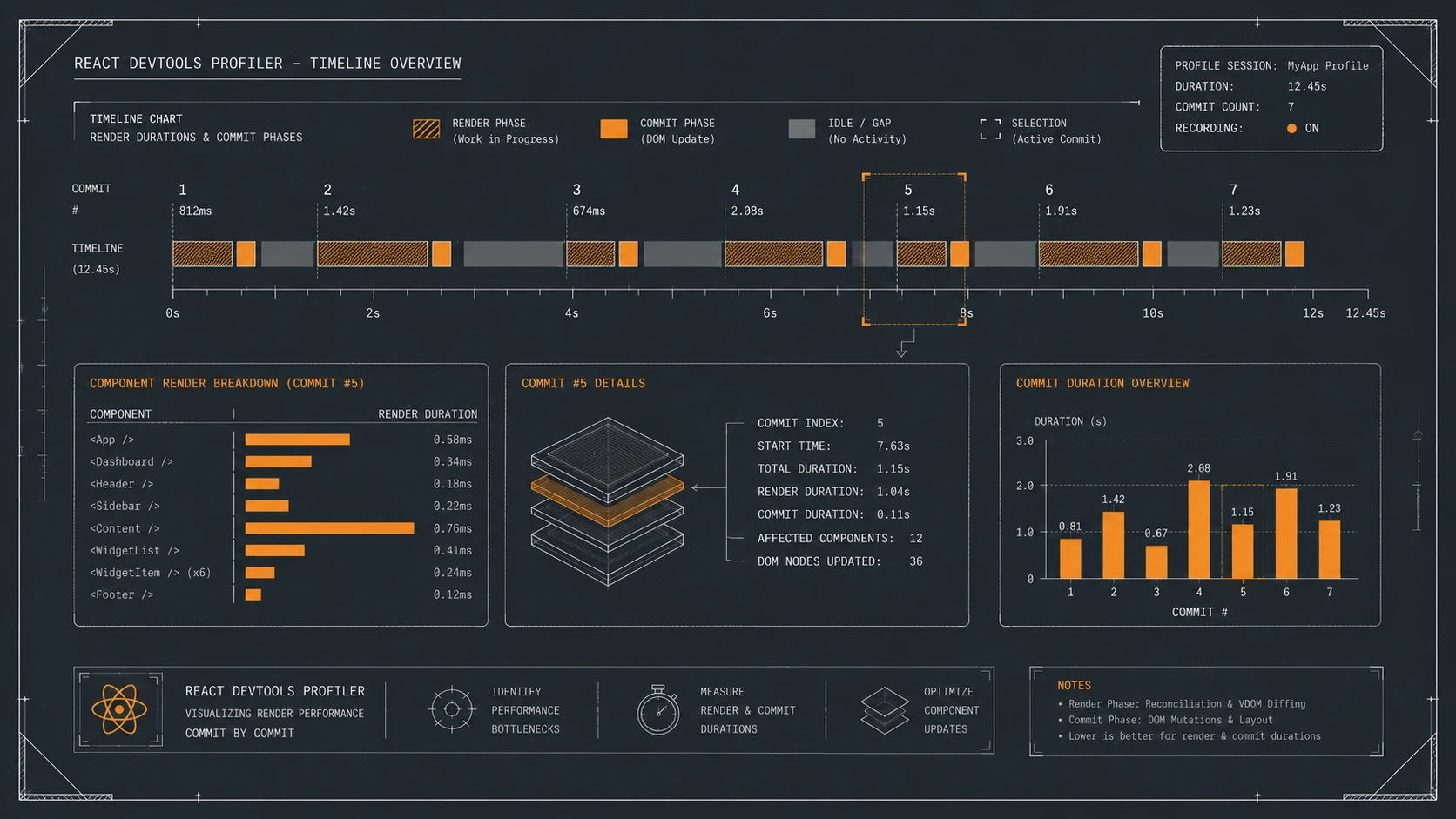
React.PureComponent improves performance only when rendering can legitimately be skipped.
Development teams should evaluate:
- ◆Component complexity
- ◆Rendering frequency
- ◆State organization
- ◆Object allocation patterns
- ◆Immutable update practices
- ◆Browser profiling results
Performance optimization should always be guided by measurement rather than assumptions.
Security Considerations
React.PureComponent focuses exclusively on rendering optimization.
Enterprise applications should continue implementing:
- ◆Authentication
- ◆Authorization
- ◆Input validation
- ◆Secure API communication
- ◆Protection against cross-site scripting
Rendering performance improvements do not affect application security architecture.
Scalability
React.PureComponent contributes to scalable frontend development through:
- ◆Standardized rendering optimization
- ◆Reduced duplicate rendering
- ◆Cleaner component implementations
- ◆Easier maintenance
- ◆Consistent engineering practices
As applications grow, standardized optimization techniques become increasingly valuable.
Best Practices
Organizations adopting React 15.3 should:
- ◆Use React.PureComponent for components with predictable rendering behavior.
- ◆Follow immutable update patterns.
- ◆Keep component state focused and minimal.
- ◆Separate presentation from business logic.
- ◆Profile rendering performance regularly.
- ◆Avoid unnecessary object mutation.
- ◆Build reusable component libraries.
- ◆Validate optimization using representative workloads.
Performance improvements should complement maintainable application architecture.
Common Mistakes
Development teams should avoid:
- ◆Assuming React.PureComponent improves every component.
- ◆Mutating objects while relying on shallow comparison.
- ◆Replacing thoughtful architecture with premature optimization.
- ◆Building excessively large components.
- ◆Ignoring application profiling.
- ◆Applying optimization without understanding rendering behavior.
Successful optimization depends upon predictable application state management.
Technology Comparison
| Capability | React.Component | React.PureComponent |
|---|---|---|
| Default Rendering | Updates normally | Shallow comparison before update |
| Automatic Update Optimization | No | Yes |
| Manual Lifecycle Implementation | Optional | Usually unnecessary for common cases |
| Immutable Data Compatibility | Good | Excellent |
| Enterprise Maintainability | Good | Improved for many scenarios |
| Rendering Efficiency | Application dependent | Potentially improved |
React.PureComponent simplifies a common optimization pattern while preserving React's declarative programming model.
Adoption Strategy
Organizations should introduce React.PureComponent incrementally.
A practical adoption strategy includes:
- 1.Profile existing applications.
- 2.Identify components with frequent rendering.
- 3.Evaluate immutable state management.
- 4.Introduce React.PureComponent selectively.
- 5.Measure rendering improvements.
- 6.Update component development guidelines.
- 7.Expand usage where measurable benefits are observed.
Incremental adoption minimizes implementation risk while ensuring optimization remains evidence-based.
Limitations
As of July 2016, several considerations remain.
Current observations include:
- ◆Shallow comparison cannot detect internal mutations of existing objects.
- ◆Immutable data practices become increasingly important.
- ◆Some components continue requiring customized rendering logic.
- ◆Performance improvements depend on application architecture rather than the framework feature alone.
Organizations should evaluate React.PureComponent within the broader context of component design and state management.
Looking Ahead
React 15.3 continues refining the React development model by introducing React.PureComponent, making rendering optimization more accessible for enterprise applications. By standardizing shallow comparison behavior, React allows developers to reduce unnecessary rendering without repeatedly implementing identical optimization logic.
As of July 2016, enterprise teams building large Single Page Applications should view React.PureComponent as a practical enhancement rather than a universal optimization solution. Applications that combine modular component architecture, immutable data patterns, and disciplined performance measurement are well positioned to benefit from this addition while maintaining readable and maintainable React codebases.