Introduction
React has rapidly established itself as one of the leading libraries for building modern user interfaces. Enterprises are increasingly adopting React for customer portals, Software as a Service (SaaS) platforms, internal dashboards, administrative consoles, and interactive business applications. While React provides an excellent component model, production deployments still require developers to solve routing, server-side rendering, asset bundling, and deployment concerns.
Many React applications today rely entirely on client-side rendering. Although this approach simplifies development, it introduces challenges including slower initial page rendering, limited search engine visibility, increased JavaScript payloads, and additional complexity when delivering content to browsers over slower network connections.
Next.js 1.0 addresses these concerns by providing a lightweight framework that integrates server-side rendering with React while reducing configuration overhead. Instead of assembling numerous build tools and server components manually, developers receive an opinionated development experience that emphasizes convention over configuration.
As of September 2016, Next.js is an emerging framework that aims to simplify production React development while making server-side rendering more accessible for enterprise web applications.
Industry Background
Modern web applications increasingly emphasize:
- ◆Single Page Applications
- ◆Component-based architecture
- ◆RESTful APIs
- ◆Progressive user interfaces
- ◆Cloud deployment
- ◆Continuous delivery
- ◆Responsive design
React has become a popular choice for user interface development, but organizations continue evaluating strategies that balance client-side interactivity with server-generated content.
Server-side rendering represents one approach to improving initial application delivery while preserving React's component architecture.
The Business Problem
Organizations developing large React applications commonly encounter:
- ◆Complex project setup
- ◆Manual Webpack configuration
- ◆Slow initial page rendering
- ◆Search engine indexing challenges
- ◆Duplicate server and client rendering logic
- ◆Complicated deployment workflows
- ◆Inconsistent application architecture
Development teams seek frameworks that standardize production-ready React application development while minimizing infrastructure complexity.
Understanding Next.js 1.0
Next.js is a framework built on top of React that provides server-side rendering and a structured application architecture.
Rather than requiring developers to configure every aspect of the rendering pipeline, Next.js supplies conventions for routing, page rendering, bundling, and production deployment.
Primary objectives include:
- ◆Server-side rendering
- ◆Simplified project structure
- ◆Automatic routing
- ◆Production-ready builds
- ◆Improved developer productivity
The framework complements React rather than replacing it.
Core Architecture
| Component | Responsibility |
|---|---|
| Browser | Requests application pages |
| Next.js Server | Renders React components |
| React Components | Define the user interface |
| Routing System | Maps URLs to pages |
| Bundler | Produces optimized JavaScript assets |
| REST API | Supplies application data |
This architecture separates rendering responsibilities while allowing React components to execute on both the server and client where appropriate.
Server-Side Rendering
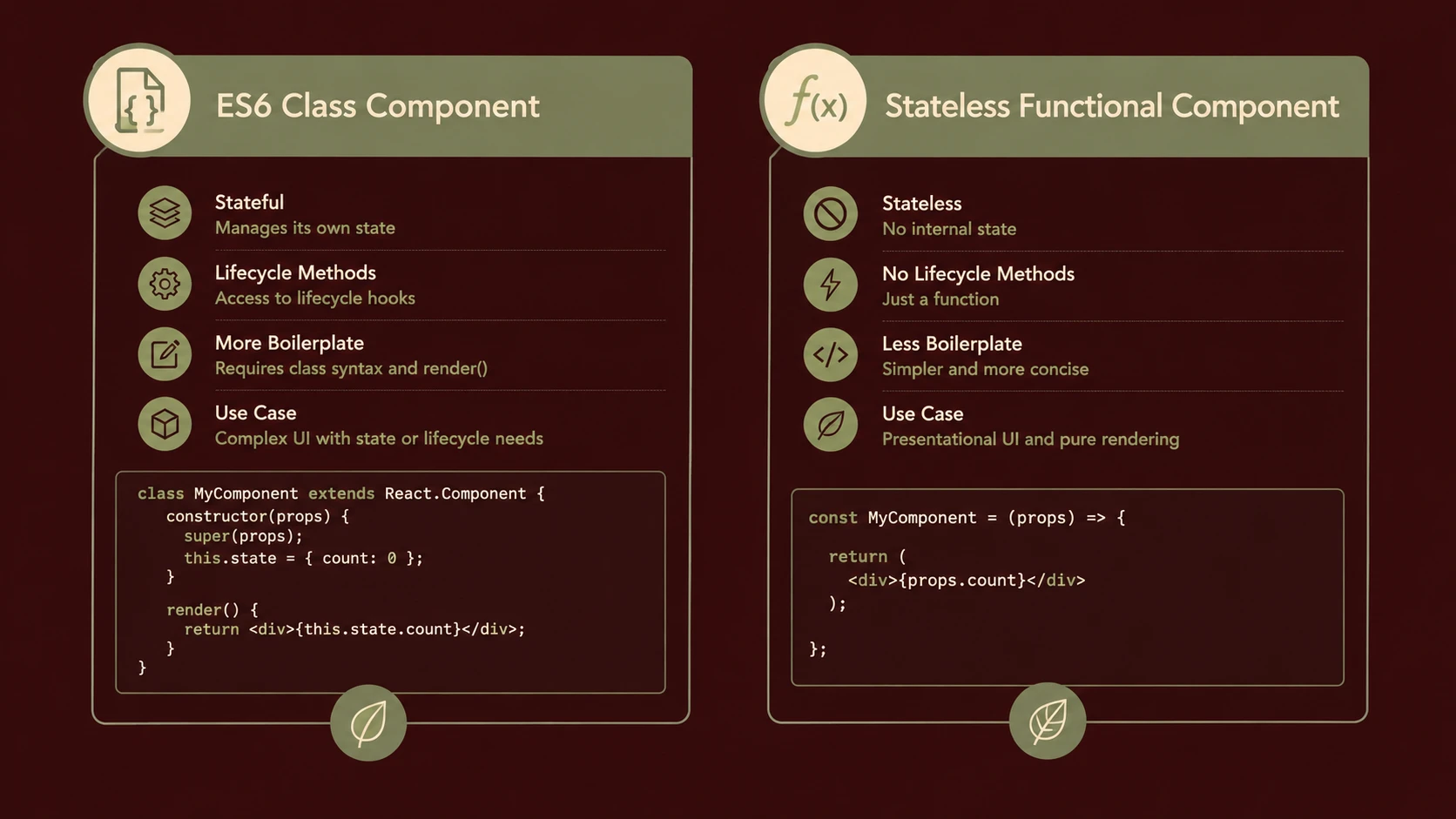
// Simple page with getInitialProps Server-Side data fetching in Next.js 1.0
import React from 'react';

export default class UsersPage extends React.Component {
  static async getInitialProps({ req }) {
    const userAgent = req ? req.headers['user-agent'] : navigator.userAgent;
    return { userAgent };
  }

  render() {
    return <div>Your user agent is: {this.props.userAgent}</div>;
  }
}
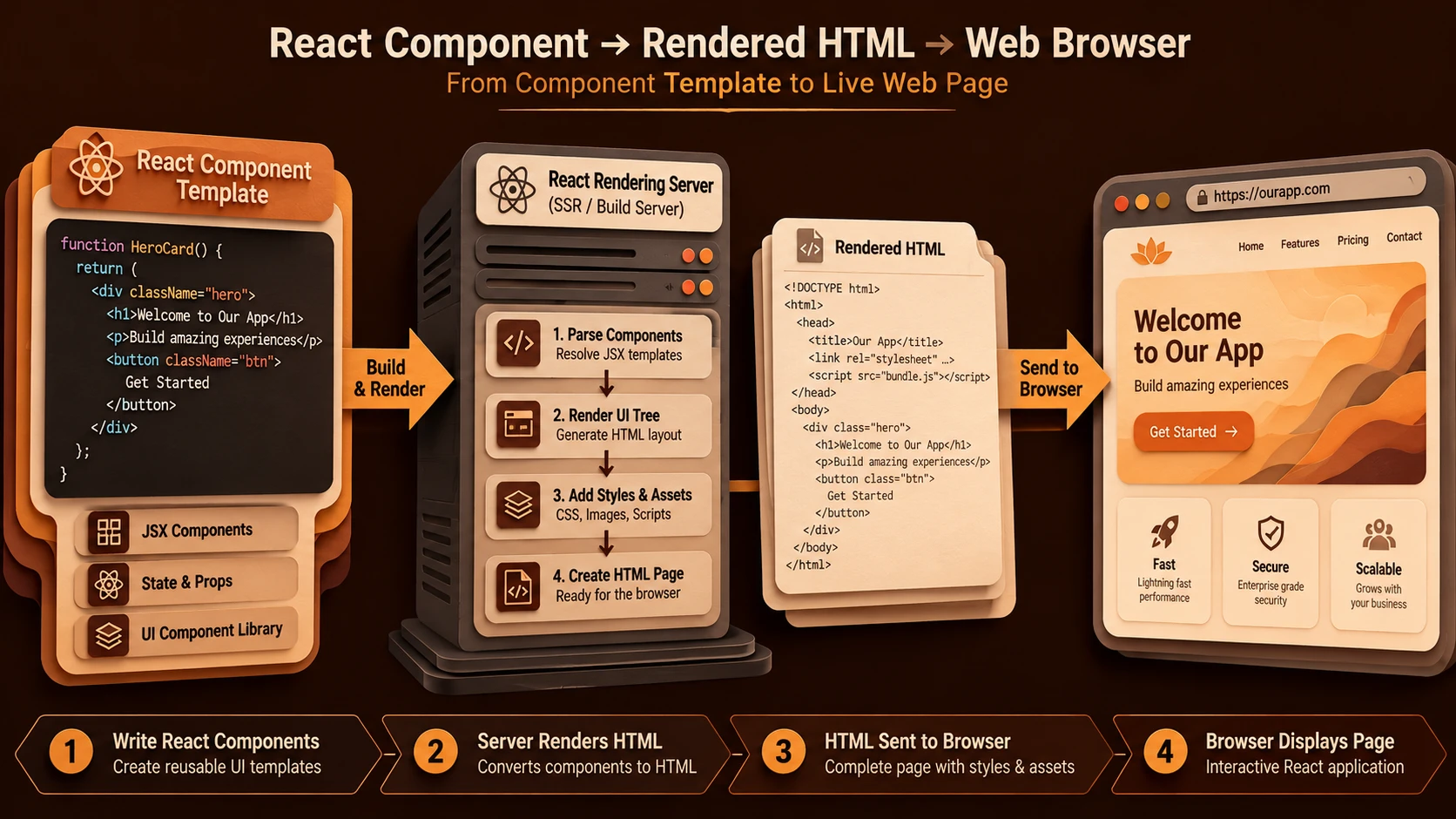
The defining capability of Next.js is server-side rendering.
Instead of sending an initially empty HTML document that depends entirely upon client-side JavaScript execution, the server generates HTML before responding to the browser.
A typical request follows these stages:
- 1.The browser requests a page.
- 2.Next.js receives the request.
- 3.React components execute on the server.
- 4.HTML is generated.
- 5.The rendered page is returned to the browser.
- 6.Client-side JavaScript enables interactive behavior.
This process improves the initial rendering experience while maintaining React's component model.
Automatic Routing
Next.js introduces a file-based routing model.
Rather than maintaining separate routing configuration files, pages are organized through project structure.
Potential advantages include:
- ◆Reduced configuration
- ◆Predictable application organization
- ◆Easier navigation
- ◆Simpler onboarding
Convention-based routing encourages consistency across development teams.
React Integration
Next.js builds directly upon React.
Developers continue using:
- ◆React components
- ◆Component composition
- ◆Properties
- ◆State management
- ◆Declarative rendering
The framework focuses on application infrastructure rather than replacing React's programming model.
Development Workflow
A typical development process includes:
- 1.Create React page components.
- 2.Organize pages according to project structure.
- 3.Connect application data sources.
- 4.Execute the development server.
- 5.Build production assets.
- 6.Deploy the application.
The framework reduces the amount of manual configuration required to reach production.
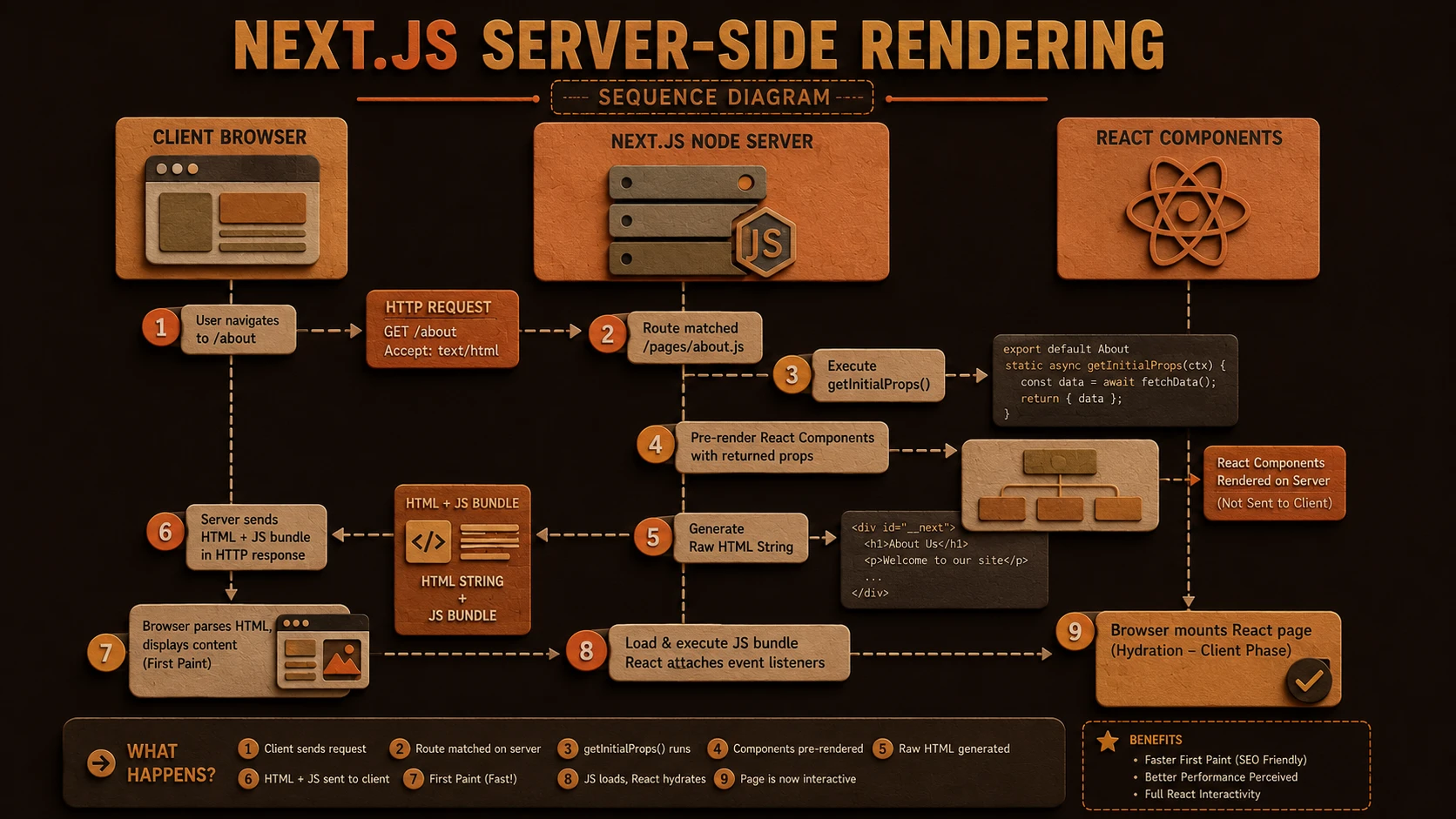
System architecture diagram and conceptual workflow layout for Next.js 1.0 Release.
Routing and Navigation
Enterprise applications frequently include:
- ◆Customer portals
- ◆Administrative dashboards
- ◆Product catalogs
- ◆Reporting systems
- ◆Documentation portals
A consistent routing model simplifies long-term maintenance while improving application organization.
Enterprise Use Cases
| Scenario | Benefit |
|---|---|
| SaaS Platforms | Server-rendered application delivery |
| Enterprise Dashboards | Improved initial page rendering |
| Customer Portals | Simplified routing |
| Documentation Websites | Better content delivery |
| Business Applications | Standardized React architecture |
| Corporate Websites | Server-generated HTML |
Organizations building production React applications benefit from an integrated rendering and deployment framework.
Performance Considerations
Server-side rendering changes how applications are delivered but should be evaluated alongside overall architecture.
Development teams should consider:
- ◆Server rendering overhead
- ◆JavaScript bundle size
- ◆Network latency
- ◆Browser rendering performance
- ◆API response times
- ◆Application caching strategies
Rendering improvements should be validated using representative production workloads.
Security Considerations
Next.js focuses on application rendering rather than security.
Organizations should continue implementing:
- ◆HTTPS
- ◆Authentication
- ◆Authorization
- ◆Input validation
- ◆Secure API communication
- ◆Protection against cross-site scripting
Security architecture remains the responsibility of the complete application.
Scalability
Next.js supports scalable frontend architecture through:
- ◆Modular page organization
- ◆Reusable React components
- ◆Server-side rendering
- ◆Consistent project structure
- ◆Deployment automation
Combined with scalable backend infrastructure, these capabilities support enterprise web applications.
Best Practices
Organizations evaluating Next.js should:
- ◆Keep page components focused.
- ◆Build reusable React components.
- ◆Separate presentation from business logic.
- ◆Optimize API communication.
- ◆Measure rendering performance.
- ◆Standardize project structure.
- ◆Automate production builds.
- ◆Test server-rendered output across supported browsers.
Consistent engineering practices improve maintainability as applications grow.
Common Mistakes
Development teams should avoid:
- ◆Mixing routing conventions inconsistently.
- ◆Embedding business logic directly within presentation components.
- ◆Assuming server-side rendering alone guarantees application performance.
- ◆Ignoring JavaScript bundle optimization.
- ◆Creating excessively large page components.
- ◆Neglecting server performance testing.
A well-designed application architecture remains essential regardless of rendering strategy.
Technology Comparison
| Capability | React Library | Next.js 1.0 |
|---|---|---|
| UI Components | Yes | Yes |
| Server-Side Rendering | Manual implementation | Built in |
| Routing | External libraries | Convention based |
| Project Structure | Developer defined | Opinionated |
| Production Build Workflow | Manual configuration | Integrated |
| Enterprise Readiness | Flexible | Improved through conventions |
Next.js extends React by providing an opinionated application framework for production deployments.
Adoption Strategy
Organizations should evaluate Next.js incrementally.
A practical adoption approach includes:
- 1.Select a suitable React application.
- 2.Introduce Next.js routing.
- 3.Enable server-side rendering.
- 4.Measure rendering performance.
- 5.Integrate with existing REST APIs.
- 6.Automate deployment pipelines.
- 7.Expand adoption after successful evaluation.
Pilot projects allow engineering teams to understand operational characteristics before wider deployment.
Limitations
As of September 2016, Next.js is an early framework with an evolving ecosystem.
Current considerations include:
- ◆Best practices continue to mature.
- ◆Existing React projects may require architectural adjustments.
- ◆Organizations should evaluate deployment requirements carefully.
- ◆Development teams should balance server-side rendering benefits against operational complexity.
Incremental adoption provides an effective strategy for evaluating long-term suitability.
Looking Ahead
Next.js 1.0 represents an important step toward simplifying production React development by combining server-side rendering, convention-based routing, and integrated application tooling within a unified framework. Rather than requiring extensive custom configuration, it provides a structured foundation for building modern React applications intended for production deployment.
As of September 2016, enterprise architects and frontend engineering teams should evaluate Next.js for customer-facing websites, SaaS platforms, and business applications where server-side rendering, maintainable project organization, and streamlined deployment workflows can provide measurable operational advantages. As the React ecosystem continues to evolve, frameworks that reduce infrastructure complexity while preserving development flexibility are likely to play an increasingly important role.