Introduction
For many years, enterprise server-side development has been dominated by mature platforms such as Java EE, Microsoft's .NET Framework, PHP, Perl, Python, and Ruby. These technologies have powered countless business applications, web portals, e-commerce systems, and internal enterprise platforms.
Although each platform offers unique strengths, most traditional web servers rely on request-processing models that allocate a thread or process for every incoming request. As application traffic grows, this architecture often requires increasingly powerful hardware or complex scaling strategies to maintain responsiveness.
An emerging project known as Node.js is challenging this traditional approach. Created by Ryan Dahl, Node.js brings JavaScript to the server and introduces an event-driven, non-blocking I/O model designed to handle large numbers of concurrent network connections with comparatively modest resource consumption.
As of August 2010, Node.js remains an emerging technology rather than a mainstream enterprise platform. Nevertheless, its architectural concepts are attracting significant attention among software architects, infrastructure engineers, and web developers searching for new ways to build highly scalable network services.
This article explores the architecture behind Node.js, examines its strengths and limitations, compares it with established server-side platforms, and discusses where it may fit within enterprise environments today.
Why Traditional Server Architectures Face Challenges
Most enterprise web applications process requests using a thread-per-request or process-per-request model.
A simplified request lifecycle typically looks like this:
- ◆Client sends a request.
- ◆A server thread accepts the request.
- ◆Database operations are performed.
- ◆Files may be read from disk.
- ◆External services are contacted.
- ◆The response is returned.
- ◆The thread becomes available again.
While this model is proven and reliable, many server threads spend considerable time waiting for input/output operations to complete rather than performing actual computation.
As concurrency increases, idle threads consume memory and operating system resources even while waiting for network or disk operations.
The Node.js Philosophy
Node.js approaches server development differently.
Rather than creating a separate thread for every client request, Node.js uses an event-driven architecture built around non-blocking I/O.
Instead of waiting for an operation such as reading a file or querying a remote service to complete, Node.js initiates the operation and continues processing other events. When the operation finishes, a callback function handles the result.
This architecture allows a relatively small number of system resources to support many simultaneous connections.
Understanding Asynchronous I/O
Input/output operations frequently represent the slowest portion of application execution.
Examples include:
- ◆Reading files
- ◆Writing files
- ◆Database communication
- ◆HTTP requests
- ◆Network sockets
- ◆Email delivery
Traditional synchronous code pauses execution until these operations finish.
Node.js instead schedules the operation and continues processing additional events.
A simplified conceptual example:
fs.readFile("customers.txt", function(err, data) {
    if (err) {
        console.log(err);
        return;
    }

    console.log(data);
});
Rather than blocking execution while the file is read, Node.js continues handling other requests until the operation completes.
Event-Driven Programming
The event loop forms the foundation of Node.js.
Applications respond to events rather than processing requests through multiple blocking threads.
Examples of events include:
- ◆Incoming HTTP requests
- ◆File completion events
- ◆Network messages
- ◆Timer expiration
- ◆Database responses
- ◆Socket communication
Developers define callback functions that execute when specific events occur.
Although this programming model differs from traditional server development, it offers considerable efficiency for applications dominated by I/O operations.
JavaScript Beyond the Browser
One of Node.js's most significant innovations is enabling JavaScript to execute outside the browser.
This creates several potential advantages.
Development teams may eventually:
- ◆Share programming language expertise between client and server.
- ◆Reuse validation logic where appropriate.
- ◆Simplify developer onboarding.
- ◆Reduce context switching between languages.
Organizations already investing heavily in JavaScript for browser development may find this particularly attractive.
Comparing Traditional Servers and Node.js
| Feature | Traditional Server Platforms | Node.js |
|---|---|---|
| Programming Model | Thread or Process Based | Event Driven |
| I/O | Often Blocking | Non-Blocking |
| Concurrency | Thread Scaling | Event Loop |
| Memory Usage | Higher Under Heavy Concurrency | Potentially Lower |
| Language | Java, C#, PHP, Ruby, Python | JavaScript |
| Best Fit | General Enterprise Applications | I/O-Intensive Network Applications |
Node.js should not necessarily replace existing enterprise platforms but instead be evaluated according to workload characteristics.
Architecture Overview
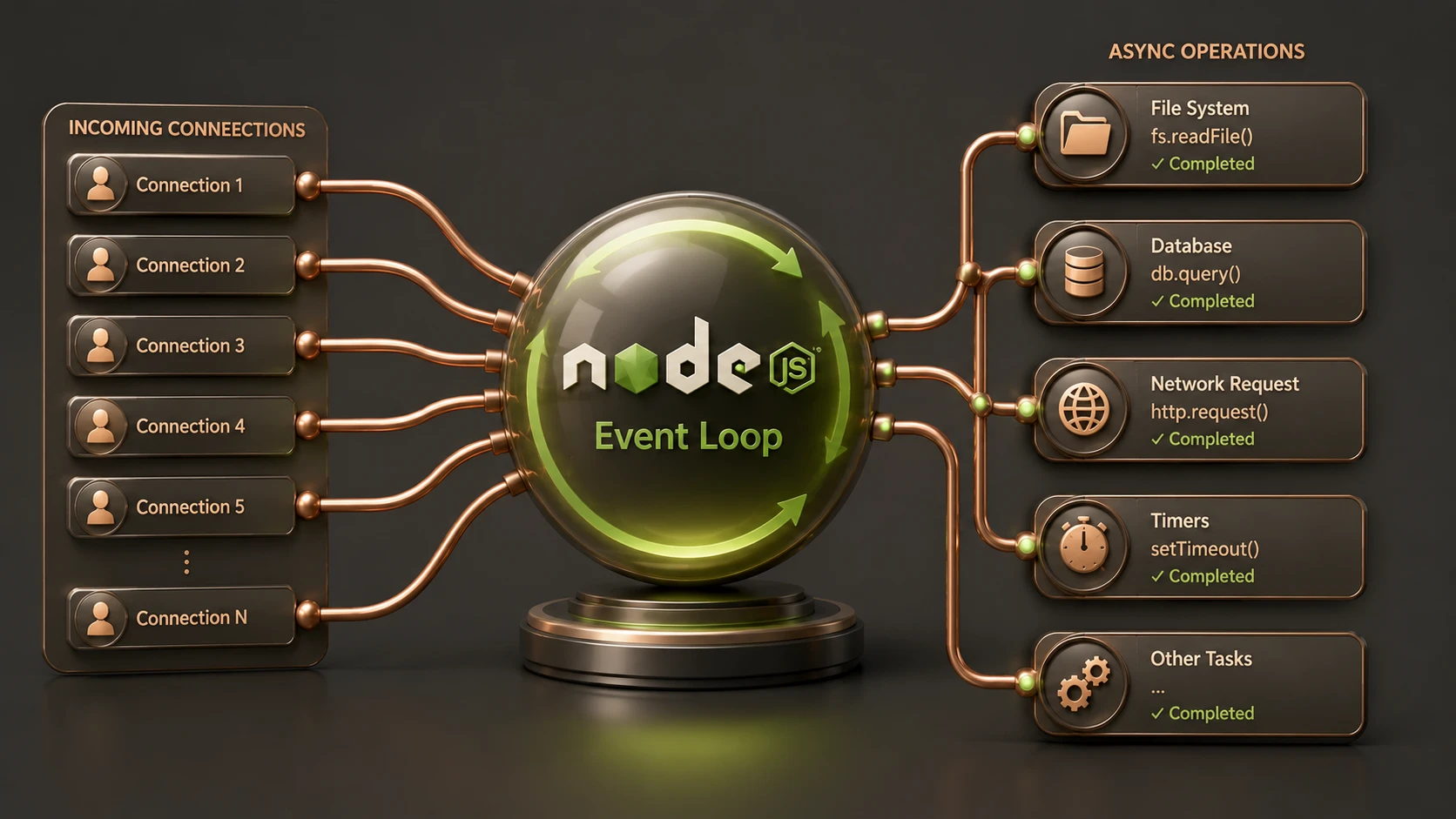
A simplified Node.js architecture resembles the following:
Clients
    |
HTTP Server
    |
Node.js Event Loop
    |
-----------------------------
| File System |
| Network I/O |
| Database |
| External APIs |
-----------------------------
Rather than dedicating a thread to every client connection, the event loop coordinates asynchronous operations and executes callbacks when results become available.
Enterprise Use Cases
Although Node.js is still evolving, several categories of applications appear well suited to its architecture.
Real-Time Applications
Applications requiring persistent network connections, such as chat systems or live notifications, may benefit from Node.js's event-driven model.
Web APIs
REST-style services performing lightweight request processing and frequent I/O operations represent another promising use case.
Proxy Servers
Applications acting as intermediaries between clients and backend services can take advantage of efficient network communication.
Streaming Services
Applications delivering logs, monitoring information, or continuous data streams may also benefit from asynchronous processing.
Lightweight Web Servers
Organizations experimenting with service-oriented architectures may evaluate Node.js for smaller network services rather than monolithic web applications.
Areas Where Traditional Platforms Remain Strong
Enterprise organizations should recognize that Node.js is still relatively young.
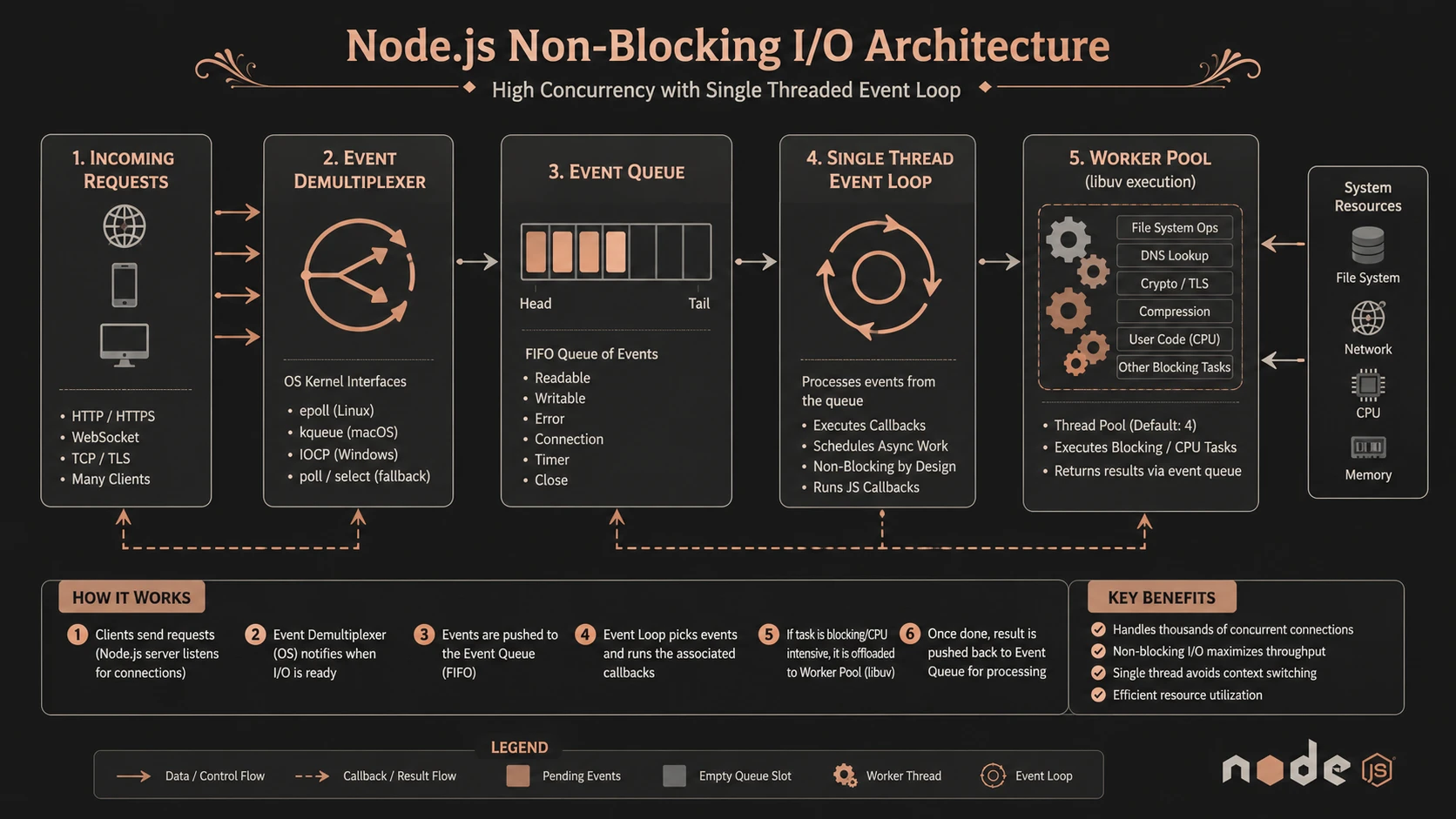
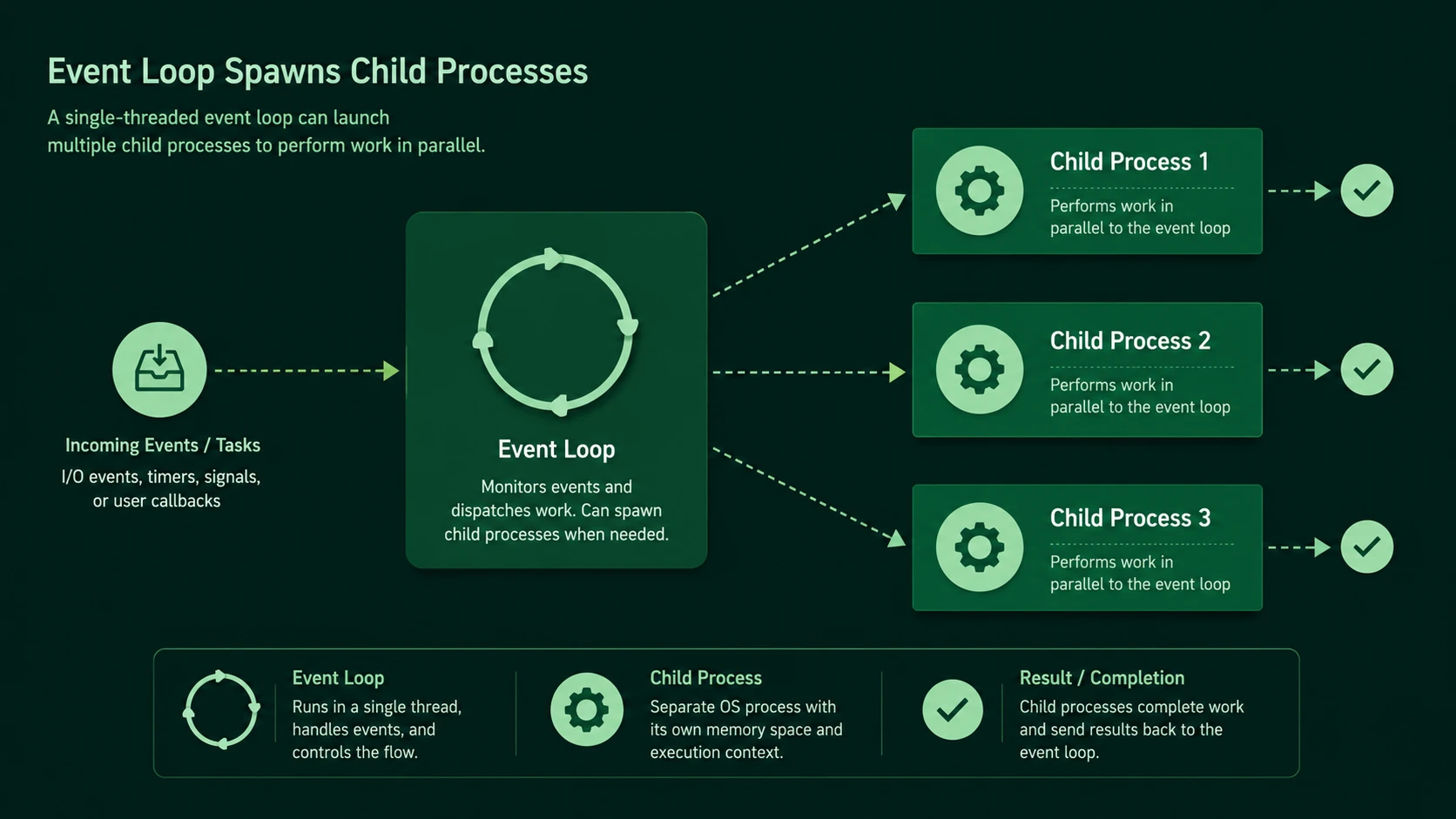
Event loop routing for non-blocking asynchronous I/O execution threads.
Established platforms currently offer advantages including:
- ◆Mature application servers
- ◆Extensive enterprise tooling
- ◆Rich IDE support
- ◆Proven deployment practices
- ◆Comprehensive third-party libraries
- ◆Long operational history
Mission-critical business systems often depend upon these mature ecosystems.
Node.js should therefore be evaluated carefully rather than adopted universally.
Performance Considerations
Node.js excels primarily when applications spend significant time waiting for I/O operations.
Examples include:
- ◆Network communication
- ◆File transfers
- ◆Web services
- ◆Messaging systems
CPU-intensive workloads such as:
- ◆Large scientific calculations
- ◆Video encoding
- ◆Complex financial modeling
may not realize the same advantages because JavaScript execution itself remains single-threaded within the event loop.
Understanding application characteristics is therefore essential before selecting a platform.
Development Benefits
Several factors contribute to growing developer interest in Node.js.
Faster Development Cycles
JavaScript is already familiar to many web developers.
Unified Skill Sets
Client-side and server-side development can potentially share language expertise.
Lightweight Deployment
Node.js applications generally consist of relatively small server programs that are straightforward to deploy.
Network-Oriented Design
The platform was designed specifically with scalable network services in mind.
Best Practices
Organizations experimenting with Node.js should consider the following recommendations.
- ◆Use asynchronous APIs consistently.
- ◆Handle errors carefully within callbacks.
- ◆Keep callback functions manageable.
- ◆Separate business logic from networking code.
- ◆Log application errors centrally.
- ◆Monitor memory usage and response times.
- ◆Validate all client input.
- ◆Secure network endpoints.
- ◆Benchmark under realistic workloads.
Following disciplined engineering practices helps organizations evaluate Node.js objectively.
Common Mistakes
Early adopters may encounter several implementation challenges.
Blocking the Event Loop
Executing long-running computations prevents other requests from being processed efficiently.
Ignoring Error Handling
Every asynchronous operation should properly handle potential failures.
Assuming Universal Performance Improvements
Applications dominated by CPU processing may not benefit from an event-driven architecture.
Migrating Existing Systems Prematurely
Replacing stable enterprise platforms without measurable business value introduces unnecessary project risk.
Overlooking Operational Monitoring
As with any production platform, logging, monitoring, and performance measurement remain essential.
Adoption Recommendations
Organizations interested in Node.js should pursue incremental adoption.
Phase 1
- ◆Train development teams.
- ◆Build internal prototypes.
- ◆Evaluate deployment processes.
Phase 2
- ◆Develop internal utilities.
- ◆Build lightweight web services.
- ◆Benchmark performance.
Phase 3
- ◆Deploy non-critical production services.
- ◆Measure scalability.
- ◆Review operational metrics.
Phase 4
- ◆Evaluate broader adoption for appropriate workloads.
- ◆Continue integrating Node.js into enterprise development standards where justified.
A measured adoption strategy enables organizations to gain experience while minimizing operational risk.
Challenges Enterprises Must Consider
Before adopting Node.js for production systems, architects should evaluate several important questions.
- ◆Is the application primarily I/O-bound or CPU-bound?
- ◆Does the organization possess JavaScript expertise?
- ◆Are existing deployment tools compatible?
- ◆How will monitoring and diagnostics be implemented?
- ◆Are required third-party libraries sufficiently mature?
- ◆Does the application's security model align with organizational standards?
These questions should form part of any enterprise technology evaluation.
Why the Industry Is Paying Attention
Node.js represents more than simply another programming framework. It introduces an alternative philosophy for building scalable servers by emphasizing asynchronous execution, event-driven programming, and efficient resource utilization.
Although still in its early stages, the platform has already demonstrated that JavaScript can play a meaningful role beyond the browser. Its architectural concepts are encouraging developers to reconsider traditional assumptions about server scalability and concurrency.
Whether Node.js ultimately becomes a mainstream enterprise platform remains uncertain, but it has already contributed valuable ideas to the broader discussion surrounding modern web infrastructure.
Looking Ahead
Node.js is still an emerging technology, and enterprise adoption remains at an early stage. Organizations evaluating the platform during 2010 should approach it as a promising option for specific categories of network-intensive applications rather than a universal replacement for established enterprise frameworks.
Its event-driven architecture, non-blocking I/O model, and use of JavaScript on the server present compelling possibilities for building highly concurrent applications. As development tools, community support, and production experience continue to grow, enterprise architects will have additional opportunities to assess where Node.js can deliver meaningful operational and business value within modern application portfolios.