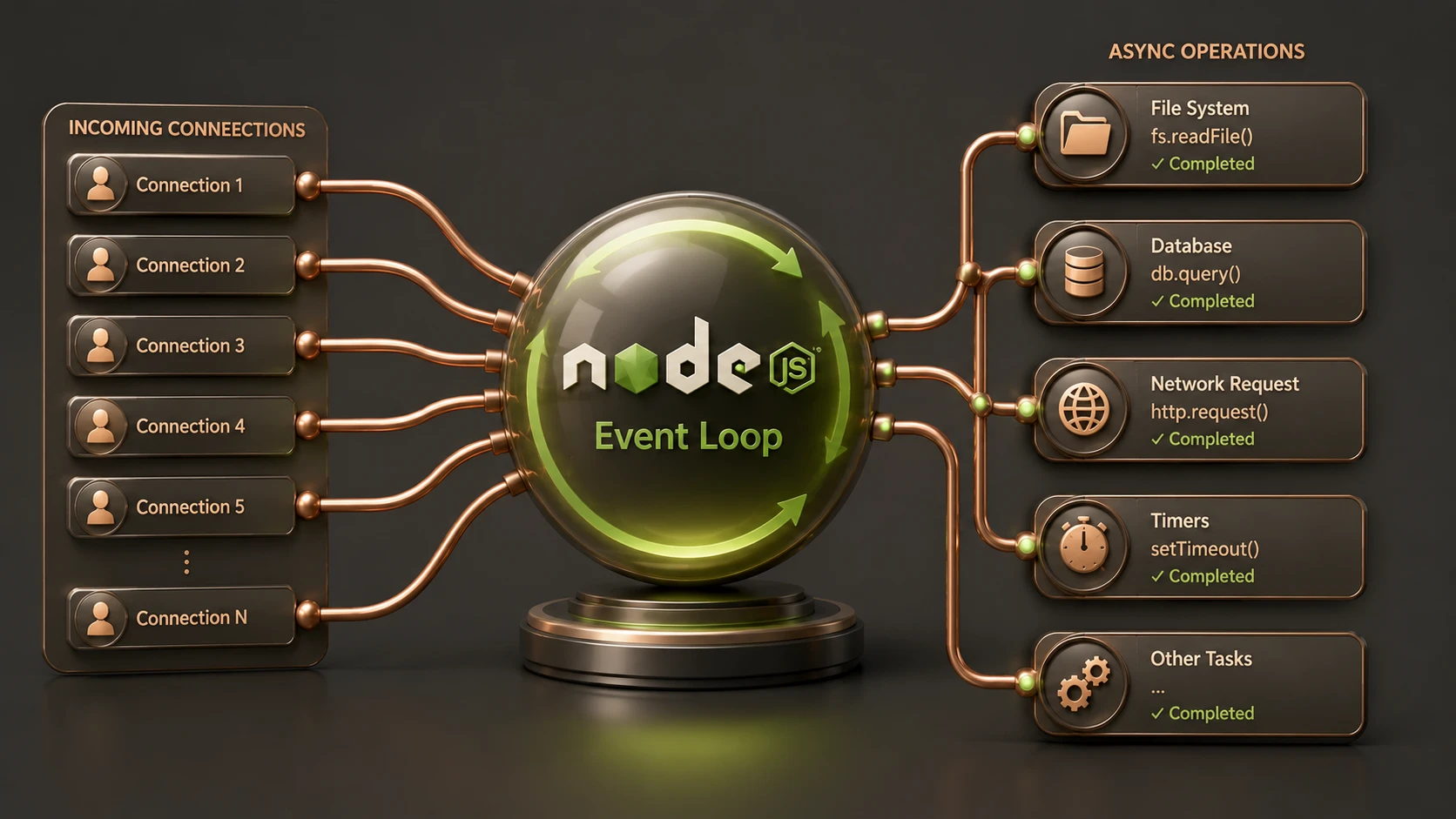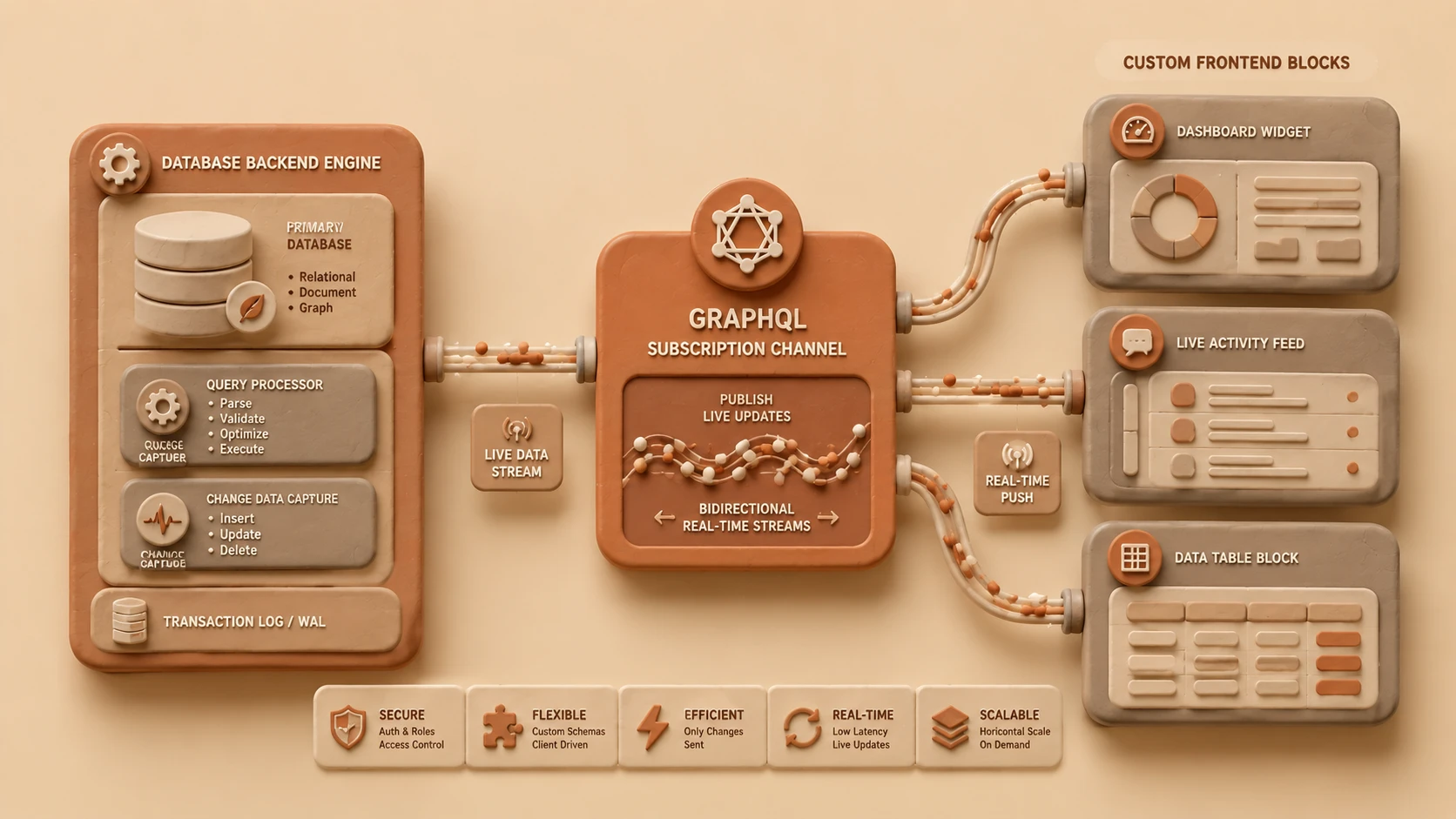
Introduction
Enterprise software has undergone a fundamental architectural transformation over the past decade. Earlier backend systems were primarily designed around monolithic applications exposing REST APIs to a single web frontend. While this model successfully powered the first generation of digital platforms, today's organizations must deliver experiences across websites, mobile applications, smart devices, AI assistants, partner ecosystems, customer portals, internal dashboards, and emerging digital channels.
Supporting these increasingly diverse clients requires backend architectures that are flexible, scalable, and capable of serving data efficiently across multiple consumption models. Organizations are therefore moving toward Headless Architecture, where business capabilities and content are separated from presentation layers, allowing any client to consume the same backend services.
Alongside this shift, GraphQL has matured into a widely adopted API technology that enables clients to request exactly the data they need while reducing over-fetching and under-fetching commonly associated with traditional REST APIs. At the same time, event-driven systems, WebSockets, server-sent events, managed messaging platforms, and real-time databases are enabling applications to react instantly to changing business events.
Rather than viewing these technologies independently, enterprises increasingly combine Headless platforms, GraphQL, and real-time communication into a unified backend architecture capable of powering modern digital ecosystems.
From the perspective of April 2024, this combination represents one of the defining backend architecture patterns for enterprise software.
Industry Background
Enterprise organizations continue expanding digital services across multiple platforms.
Common delivery channels include:
- ◆Web applications.
- ◆Mobile applications.
- ◆Customer portals.
- ◆AI assistants.
- ◆Smart devices.
- ◆Partner APIs.
- ◆Internal enterprise systems.
Modern platform priorities increasingly emphasize:
- ◆API-first development.
- ◆Cloud-native infrastructure.
- ◆Omnichannel delivery.
- ◆Real-time experiences.
- ◆Platform engineering.
- ◆Developer productivity.
Backend architecture has become the foundation for delivering consistent experiences across every digital touchpoint.
The Business Problem
Traditional backend architectures frequently introduce several operational challenges.
Organizations commonly experience:
- ◆Multiple duplicated APIs.
- ◆Over-fetching of data.
- ◆Client-specific backend implementations.
- ◆Slow feature delivery.
- ◆Limited real-time capabilities.
- ◆Increasing integration complexity.
- ◆Difficult frontend evolution.
As organizations support more client applications, maintaining separate backend implementations becomes increasingly expensive.
Headless platforms, GraphQL, and real-time communication address these challenges through flexible service-oriented architecture.
Understanding the Technology
Modern backend platforms increasingly combine three complementary architectural approaches.
Headless Architecture separates business capabilities from presentation.
GraphQL provides flexible client-driven API access.
Real-time infrastructure delivers immediate updates through event-driven communication.
Together they enable:
- ◆API-first development.
- ◆Independent frontend evolution.
- ◆Efficient data retrieval.
- ◆Event-driven communication.
- ◆Cloud-native scalability.
- ◆Omnichannel delivery.
- ◆Faster application development.
These capabilities form the foundation of many enterprise digital platforms.
Core Architecture
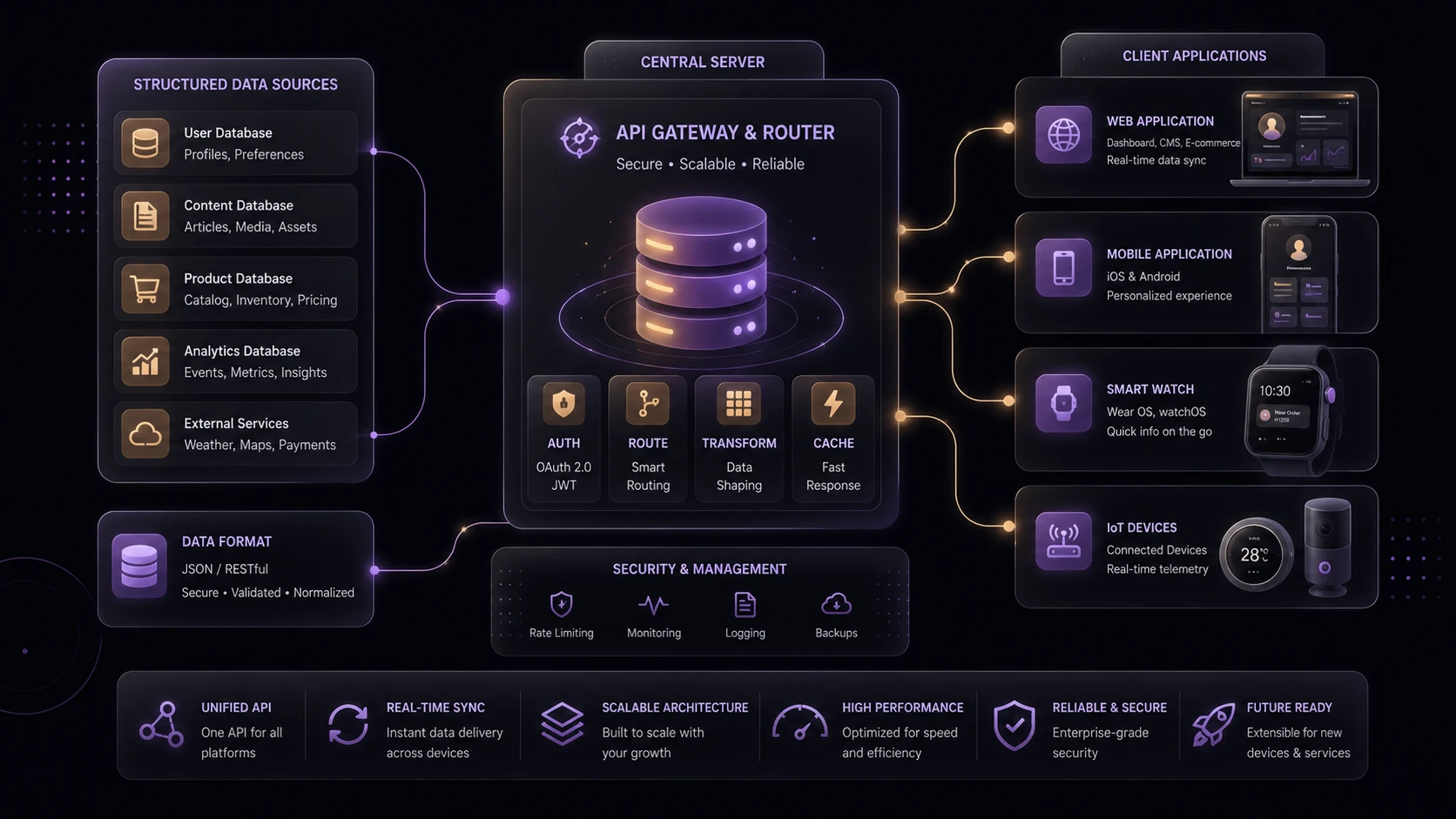
A simplified backend architecture appears below.
| Component | Responsibility |
|---|---|
| Client Applications | Web, mobile, desktop, AI, IoT |
| API Gateway | Authentication, routing, governance |
| GraphQL Layer | Flexible data aggregation |
| Headless Services | Business logic and content |
| Event Streaming Platform | Real-time event distribution |
| Databases | Operational and analytical storage |
| Cloud Infrastructure | Compute, scaling, monitoring |
Business services expose reusable capabilities while GraphQL and real-time messaging deliver optimized client experiences.
Key Features
Headless Architecture
The defining principle of Headless Architecture is separating backend functionality from presentation.
Instead of tightly coupling user interfaces with server implementations, business capabilities become reusable services consumed by multiple client applications.
Benefits include:
- ◆Independent frontend development.
- ◆Platform reuse.
- ◆Faster innovation.
- ◆Omnichannel delivery.
- ◆Improved scalability.
Organizations can introduce new customer experiences without redesigning core business systems.
GraphQL APIs
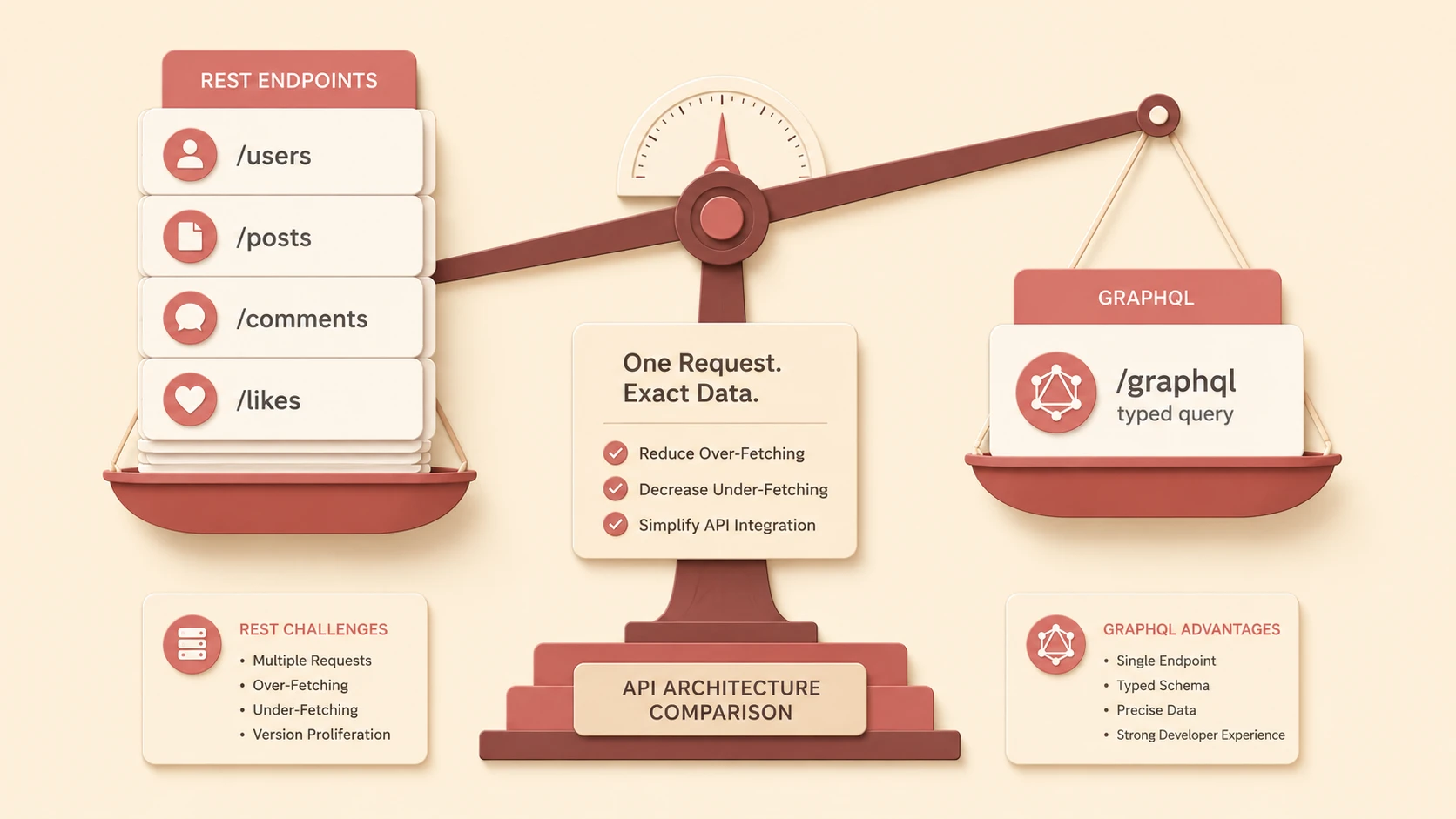
GraphQL allows clients to request exactly the information they require.
Rather than exposing numerous specialized REST endpoints, GraphQL enables flexible queries that reduce unnecessary data transfer.
Advantages include:
- ◆Reduced over-fetching.
- ◆Fewer network requests.
- ◆Strong typing.
- ◆Schema-driven development.
- ◆Better frontend productivity.
For complex enterprise applications, GraphQL simplifies communication between frontend clients and distributed backend services.
Real-Time Communication
Modern users increasingly expect immediate updates.
Real-time technologies enable:
- ◆Live dashboards.
- ◆Messaging.
- ◆Notifications.
- ◆Collaborative editing.
- ◆Financial data updates.
- ◆Operational monitoring.
Instead of continuously polling servers, applications receive updates whenever business events occur.
Event-Driven Architecture
Backend systems increasingly communicate through business events rather than tightly coupled service calls.
Typical events include:
- ◆Customer registration.
- ◆Payment completion.
- ◆Inventory changes.
- ◆Shipment updates.
- ◆Device telemetry.
- ◆Workflow completion.
Event-driven architecture improves scalability while reducing dependencies between services.
API-First Development
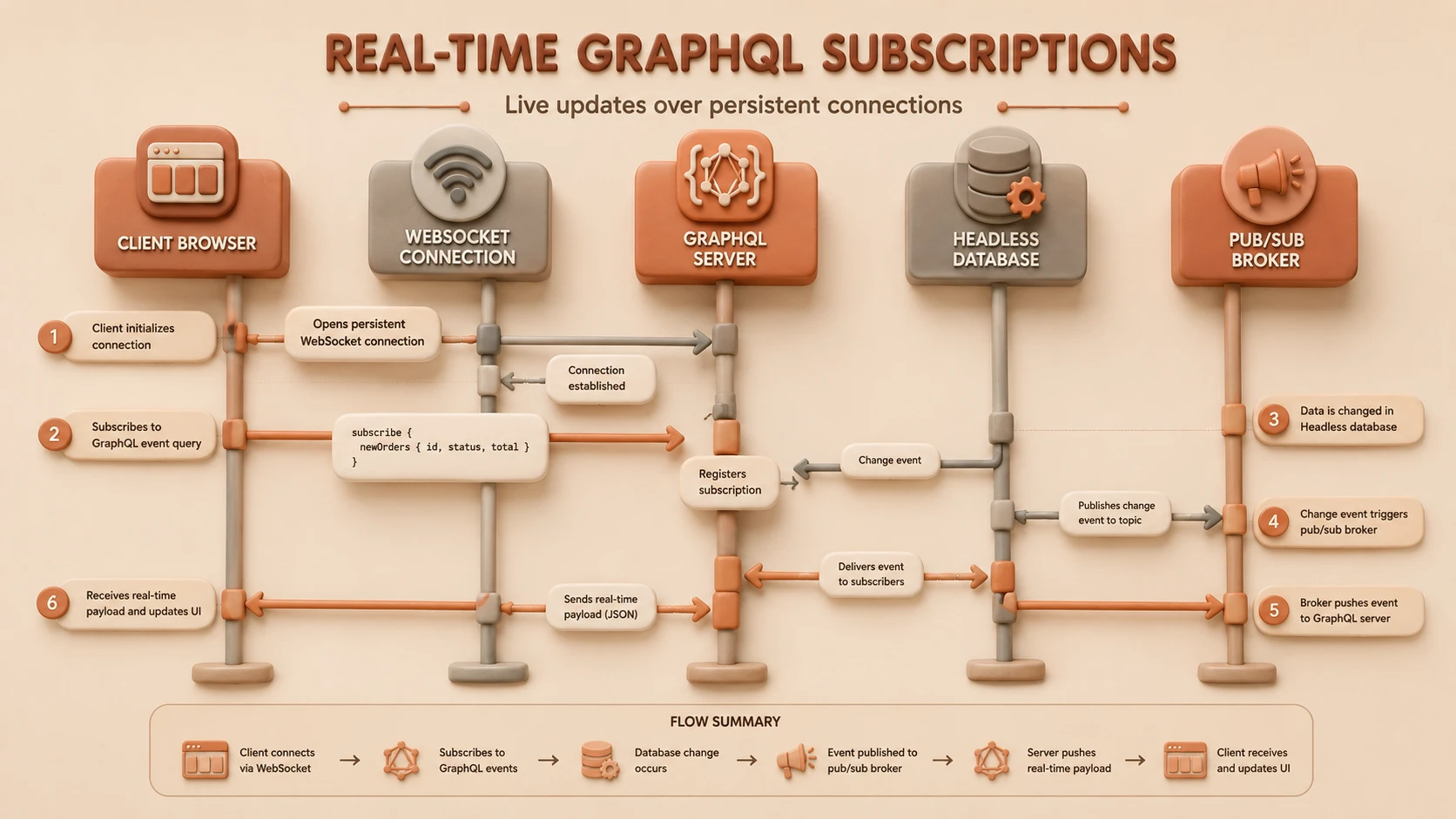
System architecture diagram and conceptual workflow layout for Headless + GraphQL + Real-Time.
Modern engineering teams design APIs before implementing user interfaces.
This enables:
- ◆Parallel development.
- ◆Better documentation.
- ◆Consistent integration.
- ◆Easier testing.
- ◆Reusable business services.
API-first thinking aligns naturally with Headless Architecture.
Cloud-Native Backend Services
Container orchestration, managed databases, serverless computing, and automated infrastructure provide scalable execution environments for modern backend services.
Cloud-native deployment simplifies operational management while supporting enterprise growth.
How It Works
A simplified workflow appears below.
Client Application
        |
API Gateway
        |
GraphQL Query
        |
Headless Services
        |
Business Logic
        |
Database
        |
Business Events
        |
Real-Time Updates
        |
Connected Clients
GraphQL retrieves requested data while event-driven infrastructure delivers real-time updates to subscribed clients.
Enterprise Use Cases
Enterprise SaaS Platforms
Web applications, mobile clients, and partner portals share a common backend while evolving independently.
E-Commerce
Product catalogs, inventory, pricing, and checkout services expose reusable APIs while customers receive live inventory updates.
Financial Services
Banking dashboards display near real-time account activity, transaction processing, and fraud alerts.
Healthcare Platforms
Clinical applications synchronize patient information across multiple devices while maintaining secure backend services.
AI-Powered Applications
Conversational assistants retrieve structured business information through GraphQL while subscribing to real-time operational events.
Performance Considerations
Organizations implementing this architecture should evaluate:
- ◆GraphQL query performance.
- ◆API response latency.
- ◆Event processing throughput.
- ◆Subscription scalability.
- ◆Cache efficiency.
- ◆Database optimization.
Performance optimization should balance flexibility with predictable operational behavior.
Security Considerations
Enterprise backend platforms require comprehensive governance.
Organizations should implement:
- ◆Strong authentication.
- ◆OAuth or equivalent authorization.
- ◆API rate limiting.
- ◆GraphQL query validation.
- ◆Encryption in transit.
- ◆Audit logging.
- ◆Zero Trust networking principles.
Security should remain consistent across REST APIs, GraphQL endpoints, and real-time communication channels.
Scalability
Headless, GraphQL, and real-time architectures improve enterprise scalability through:
- ◆Independent frontend evolution.
- ◆API reuse.
- ◆Event-driven communication.
- ◆Horizontal service scaling.
- ◆Efficient client communication.
- ◆Cloud-native deployment.
These characteristics support modern digital platforms serving millions of users across multiple channels.
Best Practices
Organizations adopting this architecture should:
- ◆Design APIs around business capabilities rather than client implementations.
- ◆Use GraphQL where flexible data retrieval provides measurable value.
- ◆Introduce event-driven communication for real-time workloads.
- ◆Build reusable backend services.
- ◆Monitor API performance continuously.
- ◆Standardize authentication across all communication channels.
- ◆Invest in observability from the beginning.
Successful implementation combines platform engineering, API governance, and disciplined service architecture.
Common Mistakes
| Mistake | Business Impact |
|---|---|
| Replacing every REST API with GraphQL regardless of requirements | Unnecessary complexity |
| Ignoring GraphQL query optimization | Performance degradation |
| Treating Headless Architecture as only a CMS strategy | Missed enterprise reuse opportunities |
| Using real-time communication for infrequently changing data | Increased infrastructure costs |
| Building client-specific business logic inside GraphQL resolvers | Reduced maintainability |
| Neglecting centralized API governance | Security and operational risks |
Organizations should select each technology according to measurable business and architectural requirements rather than industry trends.
Technology Comparison
| Characteristic | Traditional Backend | Headless + GraphQL + Real-Time |
|---|---|---|
| Frontend Integration | Application specific | Omnichannel and reusable |
| API Model | Primarily REST | GraphQL with API-first design |
| Data Delivery | Request-response | Request-response plus event-driven updates |
| Scalability | Service dependent | Cloud-native and modular |
| Client Flexibility | Limited | High |
| User Experience | Mostly static interactions | Dynamic and real-time |
The modern backend stack combines independent services, flexible APIs, and event-driven communication to support increasingly sophisticated digital experiences.
Adoption Strategy
Organizations should modernize incrementally.
- 1.Separate business logic from presentation layers.
- 2.Introduce API-first development practices.
- 3.Evaluate GraphQL for client-driven data requirements.
- 4.Add event-driven messaging for real-time business workflows.
- 5.Implement centralized API governance and observability.
- 6.Expand headless services across additional customer channels.
This phased approach enables organizations to modernize backend architecture while minimizing operational disruption.
Limitations
As of April 2024, organizations should recognize several considerations.
- ◆GraphQL is not universally superior to REST and should be adopted where flexible client queries justify its additional complexity.
- ◆Headless Architecture requires disciplined API governance and service ownership.
- ◆Real-time infrastructure introduces operational considerations related to scalability, monitoring, and event consistency.
- ◆Organizations should avoid unnecessary architectural complexity for smaller applications with limited integration requirements.
- ◆Long-term success depends on platform engineering, standardized APIs, observability, and continuous architectural governance.
These considerations should guide enterprise backend modernization strategies.
Looking Ahead
From the perspective of April 2024, Headless Architecture, GraphQL, and real-time communication have matured into complementary technologies that collectively define the modern enterprise backend stack. Rather than building isolated applications around tightly coupled frontends and backend services, organizations are creating reusable business platforms capable of supporting web applications, mobile experiences, AI assistants, IoT devices, partner integrations, and future digital channels through a unified architecture.
As enterprise ecosystems continue expanding, backend platforms will increasingly emphasize composability, API-first engineering, event-driven communication, and cloud-native scalability. Organizations investing in Headless services, GraphQL, real-time infrastructure, and strong platform governance will be well positioned to build adaptable, high-performance systems that meet the evolving demands of modern digital business.