Introduction
Node.js has gained widespread adoption for building high-performance web servers, REST APIs, proxy services, and real-time communication platforms. Its event-driven architecture allows a single process to manage thousands of concurrent network connections while using comparatively few system resources.
This efficiency, however, depends on keeping the event loop responsive. When applications perform computationally intensive operations such as image processing, report generation, encryption, data compression, or large mathematical calculations, the event loop can become blocked. During these periods, incoming requests cannot be processed until the current operation completes.
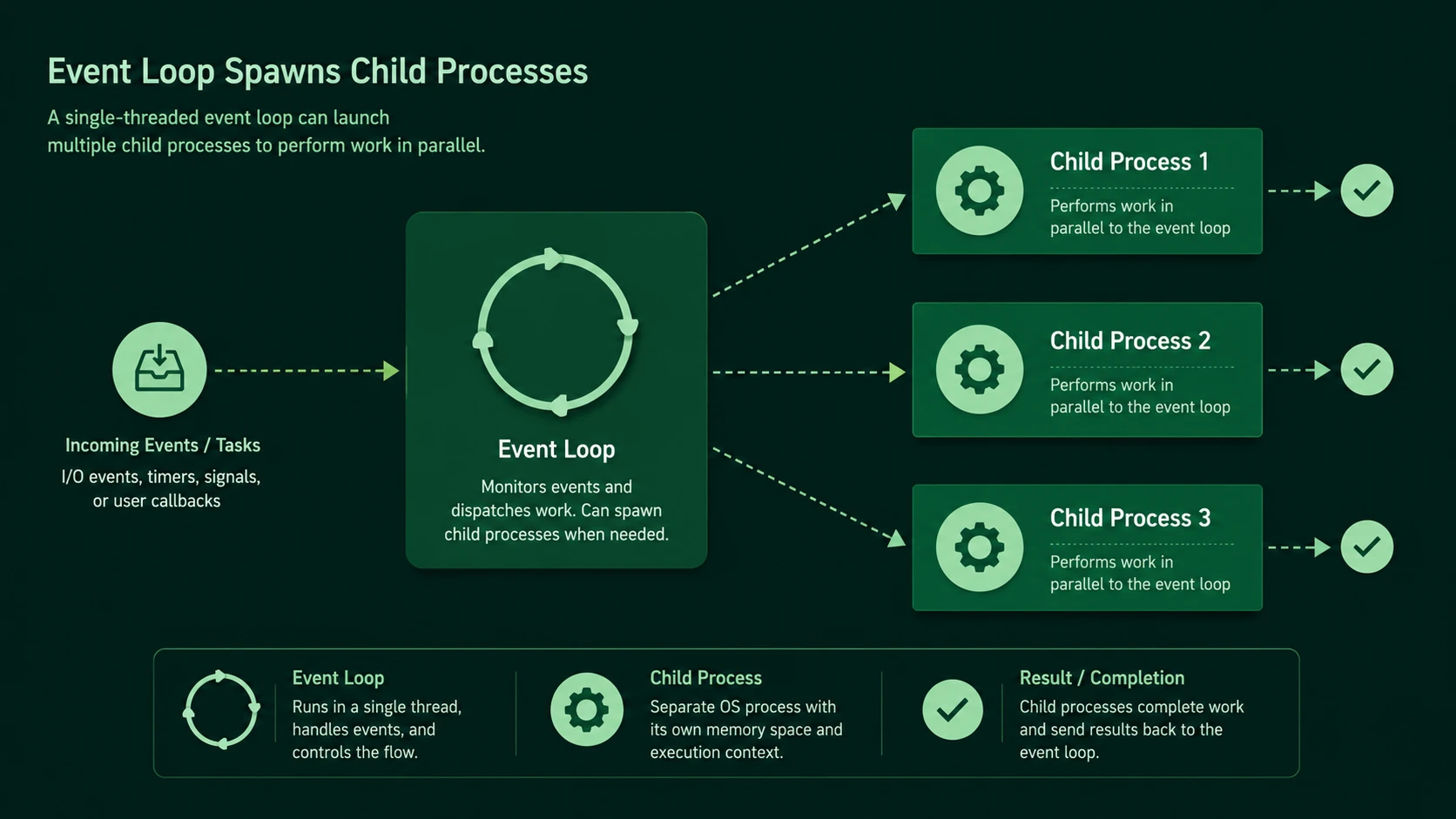
To address this limitation, Node.js provides the Child Process module, enabling applications to execute CPU-intensive work in separate operating system processes while allowing the primary event loop to continue serving client requests.
From the perspective of June 2014, child processes represent one of the most important architectural techniques for building scalable Node.js applications that combine asynchronous networking with computationally demanding workloads.
Industry Background
Modern enterprise applications increasingly combine multiple workload types within a single platform.
Examples include:
- ◆RESTful web services.
- ◆Image processing.
- ◆Financial calculations.
- ◆PDF generation.
- ◆Video transcoding.
- ◆Log analysis.
- ◆Data import and export.
- ◆Scientific computation.
While Node.js performs exceptionally well for asynchronous I/O, CPU-bound operations compete with request processing because all JavaScript execution occurs within the same event loop.
As organizations adopt Node.js for broader enterprise workloads, architectural separation between I/O operations and computational tasks becomes increasingly important.
The Business Problem
Applications performing CPU-intensive work directly inside the event loop often encounter several operational issues.
Organizations commonly experience:
- ◆Increased request latency.
- ◆Reduced API responsiveness.
- ◆Timeouts during peak traffic.
- ◆Poor user experience.
- ◆Lower concurrency.
- ◆Unpredictable response times.
- ◆Underutilized multicore processors.
Although Node.js efficiently manages asynchronous I/O, long-running synchronous JavaScript operations prevent the event loop from servicing new requests.
Child processes provide a practical mechanism for isolating these workloads.
Understanding the Technology
The Child Process module enables Node.js applications to create independent operating system processes.
Each child process executes separately from the primary Node.js runtime, allowing CPU-intensive work to proceed without blocking the main application.
The module provides several approaches.
- ◆spawn().
- ◆exec().
- ◆execFile().
- ◆fork().
Each method supports different workload patterns and communication models.
Processes communicate using standard input, standard output, standard error, or inter-process messaging depending on the selected API.
Core Architecture
A simplified architecture appears below.
| Component | Responsibility |
|---|---|
| Client Requests | Generate application workload |
| Node.js Event Loop | Handles asynchronous I/O |
| Child Process Module | Creates worker processes |
| Child Processes | Execute CPU-intensive operations |
| Operating System Scheduler | Allocates CPU resources |
| IPC Channel | Exchanges messages and results |
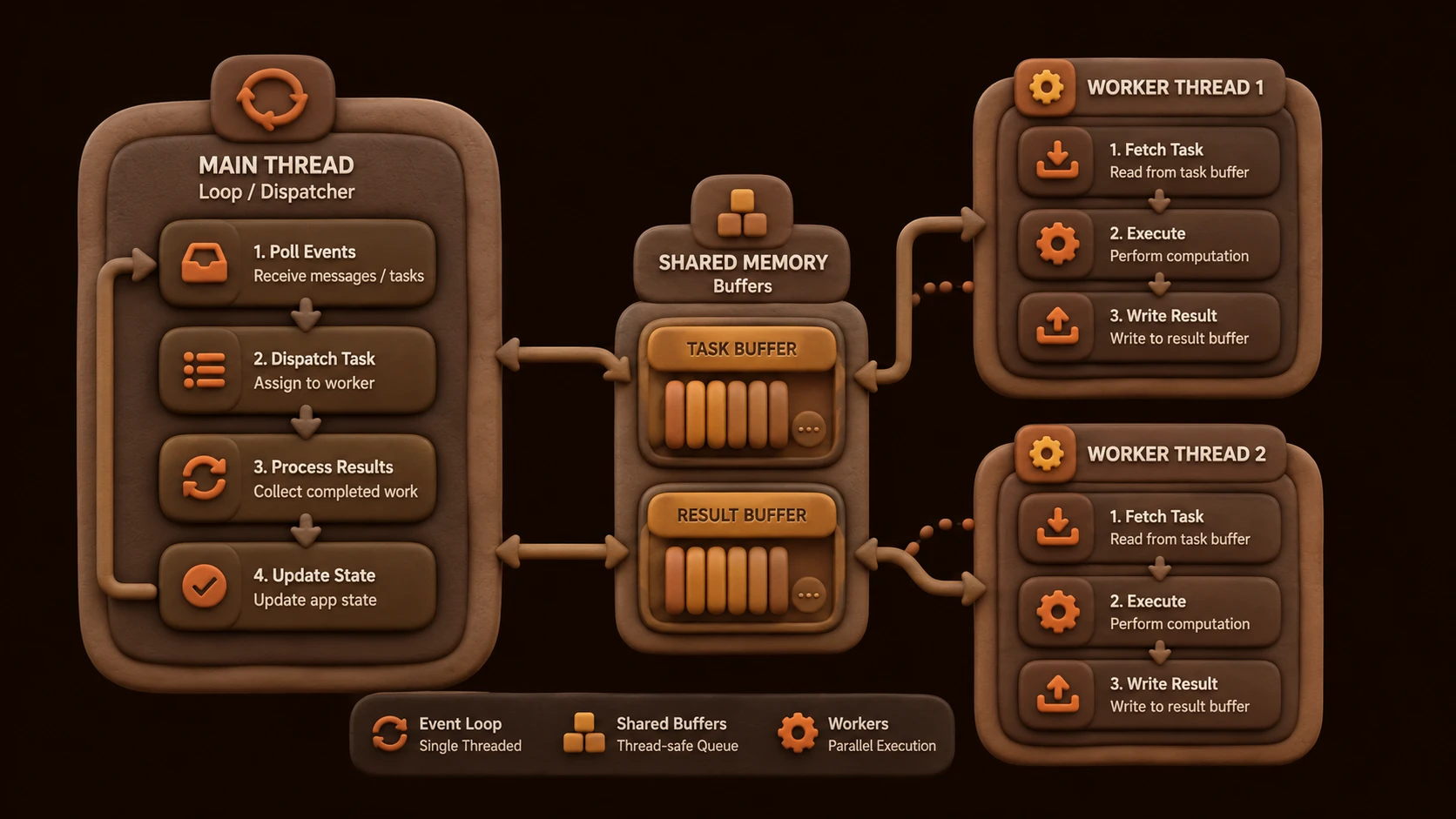
The event loop continues processing incoming requests while worker processes execute computational tasks independently.
Key Features
Process Isolation
Each child process operates independently with its own memory space, preventing computational workloads from interfering with the primary server process.
Parallel Execution
Modern multicore systems can execute multiple child processes simultaneously, improving hardware utilization.
Non-Blocking Server Operation
The main Node.js application remains responsive while long-running calculations execute elsewhere.
Inter-Process Communication
Parent and child processes exchange commands, status updates, and results using messaging channels.
External Program Execution
Applications may execute existing command-line utilities and native programs without rewriting them in JavaScript.
Fault Isolation
Failures occurring within child processes are less likely to terminate the primary application process when managed correctly.
How It Works
A simplified execution model appears below.
Client Request
      |
Node.js Server
      |
Event Loop
      |
Child Process Created
      |
CPU-Intensive Calculation
      |
Result Returned
      |
HTTP Response
The event loop delegates computational work while remaining available to accept additional client requests.
Enterprise Use Cases
Child processes support numerous enterprise scenarios.
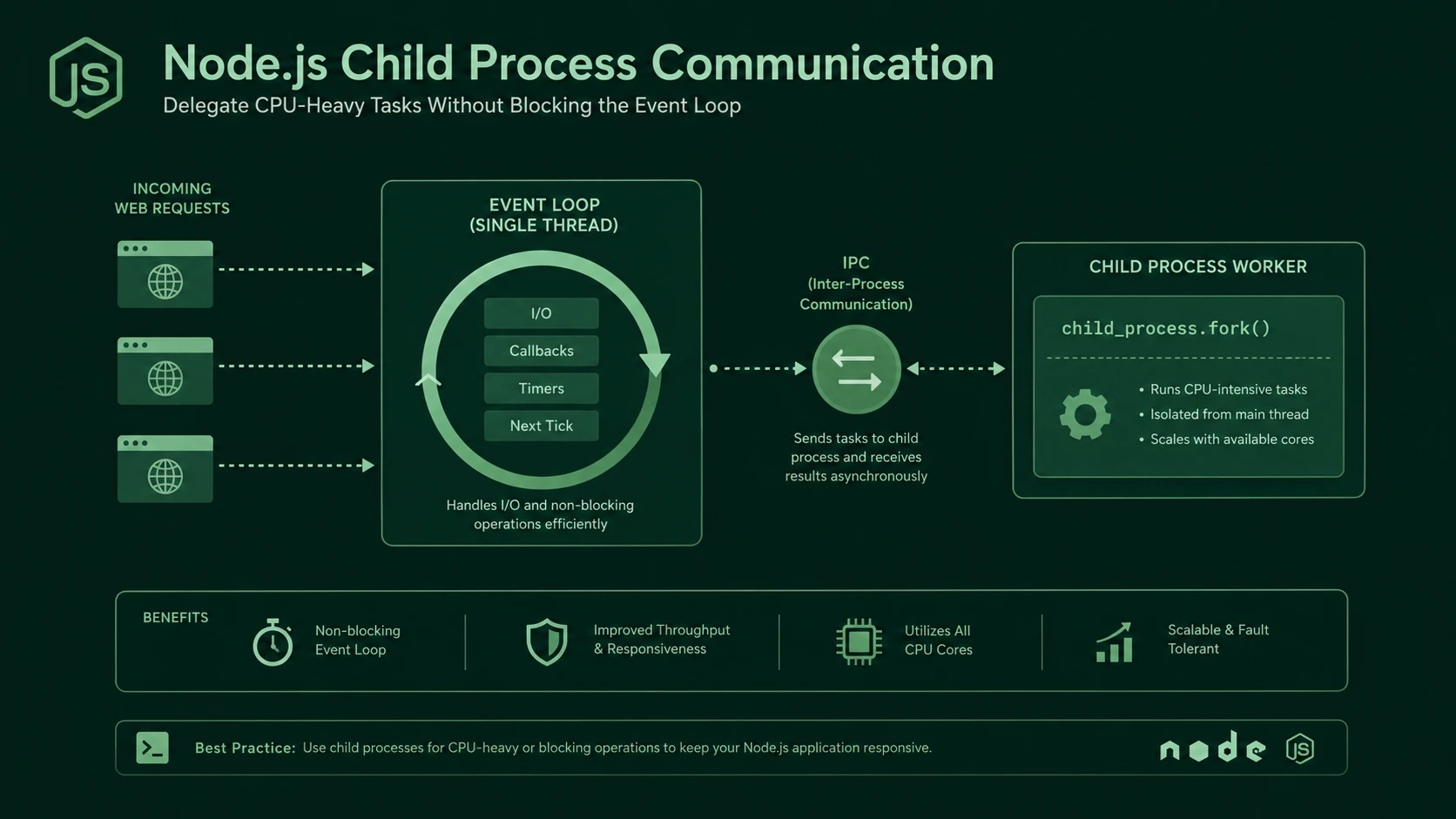
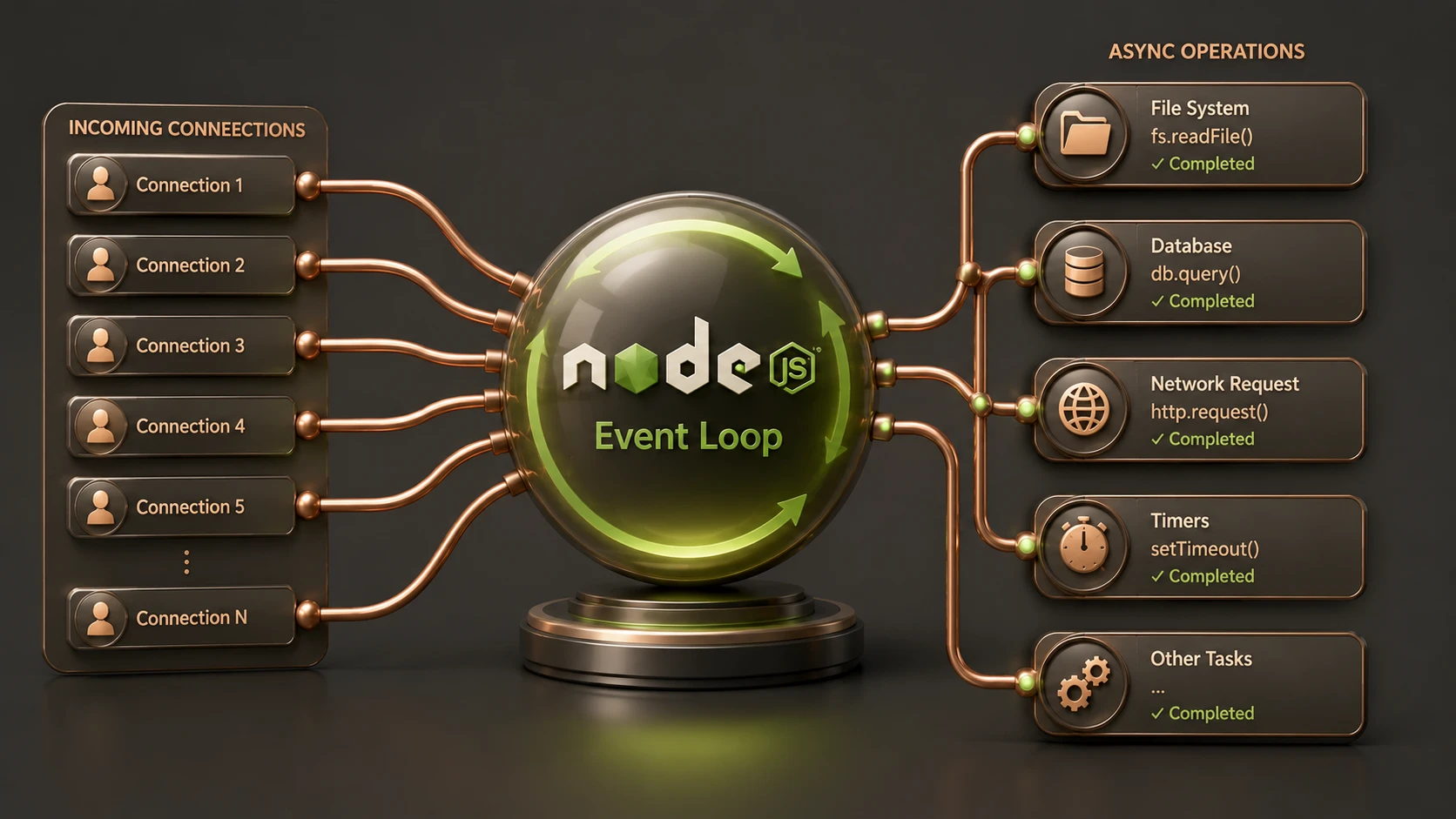
Event loop routing for non-blocking asynchronous I/O execution threads.
Report Generation
Large business reports can be generated independently without delaying web requests.
Image Processing
Thumbnail generation, resizing, and image conversion workloads can execute outside the primary application process.
Data Analytics
Complex calculations on imported datasets can execute asynchronously.
Financial Systems
Risk analysis, pricing calculations, and batch computations can utilize multiple processor cores.
Document Conversion
Generating PDF documents or converting office files can execute through external utilities launched as child processes.
Performance Considerations
Child processes improve responsiveness but introduce additional operational costs.
Important considerations include:
- ◆Process creation overhead.
- ◆Memory consumption.
- ◆Inter-process communication latency.
- ◆CPU scheduling.
- ◆Result serialization.
For very small tasks, process startup costs may outweigh performance benefits. Long-running or computationally expensive workloads typically justify process isolation.
Security Considerations
Launching external processes requires careful security planning.
Organizations should implement:
- ◆Input validation.
- ◆Restricted executable paths.
- ◆Least-privilege execution.
- ◆Controlled environment variables.
- ◆Secure file permissions.
- ◆Resource monitoring.
Applications should avoid constructing shell commands directly from untrusted user input, as improper command construction may introduce command injection risks.
Scalability
Child processes improve scalability by distributing computational workloads across available processor cores.
Scalable deployment characteristics include:
- ◆Parallel execution.
- ◆Independent worker processes.
- ◆Better CPU utilization.
- ◆Improved request responsiveness.
- ◆Horizontal application scaling.
This architecture enables web servers to maintain responsiveness even while executing resource-intensive business logic.
Best Practices
Organizations adopting child processes should:
- ◆Reserve child processes for CPU-intensive workloads.
- ◆Monitor worker process resource usage.
- ◆Reuse long-running workers where appropriate.
- ◆Handle process failures gracefully.
- ◆Validate all external command inputs.
- ◆Measure process startup overhead.
- ◆Log worker execution results consistently.
Careful workload analysis ensures that process creation improves rather than degrades application performance.
Common Mistakes
| Mistake | Business Impact |
|---|---|
| Executing CPU-intensive work in the event loop | Reduced application responsiveness |
| Creating excessive child processes | Higher memory consumption |
| Ignoring worker failures | Unreliable processing |
| Using shell commands without validation | Increased security risk |
| Passing large datasets unnecessarily through IPC | Lower throughput |
| Failing to monitor resource utilization | Production instability |
Avoiding these issues helps organizations maintain efficient server performance.
Technology Comparison
| Approach | Advantages | Limitations |
|---|---|---|
| Event Loop Only | Simple architecture and low overhead | Poor for CPU-intensive workloads |
| Child Processes | Parallel execution and process isolation | Process startup and IPC overhead |
| External Worker Services | Independent scaling and fault isolation | Higher operational complexity |
Child processes provide a practical middle ground for applications requiring occasional computational workloads without introducing a separate distributed architecture.
Adoption Strategy
Organizations should introduce child processes selectively.
Recommended roadmap:
- 1.Profile application performance.
- 2.Identify CPU-bound operations.
- 3.Move computational workloads into child processes.
- 4.Implement structured inter-process communication.
- 5.Benchmark throughput under realistic production workloads.
- 6.Continuously monitor CPU, memory, and process health.
A measured adoption strategy minimizes complexity while improving application responsiveness.
Limitations
Although child processes provide significant architectural advantages, organizations should recognize several considerations.
- ◆Process creation introduces measurable overhead.
- ◆Memory consumption increases because each process maintains its own runtime.
- ◆Communication between processes requires serialization.
- ◆Worker lifecycle management adds operational complexity.
- ◆Excessive process creation can reduce overall system efficiency.
Child processes should therefore be reserved for workloads where computational isolation provides clear performance benefits.
Looking Ahead
From the perspective of June 2014, the Child Process module remains an essential capability for enterprise Node.js applications that must combine highly concurrent network services with CPU-intensive processing. While Node.js continues to excel at asynchronous I/O, effective architecture requires recognizing when computational workloads should execute outside the event loop.
As organizations continue adopting Node.js for increasingly sophisticated enterprise systems, combining event-driven networking with carefully managed worker processes is likely to become a common architectural pattern. Teams that understand these trade-offs and apply child processes strategically will be well positioned to build responsive, scalable, and maintainable server-side applications while making efficient use of modern multicore hardware.