Introduction
As JavaScript applications continue evolving into increasingly sophisticated enterprise platforms, developers spend a considerable amount of time writing defensive code. Business applications frequently consume external APIs, interact with optional configuration values, process partially populated datasets, and integrate with systems that cannot always guarantee complete object structures.
Traditional JavaScript approaches often require multiple nested conditional expressions before accessing deeply nested properties. Likewise, assigning default values frequently relies on logical OR (||), which can unintentionally replace valid values such as 0, false, or empty strings.
These patterns increase code complexity, reduce readability, and make large codebases more difficult to maintain.
TypeScript 3.7 addresses these long-standing challenges by introducing Optional Chaining and Nullish Coalescing. These language features provide concise, expressive syntax for working safely with nullable values while preserving JavaScript compatibility.
Beyond these headline capabilities, TypeScript 3.7 also introduces assertion functions, expanded recursive type alias support, compiler refinements, and improved developer tooling.
From the perspective of November 2019, TypeScript 3.7 represents one of the most practical and developer-focused releases in the language's history.
Industry Background
Enterprise software increasingly depends upon TypeScript for large-scale application development.
Organizations commonly build:
- ◆React applications.
- ◆Angular platforms.
- ◆Vue applications.
- ◆Node.js services.
- ◆Progressive Web Applications.
- ◆Enterprise dashboards.
- ◆Cloud management portals.
These applications frequently process:
- ◆External API responses.
- ◆Optional configuration values.
- ◆User-generated content.
- ◆Distributed service responses.
- ◆Dynamic JSON structures.
Reliable null handling has therefore become an essential aspect of application architecture.
The Business Problem
Large JavaScript applications frequently encounter several maintainability challenges.
Organizations commonly experience:
- ◆Deep null checking.
- ◆Verbose conditional logic.
- ◆Runtime property access errors.
- ◆Repetitive defensive programming.
- ◆Incorrect default value handling.
- ◆Difficult code reviews.
- ◆Reduced readability.
As projects continue growing, simplifying common programming patterns becomes increasingly valuable.
TypeScript 3.7 directly addresses these concerns through improved language syntax.
Understanding the Technology
TypeScript 3.7 expands the language through several important capabilities.
Major enhancements include:
- ◆Optional Chaining.
- ◆Nullish Coalescing.
- ◆Assertion Functions.
- ◆Recursive Type Aliases.
- ◆Compiler improvements.
- ◆Better editor tooling.
- ◆Continued ECMAScript alignment.
These additions improve developer productivity without changing JavaScript runtime behavior beyond the generated output.
Core Architecture
A simplified TypeScript development architecture appears below.
| Component | Responsibility |
|---|---|
| TypeScript Source | Application implementation |
| Type System | Compile-time validation |
| TypeScript Compiler | Parsing and transpilation |
| JavaScript Output | Runtime execution |
| Browser or Node.js | Application runtime |
| IDE Language Service | Static analysis and tooling |
The compiler performs type analysis before generating compatible JavaScript for supported execution environments.
Key Features
Optional Chaining
Optional Chaining is the defining capability of TypeScript 3.7.
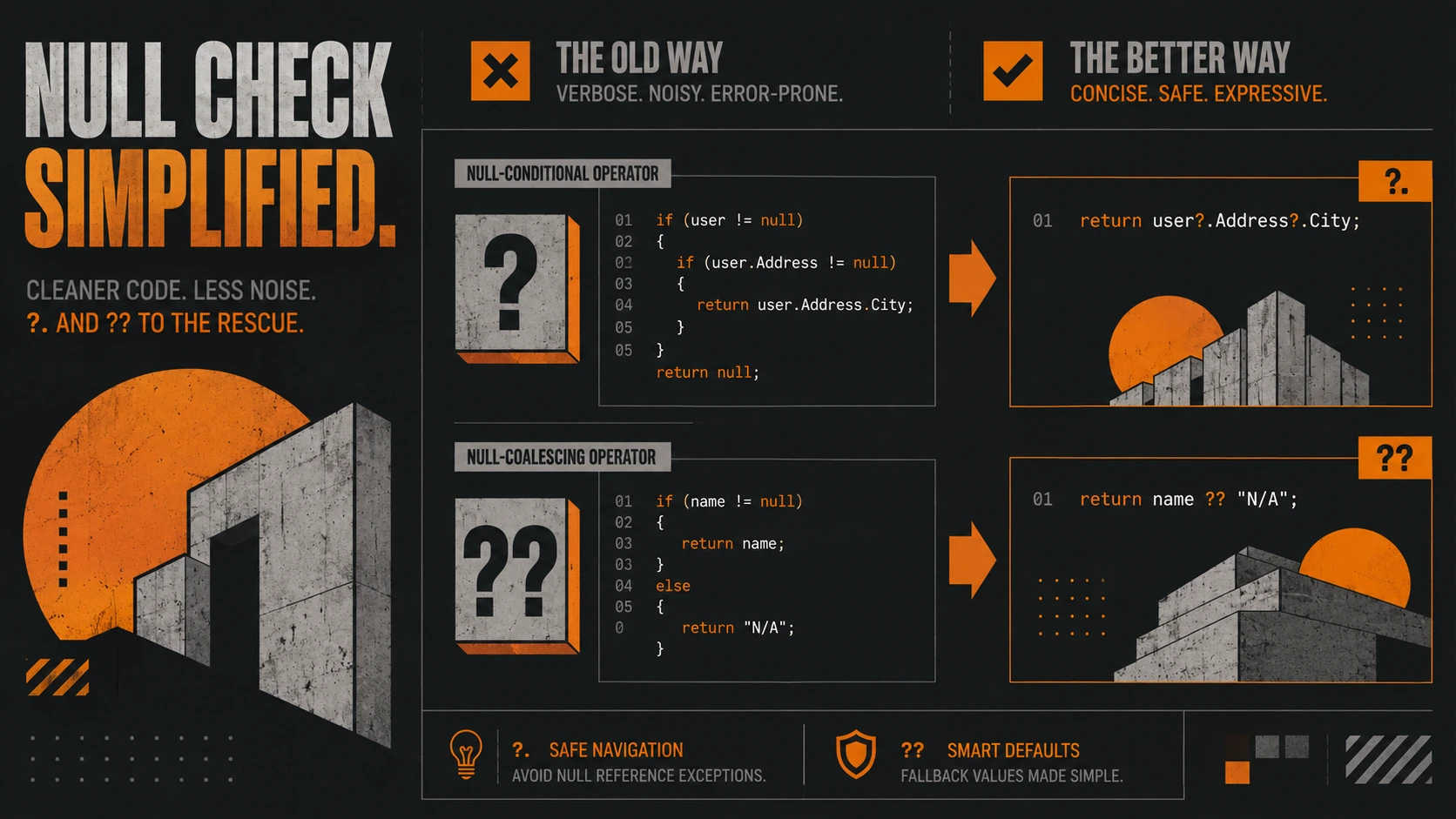
Instead of writing multiple conditional expressions to verify object existence before property access, developers can use the ?. operator.
For example:
const city = customer?.address?.city;If any intermediate value evaluates to null or undefined, evaluation stops and the expression returns undefined.
This significantly reduces repetitive null-checking logic while improving readability.
Common use cases include:
- ◆API responses.
- ◆Configuration objects.
- ◆Nested application state.
- ◆Optional user preferences.
- ◆Complex domain models.
Nullish Coalescing
TypeScript 3.7 introduces the ?? operator.
Unlike the logical OR operator, Nullish Coalescing applies default values only when the left-hand operand is null or undefined.
For example:
const timeout = config.timeout ?? 5000;This preserves legitimate values such as:
- ◆
0 - ◆
false - ◆
""
making application behavior more predictable.
Assertion Functions
Assertion functions allow developers to express runtime validation in ways that improve compile-time type analysis.
After successful assertions, the compiler can safely narrow variable types, reducing unnecessary type guards throughout the application.
This capability is particularly useful for validation frameworks and enterprise utility libraries.
Recursive Type Aliases
TypeScript 3.7 expands support for recursive type aliases.
Complex hierarchical data structures become easier to model while preserving compile-time correctness.
Examples include:
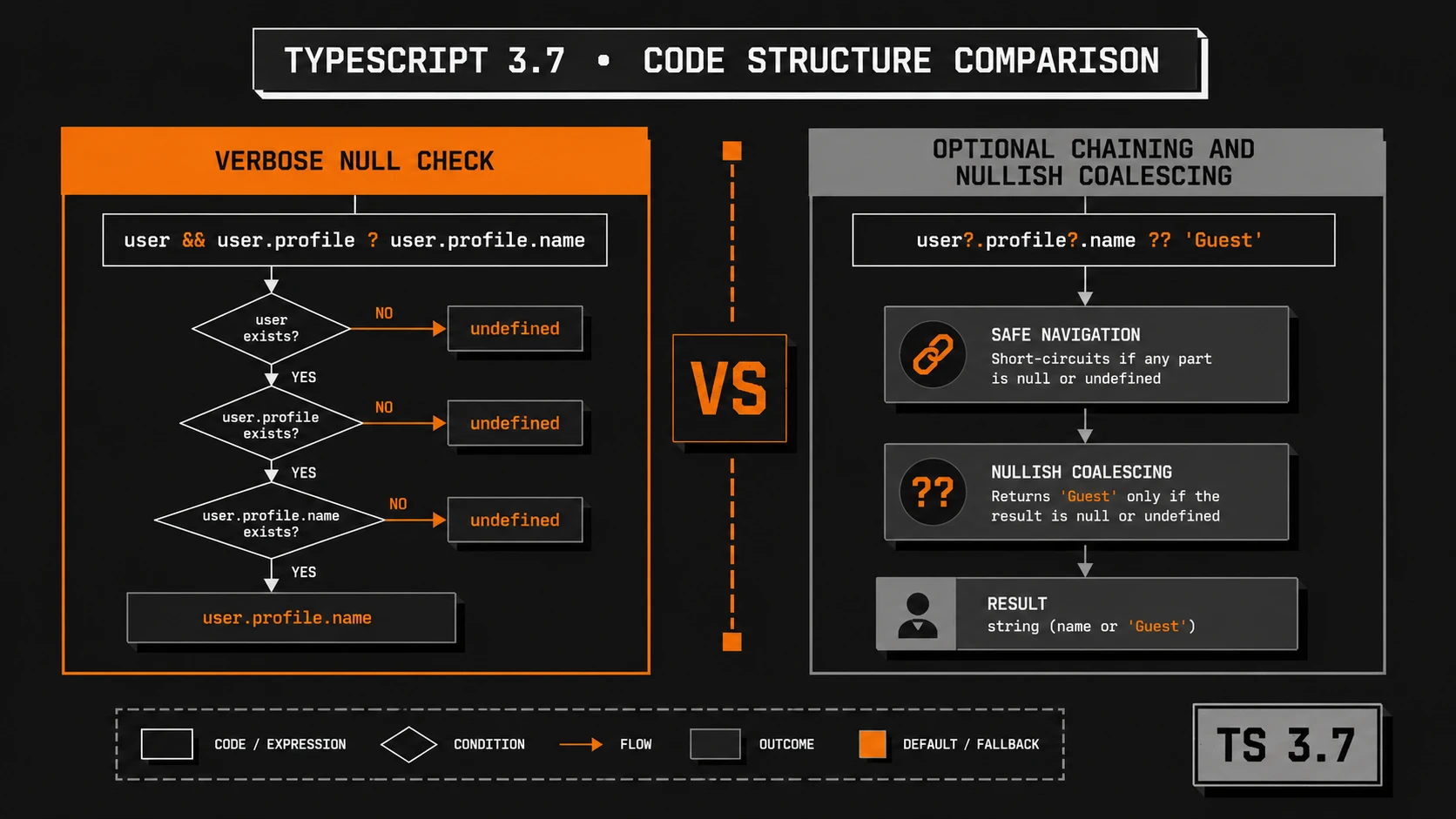
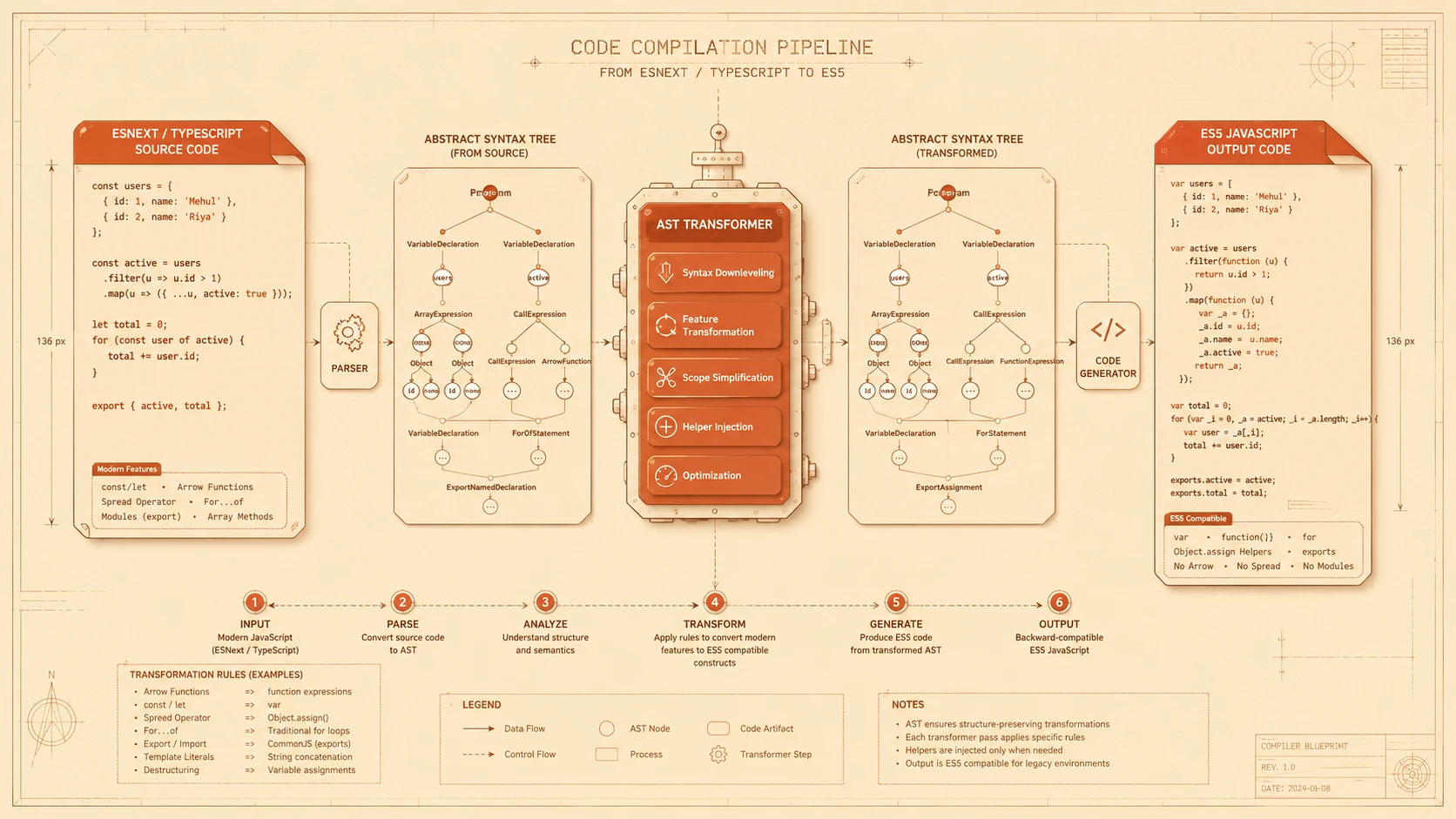
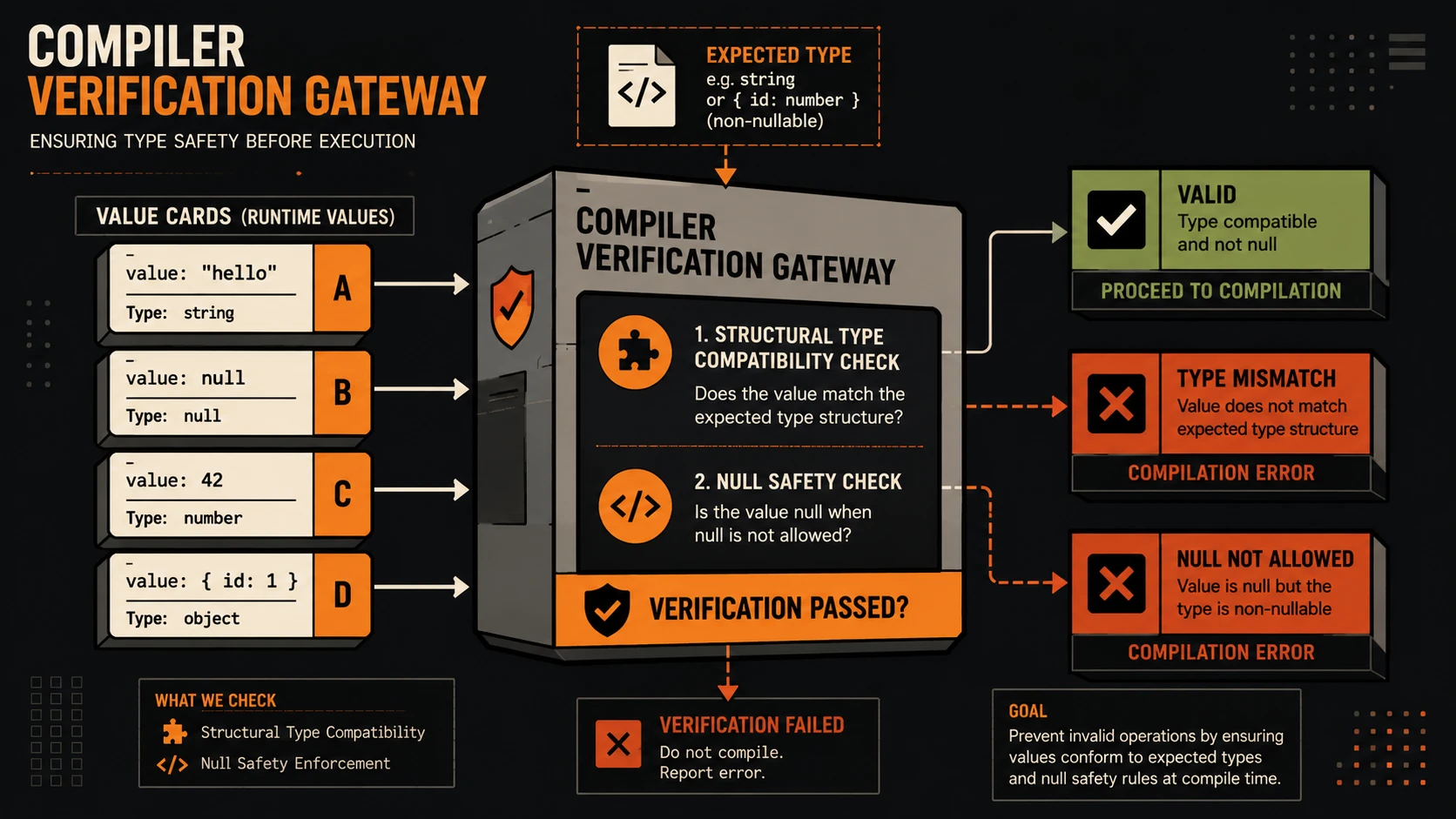
System architecture diagram and conceptual workflow layout for TypeScript 3.7: Optional Chaining and Nullish Coalescing Syntax Support.
- ◆Tree structures.
- ◆Configuration hierarchies.
- ◆Nested JSON documents.
- ◆Organizational models.
Improved Compiler Experience
The compiler continues improving diagnostics, editor responsiveness, and overall development productivity.
Large enterprise projects benefit from smoother development workflows.
ECMAScript Alignment
TypeScript continues aligning language features with emerging ECMAScript standards while maintaining backward compatibility across supported JavaScript environments.
How It Works
A simplified evaluation workflow appears below.
Application Object
        |
Optional Chaining
        |
Null Value?
     /      \
   Yes      No
    |        |
undefined  Continue Evaluation
        |
Nullish Coalescing
        |
Default Value if Needed
Optional Chaining safely terminates property access while Nullish Coalescing provides defaults only when values are truly absent.
Enterprise Use Cases
Enterprise APIs
Applications consuming REST services benefit from safer navigation of optional response fields.
Configuration Management
Application configuration becomes easier to read while preserving valid zero and Boolean values.
Cloud Platforms
Distributed services often exchange partially populated data structures that benefit from concise null handling.
React Applications
Component properties and application state become simpler to access without extensive defensive code.
Node.js Services
Backend applications processing dynamic request payloads gain improved readability and reduced runtime error potential.
Performance Considerations
TypeScript 3.7 primarily improves developer productivity rather than application execution speed.
Organizations should evaluate:
- ◆Generated JavaScript size.
- ◆Compiler performance.
- ◆Development productivity.
- ◆Code readability.
- ◆Static analysis quality.
- ◆Continuous Integration throughput.
The primary benefits arise through maintainability rather than measurable runtime performance gains.
Security Considerations
Optional Chaining improves application robustness but does not replace secure software engineering.
Organizations should continue implementing:
- ◆Input validation.
- ◆Authentication.
- ◆Authorization.
- ◆Secure dependency management.
- ◆HTTPS.
- ◆Secure API communication.
Language improvements complement comprehensive security architecture.
Scalability
TypeScript 3.7 strengthens enterprise scalability through:
- ◆Cleaner code.
- ◆Reduced defensive programming.
- ◆Better type inference.
- ◆Improved maintainability.
- ◆Easier onboarding.
These improvements become increasingly valuable as development teams and codebases continue expanding.
Best Practices
Organizations adopting TypeScript 3.7 should:
- ◆Replace repetitive null checks with Optional Chaining where appropriate.
- ◆Use Nullish Coalescing instead of logical OR when preserving valid falsy values is important.
- ◆Introduce assertion functions into validation libraries.
- ◆Continue enabling strict compiler options.
- ◆Benchmark build pipelines after upgrading.
- ◆Standardize TypeScript versions across engineering teams.
- ◆Document organization-wide coding conventions.
Consistent adoption improves maintainability throughout large projects.
Common Mistakes
| Mistake | Business Impact |
|---|---|
| Using Optional Chaining where missing data indicates an application defect | Hidden logic errors |
| Replacing every logical OR with Nullish Coalescing indiscriminately | Incorrect business behavior |
| Ignoring runtime validation because compile-time types exist | Reduced application reliability |
| Overusing recursive types unnecessarily | Increased type complexity |
| Delaying compiler upgrades | Missed productivity improvements |
| Neglecting team coding standards | Inconsistent code quality |
Successful adoption requires understanding when concise syntax improves clarity without obscuring business logic.
Technology Comparison
| Characteristic | Earlier TypeScript Versions | TypeScript 3.7 | ||
|---|---|---|---|---|
| Nested Property Access | Multiple conditional checks | Optional Chaining (?.) | ||
| Default Value Assignment | Logical OR (` | `) | Nullish Coalescing (??) | |
| Runtime Validation | Traditional type guards | Assertion Functions | ||
| Recursive Types | Limited support | Expanded recursive aliases | ||
| Enterprise Maintainability | Strong | Significantly improved readability |
TypeScript 3.7 simplifies several common programming patterns while maintaining full compatibility with existing application architectures.
Adoption Strategy
Organizations should adopt TypeScript 3.7 through a structured modernization plan.
- 1.Upgrade the TypeScript compiler across development environments.
- 2.Review existing null-checking patterns.
- 3.Introduce Optional Chaining into new development first.
- 4.Replace logical OR with Nullish Coalescing where business semantics require preserving falsy values.
- 5.Validate generated JavaScript across supported runtime environments.
- 6.Update internal coding guidelines to reflect new language capabilities.
This incremental strategy minimizes migration risk while allowing engineering teams to benefit from clearer, more maintainable code.
Limitations
As of November 2019, organizations should recognize several considerations.
- ◆Optional Chaining prevents runtime errors caused by null or undefined access but does not validate business correctness.
- ◆Existing projects should modernize gradually rather than performing large-scale automated rewrites.
- ◆Development teams should understand the semantic differences between
||and??before widespread adoption. - ◆Compiler-generated JavaScript should be validated for target execution environments.
- ◆Coding standards remain essential for maintaining consistency across large engineering organizations.
These considerations should guide enterprise adoption planning.
Looking Ahead
From the perspective of November 2019, TypeScript 3.7 represents one of the language's most impactful releases for day-to-day software development. Optional Chaining and Nullish Coalescing simplify patterns that appear throughout virtually every enterprise codebase, reducing repetitive defensive programming while improving readability and maintainability.
Combined with assertion functions, recursive type enhancements, and continued compiler refinements, TypeScript 3.7 demonstrates Microsoft's commitment to evolving the language through practical improvements that address real engineering challenges. Organizations building long-lived React, Angular, Vue, and Node.js applications should view this release as an important milestone toward cleaner, safer, and more expressive enterprise JavaScript development.