Introduction
JavaScript continues its rapid evolution from a browser scripting language into one of the primary programming languages for enterprise software development. Modern organizations increasingly depend on JavaScript across browser applications, Node.js services, cloud-native platforms, command-line tooling, build automation, desktop applications, and mobile development.
The annual ECMAScript release cycle has allowed the language to evolve through incremental improvements rather than disruptive redesigns. Recent editions introduced classes, modules, Promises, async/await, destructuring, template literals, and numerous improvements that have modernized both browser and server-side development.
ECMAScript 2018 (commonly referred to as ES9) continues this approach by focusing on practical language enhancements that improve developer productivity while preserving backward compatibility. Among the most significant additions are Object Rest and Spread Properties, asynchronous iteration, Promise.finally(), and several regular expression improvements.
As of June 2018, browser vendors, JavaScript engines, transpilers, and enterprise tooling are rapidly adopting these features, making ES9 another important milestone in modern JavaScript development.
Industry Background
Enterprise JavaScript applications increasingly include:
- ◆Single Page Applications
- ◆Progressive Web Applications
- ◆RESTful APIs
- ◆Microservices
- ◆Server-side rendering
- ◆Build automation
- ◆Event-driven architectures
These applications routinely manipulate complex objects, process asynchronous data streams, and integrate with numerous external services.
Language features that reduce boilerplate while preserving readability directly improve maintainability across large codebases.
The Business Problem
Enterprise development teams commonly encounter:
- ◆Verbose object cloning
- ◆Manual property filtering
- ◆Complex asynchronous data processing
- ◆Difficult cleanup logic for asynchronous workflows
- ◆Repetitive object transformation code
- ◆Reduced readability when handling streams of asynchronous data
Modern language constructs seek to simplify these patterns while maintaining JavaScript's flexibility.
Understanding ECMAScript 2018
ECMAScript 2018 extends the language with several practical enhancements.
Major additions include:
- ◆Object Rest Properties
- ◆Object Spread Properties
- ◆Asynchronous Iteration
- ◆Promise.finally()
- ◆Regular Expression improvements
These capabilities continue improving JavaScript's suitability for enterprise-scale application development.
Core Architecture
| Feature | Primary Responsibility |
|---|---|
| Object Rest | Extract remaining object properties |
| Object Spread | Clone and merge objects |
| Async Iteration | Consume asynchronous data streams |
| Promise.finally() | Execute cleanup logic |
| Enhanced Regular Expressions | Improve text processing |
| JavaScript Engine | Executes compiled source code |
Together these additions improve both application readability and developer productivity.
Object Rest Properties
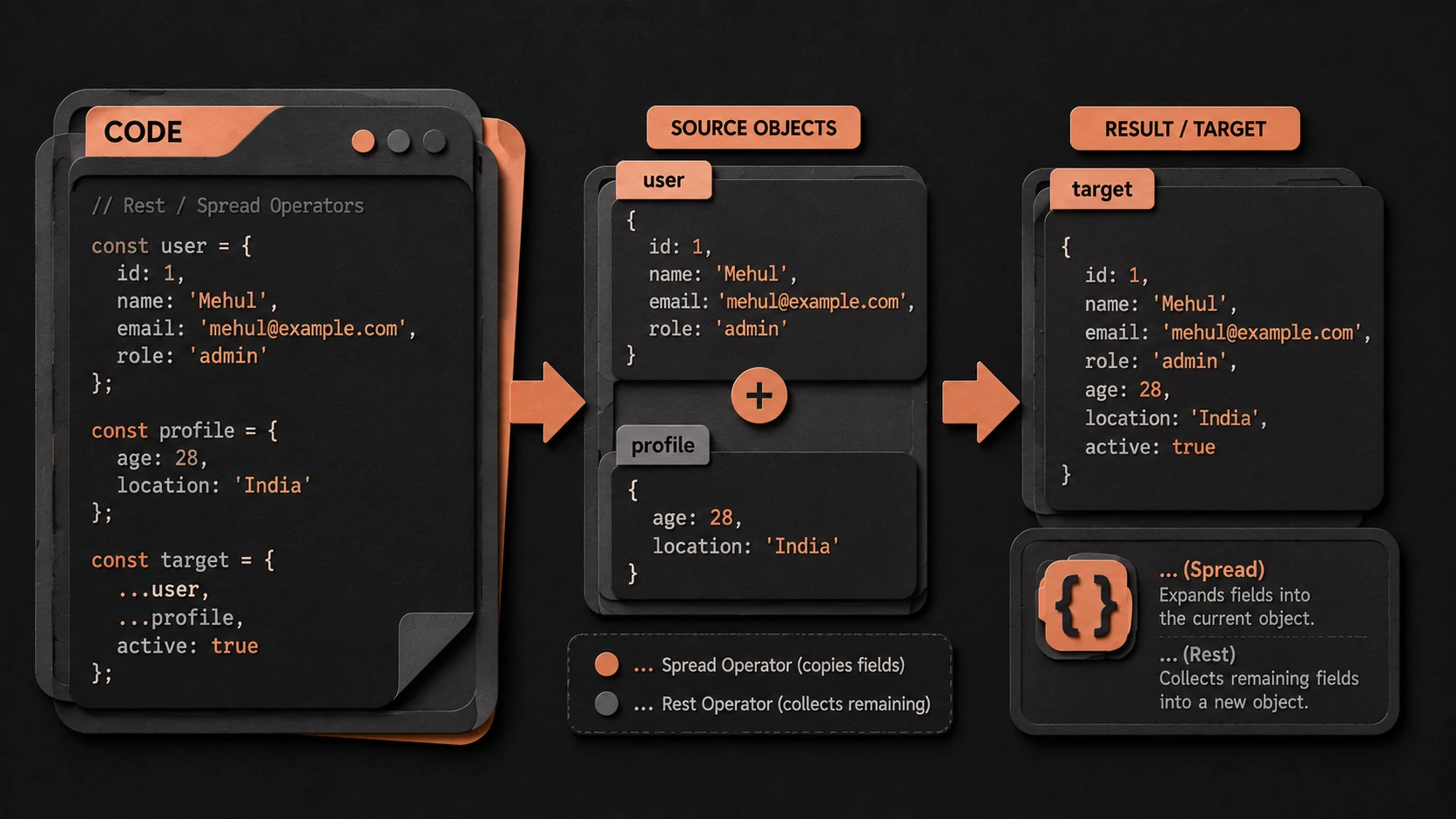
Object Rest Properties extend JavaScript destructuring by allowing developers to collect remaining properties into a new object.
Typical scenarios include:
- ◆Removing specific fields
- ◆Sanitizing objects
- ◆API response transformation
- ◆Configuration processing
Benefits include:
- ◆Less boilerplate
- ◆Cleaner destructuring
- ◆Easier object manipulation
- ◆Improved readability
Rather than manually copying properties, developers can express intent more directly.
Object Spread Properties
Object Spread complements Rest Properties by simplifying object creation and merging.
Developers frequently need to:
- ◆Clone objects
- ◆Override configuration values
- ◆Merge multiple objects
- ◆Build immutable state updates
Object Spread provides concise syntax for these common operations.
Advantages include:
- ◆Improved readability
- ◆Reduced repetitive assignments
- ◆Cleaner immutable programming patterns
- ◆Better support for component-based architectures
Applications using immutable state management particularly benefit from this feature.
Asynchronous Iteration
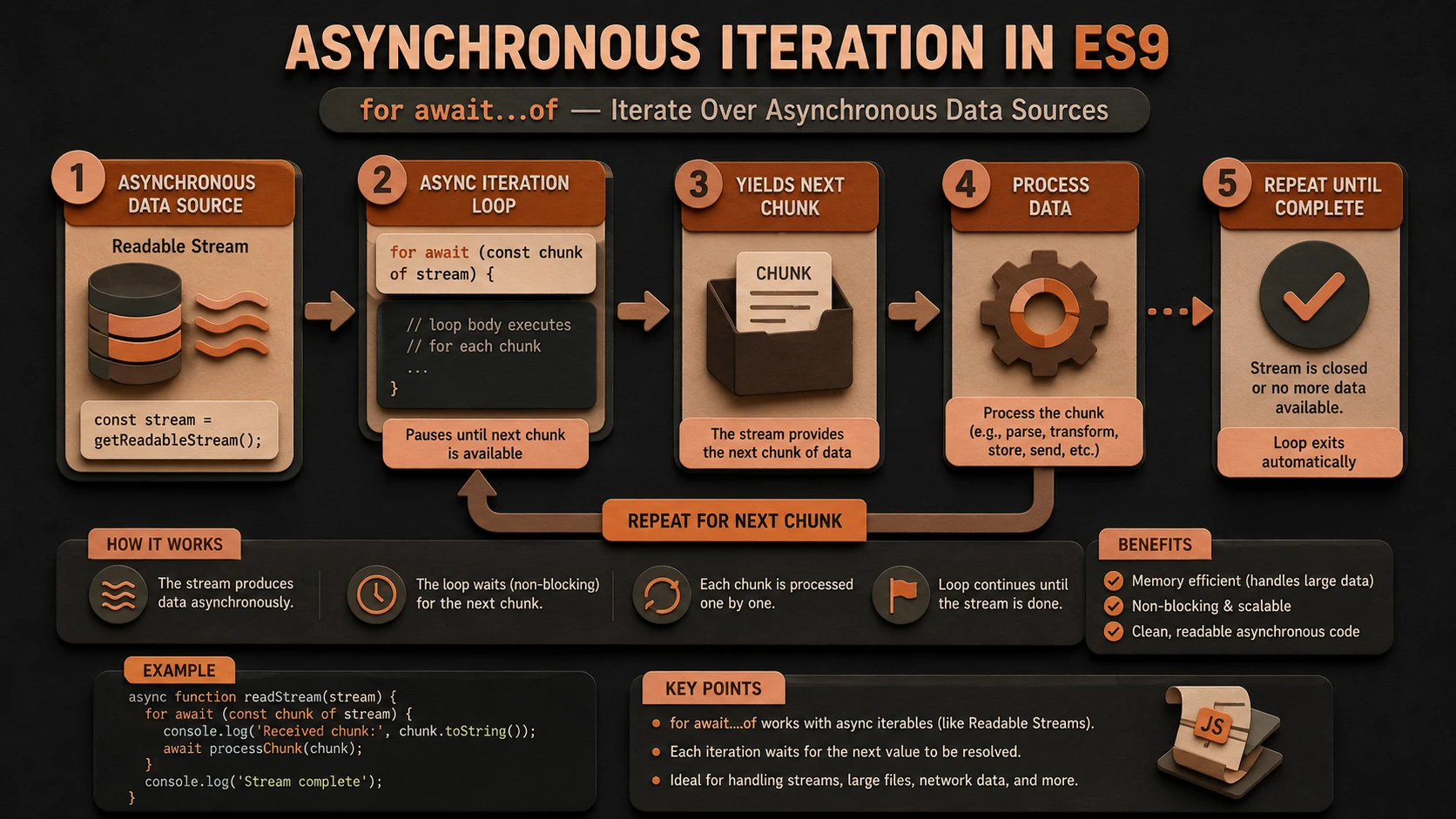
One of the most significant additions in ES9 is asynchronous iteration.
Traditional iteration assumes that data is immediately available.
However, modern applications increasingly consume:
- ◆Network streams
- ◆Event sources
- ◆Paginated APIs
- ◆File processing
- ◆Message queues
Asynchronous iteration allows these data sources to be processed using familiar iteration constructs.
A typical workflow includes:
- 1.An asynchronous data source becomes available.
- 2.The iterator retrieves data.
- 3.Processing pauses while awaiting the next value.
- 4.New data arrives.
- 5.Iteration continues.
- 6.Processing completes after the final item.
This programming model simplifies stream-oriented application logic.
Promise.finally()
Promise.finally() introduces a standardized mechanism for executing cleanup logic regardless of whether a Promise succeeds or fails.
Typical use cases include:
- ◆Closing resources
- ◆Stopping progress indicators
- ◆Releasing locks
- ◆Logging completion
- ◆Resetting application state
Event loop routing for non-blocking asynchronous I/O execution threads.
Benefits include:
- ◆Cleaner asynchronous code
- ◆Reduced duplication
- ◆Centralized cleanup logic
- ◆Improved maintainability
This feature complements async/await while remaining compatible with existing Promise-based programming.
Regular Expression Enhancements
ECMAScript 2018 also improves JavaScript's regular expression capabilities.
Enhancements expand support for more expressive pattern matching while improving text processing flexibility.
Enterprise applications commonly use regular expressions for:
- ◆Input validation
- ◆Log analysis
- ◆Configuration parsing
- ◆Data transformation
- ◆Search functionality
These additions strengthen JavaScript's capabilities for processing structured and semi-structured text.
Enterprise Use Cases
| Scenario | Benefit |
|---|---|
| React Applications | Immutable state updates using object spread |
| Node.js APIs | Cleaner asynchronous workflows |
| Cloud Services | Simplified stream processing |
| Data Pipelines | Asynchronous iteration |
| Enterprise Dashboards | Easier object transformation |
| Configuration Management | Cleaner object merging |
Organizations maintaining large JavaScript applications benefit from language constructs that reduce repetitive implementation code.
Performance Considerations
Most ES9 improvements target developer productivity rather than raw execution speed.
Development teams should continue evaluating:
- ◆Object allocation
- ◆Memory usage
- ◆Asynchronous execution
- ◆Stream processing performance
- ◆JavaScript engine optimization
Performance optimization should continue to rely on representative production measurements.
Security Considerations
Language enhancements do not alter application security responsibilities.
Organizations should continue implementing:
- ◆Input validation
- ◆Authentication
- ◆Authorization
- ◆Dependency management
- ◆Secure API communication
- ◆Error handling
Cleaner language syntax complements but does not replace secure software engineering practices.
Scalability
ECMAScript 2018 supports scalable development by encouraging:
- ◆Cleaner object manipulation
- ◆Improved asynchronous workflows
- ◆Better code readability
- ◆Reduced boilerplate
- ◆More maintainable business logic
These improvements become increasingly valuable as enterprise JavaScript codebases continue expanding.
Best Practices
Organizations adopting ES9 should:
- ◆Use Object Spread for immutable object updates.
- ◆Apply Rest Properties when excluding object fields.
- ◆Prefer asynchronous iteration for streaming data sources.
- ◆Use Promise.finally() for cleanup logic.
- ◆Continue following established asynchronous programming guidelines.
- ◆Benchmark performance before optimization.
- ◆Standardize coding conventions across development teams.
- ◆Validate runtime compatibility during deployment.
Consistent language usage improves long-term maintainability.
Common Mistakes
Development teams should avoid:
- ◆Assuming object spread performs deep cloning.
- ◆Overusing object copying where references are appropriate.
- ◆Mixing multiple asynchronous programming styles unnecessarily.
- ◆Ignoring cleanup responsibilities after asynchronous operations.
- ◆Using asynchronous iteration where synchronous collections are sufficient.
- ◆Adopting new syntax without updating coding standards.
Language improvements should enhance clarity rather than introduce unnecessary complexity.
Technology Comparison
| Capability | ECMAScript 2017 | ECMAScript 2018 |
|---|---|---|
| Async/Await | Yes | Yes |
| Object Rest Properties | No | Yes |
| Object Spread Properties | No | Yes |
| Asynchronous Iteration | No | Yes |
| Promise.finally() | No | Yes |
| Enhanced Regular Expressions | Limited | Improved |
ECMAScript 2018 extends JavaScript through practical enhancements while preserving compatibility with existing applications.
Adoption Strategy
Organizations should adopt ES9 incrementally.
A practical migration strategy includes:
- 1.Upgrade JavaScript tooling and transpilers.
- 2.Enable ECMAScript 2018 language support.
- 3.Introduce Object Rest and Spread in new development.
- 4.Adopt asynchronous iteration for suitable streaming workloads.
- 5.Standardize Promise.finally() usage for cleanup operations.
- 6.Update internal coding guidelines.
- 7.Validate browser and runtime compatibility before production deployment.
Incremental adoption minimizes migration risk while allowing development teams to gain familiarity with the new language capabilities.
Limitations
As of June 2018, organizations should recognize several considerations.
Current observations include:
- ◆Browser support continues expanding across implementations.
- ◆Existing transpilation workflows remain important for applications targeting older environments.
- ◆Object Spread performs shallow rather than deep copying.
- ◆Asynchronous iteration is most beneficial for asynchronous data sources rather than ordinary collections.
Successful adoption depends upon understanding each feature's intended use rather than applying new syntax universally.
Looking Ahead
ECMAScript 2018 continues JavaScript's steady evolution by introducing practical language improvements that simplify everyday programming tasks without altering the language's core design principles. Object Rest and Spread Properties reduce repetitive object manipulation, asynchronous iteration modernizes stream processing, and Promise.finally() improves the clarity of asynchronous cleanup logic.
As of June 2018, enterprise architects and senior JavaScript developers should evaluate these capabilities as natural extensions of existing development practices. Organizations that combine modern ECMAScript features with disciplined architecture, consistent coding standards, and comprehensive testing will continue building maintainable, scalable JavaScript applications across both browser and server environments.