Introduction
Modern software development increasingly depends on reusable open source components. Rather than implementing every feature from scratch, development teams routinely assemble applications from thousands of community-maintained libraries. This approach accelerates delivery, encourages code reuse, and allows organizations to benefit from continuous innovation across the open source ecosystem.
Within the JavaScript community, NPM has become the primary package management platform for distributing reusable modules. Thousands of packages are published every week, allowing developers to install dependencies with minimal effort.
During March 2016, the unexpected removal of the Left-Pad package demonstrated how even a very small library could affect thousands of downstream applications. Although Left-Pad consisted of only a few lines of code, its removal temporarily disrupted builds across a significant portion of the JavaScript ecosystem.
From the perspective of March 2016, the incident serves as an important reminder that dependency management is not merely a developer convenience but a critical aspect of enterprise software engineering.
Industry Background
JavaScript development has rapidly adopted modular software architecture.
Organizations increasingly rely on:
- ◆NPM packages.
- ◆Open source frameworks.
- ◆Build automation.
- ◆Continuous Integration.
- ◆Continuous Delivery.
- ◆Shared utility libraries.
- ◆Community-maintained components.
Applications often depend upon hundreds of direct packages, while those packages introduce additional transitive dependencies.
As ecosystems expand, dependency trees become increasingly difficult to understand and govern.
The Business Problem
Heavy dependence on external packages introduces several operational risks.
Organizations commonly face:
- ◆Dependency availability.
- ◆Version conflicts.
- ◆Build instability.
- ◆Unverified third-party code.
- ◆Package abandonment.
- ◆Registry availability.
- ◆Limited visibility into transitive dependencies.
The Left-Pad incident demonstrated that even a seemingly insignificant package can become critical when referenced by numerous upstream libraries.
This event highlights the importance of software supply chain governance.
Understanding the Technology
NPM provides package discovery, version management, dependency resolution, and package distribution.
A typical package lifecycle includes:
- ◆Package publication.
- ◆Versioning.
- ◆Dependency resolution.
- ◆Installation.
- ◆Application integration.
When developers install an application dependency, NPM automatically retrieves both direct and indirect dependencies required by that package.
This automation significantly improves developer productivity but also increases dependency complexity.
Core Architecture
A simplified package management architecture appears below.
| Component | Responsibility |
|---|---|
| Application | Business logic |
| package.json | Dependency declarations |
| NPM Client | Dependency installation |
| NPM Registry | Package distribution |
| Package Authors | Library maintenance |
| Continuous Integration | Automated builds |
Each package may itself depend upon additional packages, forming a hierarchical dependency graph.
Key Features
Centralized Package Distribution
NPM enables developers to publish reusable libraries through a centralized registry, simplifying software distribution.
Automatic Dependency Resolution
The package manager installs required dependencies recursively, reducing manual configuration.
Semantic Versioning
Version identifiers help developers communicate compatibility expectations while managing package evolution.
Community Ecosystem
The open source ecosystem enables rapid innovation by encouraging reusable software components.
Build Automation
Continuous Integration systems commonly restore dependencies automatically before compilation and testing.
Dependency Reuse
Organizations avoid duplicating common functionality by consuming existing libraries maintained by specialized contributors.
The Left-Pad Incident
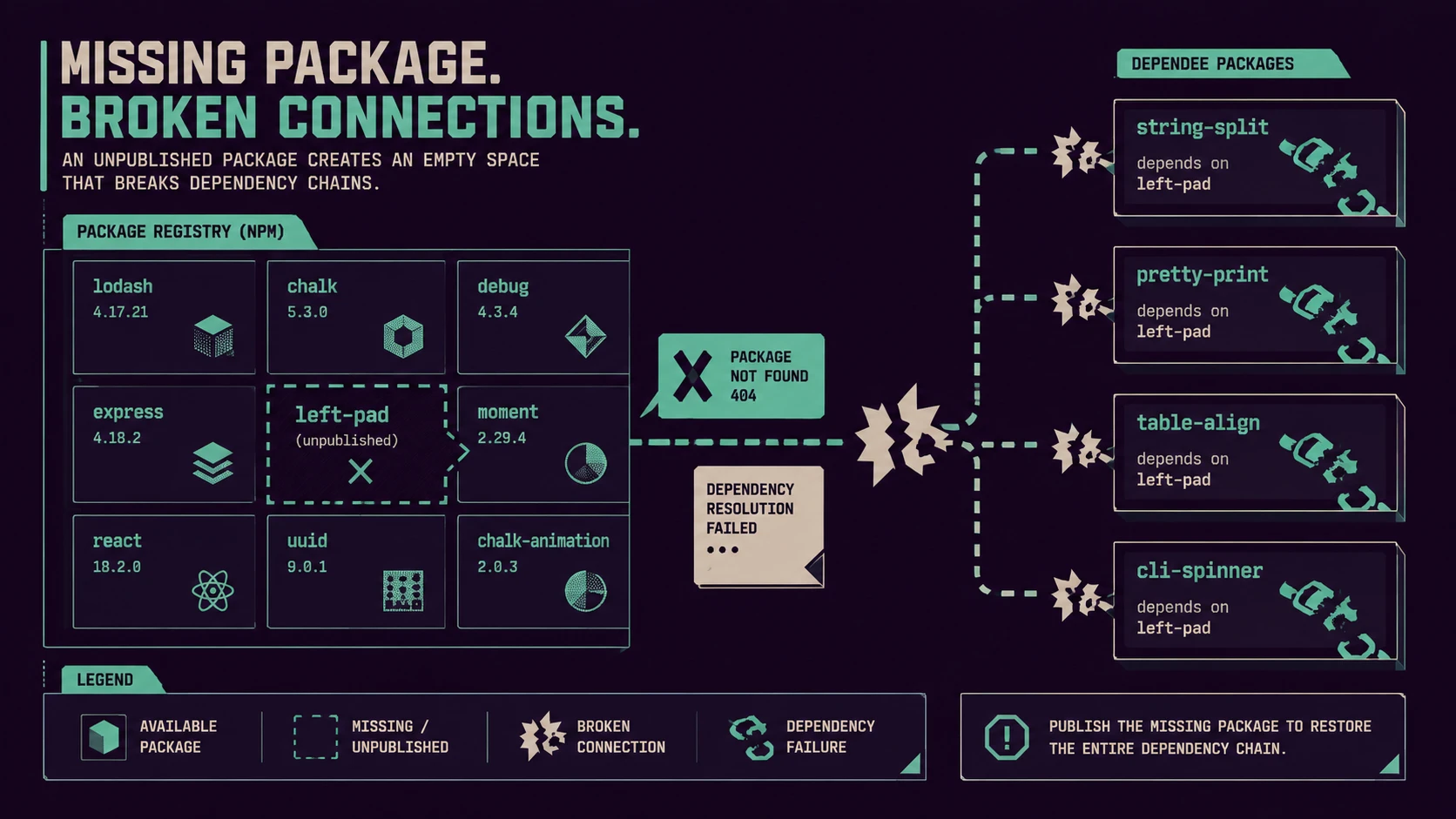
The Left-Pad package performed a simple string-padding operation.
Despite its modest functionality, numerous packages depended upon it either directly or indirectly.
When the package became unavailable from the public registry, build failures occurred throughout the JavaScript ecosystem because dependency resolution could no longer retrieve the required package version.
The incident demonstrated several important engineering lessons.
- ◆Small packages may have broad ecosystem impact.
- ◆Dependency graphs are often deeper than expected.
- ◆Build reproducibility depends on package availability.
- ◆Registry governance directly affects software delivery.
How It Works
A simplified dependency workflow appears below.
Application
      |
package.json
      |
NPM Client
      |
Dependency Resolution
      |
NPM Registry
      |
Download Packages
      |
Application Build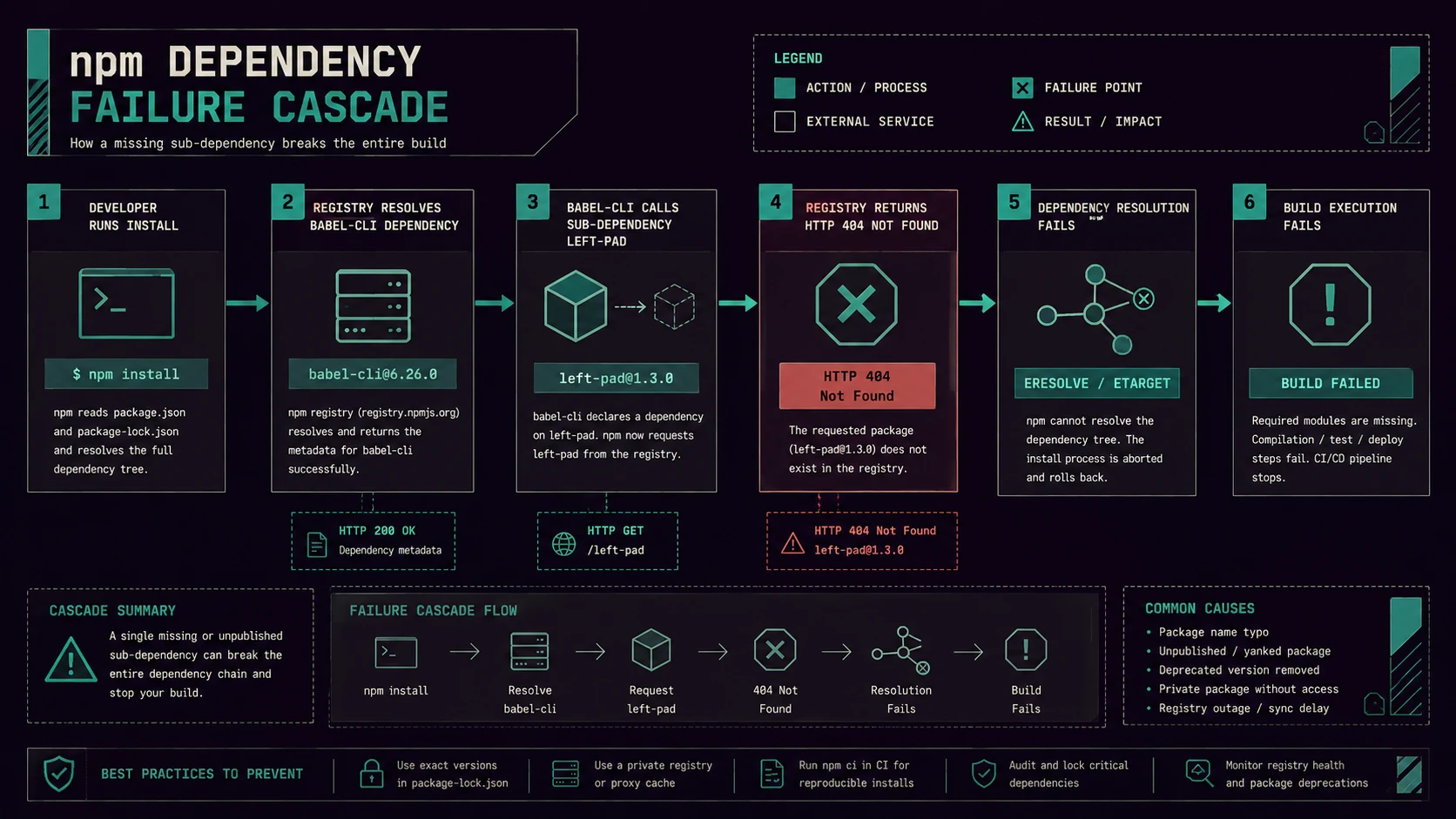
System architecture diagram and conceptual workflow layout for NPM Package Management Security.
Any interruption within the dependency chain can affect successful application builds.
Enterprise Use Cases
Enterprise Web Applications
Organizations developing Node.js applications depend heavily on package ecosystems for rapid feature development.
Continuous Integration
Automated build pipelines restore project dependencies before testing and deployment.
Internal Package Development
Large enterprises often publish reusable internal libraries shared across multiple development teams.
API Platforms
Node.js services frequently consume middleware, authentication libraries, logging frameworks, and utility packages from NPM.
Development Standardization
Package management enables consistent dependency installation across developer workstations and build servers.
Performance Considerations
Dependency management primarily affects build processes rather than application runtime.
Important considerations include:
- ◆Installation speed.
- ◆Package cache utilization.
- ◆Registry availability.
- ◆Dependency graph complexity.
- ◆Build reproducibility.
- ◆Network latency.
Organizations should optimize dependency restoration as part of their Continuous Integration workflows.
Security Considerations
The Left-Pad incident emphasizes broader software supply chain concerns.
Organizations should implement:
- ◆Dependency reviews.
- ◆Trusted package selection.
- ◆Version governance.
- ◆Internal package mirrors where appropriate.
- ◆Automated dependency auditing.
- ◆Build reproducibility controls.
Third-party code should receive the same level of governance as internally developed software.
Scalability
Large software organizations require structured package management.
Scalable practices include:
- ◆Standardized dependency policies.
- ◆Shared internal libraries.
- ◆Automated build pipelines.
- ◆Package version governance.
- ◆Centralized artifact management.
These practices reduce operational risk as development teams and application portfolios expand.
Best Practices
Organizations managing NPM dependencies should:
- ◆Minimize unnecessary package dependencies.
- ◆Evaluate the maintenance quality of third-party libraries.
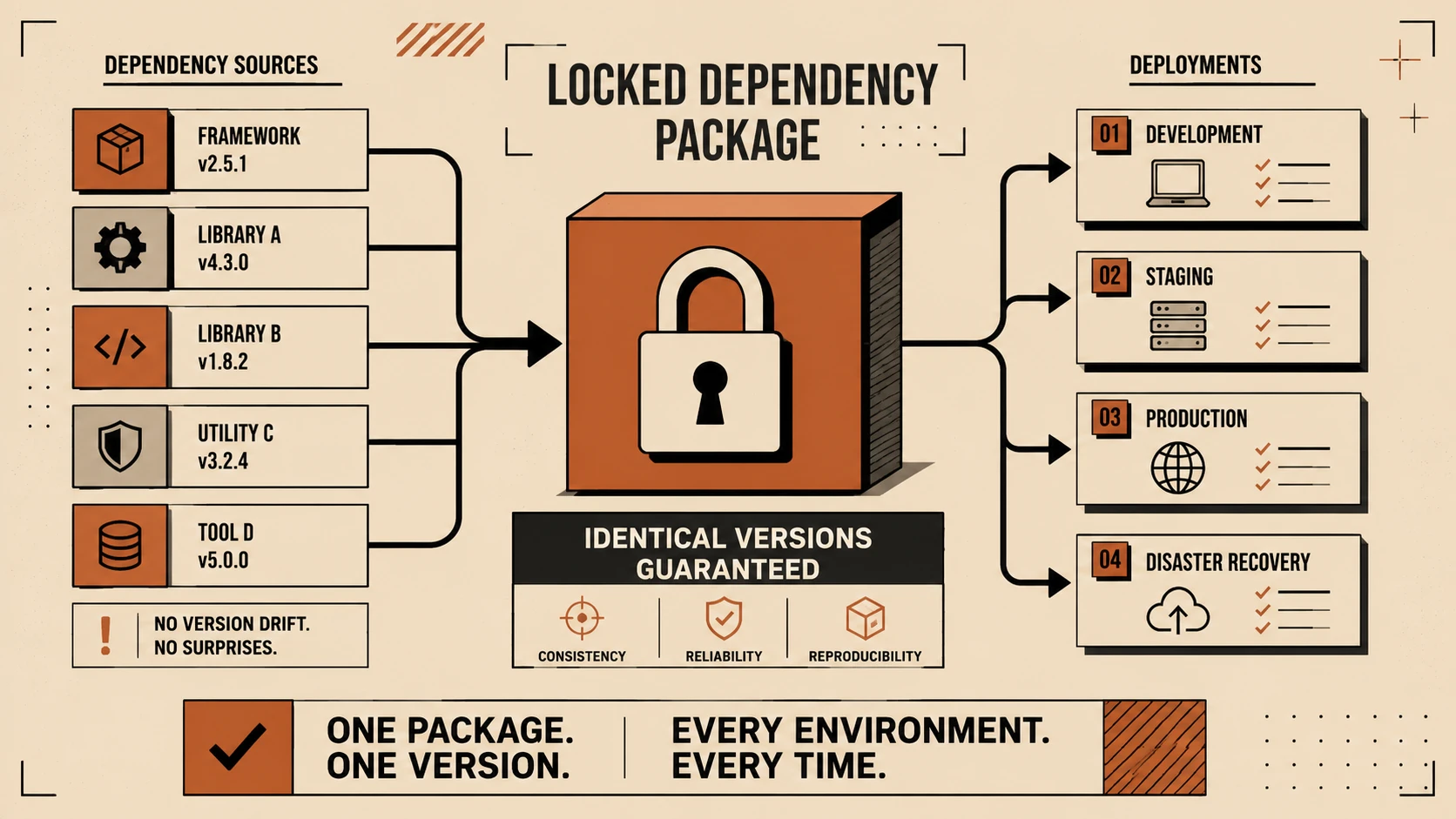
- ◆Lock dependency versions for production builds.
- ◆Monitor package updates carefully.
- ◆Review transitive dependencies.
- ◆Maintain reproducible build environments.
- ◆Establish internal package governance policies.
Disciplined dependency management improves both operational stability and long-term maintainability.
Common Mistakes
| Mistake | Business Impact |
|---|---|
| Installing packages without evaluation | Increased operational risk |
| Excessive dependency chains | Higher maintenance complexity |
| Ignoring transitive dependencies | Limited visibility into application risk |
| Depending entirely on external registries | Reduced build resilience |
| Updating packages without testing | Production instability |
| Lack of dependency governance | Inconsistent enterprise standards |
Avoiding these mistakes helps organizations build more resilient software delivery pipelines.
Technology Comparison
| Approach | Advantages | Limitations |
|---|---|---|
| Manual Library Management | Complete organizational control | High maintenance effort |
| NPM Public Registry | Large ecosystem and rapid development | External dependency risk |
| Internal Package Repositories | Improved governance and availability | Additional operational management |
Many enterprises combine public open source packages with internally governed package repositories to balance flexibility and operational control.
Adoption Strategy
Organizations should strengthen dependency management using a phased approach.
- 1.Inventory existing package dependencies.
- 2.Identify critical third-party libraries.
- 3.Standardize dependency version policies.
- 4.Improve Continuous Integration reproducibility.
- 5.Evaluate internal package repository strategies.
- 6.Establish formal software supply chain governance.
This approach reduces operational risk while preserving the productivity benefits of open source development.
Limitations
As of March 2016, the JavaScript ecosystem continues evolving rapidly.
Organizations should recognize several considerations.
- ◆Public package ecosystems rely heavily on community maintainers.
- ◆Dependency graphs may change frequently.
- ◆Registry governance policies continue evolving.
- ◆Enterprise dependency visibility remains challenging.
- ◆Build reproducibility requires ongoing operational discipline.
These considerations reinforce the need for structured dependency management processes.
Looking Ahead
From the perspective of March 2016, the Left-Pad incident is likely to influence how organizations approach software dependency management. While open source ecosystems remain an extraordinary source of innovation and productivity, they also introduce operational dependencies that deserve the same architectural attention as databases, application servers, and network infrastructure.
For enterprise engineering teams, the primary lesson is clear: package management is no longer simply a development convenience. It is an essential part of software governance, build reliability, and operational resilience. Organizations that establish disciplined dependency management practices today will be better prepared to build stable, maintainable, and scalable Node.js applications as the JavaScript ecosystem continues to grow.