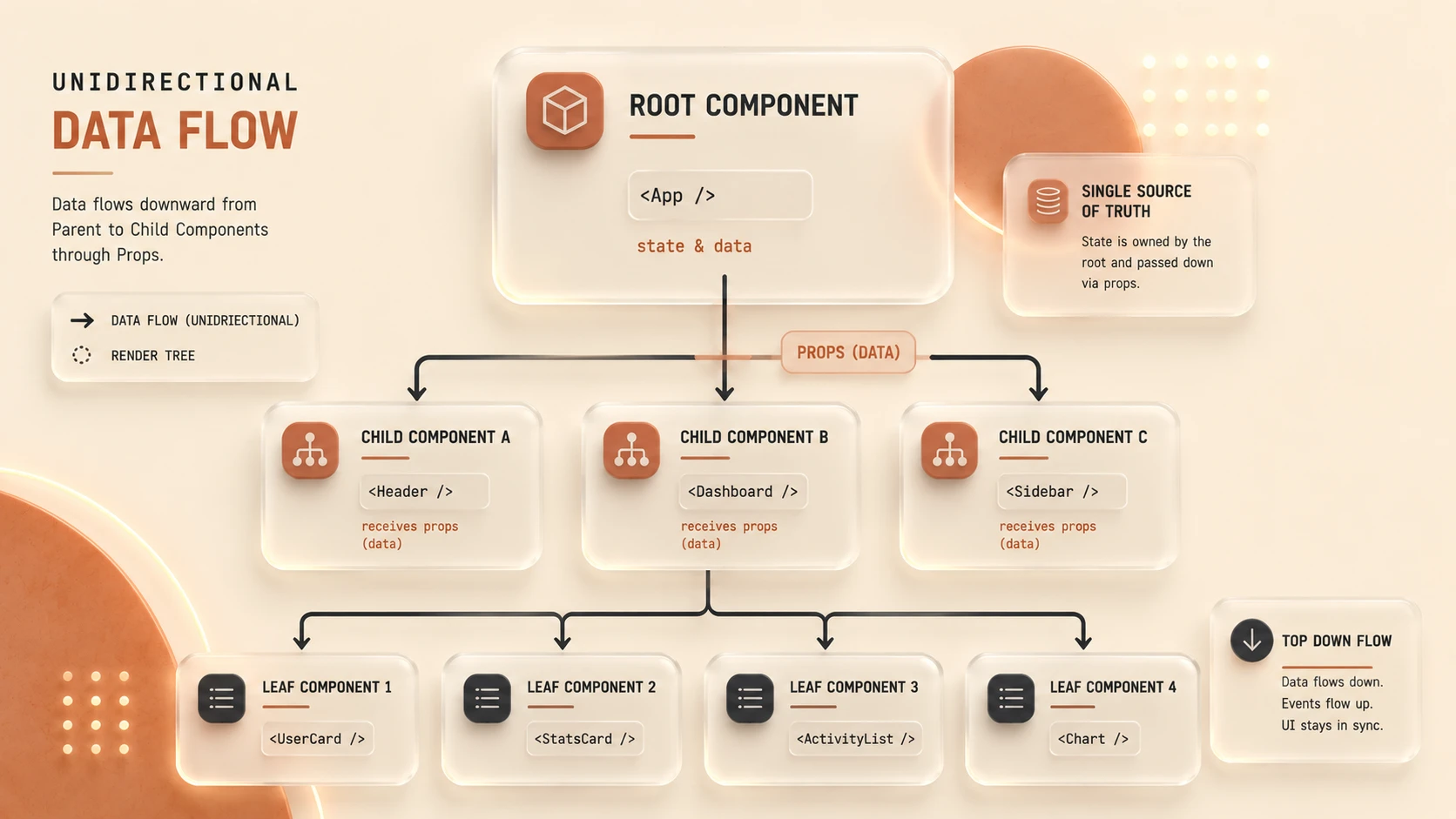
Introduction
Modern web applications increasingly resemble desktop software. Enterprise dashboards, collaborative workspaces, customer relationship management systems, financial trading platforms, and business intelligence portals routinely manage thousands of interactive interface elements while processing continuous user input and asynchronous network activity.
React has become one of the most influential JavaScript libraries by introducing a component-oriented architecture and Virtual DOM reconciliation model that simplifies UI development. As React applications continue expanding in complexity, however, rendering performance and scheduling flexibility have become increasingly important.
Facebook has introduced React Fiber, a complete redesign of React's reconciliation engine. Rather than changing how developers build components, Fiber fundamentally changes how React schedules, prioritizes, and performs rendering work internally.
From the perspective of January 2017, React Fiber represents one of the most ambitious architectural redesigns undertaken by the React team since the library's initial release.
Industry Background
Modern enterprise applications increasingly demand responsive user interfaces.
Organizations commonly develop:
- ◆Single Page Applications.
- ◆Enterprise dashboards.
- ◆Customer portals.
- ◆Financial analytics platforms.
- ◆Real-time collaboration tools.
- ◆Cloud administration consoles.
- ◆Software-as-a-Service applications.
As interface complexity increases, rendering workloads also grow. Long-running rendering operations can negatively affect user experience by delaying animations, interactions, and visual updates.
Developers increasingly require rendering systems capable of balancing responsiveness with computational efficiency.
The Business Problem
Large React applications frequently encounter several rendering challenges.
Organizations commonly experience:
- ◆Long rendering operations.
- ◆Reduced interface responsiveness.
- ◆Expensive reconciliation.
- ◆Animation interruptions.
- ◆Complex update scheduling.
- ◆Performance bottlenecks.
- ◆Limited prioritization of rendering work.
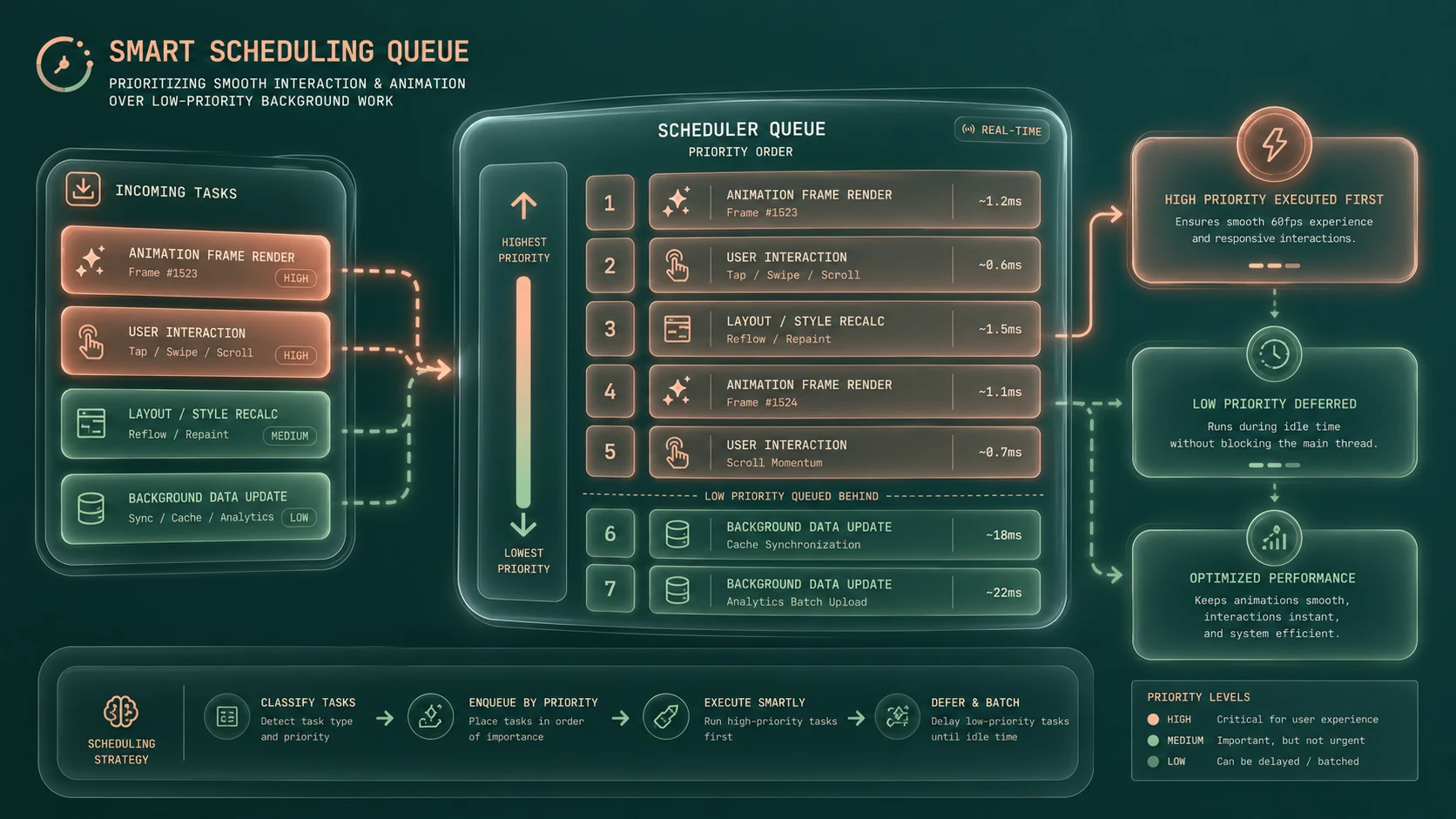
Traditional synchronous rendering requires React to complete reconciliation before yielding control, making it difficult to prioritize user interactions over less critical rendering tasks.
React Fiber addresses these limitations through a redesigned scheduling architecture.
Understanding the Technology
Fiber is a complete rewrite of React's reconciliation engine.
Rather than altering React's programming model, Fiber changes how component updates are represented and processed internally.
Major architectural goals include:
- ◆Incremental rendering.
- ◆Task prioritization.
- ◆Interruptible reconciliation.
- ◆Better scheduling.
- ◆Improved responsiveness.
- ◆Future animation support.
- ◆Scalable rendering architecture.
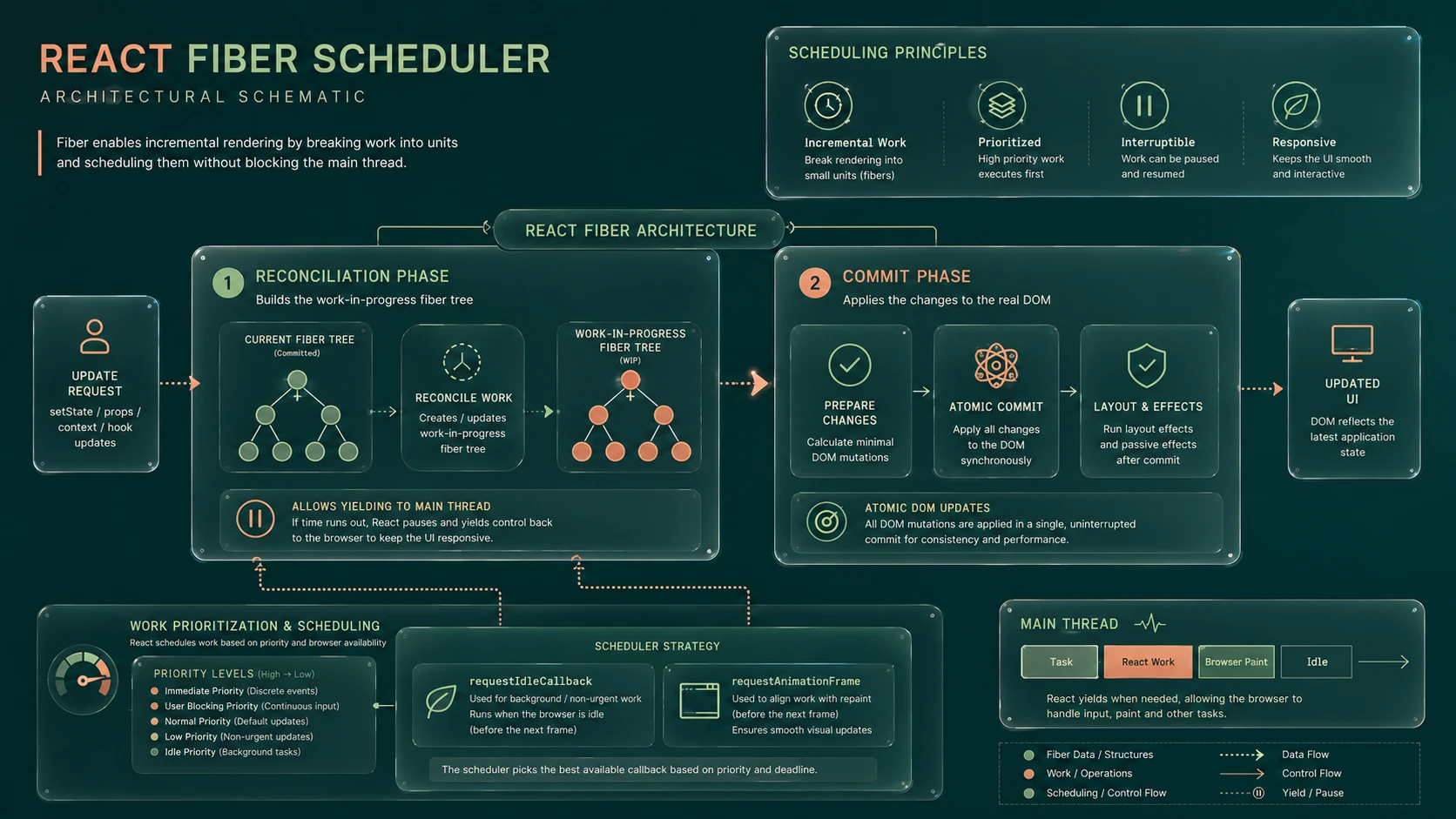
Instead of treating reconciliation as one uninterrupted operation, Fiber divides rendering work into smaller units that can be scheduled more intelligently.
Core Architecture
A simplified Fiber architecture appears below.
| Component | Responsibility |
|---|---|
| React Components | Define application UI |
| Fiber Nodes | Represent units of rendering work |
| Scheduler | Prioritizes rendering tasks |
| Reconciliation Engine | Calculates UI updates |
| Virtual DOM | Intermediate UI representation |
| Browser DOM | Final rendered interface |
Each Fiber node represents a unit of work that the scheduler can process independently, providing greater flexibility than the previous reconciliation implementation.
Key Features
Fiber-Based Reconciliation
Fiber replaces the previous reconciliation implementation with a more flexible internal data structure.
Rather than processing the entire component tree as a single operation, rendering work can be organized into manageable units.
This provides the foundation for more sophisticated scheduling.
Incremental Rendering
One of Fiber's primary objectives is incremental rendering.
Large rendering operations may be divided into smaller pieces, allowing the browser to remain responsive during complex updates.
This approach is particularly valuable for applications containing deeply nested component hierarchies.
Task Prioritization
Not every interface update requires identical urgency.
Fiber introduces scheduling capabilities intended to prioritize critical interactions such as user input over less urgent rendering work.
This enables more responsive applications under heavy workloads.
Interruptible Rendering
Unlike traditional synchronous reconciliation, Fiber is designed to support pausing and resuming rendering work.
Higher-priority operations can therefore receive attention before lower-priority tasks complete.
Improved Scheduling Architecture
The redesigned scheduler separates rendering decisions from application logic, providing a more flexible foundation for future rendering capabilities.
Backward Developer Experience
Despite extensive internal architectural changes, React developers continue building applications using familiar component-based programming techniques.
Most improvements occur within the framework implementation rather than the application programming model.
How It Works
A simplified rendering workflow appears below.
Event loop routing for non-blocking asynchronous I/O execution threads.
Application State Change
          |
React Scheduler
          |
Fiber Work Units
          |
Priority Evaluation
          |
Incremental Reconciliation
          |
Virtual DOM
          |
Browser DOM Update
The scheduler determines when rendering work should proceed and which operations receive higher execution priority.
Enterprise Use Cases
Enterprise Dashboards
Business intelligence systems displaying continuously changing operational metrics benefit from responsive rendering.
Financial Trading Platforms
Applications processing frequent interface updates require predictable responsiveness during periods of heavy activity.
Software-as-a-Service Platforms
Large customer-facing applications containing numerous interactive components benefit from improved rendering scalability.
Collaboration Applications
Real-time document editing and communication platforms require responsive interfaces while processing frequent updates.
Cloud Administration Portals
Infrastructure management consoles displaying numerous dynamic resources can benefit from incremental rendering.
Performance Considerations
Fiber focuses primarily on rendering responsiveness rather than raw computation speed.
Organizations should evaluate:
- ◆Rendering latency.
- ◆User interaction responsiveness.
- ◆Component hierarchy complexity.
- ◆Browser rendering performance.
- ◆Memory utilization.
- ◆Scheduling efficiency.
Performance improvements depend upon application architecture and workload characteristics.
Security Considerations
React Fiber changes rendering architecture rather than application security.
Organizations should continue implementing:
- ◆Authentication.
- ◆Authorization.
- ◆Input validation.
- ◆Secure API communication.
- ◆Cross-Site Scripting protections.
- ◆Dependency management.
Secure application design remains independent of rendering implementation.
Scalability
Fiber strengthens React's ability to support increasingly complex interfaces.
Scalable characteristics include:
- ◆Better scheduling.
- ◆Incremental rendering.
- ◆Improved responsiveness.
- ◆Flexible reconciliation.
- ◆Large component tree management.
These capabilities align well with enterprise applications that continue expanding in both functionality and interface complexity.
Best Practices
Organizations evaluating React Fiber should:
- ◆Continue building modular components.
- ◆Minimize unnecessary component rendering.
- ◆Profile application performance regularly.
- ◆Maintain predictable application state.
- ◆Benchmark representative workloads.
- ◆Reduce excessive component nesting where practical.
- ◆Monitor rendering performance during user interaction.
Sound application architecture remains the primary contributor to overall performance.
Common Mistakes
| Mistake | Business Impact |
|---|---|
| Assuming Fiber changes the React programming model | Architectural misunderstanding |
| Expecting automatic performance improvements for every application | Unrealistic expectations |
| Ignoring component optimization | Missed performance opportunities |
| Treating scheduling improvements as a substitute for efficient application design | Reduced scalability |
| Benchmarking only synthetic workloads | Misleading performance conclusions |
| Neglecting browser profiling | Incomplete optimization analysis |
Organizations should evaluate Fiber as an architectural enhancement rather than a replacement for established performance engineering practices.
Technology Comparison
| Characteristic | Previous React Reconciler | React Fiber |
|---|---|---|
| Rendering Model | Primarily synchronous reconciliation | Incremental reconciliation architecture |
| Scheduling | Limited prioritization | Flexible scheduling model |
| Task Interruption | Limited | Designed for interruptible work |
| Rendering Priorities | Minimal control | Priority-aware scheduling |
| Enterprise Scalability | Mature | Improved foundation for complex interfaces |
Fiber represents a redesign of React's rendering engine while preserving the component programming model familiar to existing developers.
Adoption Strategy
Organizations should evaluate Fiber through controlled adoption.
- 1.Monitor React release guidance.
- 2.Benchmark representative enterprise applications.
- 3.Profile rendering bottlenecks.
- 4.Validate third-party library compatibility.
- 5.Train development teams on the new rendering architecture.
- 6.Expand deployment after comprehensive testing.
This measured approach minimizes operational risk while allowing engineering teams to understand the practical effects of the redesigned reconciliation engine.
Limitations
As of January 2017, React Fiber is still an evolving architectural initiative.
Organizations should recognize several considerations.
- ◆Production guidance continues developing.
- ◆Internal implementation details may evolve.
- ◆Ecosystem adoption is ongoing.
- ◆Performance characteristics vary across applications.
- ◆Existing optimization techniques remain valuable.
These considerations should be incorporated into enterprise evaluation plans before broad deployment.
Looking Ahead
From the perspective of January 2017, React Fiber represents one of the most significant internal architectural changes since React's introduction. By redesigning reconciliation around incremental work scheduling, interruptible rendering, and priority-based execution, Facebook has established a foundation capable of supporting increasingly sophisticated user interfaces without requiring developers to abandon the familiar React component model.
As enterprise web applications continue growing in complexity, rendering flexibility is becoming as important as rendering speed. If Fiber delivers on its architectural objectives while preserving React's existing developer experience, it has the potential to significantly improve how large-scale applications balance responsiveness, scalability, and maintainability in future React releases.