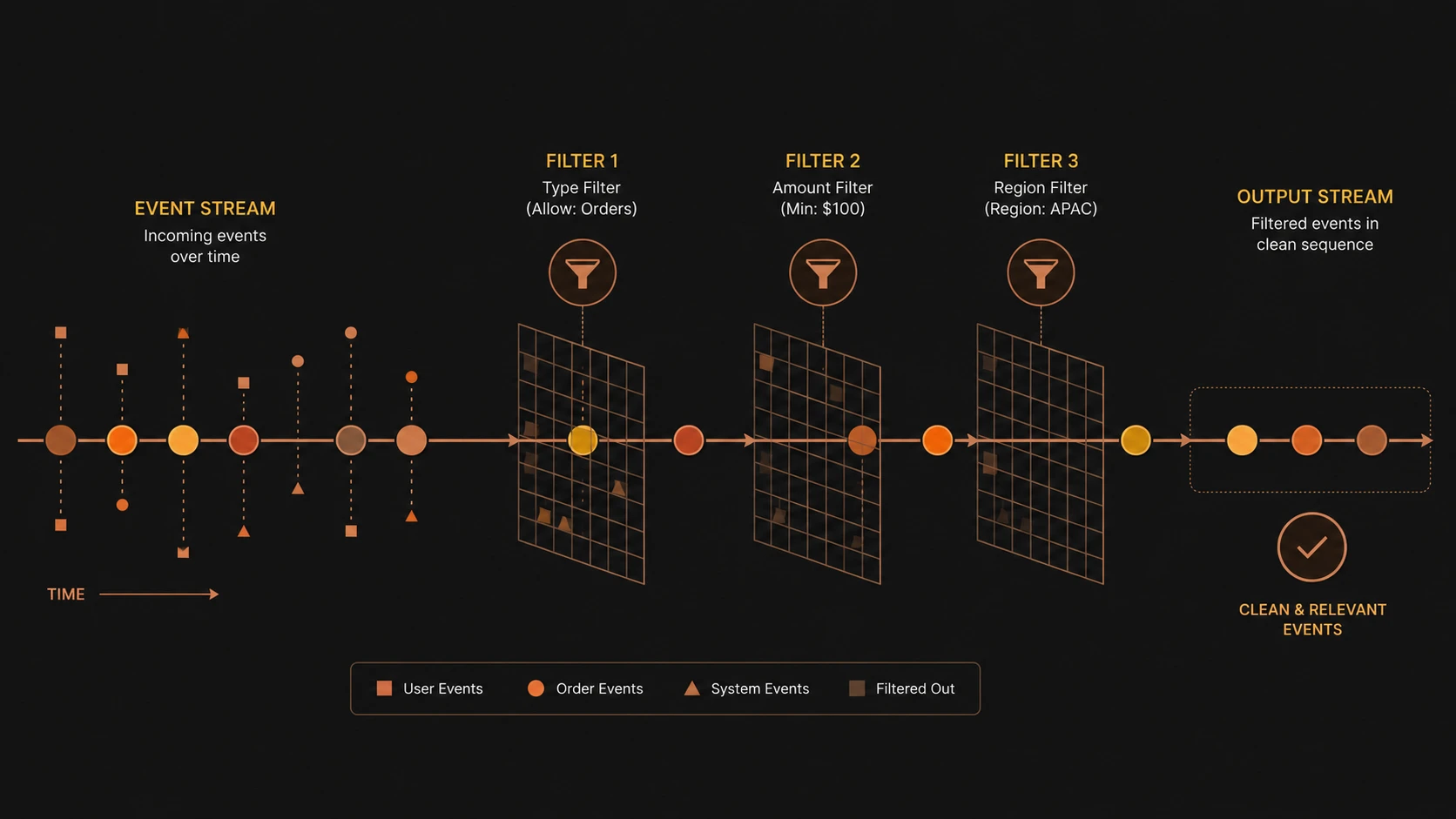
Introduction
Modern enterprise software increasingly depends upon asynchronous operations. User interface interactions, network communication, sensor data, messaging systems, background processing, and distributed services all generate continuous streams of events that traditional imperative programming models often struggle to manage efficiently.
Conventional event handling typically leads to deeply nested callbacks, duplicated state management, and increasingly complex synchronization logic. As applications grow, maintaining these asynchronous workflows becomes progressively more difficult.
Reactive Extensions (Rx) introduces a fundamentally different approach by treating events as observable sequences that can be queried and transformed using familiar declarative programming techniques. Rather than managing events individually, developers compose pipelines that process entire streams of data.
For enterprise .NET developers, Rx represents one of Microsoft's most innovative programming libraries for building responsive, scalable, and maintainable event-driven applications.
Industry Background
Enterprise software architecture has steadily shifted toward asynchronous computing. Applications increasingly depend upon:
- ◆Network services
- ◆Cloud APIs
- ◆Message queues
- ◆User interface events
- ◆Background processing
- ◆Real-time notifications
- ◆Sensor data
- ◆Distributed systems
Managing these event sources using traditional callback-based programming often increases code complexity while making testing and maintenance more difficult.
Reactive programming has emerged as an alternative paradigm focused on continuous data streams rather than isolated events.
The Business Problem
Large enterprise applications commonly experience several challenges when handling asynchronous workflows:
- ◆Nested callback logic
- ◆Complex event coordination
- ◆Difficult thread synchronization
- ◆Duplicate event handling
- ◆Reduced code readability
- ◆Error-prone concurrency management
As organizations adopt increasingly event-driven architectures, development teams require abstractions capable of simplifying asynchronous programming.
Understanding Reactive Extensions
Reactive Extensions (Rx) is a .NET library that enables developers to represent asynchronous events as observable sequences.
Rather than responding to each event individually, applications compose operations that transform, filter, merge, buffer, or aggregate event streams.
The programming model is centered around two fundamental interfaces:
- ◆IObservable<T>
- ◆IObserver<T>
These interfaces provide a push-based counterpart to the pull-based IEnumerable<T> collection model familiar to .NET developers.
Core Architecture
Reactive Extensions consists of several complementary components.
| Component | Responsibility |
|---|---|
| IObservable<T> | Produces event sequences |
| IObserver<T> | Consumes event sequences |
| Scheduler | Controls execution context |
| LINQ Operators | Transform observable streams |
| Subscription | Connects producers and consumers |
| Event Sources | Generate observable data |
This architecture separates event generation from event processing while encouraging highly composable application logic.
How Reactive Extensions Works
A typical reactive workflow follows these steps:
- 1.An observable sequence produces events.
- 2.Observers subscribe to the sequence.
- 3.LINQ-style operators transform incoming data.
- 4.Schedulers determine execution context.
- 5.Processed events flow through the pipeline.
- 6.Subscribers receive transformed results.
- 7.Completion or error notifications terminate processing.
Instead of manually coordinating callbacks, developers define declarative processing pipelines that operate continuously as new events arrive.
Key Features
Observable Sequences
// Subscribing to event streams with Rx.NET
var searchBox = new TextBox();

var textChanges = Observable.FromEventPattern(searchBox, "TextChanged")
    .Select(evt => ((TextBox)evt.Sender).Text)
    .Throttle(TimeSpan.FromMilliseconds(300))
    .DistinctUntilChanged()
    .Subscribe(
        searchTerm => QuerySearchApi(searchTerm),
        error => LogError(error)
    );
Observable collections represent asynchronous event streams in a consistent programming model.
LINQ Integration
Rx extends familiar LINQ concepts to asynchronous data, allowing developers to compose expressive event-processing pipelines.
Event Composition
Multiple event sources can be merged, filtered, buffered, throttled, or combined using reusable operators.
Scheduler Abstraction
Execution scheduling becomes independent from business logic, simplifying multithreaded application development.
Error Propagation
Errors flow through observable pipelines using consistent notification mechanisms rather than scattered exception handling.
Enterprise Use Cases
Reactive Extensions is applicable across numerous enterprise scenarios.
Financial Trading Systems
Applications processing continuous market updates benefit from stream-based event handling.
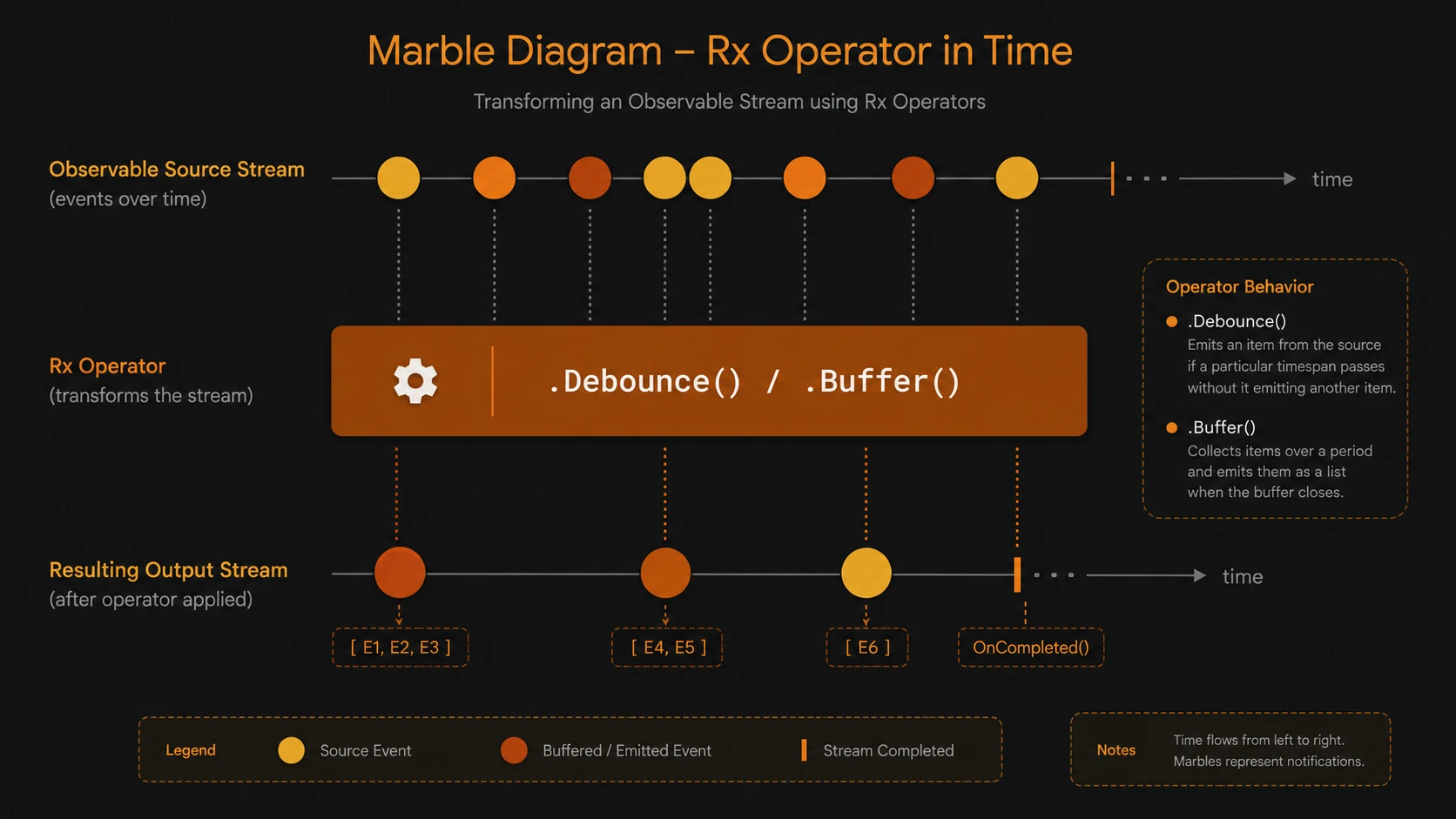
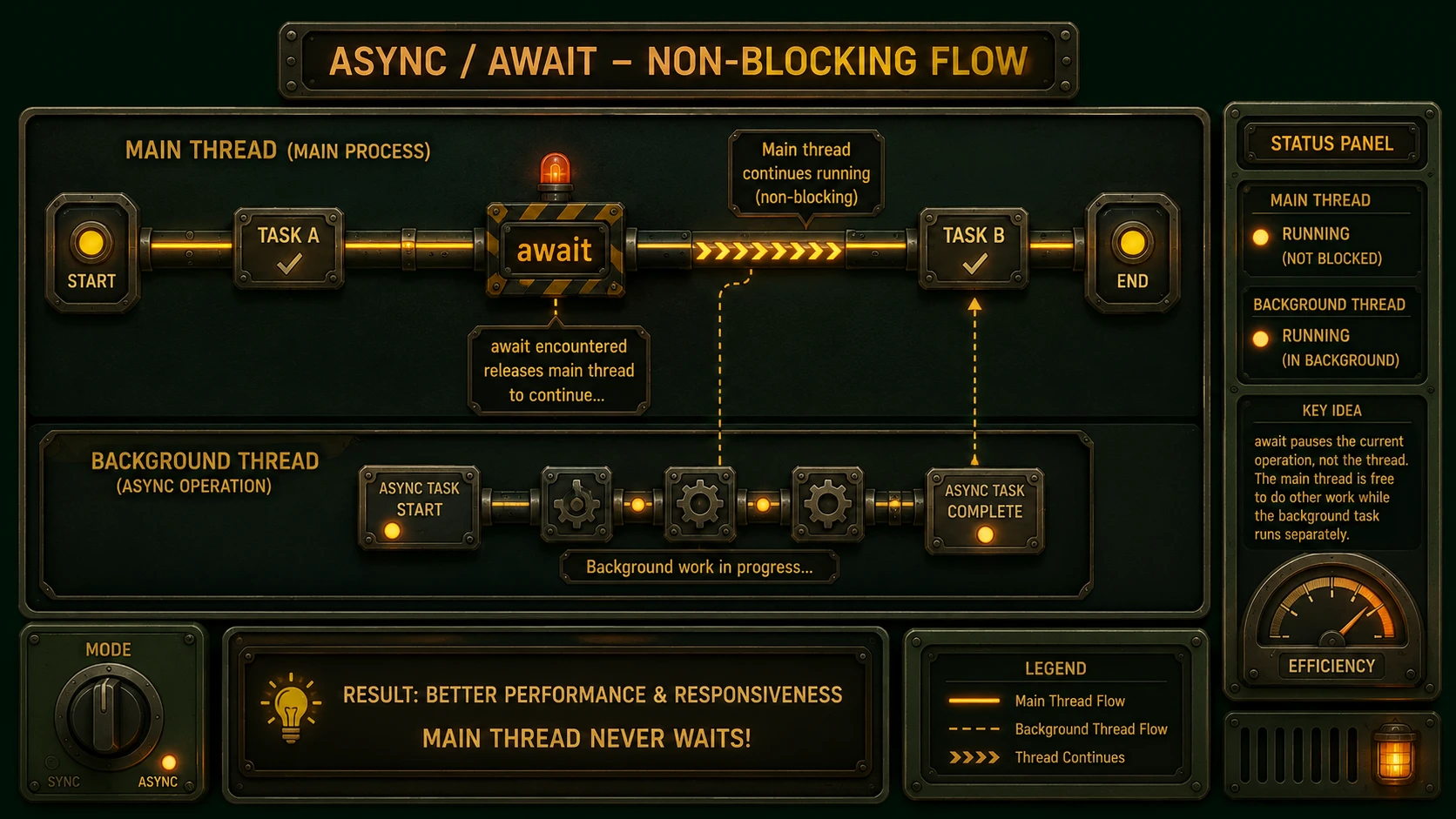
Event loop routing for non-blocking asynchronous I/O execution threads.
Monitoring Dashboards
Infrastructure monitoring platforms aggregate real-time operational metrics from numerous systems.
Desktop Applications
Complex user interface interactions become easier to coordinate using observable event streams.
Messaging Systems
Enterprise messaging platforms process continuous streams of incoming messages.
Sensor and Device Monitoring
Industrial and monitoring applications frequently consume continuous telemetry data generated by connected devices.
Performance Considerations
Rx primarily improves application architecture rather than raw execution speed.
Performance considerations include:
- ◆Efficient event composition
- ◆Reduced callback overhead
- ◆Better concurrency management
- ◆Lower synchronization complexity
- ◆Stream processing efficiency
- ◆Scheduler selection
Application performance remains dependent upon event volume, operator usage, and workload characteristics.
Security Considerations
Reactive programming does not alter fundamental application security principles.
Enterprise applications should continue implementing:
- ◆Secure authentication
- ◆Authorization controls
- ◆Input validation
- ◆Protected communication channels
- ◆Exception management
- ◆Audit logging
Observable streams carrying sensitive information should be protected according to existing enterprise security policies.
Scalability
Reactive Extensions supports scalable application design through composable asynchronous processing.
Scalability benefits include:
- ◆Non-blocking workflows
- ◆Improved resource utilization
- ◆Event pipeline reuse
- ◆Efficient concurrency
- ◆Modular processing architecture
These characteristics make Rx particularly attractive for applications processing large numbers of asynchronous events.
Best Practices
Organizations evaluating Reactive Extensions should consider the following recommendations.
- ◆Keep observable pipelines focused and readable.
- ◆Dispose subscriptions appropriately.
- ◆Minimize unnecessary operators.
- ◆Use schedulers consistently.
- ◆Separate business logic from event infrastructure.
- ◆Test observable sequences thoroughly.
- ◆Document complex event pipelines.
- ◆Benchmark production workloads.
Common Mistakes
| Mistake | Enterprise Impact |
|---|---|
| Forgetting to dispose subscriptions | Resource leaks |
| Overly complex observable chains | Reduced maintainability |
| Mixing threading concerns with business logic | Concurrency issues |
| Excessive event buffering | Higher memory usage |
| Poor scheduler selection | Performance degradation |
| Treating Rx as a replacement for every programming model | Unnecessary complexity |
Reactive programming is most effective when applied to naturally asynchronous and event-driven scenarios.
Technology Comparison
| Capability | Traditional Event Handling | Reactive Extensions |
|---|---|---|
| Event Coordination | Manual | Declarative |
| Asynchronous Composition | Limited | Excellent |
| LINQ Integration | No | Yes |
| Stream Processing | Basic | Advanced |
| Thread Management | Manual | Scheduler-Based |
| Code Maintainability | Moderate | Improved for Event-Driven Systems |
Reactive Extensions complements existing .NET programming models rather than replacing them.
Adoption Strategy
Organizations considering Rx should introduce it gradually.
Recommended steps include:
- 1.Identify event-heavy applications.
- 2.Train development teams on reactive programming concepts.
- 3.Introduce Rx in isolated modules.
- 4.Measure maintainability improvements.
- 5.Benchmark application performance.
- 6.Establish observable coding standards.
- 7.Expand adoption to additional asynchronous workloads.
- 8.Continuously review event pipeline design.
Incremental adoption minimizes project risk while allowing teams to build reactive programming expertise.
Limitations
Although Reactive Extensions offers substantial architectural benefits, organizations should recognize several considerations.
- ◆Developers must learn a different programming paradigm.
- ◆Complex observable chains may become difficult to debug.
- ◆Excessive abstraction can reduce readability.
- ◆Reactive programming is not appropriate for every workload.
- ◆Effective scheduler selection requires understanding concurrent execution.
Rx should therefore be adopted selectively where asynchronous event processing naturally dominates application behavior.
Looking Ahead
From the perspective of September 2013, Reactive Extensions represents one of Microsoft's most important contributions to modern application architecture. By introducing a unified programming model for asynchronous event streams, Rx simplifies many of the complexities associated with concurrent and event-driven software development.
As enterprise applications continue integrating cloud services, messaging infrastructure, real-time analytics, and distributed computing, programming models emphasizing composable asynchronous workflows are expected to become increasingly valuable. Reactive Extensions provides .NET developers with a mature foundation for building scalable, maintainable, and responsive enterprise applications capable of handling continuously evolving event streams.