Introduction
For more than two decades, Java has established itself as one of the dominant platforms for enterprise software development. Financial systems, telecommunications platforms, government applications, healthcare solutions, large-scale middleware, and countless business applications rely on the Java platform because of its portability, maturity, and extensive ecosystem.
As enterprise applications have grown, so too have their codebases. Large monolithic deployments often contain thousands of classes spread across numerous JAR files with loosely defined dependencies. Although Java packages provide logical organization, they do not offer strong encapsulation or explicit dependency declarations between larger application components.
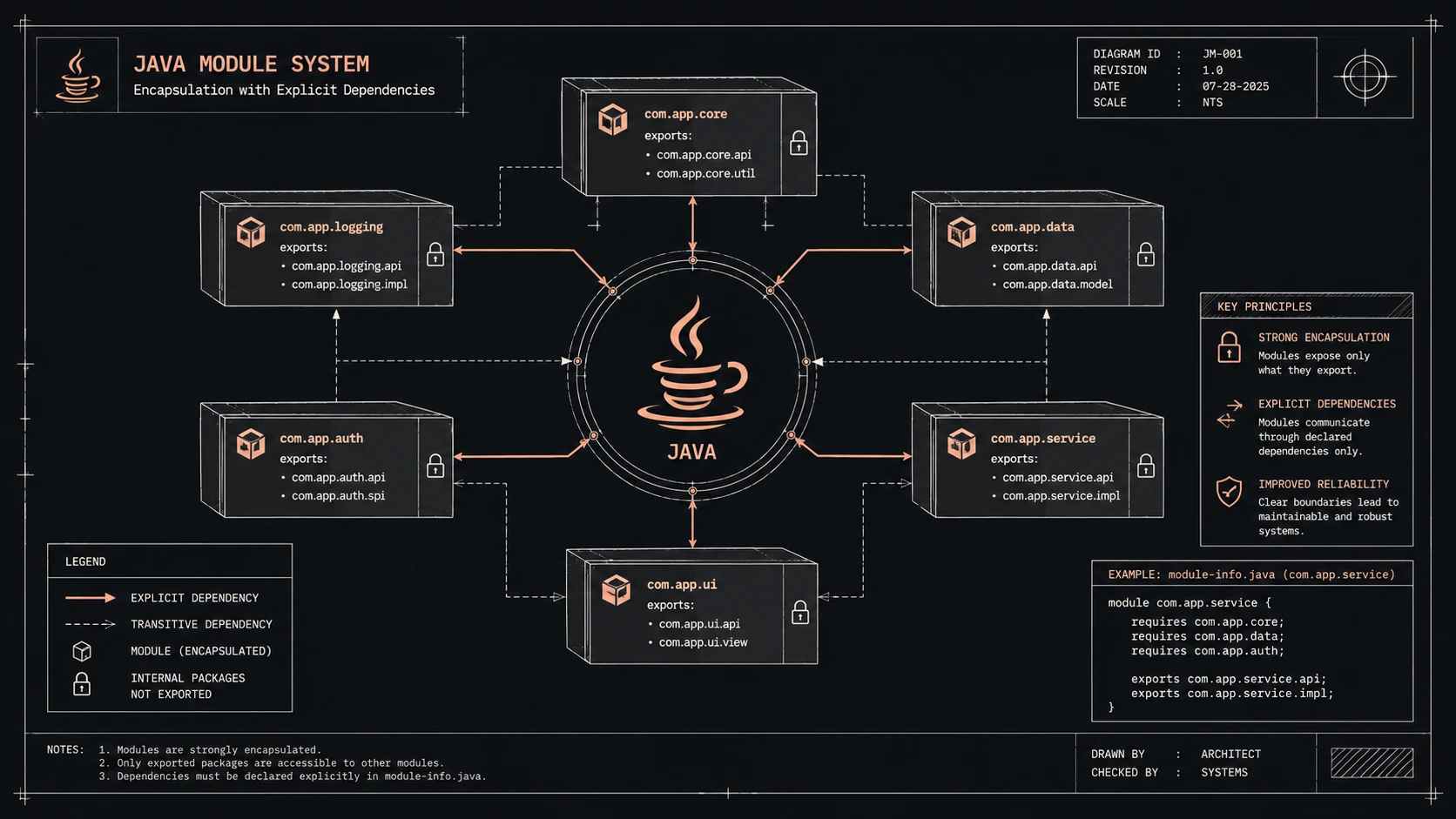
Project Jigsaw introduces one of the most significant architectural changes in the history of the Java platform. The Java Platform Module System (JPMS) adds modularity directly to the language and runtime, enabling developers to define explicit module boundaries, declare dependencies, and expose only intended APIs.
As of March 2017, Java 9 remains in preview before general availability. Nevertheless, Project Jigsaw offers enterprise architects an opportunity to evaluate how modularity may influence future application architecture, deployment, and long-term maintenance.
Industry Background
Enterprise software continues evolving toward:
- ◆Microservices
- ◆Cloud deployment
- ◆Modular application architecture
- ◆Continuous delivery
- ◆Component reuse
- ◆Automated dependency management
- ◆Large distributed systems
Programming platforms increasingly emphasize modular design as a mechanism for improving maintainability, scalability, and deployment flexibility.
The Java ecosystem has historically relied upon packages and build tools to organize applications. Project Jigsaw extends this model by introducing modules as a first-class platform concept.
The Business Problem
Large Java applications commonly experience:
- ◆Weak encapsulation
- ◆Complex dependency graphs
- ◆Classpath conflicts
- ◆Difficult maintenance
- ◆Large deployment footprints
- ◆Limited component isolation
- ◆Accidental exposure of internal implementation classes
Managing these challenges becomes increasingly difficult as enterprise systems expand over many years.
Understanding Project Jigsaw
Project Jigsaw introduces the Java Platform Module System.
Rather than viewing applications solely as collections of JAR files placed on the classpath, applications can be organized into explicit modules that declare:
- ◆Module identity
- ◆Exported packages
- ◆Required modules
- ◆Dependency relationships
This enables stronger architectural boundaries while improving application organization.
Core Architecture
| Component | Responsibility |
|---|---|
| Module | Logical deployment and encapsulation unit |
| module-info.java | Declares module metadata |
| Module Graph | Defines dependency relationships |
| Java Compiler | Validates module dependencies |
| Java Runtime | Resolves modules during execution |
| Exported Packages | Define public APIs |
Together these components establish explicit architectural relationships between application modules.
Module Descriptors
Each module contains a descriptor named module-info.java.
The descriptor defines important information including:
- ◆Module name
- ◆Required modules
- ◆Exported packages
- ◆Readability relationships
Unlike traditional package organization, module descriptors become part of the compilation and runtime model.
This allows tooling to understand application architecture more precisely.
Strong Encapsulation
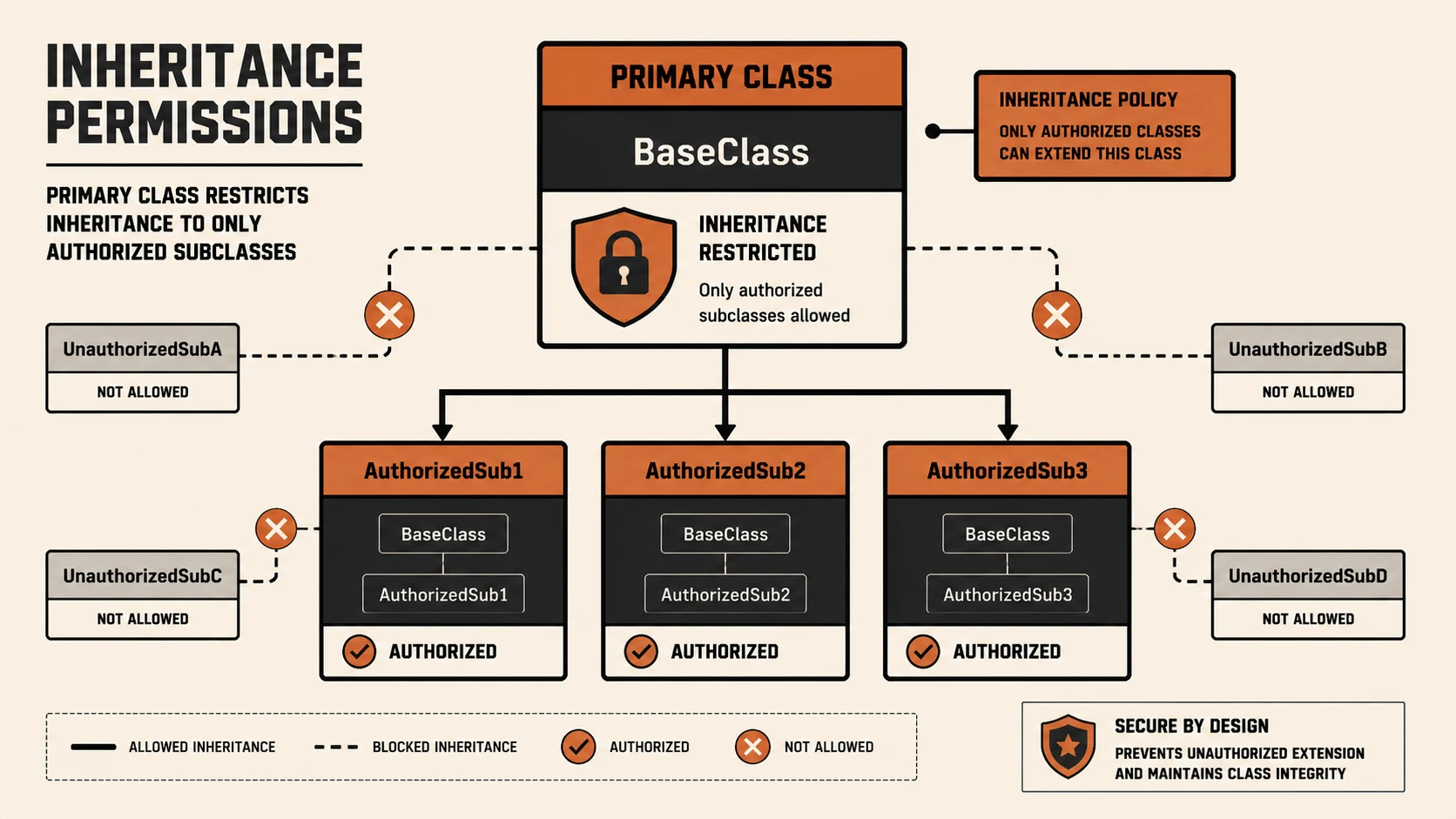
One of Project Jigsaw's primary objectives is strong encapsulation.
Historically, any public class within a package could generally be accessed by other code present on the classpath.
Modules introduce a more restrictive model.
Only explicitly exported packages become part of a module's public interface.
Benefits include:
- ◆Smaller public APIs
- ◆Better architectural boundaries
- ◆Reduced accidental coupling
- ◆Improved long-term maintainability
Strong encapsulation encourages clearer ownership of implementation details.
Explicit Dependencies
Modules declare dependencies directly.
Instead of relying upon implicit classpath behavior, developers specify which modules are required.
Advantages include:
- ◆Easier dependency analysis
- ◆Improved tooling support
- ◆Better architecture visualization
- ◆Earlier error detection
Explicit dependency declarations simplify maintenance of large enterprise systems.
Module Resolution
During compilation and execution, the Java platform constructs a module graph.
A typical workflow includes:
- 1.Module descriptors are discovered.
- 2.Required dependencies are evaluated.
- 3.The module graph is constructed.
- 4.Missing dependencies are identified.
- 5.Accessible packages are determined.
- 6.Application execution begins.
The runtime validates relationships before application startup rather than relying solely on classpath resolution.
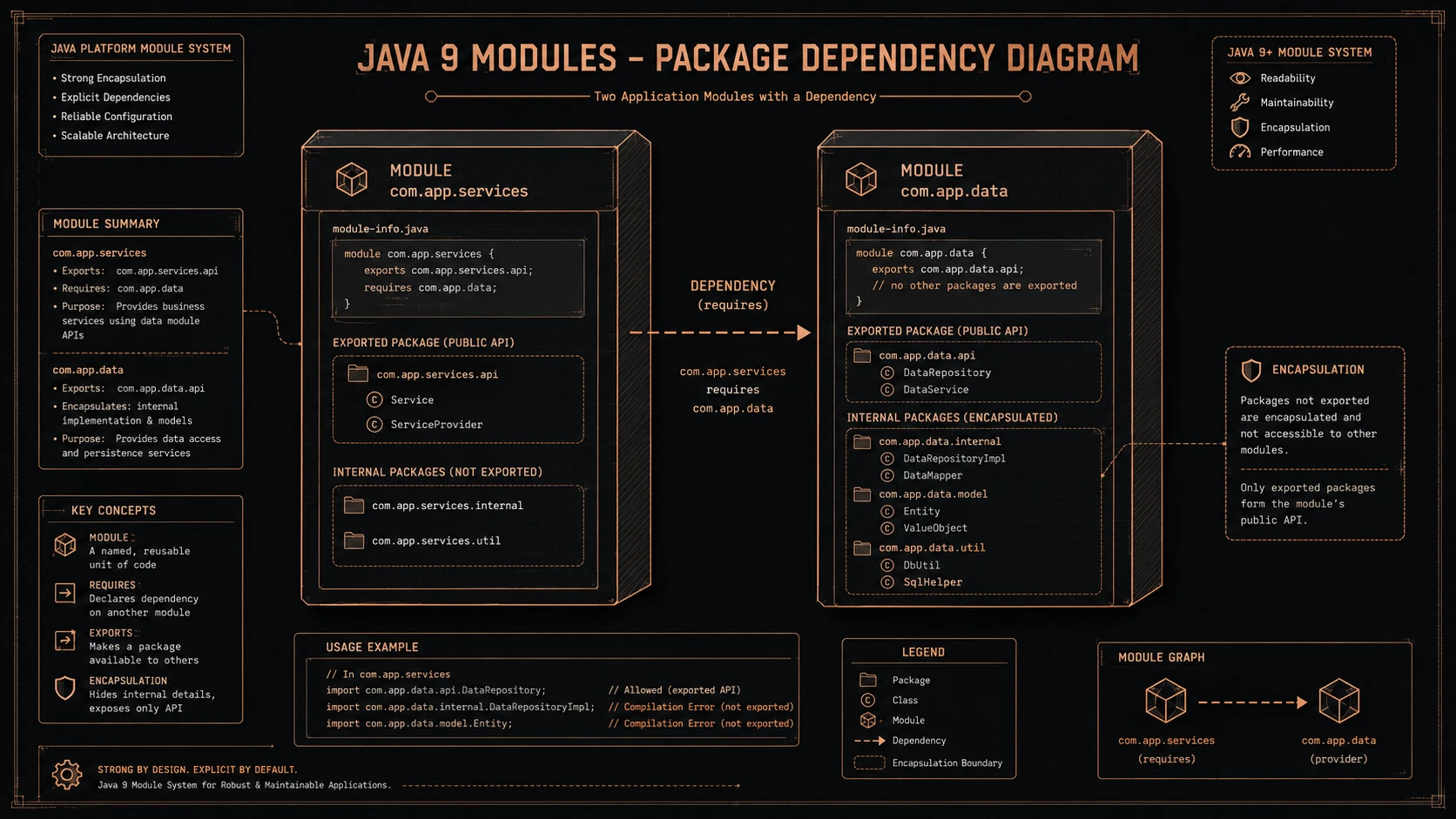
System architecture diagram and conceptual workflow layout for Java 9 Module System.
Migration Considerations
Many enterprise applications consist of extensive collections of existing JAR files.
Organizations evaluating Project Jigsaw should recognize that migration is expected to be incremental.
Possible strategies include:
- ◆Modularizing new libraries first.
- ◆Defining clear module boundaries.
- ◆Identifying internal APIs.
- ◆Reducing unnecessary dependencies.
Careful planning minimizes disruption while improving long-term maintainability.
Enterprise Use Cases
| Scenario | Benefit |
|---|---|
| Enterprise Middleware | Improved component isolation |
| Banking Systems | Explicit architectural boundaries |
| Large Business Applications | Better dependency management |
| Shared Frameworks | Controlled API exposure |
| Cloud Services | Modular deployment organization |
| Internal Platform Libraries | Strong encapsulation |
Organizations maintaining extensive Java codebases benefit most from improved architectural discipline.
Performance Considerations
Project Jigsaw primarily improves application organization rather than raw runtime performance.
Development teams should evaluate:
- ◆Startup behavior
- ◆Module resolution
- ◆Dependency organization
- ◆Deployment size
- ◆Build complexity
The greatest benefits are generally architectural rather than computational.
Security Considerations
Strong encapsulation contributes positively to software engineering practices by limiting exposure of implementation details.
Organizations should continue implementing:
- ◆Authentication
- ◆Authorization
- ◆Secure dependency management
- ◆Input validation
- ◆HTTPS communication
- ◆Secure deployment procedures
Module boundaries complement secure software architecture but do not replace application security controls.
Scalability
The Java Platform Module System supports long-term scalability through:
- ◆Clear architectural boundaries
- ◆Explicit dependencies
- ◆Better component reuse
- ◆Reduced coupling
- ◆Improved maintainability
These qualities become increasingly valuable as enterprise systems continue expanding.
Best Practices
Organizations evaluating Java 9 module previews should:
- ◆Design modules around business capabilities.
- ◆Keep exported APIs intentionally small.
- ◆Avoid unnecessary module dependencies.
- ◆Separate public interfaces from implementation.
- ◆Introduce modularization gradually.
- ◆Validate dependency graphs regularly.
- ◆Maintain architectural documentation.
- ◆Evaluate tooling compatibility during migration.
Well-designed modules improve maintainability throughout the software lifecycle.
Common Mistakes
Development teams should avoid:
- ◆Creating modules without clear responsibilities.
- ◆Exporting every package unnecessarily.
- ◆Treating modules as simple replacements for packages.
- ◆Ignoring existing architectural boundaries.
- ◆Attempting complete migration without planning.
- ◆Introducing circular module dependencies.
Successful modularization depends upon thoughtful application architecture rather than language features alone.
Technology Comparison
| Capability | Traditional Classpath | Java Platform Module System |
|---|---|---|
| Explicit Dependencies | No | Yes |
| Strong Encapsulation | Limited | Yes |
| Module Descriptors | No | Yes |
| Dependency Validation | Limited | Improved |
| Public API Control | Package visibility only | Module exports |
| Architecture Visibility | Moderate | Significantly improved |
Project Jigsaw introduces modularity directly into the Java platform rather than relying exclusively on external build tools.
Adoption Strategy
Organizations should evaluate Java 9 modules incrementally.
A practical migration strategy includes:
- 1.Identify suitable pilot projects.
- 2.Analyze existing dependency graphs.
- 3.Define module boundaries.
- 4.Introduce module descriptors.
- 5.Validate build processes.
- 6.Evaluate runtime behavior.
- 7.Expand modularization across additional components as organizational experience grows.
Incremental adoption minimizes migration risk while allowing teams to refine architectural practices.
Limitations
As of March 2017, Java 9 remains in preview, and Project Jigsaw continues approaching general availability.
Current considerations include:
- ◆Existing enterprise applications may require substantial planning before modularization.
- ◆Tooling and ecosystem support continue evolving.
- ◆Migration strategies differ according to application architecture.
- ◆Organizations should evaluate third-party library compatibility carefully.
Pilot implementations provide valuable experience before broader enterprise adoption.
Looking Ahead
Project Jigsaw represents one of the most important architectural developments in the Java platform since the introduction of generics. By introducing explicit modules, strong encapsulation, dependency declarations, and improved runtime validation, Java moves toward a more structured model for building large enterprise systems.
As of March 2017, enterprise architects should begin evaluating the Java Platform Module System within prototype applications and shared platform libraries. Organizations that invest in modular application architecture, disciplined dependency management, and clear component boundaries will be well positioned to benefit as Java 9 approaches general availability and modular development becomes a core part of the Java ecosystem.