Introduction
Java remains one of the most widely deployed enterprise programming platforms in the software industry. Financial institutions, healthcare providers, government organizations, telecommunications companies, retailers, and cloud service providers continue relying on Java to power business-critical systems ranging from high-volume transaction processing platforms to distributed microservices and large-scale enterprise applications.
The transition to a six-month release cadence has fundamentally changed how Java evolves. Rather than waiting years for major platform updates, organizations now receive incremental improvements that steadily modernize both the language and the Java Virtual Machine (JVM). This approach allows new capabilities to mature more rapidly while enabling engineering teams to adopt features according to their operational requirements.
Java 15 continues this progression through enhancements that improve language expressiveness, runtime flexibility, developer productivity, and JVM performance. Among the most significant additions are the preview of Sealed Classes, the introduction of Hidden Classes for framework and runtime developers, Text Blocks becoming a standard language feature, and continued garbage collector improvements.
From the perspective of September 2020, Java 15 represents another important step toward making Java increasingly expressive while preserving its long-standing commitment to compatibility, stability, and enterprise scalability.
Industry Background
Enterprise software platforms increasingly demand:
- ◆Cloud-native deployment.
- ◆Microservice architectures.
- ◆High availability.
- ◆Strong type safety.
- ◆Runtime performance.
- ◆Predictable maintenance.
- ◆Long-term compatibility.
Organizations commonly develop:
- ◆Banking systems.
- ◆Enterprise APIs.
- ◆ERP platforms.
- ◆Data processing services.
- ◆Messaging systems.
- ◆Cloud management software.
- ◆Business intelligence platforms.
Modern enterprise development requires language features that improve maintainability without compromising runtime stability.
The Business Problem
Large Java applications frequently encounter several architectural challenges.
Organizations commonly experience:
- ◆Complex inheritance hierarchies.
- ◆Framework-generated runtime classes.
- ◆Difficult domain modeling.
- ◆Memory management optimization requirements.
- ◆Verbose source code.
- ◆Long-term maintenance complexity.
- ◆Performance tuning overhead.
As software systems continue growing, improvements to both language design and JVM implementation become increasingly valuable.
Java 15 addresses several of these concerns through language refinements and runtime enhancements.
Understanding the Technology
Java 15 expands both the Java language and the JVM.
Major capabilities include:
- ◆Sealed Classes (Preview).
- ◆Hidden Classes.
- ◆Text Blocks (Standard).
- ◆Garbage collector improvements.
- ◆JVM enhancements.
- ◆Performance optimizations.
- ◆Continued OpenJDK evolution.
These improvements target both application developers and framework authors.
Core Architecture
A simplified Java 15 architecture appears below.
| Component | Responsibility |
|---|---|
| Java Source Code | Application implementation |
| Java Compiler | Compilation to bytecode |
| JVM | Runtime execution |
| Class Loader | Class loading |
| Hidden Classes | Runtime-generated implementation classes |
| Garbage Collector | Memory management |
| Operating System | Process execution |
The JVM coordinates execution while language enhancements improve application architecture and developer productivity.
Key Features
Sealed Classes (Preview)
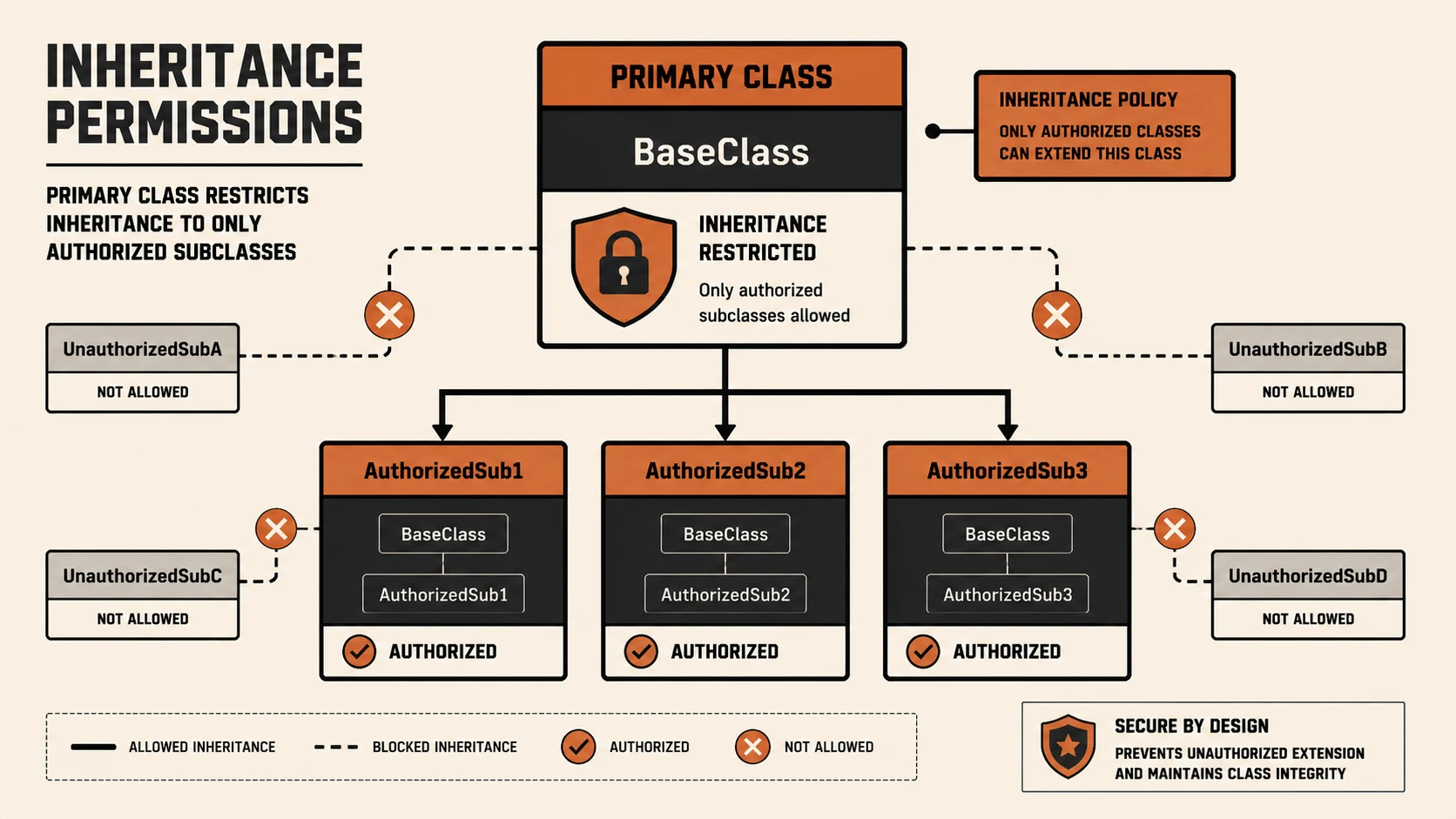
One of the most significant language additions in Java 15 is the preview of Sealed Classes.
Traditionally, Java allows public classes and interfaces to be extended or implemented by any appropriate type. While this flexibility has clear advantages, enterprise domain models sometimes require stricter control over inheritance.
Sealed Classes allow developers to explicitly define which classes may extend a superclass or implement an interface.
This improves:
- ◆Domain modeling.
- ◆API design.
- ◆Compile-time safety.
- ◆Code readability.
- ◆Architectural clarity.
For enterprise applications, Sealed Classes provide a more expressive way to model closed business hierarchies such as financial transaction types, workflow states, or authorization models.
Hidden Classes
Java 15 introduces Hidden Classes as a JVM capability intended primarily for framework developers.
Many enterprise frameworks dynamically generate classes at runtime for:
- ◆Dependency injection.
- ◆Dynamic proxies.
- ◆Bytecode generation.
- ◆Reflection-based frameworks.
- ◆Runtime optimization.
Hidden Classes provide a more efficient mechanism for managing these runtime-generated implementation details without exposing them as conventional application classes.
This improves flexibility for framework and tooling developers while reducing unnecessary visibility within application class loaders.
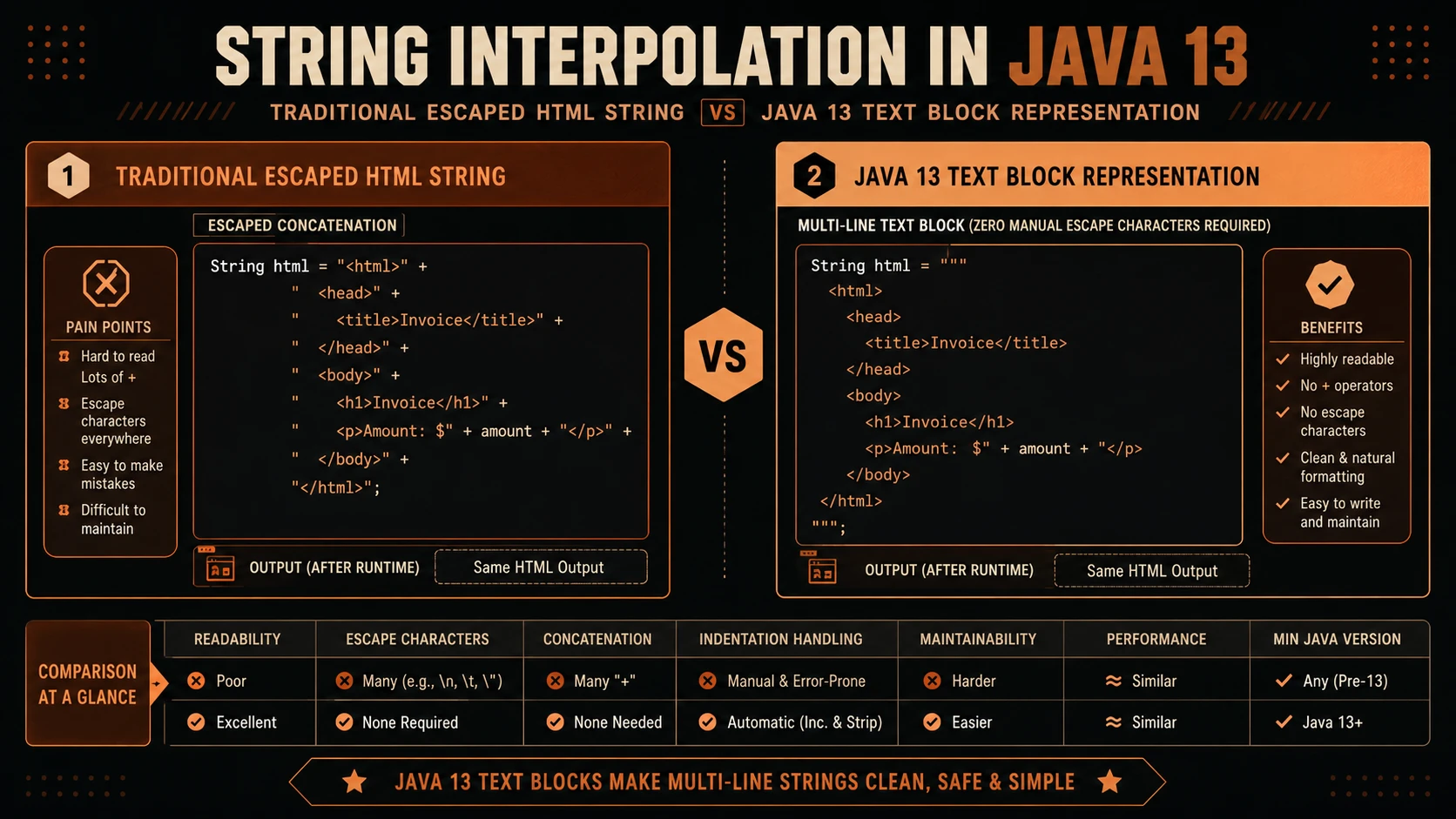
Text Blocks Become Standard
Text Blocks graduate from preview status and become a standard Java language feature.
Developers can represent multiline strings more naturally, improving readability for:
- ◆SQL queries.
- ◆JSON documents.
- ◆XML payloads.
- ◆HTML templates.
- ◆Configuration examples.
This reduces string concatenation and escape sequence complexity.
Garbage Collector Improvements
Java 15 continues improving JVM memory management through refinements across supported garbage collectors.
These improvements focus on:
- ◆Lower pause times.
- ◆Improved memory efficiency.
- ◆Better runtime predictability.
- ◆Continued scalability.
Enterprise applications processing large workloads benefit from incremental runtime optimization without requiring source code changes.
JVM Performance Enhancements
The Java Virtual Machine continues receiving internal optimizations affecting:
- ◆Class loading.
- ◆Runtime execution.
- ◆Memory management.
- ◆Diagnostics.
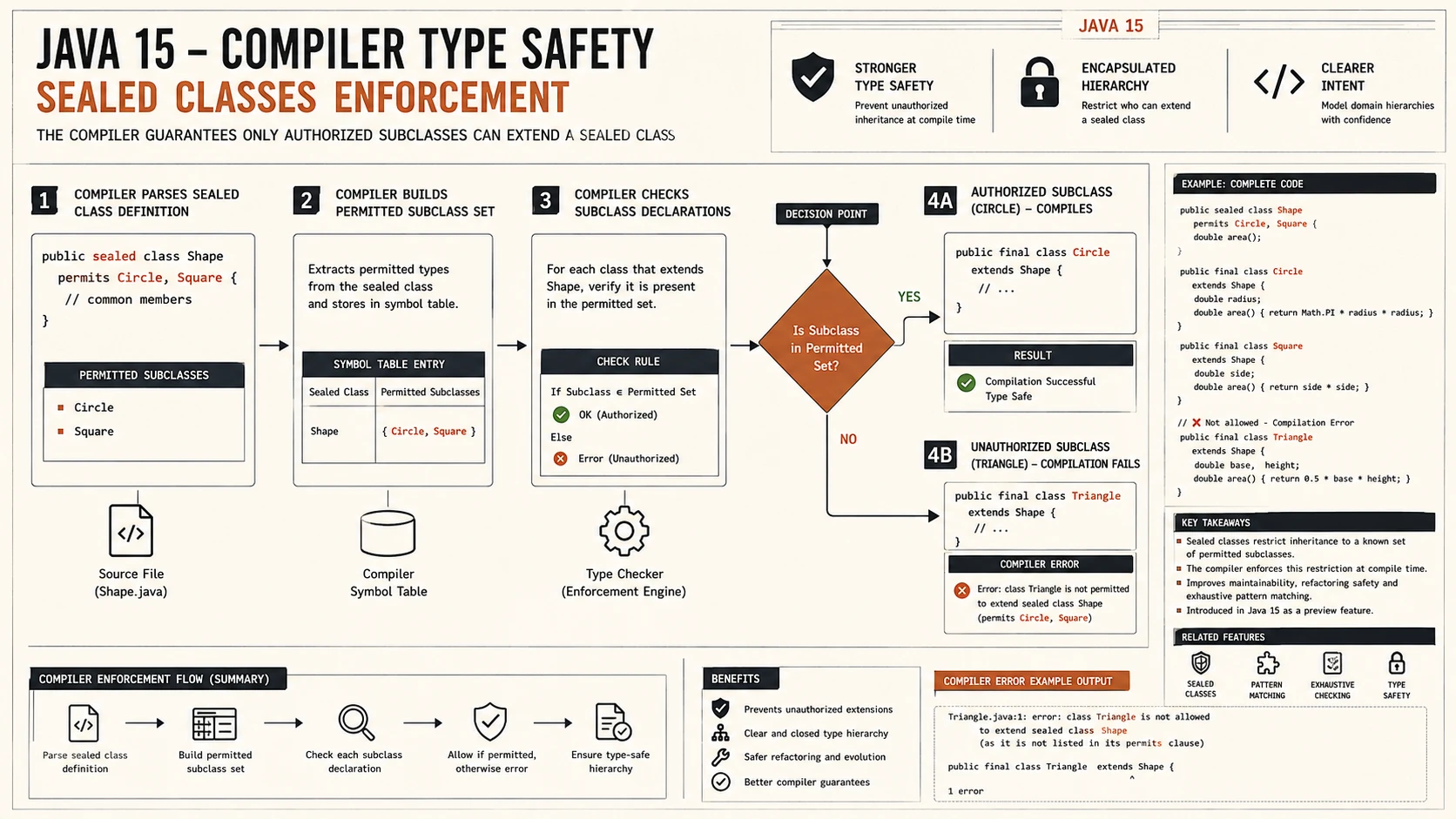
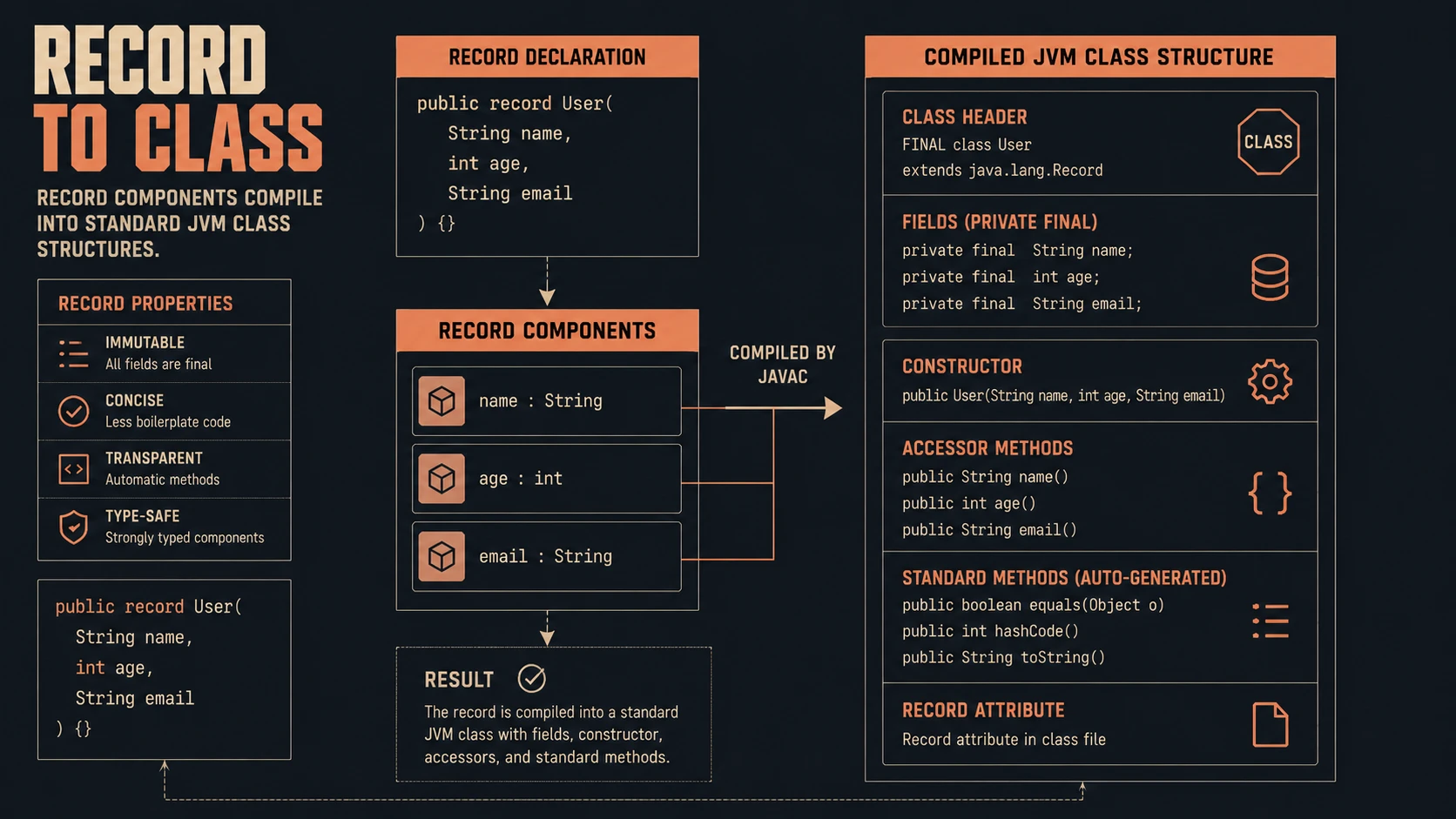
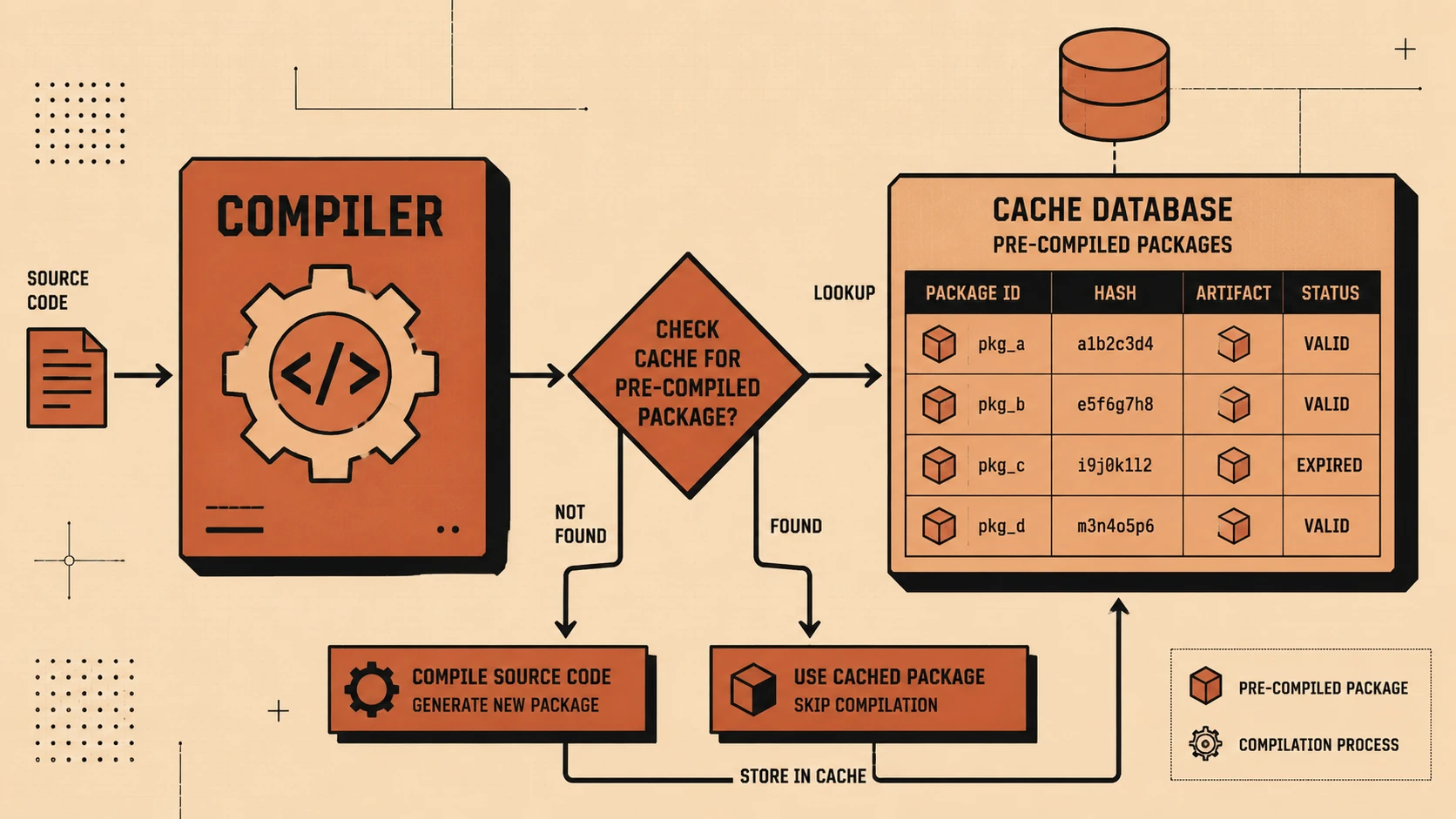
System architecture diagram and conceptual workflow layout for Java 15: Sealed Classes, Hidden Classes, and Garbage Collector Updates.
These improvements contribute to overall platform maturity.
Continued Platform Evolution
Java 15 demonstrates the ongoing value of incremental platform evolution, allowing language and runtime improvements to reach developers more rapidly while maintaining strong backward compatibility.
How It Works
A simplified execution workflow appears below.
Java Source
      |
Java Compiler
      |
Bytecode
      |
JVM
      |
Hidden Classes
Garbage Collector
Runtime Execution
      |
Application
The compiler generates bytecode while the JVM manages execution, dynamic class generation, and automatic memory management.
Enterprise Use Cases
Enterprise Domain Models
Sealed Classes improve modeling of business rules where inheritance should remain explicitly controlled.
Dependency Injection Frameworks
Frameworks generating runtime implementation classes benefit from Hidden Classes.
Cloud Services
Runtime improvements contribute to stable execution across cloud-native deployments.
Financial Applications
Structured domain hierarchies become easier to represent using controlled inheritance.
Internal Development Platforms
Developer productivity improves through Text Blocks and cleaner application code.
Performance Considerations
Java 15 includes numerous runtime optimizations.
Organizations should evaluate:
- ◆Garbage collection latency.
- ◆Heap utilization.
- ◆Application startup.
- ◆Runtime throughput.
- ◆Class loading behavior.
- ◆Memory allocation patterns.
Performance characteristics should be benchmarked using representative production workloads before large-scale deployment.
Security Considerations
Java 15 continues the platform's strong security foundation.
Organizations should continue implementing:
- ◆Secure coding practices.
- ◆Authentication.
- ◆Authorization.
- ◆Secure dependency management.
- ◆JVM update management.
- ◆Transport encryption.
Language improvements complement comprehensive enterprise security architecture.
Scalability
Java 15 strengthens enterprise scalability through:
- ◆Improved runtime performance.
- ◆Better domain modeling.
- ◆More efficient framework support.
- ◆Cleaner application architecture.
- ◆Continued JVM optimization.
These characteristics benefit distributed enterprise applications operating at significant scale.
Best Practices
Organizations adopting Java 15 should:
- ◆Evaluate Sealed Classes for new domain models.
- ◆Continue using stable language features for production systems where organizational policies require them.
- ◆Benchmark garbage collector performance.
- ◆Review framework compatibility before upgrading.
- ◆Modernize multiline string handling using Text Blocks.
- ◆Validate JVM tuning after migration.
- ◆Standardize Java versions across engineering teams.
Incremental adoption reduces operational risk while allowing organizations to benefit from modern language capabilities.
Common Mistakes
| Mistake | Business Impact |
|---|---|
| Using preview language features without organizational evaluation | Upgrade complexity |
| Assuming Hidden Classes are intended for ordinary application development | Architectural misunderstanding |
| Ignoring JVM performance benchmarking | Uncertain production behavior |
| Delaying framework compatibility testing | Deployment risk |
| Retaining verbose multiline string construction | Reduced code readability |
| Skipping garbage collector tuning reviews after upgrading | Missed performance improvements |
Successful modernization depends upon balancing new platform capabilities with disciplined enterprise engineering practices.
Technology Comparison
| Characteristic | Java 14 | Java 15 |
|---|---|---|
| Sealed Classes | Preview work in progress | Preview refinement continues |
| Hidden Classes | Not available | Introduced |
| Text Blocks | Preview | Standard language feature |
| Garbage Collection | Mature collectors | Continued runtime improvements |
| Enterprise Development | Strong | Further modernization |
Java 15 extends both language capabilities and JVM functionality while maintaining Java's emphasis on long-term compatibility.
Adoption Strategy
Organizations should approach Java 15 through structured evaluation.
- 1.Upgrade development environments.
- 2.Validate third-party framework compatibility.
- 3.Benchmark representative workloads.
- 4.Evaluate Sealed Classes for suitable domain models.
- 5.Modernize multiline string handling where appropriate.
- 6.Expand production deployment following comprehensive testing.
This phased approach minimizes operational disruption while enabling engineering teams to evaluate new platform capabilities.
Limitations
As of September 2020, organizations should recognize several considerations.
- ◆Sealed Classes remain a preview feature and should be evaluated according to organizational policies before production adoption.
- ◆Hidden Classes primarily target framework and JVM tooling developers rather than typical business application development.
- ◆Existing JVM tuning should be reviewed after upgrading.
- ◆Third-party framework compatibility should be validated carefully.
- ◆Performance characteristics should be confirmed through representative production testing.
These considerations should guide enterprise modernization planning.
Looking Ahead
From the perspective of September 2020, Java 15 demonstrates the continued success of the OpenJDK rapid release model. Rather than delivering disruptive platform redesigns, the release introduces carefully targeted improvements that strengthen both developer productivity and JVM capabilities.
Sealed Classes provide more expressive domain modeling, Hidden Classes enhance runtime flexibility for framework developers, Text Blocks simplify source code, and ongoing garbage collector improvements continue refining JVM performance. Together, these enhancements reinforce Java's position as one of the industry's most mature and adaptable enterprise platforms for building scalable, maintainable, and long-lived business applications.