Introduction
The OpenJDK six-month release cadence continues to reshape how Java evolves. Rather than accumulating large numbers of language changes into infrequent platform releases, Java now delivers incremental improvements that can be evaluated independently while preserving the platform's long-standing commitment to backward compatibility.
Java 14 continues this approach by introducing several language enhancements aimed at reducing boilerplate and improving code readability. The most notable additions are Record Classes and Pattern Matching for instanceof, both delivered as preview features to gather community feedback before long-term standardization.
Beyond language evolution, Java 14 enables Helpful NullPointerExceptions by default, providing significantly more informative runtime diagnostics when null reference errors occur. Combined with improvements to Switch Expressions and ongoing JVM refinements, Java 14 focuses on improving everyday developer productivity while maintaining enterprise stability.
As of March 2020, Java 14 should primarily be viewed as an innovation release that allows engineering teams to evaluate emerging language features while preparing for future Long-Term Support platform upgrades.
Industry Background
Enterprise Java development increasingly emphasizes:
- ◆Cloud-native applications
- ◆Containerized deployment
- ◆Microservices
- ◆Continuous Integration and Continuous Delivery
- ◆Immutable infrastructure
- ◆Improved developer productivity
- ◆Maintainable domain models
Large enterprise codebases frequently contain repetitive data objects, defensive type checking, and complex debugging workflows. Language improvements that simplify these patterns can improve long-term maintainability.
The Business Problem
Organizations maintaining enterprise Java applications commonly encounter:
- ◆Large amounts of boilerplate code
- ◆Verbose data model implementations
- ◆Repeated instanceof checks followed by explicit casting
- ◆Difficult debugging of NullPointerExceptions
- ◆Reduced readability in business models
- ◆Increased maintenance effort across large projects
Modern language features can simplify these recurring implementation patterns while preserving Java's strong type system.
Understanding Java 14
Java 14 introduces several important platform improvements:
- ◆Record Classes (Preview)
- ◆Pattern Matching for instanceof (Preview)
- ◆Helpful NullPointerExceptions
- ◆Finalized Switch Expressions
- ◆JVM performance refinements
- ◆Continued garbage collection improvements
The release emphasizes developer productivity and code maintainability without introducing disruptive architectural changes.
Core Architecture
| Component | Responsibility |
|---|---|
| Java Compiler | Compiles Java source code |
| Record Classes | Concise immutable-style data modeling |
| Pattern Matching | Simplifies type inspection |
| HotSpot JVM | Executes compiled bytecode |
| Helpful NullPointerExceptions | Improves runtime diagnostics |
| Standard Library | Provides core platform APIs |
These components work together to improve both language expressiveness and runtime diagnostics.
Record Classes
One of the most significant additions in Java 14 is the preview introduction of Record Classes.
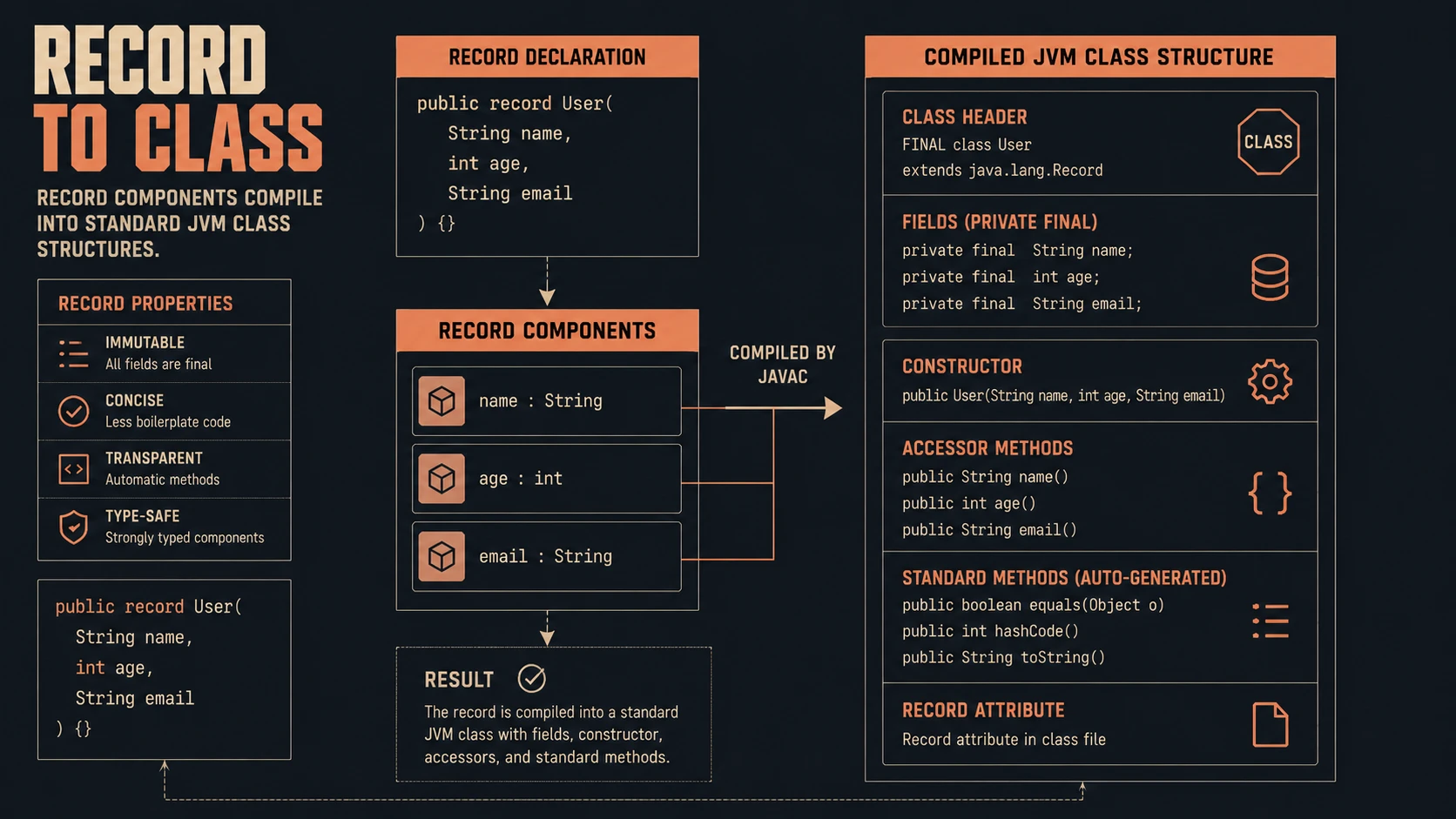
Enterprise applications frequently define classes whose primary responsibility is representing structured data. These classes often contain:
- ◆Private fields
- ◆Constructors
- ◆Getter methods
- ◆equals() implementations
- ◆hashCode() implementations
- ◆toString() methods
Although necessary, this boilerplate contributes little business value.
Record Classes provide a more concise way of expressing immutable-style data carriers while allowing the compiler to generate much of the repetitive implementation.
Benefits of Records
Potential enterprise advantages include:
- ◆Reduced boilerplate
- ◆Improved readability
- ◆Consistent data modeling
- ◆Easier maintenance
- ◆Clearer domain objects
- ◆Less handwritten infrastructure code
Applications with extensive domain models may benefit significantly from this simplified representation.
Pattern Matching for instanceof
Java has historically required two separate operations when working with polymorphic objects:
- 1.Verify an object's type using instanceof.
- 2.Perform an explicit type cast.
Pattern Matching for instanceof combines these operations into a more concise programming model.
Potential benefits include:
- ◆Reduced duplicate code
- ◆Improved readability
- ◆Fewer explicit casts
- ◆Clearer business logic
The feature aims to modernize common object-oriented programming patterns while preserving Java's strong type safety.
Simplifying Type Inspection
A typical workflow includes:
- 1.Evaluate an object's runtime type.
- 2.Match the expected type.
- 3.Access the typed object immediately.
- 4.Continue business logic.
This approach removes unnecessary repetition while making conditional logic easier to understand.
Helpful NullPointerExceptions
NullPointerException remains one of the most frequently encountered runtime exceptions in enterprise Java applications.
Historically, diagnosing these exceptions often required additional logging or debugging because the exception message provided limited context.
Java 14 enables Helpful NullPointerExceptions by default.
The JVM now provides more detailed diagnostic information identifying which expression evaluated to null.
Potential enterprise benefits include:
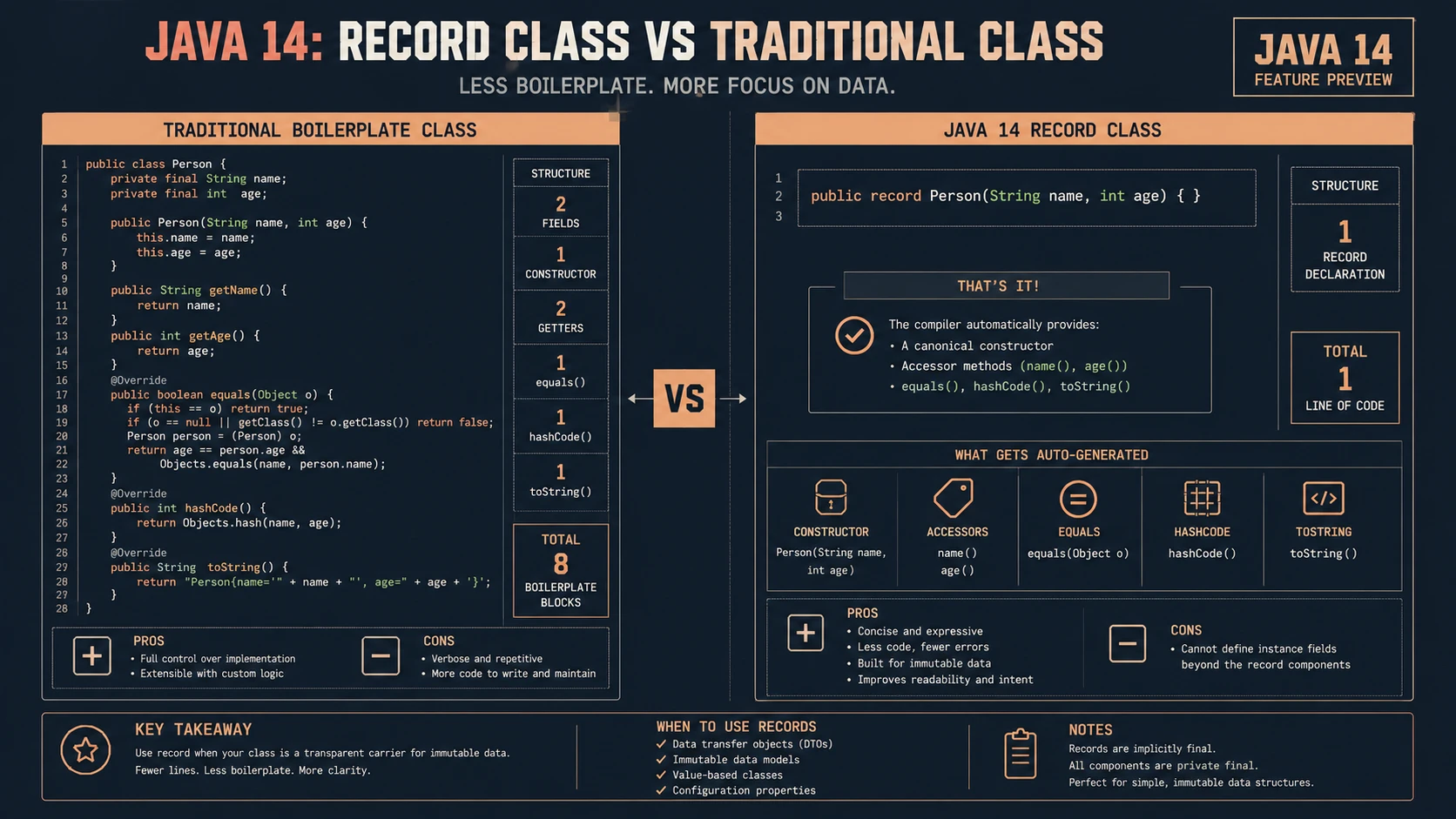
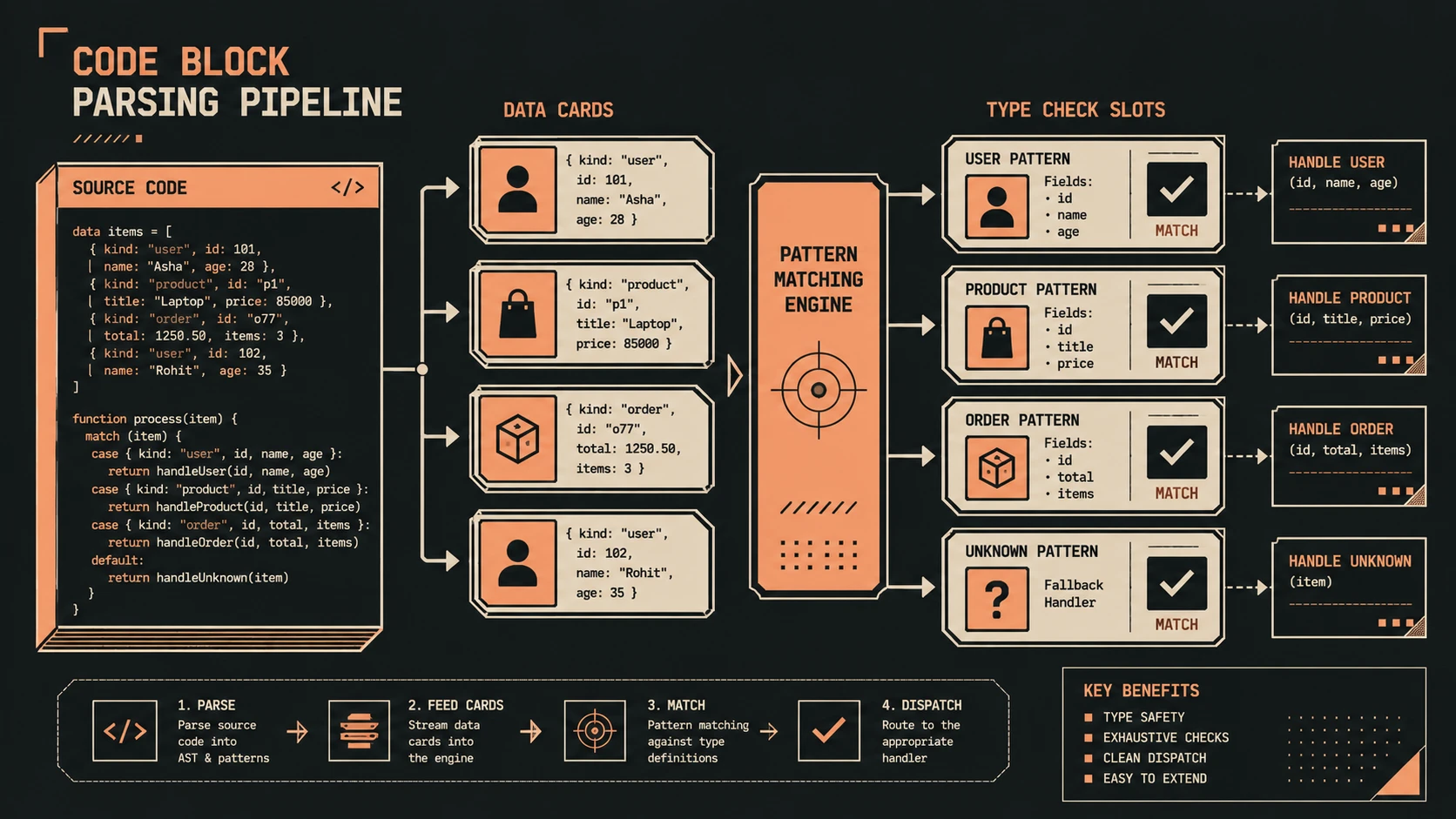
System architecture diagram and conceptual workflow layout for Java 14: Record Classes, Pattern Matching, and Helpful NullPointerExceptions.
- ◆Faster debugging
- ◆Reduced troubleshooting effort
- ◆Improved production diagnostics
- ◆Better operational visibility
This enhancement targets developer productivity rather than application behavior.
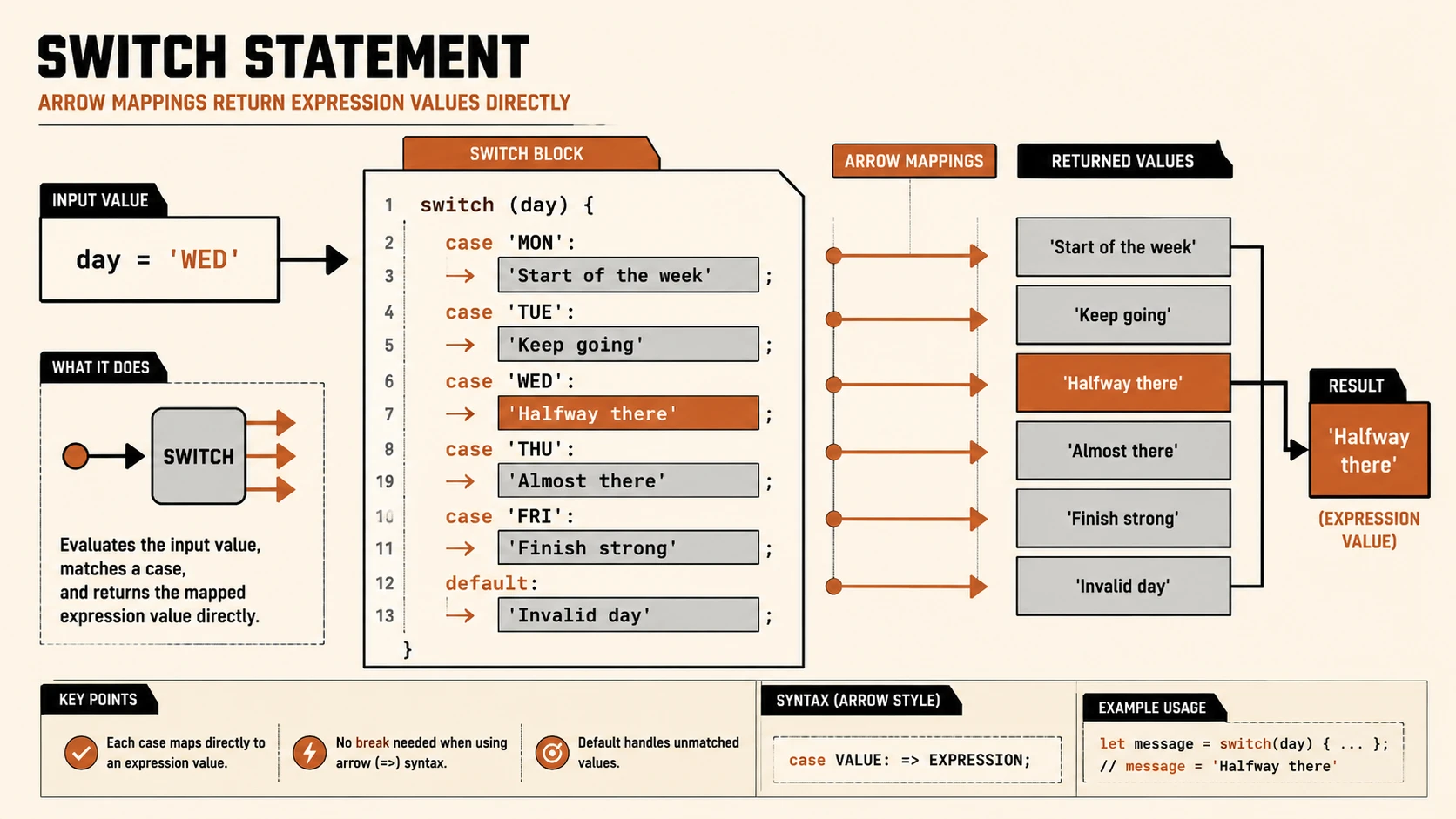
Switch Expressions
Java 14 finalizes the Switch Expressions feature introduced through earlier preview releases.
Advantages include:
- ◆Cleaner conditional logic
- ◆Expression-oriented programming
- ◆Reduced fall-through errors
- ◆Improved readability
Organizations evaluating Java 14 should consider adopting Switch Expressions where they improve code clarity.
Enterprise Use Cases
| Scenario | Benefit |
|---|---|
| Financial Systems | Concise domain models using Records |
| REST APIs | Simplified data transfer objects |
| Cloud Services | Improved debugging diagnostics |
| Enterprise Portals | Cleaner conditional logic |
| Administrative Applications | Easier maintenance |
| Middleware Platforms | Reduced boilerplate |
Organizations maintaining large Java applications benefit from language features that improve maintainability without altering application architecture.
Performance Considerations
Most Java 14 enhancements primarily target developer productivity.
Development teams should continue evaluating:
- ◆Application startup
- ◆Memory utilization
- ◆JVM optimization
- ◆Garbage collection behavior
- ◆Runtime diagnostics
- ◆Build performance
Performance improvements should continue to be validated through representative production benchmarking.
Security Considerations
Java 14 does not fundamentally modify the platform's security architecture.
Organizations should continue implementing:
- ◆Authentication
- ◆Authorization
- ◆Input validation
- ◆TLS communication
- ◆Dependency governance
- ◆Secure coding standards
Language enhancements improve maintainability but do not replace established enterprise security practices.
Scalability
Java 14 contributes to scalable software development by:
- ◆Reducing boilerplate
- ◆Improving domain model readability
- ◆Simplifying type inspection
- ◆Enhancing production diagnostics
- ◆Continuing JVM optimization
These improvements become increasingly valuable across large enterprise codebases maintained by multiple engineering teams.
Best Practices
Organizations evaluating Java 14 should:
- ◆Pilot Record Classes in new development.
- ◆Evaluate Pattern Matching within development environments.
- ◆Continue using immutable design principles.
- ◆Benchmark JVM behavior after upgrades.
- ◆Review coding standards.
- ◆Maintain automated regression testing.
- ◆Validate third-party library compatibility.
- ◆Monitor preview feature evolution.
Incremental adoption enables teams to gain practical experience while maintaining production stability.
Common Mistakes
Development teams should avoid:
- ◆Treating preview features as permanent language contracts.
- ◆Rewriting mature domain models without measurable business value.
- ◆Assuming Helpful NullPointerExceptions eliminate the need for defensive programming.
- ◆Ignoring compatibility testing.
- ◆Mixing inconsistent coding styles across projects.
- ◆Migrating production environments without sufficient validation.
Successful modernization depends upon disciplined engineering practices rather than adopting every available language enhancement immediately.
Technology Comparison
| Capability | Java 13 | Java 14 |
|---|---|---|
| Record Classes | No | Preview |
| Pattern Matching for instanceof | No | Preview |
| Helpful NullPointerExceptions | Optional | Enabled by default |
| Switch Expressions | Preview | Finalized |
| JVM Diagnostics | Good | Improved |
| Six-Month Release Cadence | Yes | Yes |
Java 14 continues the platform's incremental modernization by improving both language expressiveness and runtime diagnostics.
Adoption Strategy
Organizations should evaluate Java 14 through controlled pilot projects.
A recommended strategy includes:
- 1.Upgrade development environments.
- 2.Evaluate Record Classes in non-production projects.
- 3.Introduce Switch Expressions where appropriate.
- 4.Test Helpful NullPointerExceptions within operational workflows.
- 5.Validate build tools and IDE compatibility.
- 6.Benchmark application performance.
- 7.Continue monitoring future Long-Term Support planning before broad production migration.
This measured approach allows organizations to evaluate new capabilities while minimizing operational risk.
Limitations
As of March 2020, several considerations remain.
Current observations include:
- ◆Record Classes remain preview features.
- ◆Pattern Matching for instanceof remains in preview.
- ◆Java 14 is not a Long-Term Support release.
- ◆Existing enterprise applications should continue emphasizing compatibility testing before adopting new language capabilities.
Organizations should therefore treat Java 14 primarily as an evaluation platform for future language evolution.
Looking Ahead
Java 14 continues OpenJDK's strategy of incremental innovation by reducing boilerplate, improving diagnostics, and modernizing the language without compromising backward compatibility. Record Classes simplify data modeling, Pattern Matching improves readability for object-oriented code, Helpful NullPointerExceptions enhance production troubleshooting, and finalized Switch Expressions modernize conditional programming.
As of March 2020, enterprise architects should evaluate Java 14 as an opportunity to familiarize engineering teams with the next generation of Java language capabilities. Organizations that combine disciplined experimentation, comprehensive testing, and incremental adoption will be well positioned for future Long-Term Support platform releases while continuing to improve code quality across enterprise Java systems.