Introduction
Java has long been recognized for emphasizing explicitness, readability, and compile-time type safety. Since its introduction, one of Java's defining characteristics has been that every variable declaration explicitly specifies its type. While this improves readability in many situations, modern Java applications frequently involve generic collections, lambda expressions, streams, and fluent APIs where repeated type declarations can become unnecessarily verbose.
Developers have increasingly sought ways to reduce boilerplate while maintaining Java's commitment to strong static typing. Several modern programming languages have demonstrated that local type inference can improve developer productivity without sacrificing compile-time safety.
Java 10 addresses this requirement by introducing Local Variable Type Inference through the reserved type name var. Unlike dynamically typed languages, Java continues performing complete compile-time type checking. The compiler simply infers the variable's declared type from its initializer.
As of March 2018, Local Variable Type Inference represents one of the most visible language improvements in Java 10. Rather than fundamentally changing Java's type system, it refines the language by reducing repetitive syntax while preserving explicit program semantics.
Industry Background
Modern enterprise Java development increasingly relies upon:
- ◆Generic collections
- ◆Lambda expressions
- ◆Stream processing
- ◆Dependency injection
- ◆Microservices
- ◆Cloud-native applications
- ◆Functional programming techniques
These programming styles often produce lengthy type declarations, particularly when working with nested generic types or fluent APIs.
Language evolution continues focusing on improving developer productivity without compromising Java's emphasis on maintainable enterprise software.
The Business Problem
Large enterprise Java applications frequently experience:
- ◆Verbose local variable declarations
- ◆Repeated generic type definitions
- ◆Reduced code readability
- ◆Boilerplate initialization code
- ◆Slower development for complex object construction
- ◆More difficult code refactoring
Reducing repetitive syntax allows developers to focus more directly on business logic while preserving static analysis and compile-time validation.
Understanding Local Variable Type Inference
Local Variable Type Inference allows developers to declare local variables using the reserved type name var.
Rather than specifying the explicit type, the compiler determines the variable's type from the initializer expression.
For example:
var customer = repository.findById(id);Although the source code omits the explicit type, the compiler still assigns a concrete static type during compilation.
No runtime type inference occurs.
Core Architecture
| Component | Responsibility |
|---|---|
| Java Compiler | Infers local variable type |
var | Placeholder for inferred type |
| Initializer Expression | Determines compile-time type |
| JVM | Executes compiled bytecode |
| Static Type System | Performs compile-time validation |
| IDE | Displays inferred types and assists developers |
The feature is implemented entirely by the compiler and introduces no changes to JVM bytecode.
How Type Inference Works
Type inference occurs entirely during compilation.
A typical compilation workflow includes:
- 1.The compiler encounters a
vardeclaration. - 2.The initializer expression is analyzed.
- 3.The inferred static type is determined.
- 4.Normal compile-time type checking continues.
- 5.Generated bytecode contains the inferred concrete type.
The JVM executes the application exactly as it would if the explicit type had been written by the developer.
Where var Can Be Used
As of Java 10, Local Variable Type Inference is intentionally limited.
Supported scenarios include:
- ◆Local variables
- ◆Enhanced
forloop variables - ◆Traditional
forloop variables - ◆Resource variables within try-with-resources when appropriate
This constrained scope reflects Java's philosophy of introducing new language features cautiously while preserving readability.
Where var Cannot Be Used
Developers should recognize that var is not a general replacement for explicit typing.
It cannot be used for:
- ◆Method parameters
- ◆Return types
- ◆Class fields
- ◆Instance variables
- ◆Static member declarations
- ◆Variables without initializers
These restrictions preserve API clarity and prevent ambiguity in public interfaces.
Readability Considerations
Although Local Variable Type Inference reduces boilerplate, readability remains the primary design objective.
Consider two common scenarios.
Appropriate use:
var customers = repository.findActiveCustomers();Less appropriate use:
var value = process(data);In the second example, the inferred type may not be immediately obvious, making the code more difficult to understand.
Developers should continue choosing descriptive variable names and writing self-documenting code.
Relationship to Static Typing
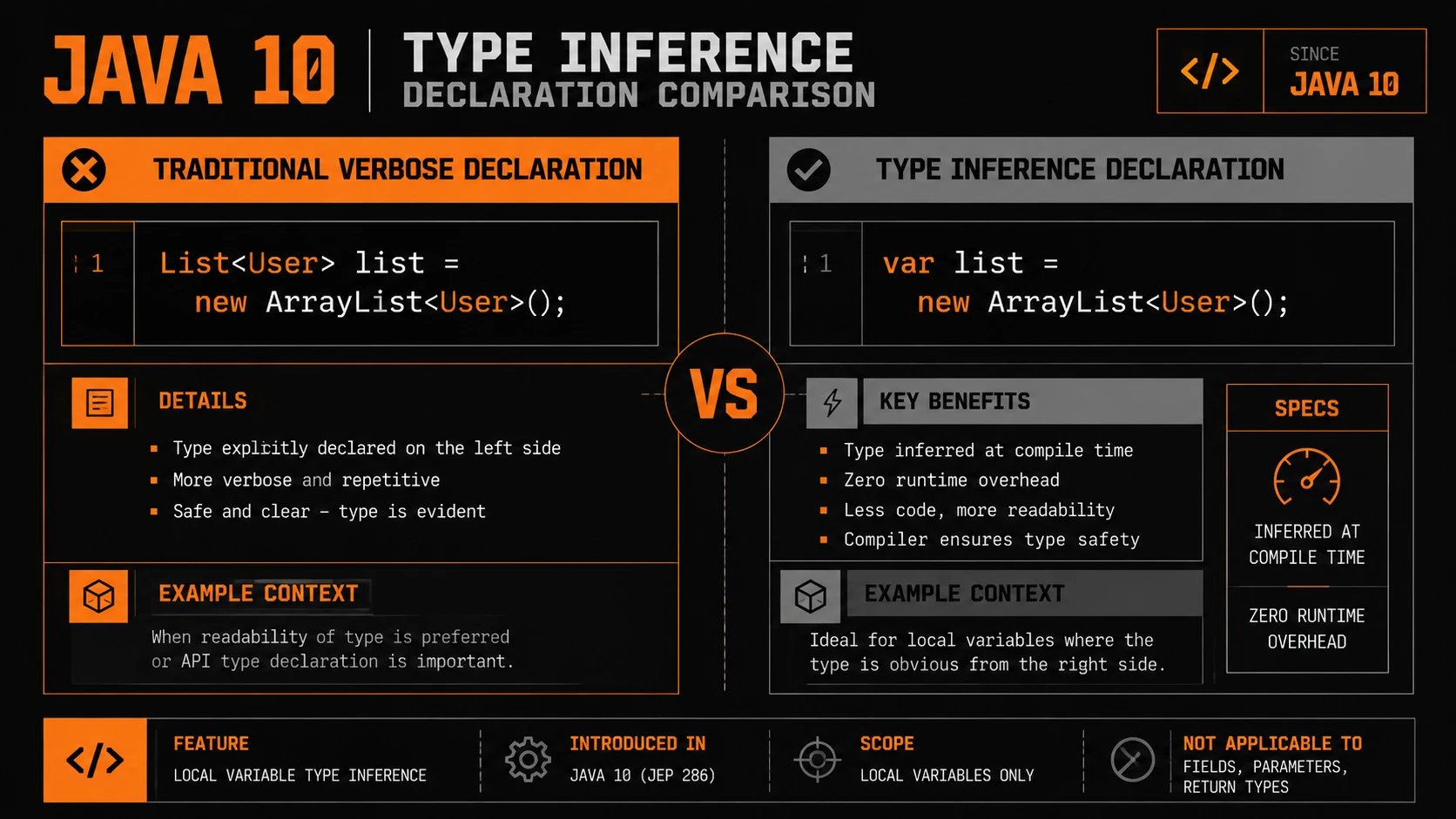
System architecture diagram and conceptual workflow layout for Java 10: Modifying JVM Syntax with Local Variable Type Inference.
One common misconception is that var introduces dynamic typing into Java.
This is not the case.
Java remains a statically typed language.
Compile-time type checking continues unchanged.
Benefits include:
- ◆Compile-time validation
- ◆IDE code completion
- ◆Refactoring support
- ◆Static analysis
- ◆Existing performance characteristics
Only the syntax used to declare local variables has changed.
Enterprise Use Cases
| Scenario | Benefit |
|---|---|
| Stream Processing | Reduced generic verbosity |
| Collection Initialization | Cleaner declarations |
| Repository Access | Improved readability |
| Dependency Injection | Less repetitive local variables |
| Builder Patterns | Simpler fluent API usage |
| Enterprise Services | Reduced boilerplate |
Applications making extensive use of generics and fluent APIs often realize the greatest readability improvements.
Performance Considerations
Local Variable Type Inference introduces no runtime performance overhead.
Since inference occurs during compilation:
- ◆Generated bytecode remains strongly typed.
- ◆JVM execution behavior is unchanged.
- ◆Garbage collection behavior is unaffected.
- ◆JIT compilation operates normally.
Performance characteristics depend upon application architecture rather than the use of var.
Security Considerations
Local Variable Type Inference does not alter Java's security model.
Organizations should continue implementing:
- ◆Input validation
- ◆Authentication
- ◆Authorization
- ◆Secure dependency management
- ◆Exception handling
- ◆Secure coding standards
Language improvements simplify implementation but do not replace secure software engineering practices.
Scalability
For large enterprise projects, consistent coding conventions remain essential.
Organizations should establish clear guidelines describing:
- ◆When
varis encouraged - ◆When explicit types remain preferable
- ◆Naming conventions
- ◆Code review expectations
- ◆Readability standards
Well-defined coding standards become increasingly important as development teams grow.
Best Practices
Organizations adopting Java 10 should:
- ◆Use
varwhen the inferred type is immediately obvious. - ◆Prefer explicit types in public APIs.
- ◆Avoid sacrificing readability for brevity.
- ◆Continue using meaningful variable names.
- ◆Update internal coding standards.
- ◆Validate IDE compatibility before migration.
- ◆Educate development teams on compiler behavior.
- ◆Use code reviews to encourage consistent usage.
Thoughtful adoption maximizes readability while reducing unnecessary verbosity.
Common Mistakes
Development teams should avoid:
- ◆Using
varindiscriminately. - ◆Hiding important domain types.
- ◆Choosing vague variable names.
- ◆Assuming
varintroduces dynamic typing. - ◆Replacing explicit types where clarity is improved by keeping them.
- ◆Ignoring established coding conventions.
Language features should support maintainability rather than reduce code clarity.
Technology Comparison
| Capability | Java 9 | Java 10 |
|---|---|---|
| Explicit Local Variable Types | Yes | Yes |
| Local Variable Type Inference | No | Yes |
| Compile-Time Type Safety | Yes | Yes |
| Generic Type Reduction | Limited | Improved |
| JVM Runtime Changes | No | No |
| IDE Refactoring Support | Yes | Yes |
Java 10 enhances developer productivity while preserving the platform's existing type system and runtime architecture.
Adoption Strategy
Organizations should introduce Local Variable Type Inference gradually.
A practical migration strategy includes:
- 1.Upgrade development environments to Java 10.
- 2.Define coding guidelines for
varusage. - 3.Introduce
varin new code rather than mass refactoring. - 4.Review readability during code reviews.
- 5.Update static analysis rules where appropriate.
- 6.Train developers on compiler inference behavior.
- 7.Evaluate adoption across larger codebases after establishing team conventions.
Incremental adoption minimizes disruption while encouraging consistent coding practices.
Limitations
As of March 2018, Local Variable Type Inference has intentionally limited scope.
Current considerations include:
- ◆Only local variables are supported.
- ◆Public APIs continue requiring explicit type declarations.
- ◆Excessive use may reduce readability.
- ◆Coding standards remain essential for large teams.
The feature is designed to improve developer productivity without fundamentally changing Java's programming model.
Looking Ahead
Java 10 demonstrates the platform's continued commitment to modern language evolution while preserving the principles that have made Java successful in enterprise software development. Local Variable Type Inference reduces repetitive syntax without compromising compile-time type safety, tooling, or runtime performance.
As of March 2018, enterprise architects and senior Java developers should evaluate var as a productivity enhancement rather than a stylistic replacement for explicit typing. Organizations that establish clear coding standards and apply Local Variable Type Inference judiciously will benefit from cleaner, more maintainable code while preserving Java's long-standing emphasis on readability, robustness, and strong static typing.