
Imagine a customer support interaction where a complex issue is resolved not by a human agent after multiple transfers, but by an AI that proactively identifies the root cause, accesses multiple systems, and even initiates necessary follow-up actions – all without explicit step-by-step instructions. This isn't science fiction; it's the emerging reality of AI Agents in customer service. The recent explosion in large language model (LLM) capabilities, including models like GPT, Claude, and Llama, has paved the way for a new paradigm, moving beyond static chatbots to intelligent, autonomous entities that can plan, reason, and execute. This transformation is not merely an upgrade; it's a fundamental shift in how enterprises can deliver exceptional customer experiences at scale through intelligent automation.
From Reactive Chatbots to Proactive AI Agents: A Paradigm Shift in CX
Are traditional chatbots failing to meet customer expectations, leaving users frustrated with endless loops and irrelevant responses? While rule-based and even early generative AI chatbots offered initial automation, their limitations in understanding complex intent, maintaining long-term context, and performing multi-step actions quickly became apparent. They often act as glorified FAQs, requiring human intervention for anything beyond simple queries.
This is where the concept of AI Agents fundamentally diverges. AI Agents are not just conversational interfaces; they are intelligent entities designed to achieve specific goals autonomously. Unlike chatbots that react to predefined inputs, agents plan a sequence of actions, utilize tools, and learn from their interactions to improve future performance. This shift empowers them to tackle more intricate customer problems, from resolving billing disputes by accessing financial systems to troubleshooting technical issues by consulting product documentation and initiating service tickets. They can even anticipate needs, offering proactive support before a customer explicitly asks.
This evolution is driven by advancements in LLMs, which provide agents with sophisticated reasoning capabilities. Coupled with frameworks for tool use, memory management, and agent orchestration, these Enterprise AI Agents can navigate complex workflows that were previously exclusive to human operators. For enterprises, this means a leap from basic automation to true intelligent automation in customer service, enhancing the overall Customer Experience (CX).
Architecting Intelligent Automation: The Core Components of an AI Agent
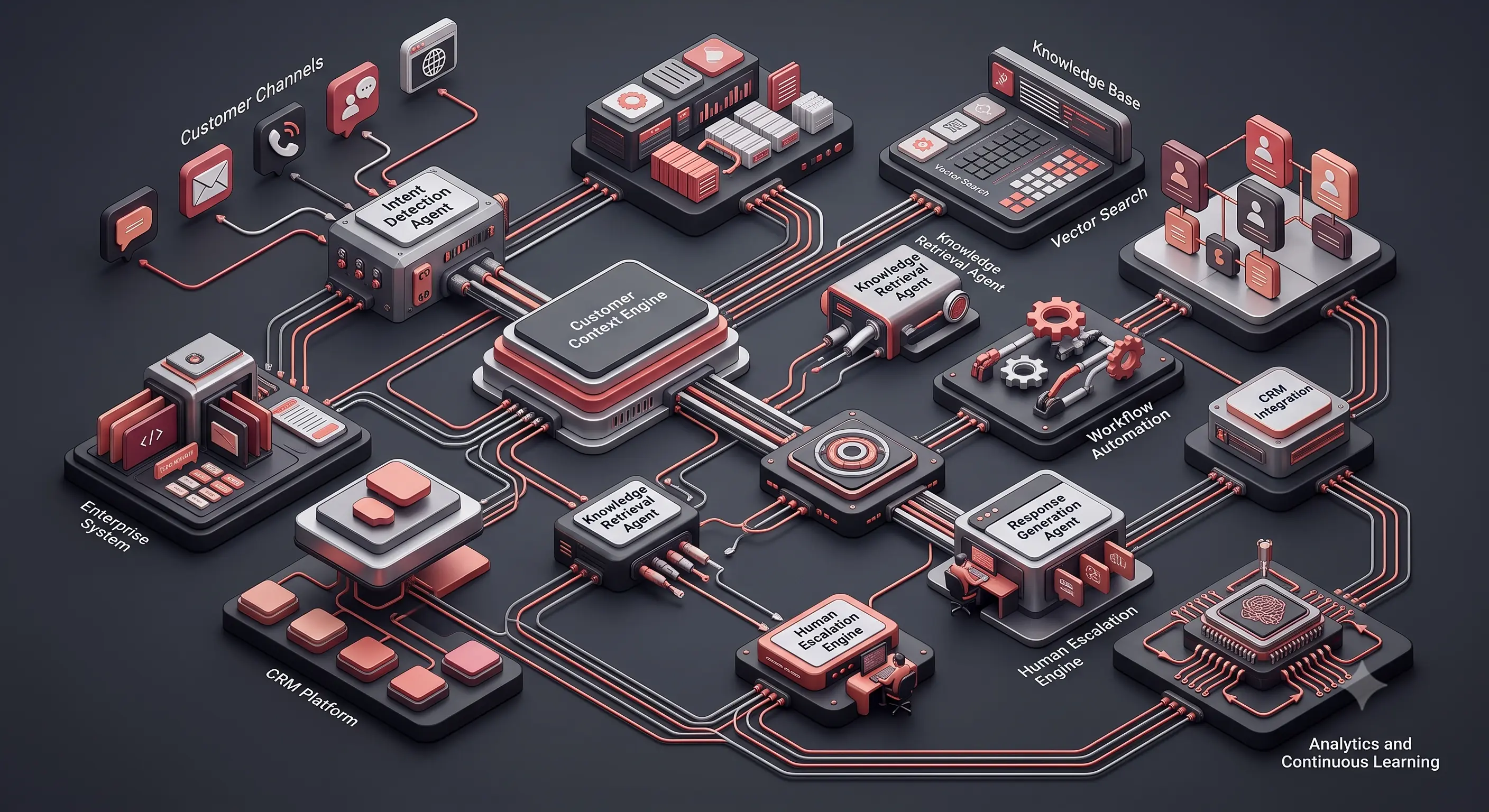
How do these intelligent agents actually function under the hood, enabling them to move beyond simple Q&A? The power of AI Agents in customer service lies in their sophisticated, multi-component architecture. At its heart is a powerful LLM (such as GPT, Claude, or Llama) acting as the 'brain', responsible for understanding natural language, generating responses, and crucially, for planning and reasoning. This central LLM is augmented by several critical components:
- ◆Memory Module: Essential for maintaining context across interactions, remembering past conversations, customer preferences, and historical data. This involves both short-term memory (for the current session) and long-term memory, often implemented using vector databases for efficient Retrieval-Augmented Generation (RAG) against extensive enterprise knowledge bases.
- ◆Tool-Use Capabilities: Agents are equipped with a suite of 'tools' – APIs or functions – allowing them to interact with external systems. This could include Customer Relationship Management (CRM) systems (e.g., Salesforce, HubSpot), Enterprise Resource Planning (ERP) platforms, internal knowledge bases, order management systems, or even diagnostic tools. The agent decides which tool to use based on its plan and the customer's request.
- ◆Planning and Reasoning Engine: This component allows the agent to break down complex requests into smaller, manageable sub-tasks. It strategizes the optimal sequence of actions, considering available tools and information. Leveraging Natural Language Processing (NLP) and Machine Learning, this is where the autonomous problem-solving truly shines, moving beyond mere instruction following.
- ◆Perception Module: Responsible for interpreting various forms of input, not just text. This might include analyzing sentiment, extracting entities, or even processing voice inputs through speech-to-text integration.
- ◆Action Execution Module: Carries out the planned actions, calling the appropriate tools and processing their outputs. It also handles error recovery and re-planning if an action fails.
- ◆Human-in-the-Loop (HITL) Interface: Crucial for enterprise deployments, this allows human agents to monitor AI agent performance, intervene when necessary, and provide feedback for continuous improvement. It ensures that complex or sensitive issues are escalated appropriately.
This modular design allows for robust, scalable, and adaptable AI Agents that can be tailored to specific enterprise needs. The ability for AI Agents to integrate deeply with existing enterprise systems is what truly differentiates them from standalone chatbots.
Engineering an AI Agent Deployment: Practical Strategies for Implementation
Considering the complexity, how can enterprises effectively deploy AI Agents for customer service automation without getting lost in theoretical promises? Successful implementation requires a strategic, phased approach, focusing on specific high-impact use cases initially. Start by identifying repetitive, high-volume, yet complex customer queries that currently consume significant human agent time. Key steps for implementation include:
- 1.Define Agent Persona and Goals: Clearly articulate the agent's role, tone, and specific objectives. Will it handle billing, technical support, or general inquiries? Clarity here guides development and evaluation.
- 2.Secure Enterprise Data and System Integration: This is perhaps the most critical step. AI Agents need secure, authenticated access to your CRM, knowledge base, ERP, order systems, and other relevant APIs. Robust API design, data privacy, and access control must be meticulously managed to maintain data integrity and security.
- 3.Develop Robust Tooling: Translate business processes into callable functions that the agent can invoke. For example, a
lookupOrderStatus(orderId)function or aresetPassword(userId)function. This allows the agent to *act* within your ecosystem. - 4.Advanced Prompt Engineering and Context Management: Crafting effective prompts is essential for guiding the LLM's reasoning and preventing 'hallucinations'. Implementing sophisticated context engineering ensures the agent remembers relevant details throughout the conversation, preventing disjointed interactions and improving the quality of customer support.
- 5.Establish Human-in-the-Loop (HITL) Workflows: Design clear escalation paths and monitoring dashboards. Human oversight is vital, especially in early deployment phases, to ensure quality and gather feedback. This ensures that complex or sensitive issues are handled by the most capable resource.
- 6.Iterative Development and Performance Tuning: Deploy in a controlled environment, collect data, analyze performance, and continuously fine-tune the agent's behavior. A/B testing different agent strategies can yield significant improvements in efficiency and customer satisfaction.
Common pitfalls include underestimating integration complexity, neglecting robust error handling, and failing to provide adequate human oversight. Enterprises must view AI Agents as an extension of their team, not a replacement, for optimal results. This careful approach ensures that AI Agents Customer Service implementations deliver tangible value.
Measuring Business Impact and Navigating the Challenges of AI Agent Adoption
How do you quantify the success of your AI agent deployment, and what are the hidden hurdles to watch out for? Measuring the impact of AI Agents in customer service automation goes beyond simple cost savings. Key performance indicators (KPIs) include:
- ◆First Contact Resolution (FCR) Rate: AI Agents should significantly improve the percentage of issues resolved on the first interaction, boosting customer satisfaction.
- ◆Average Handling Time (AHT): Automation of routine tasks can drastically reduce the time spent per customer interaction, improving operational efficiency.
- ◆Customer Satisfaction (CSAT) Scores: While initially a concern, well-designed AI Agents can lead to higher CSAT through faster, more accurate resolutions and 24/7 availability.
- ◆Agent Productivity/Occupancy Rate: Freeing human agents from repetitive tasks allows them to focus on complex, high-value interactions, enhancing their job satisfaction and overall team output.
- ◆Escalation Rate: A decrease in escalations to human agents indicates effective AI agent performance and better autonomous problem-solving.
- ◆Operational Cost Reduction: While not the sole metric, reduced staffing needs, increased efficiency, and optimized resource allocation contribute to significant cost savings over time.
Challenges often arise in data quality, integration complexity, and managing 'hallucinations' from LLMs. Ensuring clean, consistent data across CRM, ERP, and knowledge bases is critical for agent accuracy. Robust error handling and a well-defined HITL strategy mitigate risks associated with agent failures or incorrect information. Continuous monitoring and retraining are essential for long-term success. Furthermore, ethical considerations, bias mitigation, and ensuring transparent AI interactions are paramount for building customer trust and maintaining brand reputation.
Key Takeaways: Revolutionizing Customer Experience with Enterprise AI Agents
AI Agents are fundamentally reshaping customer service, moving beyond reactive chatbots to proactive, autonomous problem-solvers. Their sophisticated, multi-component architecture, leveraging powerful LLMs, advanced memory, and robust tool-use capabilities, enables them to handle complex, multi-step customer inquiries. Successful enterprise implementation hinges on strategic planning, deep integration with existing systems, meticulous prompt engineering, and a critical Human-in-the-Loop strategy. Measuring success involves a blend of efficiency metrics like FCR and AHT, alongside customer satisfaction and human agent productivity. While challenges exist in data quality and ethical considerations, the long-term benefits of enhanced customer experience and operational efficiency make AI Agents a transformative force for any enterprise seeking to revolutionize its customer service automation strategy.
SHIVAMITCS provides expert consulting and development services to help enterprises design, build, and deploy sophisticated AI Agent solutions tailored to their unique customer service needs, ensuring a seamless transition to intelligent automation and superior customer experiences.
Frequently Asked Questions
What is the key difference between an AI Agent and a traditional chatbot in customer service?
The key difference lies in autonomy and capability. A traditional chatbot is primarily reactive, following predefined rules or simple conversational flows to answer questions. An AI Agent, however, is proactive and goal-oriented. It utilizes an LLM for reasoning, can plan multi-step actions, learn from interactions, and use external tools (APIs to CRM, ERP, etc.) to achieve complex objectives autonomously, like resolving a billing dispute or troubleshooting a technical issue without explicit step-by-step instructions.
What kind of architecture supports AI Agents for enterprise customer service?
The core architecture typically involves a powerful Large Language Model (LLM) as the central 'brain'. This LLM is augmented by a Memory Module (often leveraging vector databases for RAG and long-term context), Tool-Use Capabilities (a suite of APIs to interact with enterprise systems like CRM, ERP, knowledge bases), a Planning and Reasoning Engine to break down complex tasks, and a Human-in-the-Loop (HITL) interface for monitoring and escalation. This modular design ensures scalability, adaptability, and integration with existing enterprise infrastructure.
How can enterprises measure the ROI of implementing AI Agents in customer service?
Measuring ROI involves tracking both efficiency and customer satisfaction metrics. Key performance indicators (KPIs) include First Contact Resolution (FCR) rate, Average Handling Time (AHT), Customer Satisfaction (CSAT) scores, human agent productivity (by reducing mundane tasks), and a decrease in escalation rates to human agents. While initial investment is required, the long-term benefits typically show significant operational cost reductions, improved customer experience, and more efficient resource allocation within the customer service department.
Ai Agents Customer Service plays a vital role in modern IT and AI-driven digital transformation.