Introduction
The C# language has steadily evolved through a series of focused releases that improve developer productivity while maintaining backward compatibility. Rather than introducing disruptive language changes, Microsoft has adopted a cadence of incremental compiler enhancements that simplify common programming patterns and align the language with modern application development practices.
Following the introduction of C# 7.0 earlier this year, C# 7.1 delivers another set of practical improvements aimed at making enterprise development more expressive and reducing boilerplate code. The most notable addition is support for asynchronous application entry points, allowing the Main method to participate directly in asynchronous workflows.
As cloud computing, RESTful services, distributed systems, and asynchronous programming continue becoming central to enterprise software architecture, eliminating unnecessary synchronous wrappers improves code clarity and reduces complexity.
Beyond asynchronous entry points, C# 7.1 introduces inferred tuple element names, default literal expressions, compiler improvements, and refinements to pattern matching that continue modernizing everyday programming practices.
As of December 2017, C# 7.1 represents another important step in Microsoft's strategy of delivering smaller, more frequent language enhancements that improve both productivity and maintainability.
Industry Background
Enterprise .NET applications increasingly rely on:
- ◆Cloud-hosted services
- ◆REST APIs
- ◆Microservices
- ◆Background processing
- ◆Asynchronous I/O
- ◆Distributed messaging
- ◆Cross-platform development with .NET Core
Since the introduction of async and await in C# 5.0, asynchronous programming has become the preferred model for scalable server-side applications. However, application startup still required synchronous entry points.
C# 7.1 removes this inconsistency by allowing asynchronous execution from the beginning of an application's lifecycle.
The Business Problem
Enterprise applications commonly experience:
- ◆Boilerplate startup code
- ◆Blocking application initialization
- ◆Wrapper methods around asynchronous operations
- ◆Verbose tuple declarations
- ◆Repetitive default value expressions
- ◆Reduced readability during application startup
Language improvements that simplify these patterns improve long-term maintainability while reducing unnecessary implementation details.
Understanding C# 7.1
C# 7.1 builds upon the language foundation established in C# 7.0.
Key enhancements include:
- ◆Asynchronous Main methods
- ◆Inferred tuple element names
- ◆Default literal expressions
- ◆Pattern matching refinements
- ◆Compiler improvements
These features primarily improve developer experience while preserving compatibility with existing applications.
Core Architecture
| Feature | Primary Responsibility |
|---|---|
| Async Main | Enables asynchronous application startup |
| Tuple Name Inference | Simplifies tuple declarations |
| Default Literal | Reduces repetitive initialization |
| Pattern Matching Refinements | Improves conditional logic |
| Compiler | Performs language analysis and optimization |
| .NET Runtime | Executes compiled applications |
Together these improvements simplify application implementation while preserving established programming models.
Asynchronous Main Methods
// Asynchronous Entry Point (async Main) supported in C# 7.1
using System;
using System.Net.Http;
using System.Threading.Tasks;

public class Program
{
    // Compiler allows returning Task/Task<int> directly from Main
    public static async Task Main(string[] args)
    {
        using (var client = new HttpClient())
        {
            string result = await client.GetStringAsync("https://api.shivamitcs.com/health");
            Console.WriteLine(`Service Status: ${result}`);
        }
    }
}
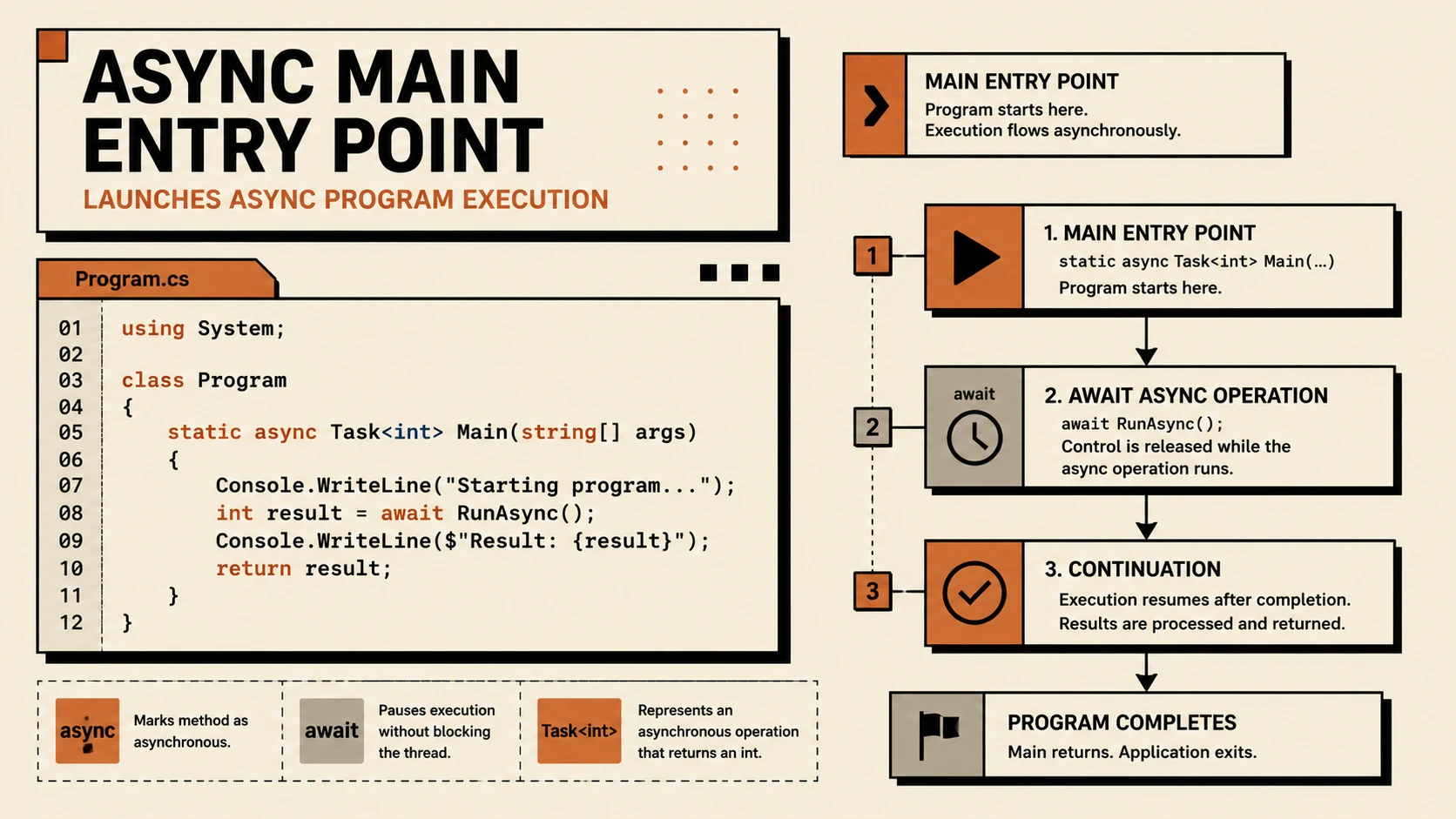
The defining enhancement of C# 7.1 is support for asynchronous application entry points.
Previously, developers wishing to perform asynchronous initialization needed to invoke asynchronous code indirectly from a synchronous Main method.
Typical startup scenarios include:
- ◆Configuration loading
- ◆Database initialization
- ◆Remote service communication
- ◆Authentication
- ◆Dependency injection setup
- ◆Application warm-up
With C# 7.1, these workflows can begin directly within an asynchronous entry point.
Benefits include:
- ◆Cleaner startup logic
- ◆Reduced wrapper methods
- ◆Better alignment with async programming
- ◆Improved readability
This change simplifies application initialization without altering the existing asynchronous programming model.
Application Startup Workflow
A modern application startup sequence may include:
- 1.Application execution begins.
- 2.The asynchronous Main method executes.
- 3.Configuration is loaded.
- 4.Required services are initialized.
- 5.External resources are accessed asynchronously.
- 6.Application processing continues.
Developers no longer need to manually bridge synchronous and asynchronous execution during startup.
Tuple Name Inference
Tuples introduced in C# 7.0 simplified returning multiple values from methods.
C# 7.1 further improves tuple usability by allowing the compiler to infer element names in many situations.
Advantages include:
- ◆Less repetitive code
- ◆Improved readability
- ◆Cleaner method signatures
- ◆Easier maintenance
Compiler inference reduces unnecessary duplication while preserving explicit program intent.
Default Literal Expressions
Developers frequently initialize values using explicit default expressions.
C# 7.1 introduces default literal expressions that reduce repetitive syntax while maintaining strong typing.
Benefits include:
- ◆Cleaner initialization
- ◆Reduced boilerplate
- ◆More readable generic code
- ◆Improved consistency
This enhancement is particularly useful within reusable libraries and generic programming scenarios.
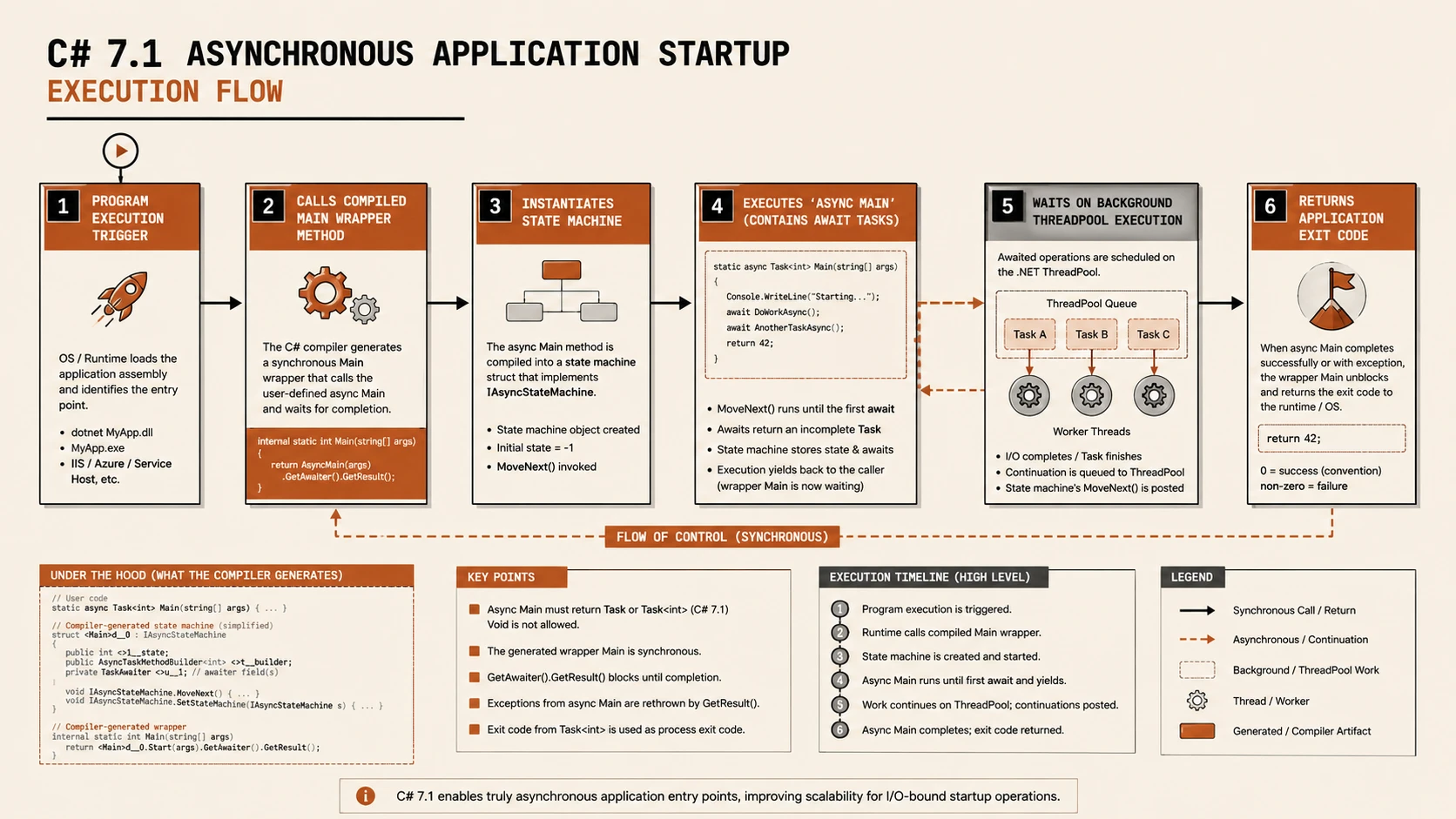
Event loop routing for non-blocking asynchronous I/O execution threads.
Pattern Matching Refinements
Pattern matching introduced in C# 7.0 continues maturing through compiler refinements.
Pattern matching improves conditional logic involving:
- ◆Type evaluation
- ◆Value comparison
- ◆Safe casting
- ◆Business rule implementation
Refinements help improve consistency and developer experience while preserving existing language semantics.
Compiler Improvements
Beyond language syntax, C# 7.1 includes compiler enhancements that improve:
- ◆Language diagnostics
- ◆Feature implementation
- ◆Compilation consistency
- ◆Developer tooling integration
Incremental compiler improvements contribute to a smoother development experience across Visual Studio and command-line build environments.
Enterprise Use Cases
| Scenario | Benefit |
|---|---|
| Cloud Services | Asynchronous startup |
| ASP.NET Core Applications | Cleaner initialization patterns |
| Console Utilities | Native async entry points |
| Enterprise Middleware | Simplified configuration loading |
| Background Processing | Improved startup workflow |
| Shared Libraries | Cleaner tuple usage |
Organizations developing modern .NET applications benefit from more expressive language constructs and reduced boilerplate.
Performance Considerations
Most C# 7.1 improvements target developer productivity rather than runtime performance.
Development teams should evaluate:
- ◆Application startup behavior
- ◆Asynchronous initialization
- ◆Memory allocation
- ◆Compiler-generated code
- ◆Overall application architecture
Well-designed software architecture remains significantly more important than isolated language syntax improvements.
Security Considerations
Language enhancements do not change core security responsibilities.
Organizations should continue implementing:
- ◆Authentication
- ◆Authorization
- ◆Input validation
- ◆Secure exception handling
- ◆HTTPS communication
- ◆Dependency management
Cleaner language constructs should complement established secure coding standards.
Scalability
C# 7.1 contributes to scalable enterprise development through:
- ◆Improved asynchronous programming
- ◆Cleaner startup code
- ◆Reduced boilerplate
- ◆More maintainable implementations
- ◆Better language consistency
These improvements become increasingly valuable across large enterprise codebases maintained by multiple teams.
Best Practices
Organizations adopting C# 7.1 should:
- ◆Use asynchronous Main methods for asynchronous startup workflows.
- ◆Continue following established async and await guidelines.
- ◆Adopt tuple name inference where readability improves.
- ◆Use default literals consistently.
- ◆Keep application startup focused and efficient.
- ◆Benchmark startup performance before optimization.
- ◆Update internal coding standards.
- ◆Train development teams on new language capabilities.
Consistent language usage improves readability across enterprise projects.
Common Mistakes
Development teams should avoid:
- ◆Introducing asynchronous operations unnecessarily during application startup.
- ◆Using inferred syntax when explicit naming improves readability.
- ◆Assuming language improvements automatically improve performance.
- ◆Mixing inconsistent coding styles.
- ◆Replacing clear domain models with excessive tuple usage.
- ◆Ignoring asynchronous exception handling.
Language enhancements should support maintainable architecture rather than encourage unnecessary complexity.
Technology Comparison
| Capability | C# 7.0 | C# 7.1 |
|---|---|---|
| Async Main | No | Yes |
| Tuple Element Name Inference | Limited | Improved |
| Default Literal Expressions | No | Yes |
| Pattern Matching | Initial Implementation | Refined |
| Compiler Diagnostics | Good | Improved |
| Enterprise Productivity | High | Higher |
C# 7.1 builds naturally upon C# 7.0 through practical language refinements rather than major architectural changes.
Adoption Strategy
Organizations should adopt C# 7.1 incrementally.
A practical migration strategy includes:
- 1.Upgrade development environments.
- 2.Enable the C# 7.1 language version.
- 3.Introduce asynchronous Main methods in new applications.
- 4.Adopt tuple inference during routine maintenance.
- 5.Update coding standards.
- 6.Validate build automation.
- 7.Expand adoption after team familiarity increases.
Incremental modernization minimizes migration risk while allowing teams to benefit from improved language expressiveness.
Limitations
As of December 2017, organizations should recognize several considerations.
Current observations include:
- ◆Existing applications do not require immediate migration.
- ◆Language improvements simplify implementation rather than fundamentally changing application architecture.
- ◆Development teams should prioritize readability over syntactic brevity.
- ◆Consistent coding conventions remain more valuable than widespread adoption of every new language feature.
Successful modernization depends upon disciplined engineering practices rather than language evolution alone.
Looking Ahead
C# 7.1 continues Microsoft's strategy of evolving the language through incremental, developer-focused improvements. Support for asynchronous Main methods removes a long-standing inconsistency in asynchronous programming, while tuple inference, default literal expressions, and compiler refinements reduce repetitive code and improve readability.
As of December 2017, enterprise architects and senior .NET developers should view C# 7.1 as a natural progression for modern application development. Organizations that combine these language improvements with sound software architecture, robust testing practices, and disciplined coding standards will continue building maintainable, scalable, and high-quality enterprise applications across the expanding .NET ecosystem.