Introduction
Enterprise software development continues to demand programming languages that balance productivity, maintainability, and performance. As .NET applications increase in size and complexity, even small language improvements can significantly reduce maintenance effort across millions of lines of code.
Microsoft's ongoing work on C# 6.0 introduces several language enhancements designed to simplify everyday programming tasks while preserving backward compatibility with existing .NET applications. At the same time, the Roslyn compiler project represents a major architectural evolution by rewriting the C# and Visual Basic compilers as managed applications and exposing compiler services through public APIs.
From the perspective of December 2014, Roslyn is more than a compiler replacement. It establishes a foundation for richer development tools, advanced code analysis, automated refactoring, and deeper IDE integration.
Industry Background
Over the past several years, software engineering has shifted toward faster release cycles, Continuous Integration, automated testing, and stronger developer tooling.
Organizations increasingly expect:
- ◆Better IDE productivity.
- ◆Faster code navigation.
- ◆Automated refactoring.
- ◆Static code analysis.
- ◆Simplified debugging.
- ◆Cleaner application code.
Language evolution is therefore no longer limited to runtime performance. Modern development environments increasingly rely on compiler intelligence to improve software quality before applications are deployed.
Roslyn reflects this broader shift toward compiler-assisted development.
The Business Problem
Large enterprise codebases often suffer from repetitive patterns that reduce maintainability.
Development teams frequently encounter:
- ◆Complex string formatting.
- ◆Repeated null validation.
- ◆Verbose property access.
- ◆Difficult refactoring.
- ◆Limited compiler extensibility.
- ◆Manual code quality enforcement.
These issues increase development time while making applications harder to maintain.
C# 6.0 introduces language features that simplify common programming patterns, while Roslyn provides a platform for more intelligent development tools.
Understanding the Technology
C# 6.0 focuses primarily on developer productivity.
Key language enhancements include:
- ◆String interpolation.
- ◆Null-conditional operators.
- ◆Expression-bodied members.
- ◆nameof expressions.
- ◆Improved auto-property initialization.
Roslyn complements these language improvements by modernizing the compiler architecture itself.
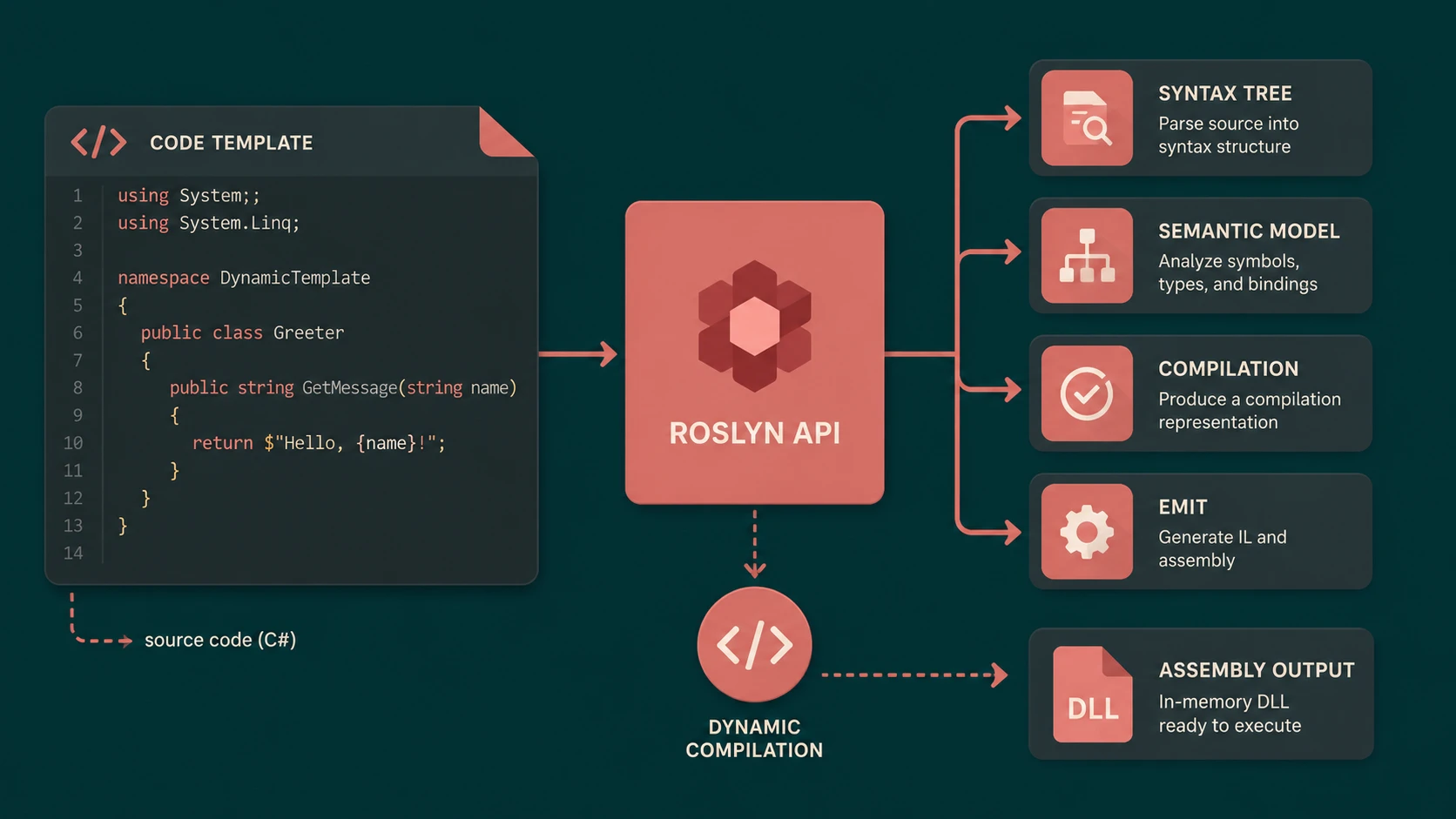
Rather than functioning only as a command-line compiler, Roslyn exposes syntax trees, semantic analysis, and compilation services through managed APIs that can be consumed by development tools.
Core Architecture
Roslyn separates compiler functionality into reusable services.
| Component | Responsibility |
|---|---|
| C# Source Code | Developer-written application logic |
| Roslyn Parser | Generates syntax trees |
| Semantic Analysis | Resolves symbols and types |
| Compilation Engine | Produces Intermediate Language |
| IDE Integration | Provides editing and diagnostics |
| .NET Framework CLR | Executes compiled assemblies |
This architecture enables development tools to analyze code using the same compiler infrastructure responsible for building applications.
Key Features
String Interpolation
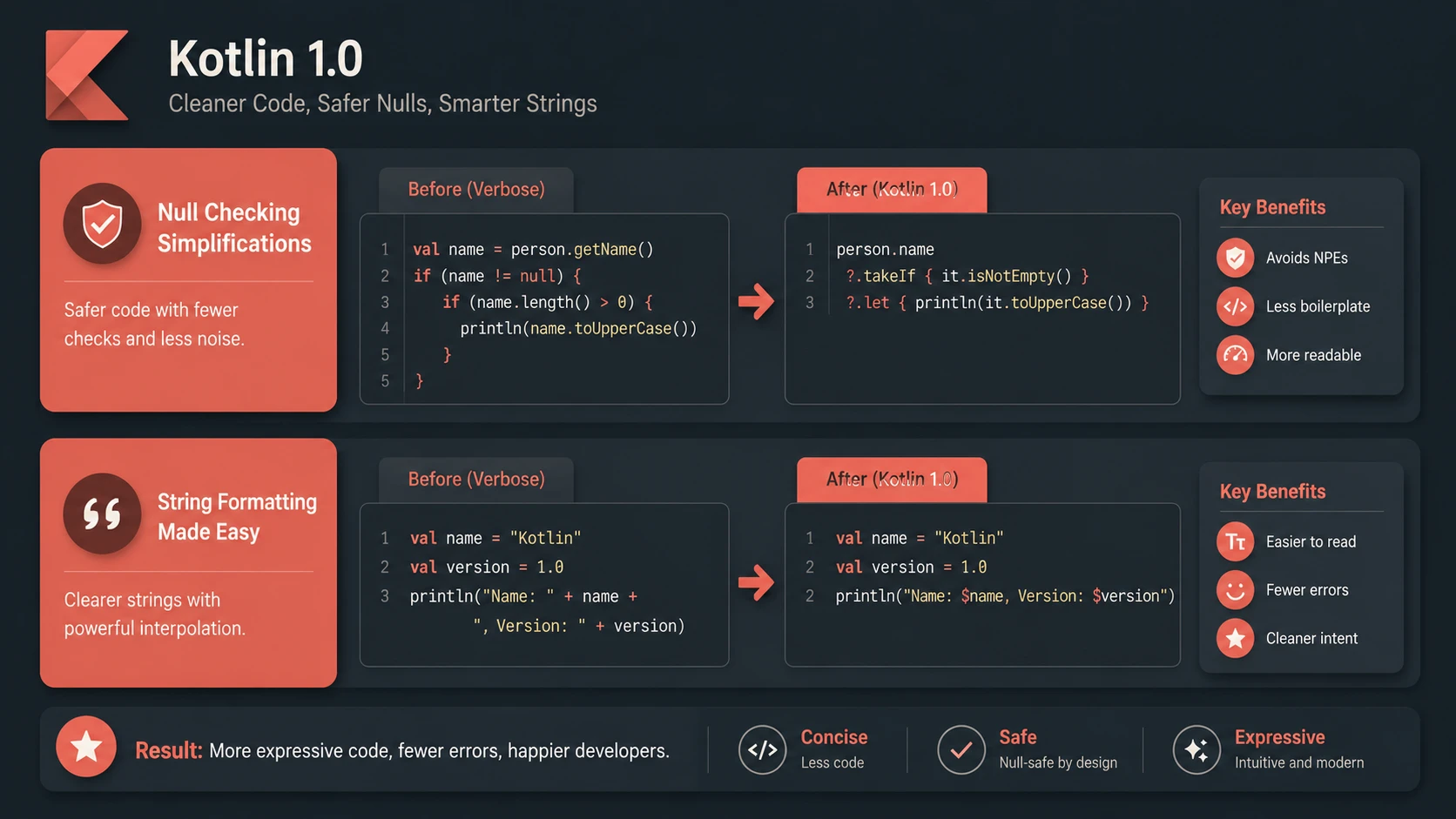
String interpolation simplifies string construction by embedding expressions directly within string literals.
Compared to traditional formatting methods, interpolated strings improve readability while reducing formatting errors.
Enterprise scenarios include:
- ◆Logging.
- ◆Report generation.
- ◆Exception messages.
- ◆User notifications.
Null-Conditional Operators
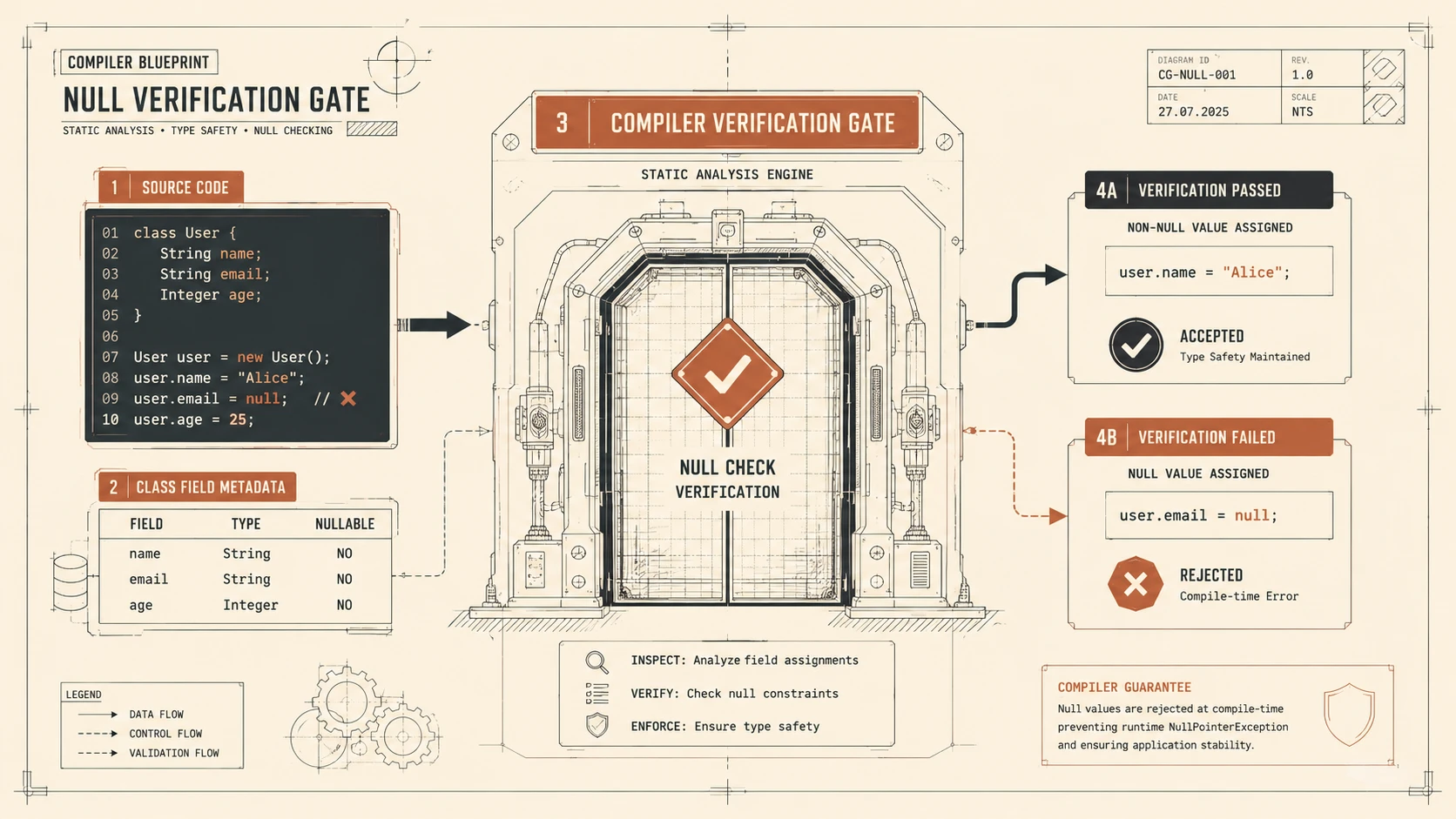
Null reference exceptions remain among the most common runtime issues in enterprise applications.
The null-conditional operator provides a concise syntax for safely accessing members when objects may be null.
This feature reduces repetitive null checking while improving code clarity.
nameof Expression
The nameof operator allows developers to reference identifiers without hardcoding string literals.
This improves maintainability during refactoring because identifier names remain synchronized with source code.
Expression-Bodied Members
Simple methods and properties can be expressed more concisely, reducing boilerplate implementation.
Roslyn Compiler APIs
Perhaps the most significant innovation is Roslyn's public compiler API.
Development tools can inspect:
- ◆Syntax trees.
- ◆Semantic models.
- ◆Symbol information.
- ◆Compiler diagnostics.
- ◆Code structure.
These capabilities enable sophisticated static analysis and automated code transformations.
How It Works
A simplified compilation workflow appears below.
Developer
      |
C# 6.0 Source Code
      |
Roslyn Parser
      |
Syntax Tree
      |
Semantic Analysis
      |
Compilation
      |
Intermediate Language
      |
.NET CLR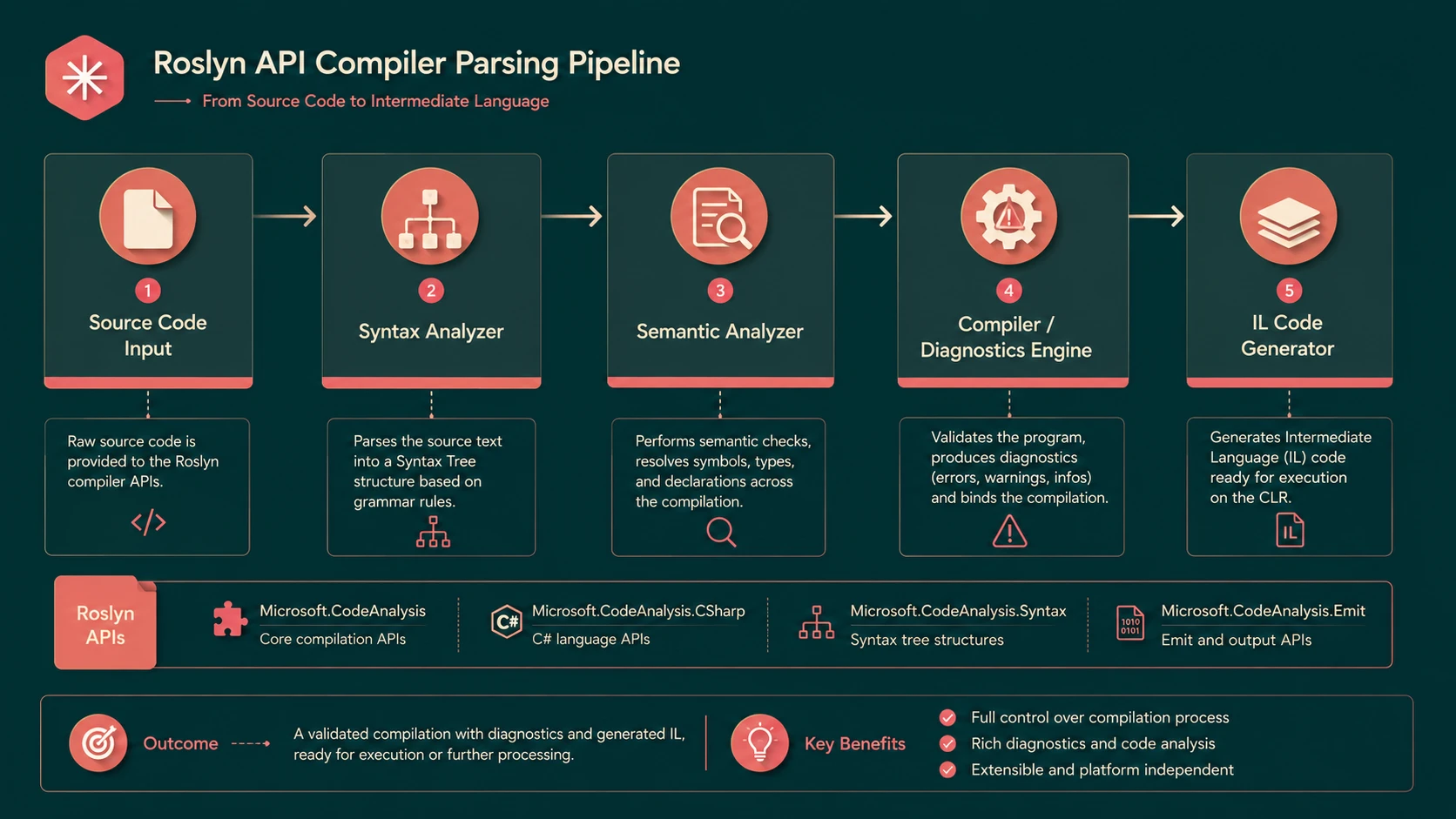
System architecture diagram and conceptual workflow layout for C# 6.0 and Roslyn Compiler.
Unlike previous compiler architectures, Roslyn exposes multiple stages of compilation for tooling and analysis.
Enterprise Use Cases
Large Enterprise Applications
Reduced boilerplate improves readability across large codebases maintained by multiple teams.
Static Analysis Tools
Organizations can develop internal analyzers that enforce coding standards and architectural rules.
Development Productivity
Improved compiler intelligence accelerates navigation, refactoring, and debugging.
Framework Development
Reusable libraries benefit from cleaner APIs and improved diagnostics.
Continuous Integration
Compiler analysis can become part of automated build validation before deployment.
Performance Considerations
The new language features primarily improve developer productivity rather than dramatically changing application runtime performance.
Important considerations include:
- ◆Compilation speed.
- ◆IDE responsiveness.
- ◆Static analysis execution.
- ◆Build pipeline integration.
- ◆Generated Intermediate Language quality.
Organizations should benchmark development workflows when introducing compiler extensions into large solutions.
Security Considerations
C# 6.0 does not fundamentally alter established .NET security practices.
Development teams should continue implementing:
- ◆Secure authentication.
- ◆Authorization.
- ◆Input validation.
- ◆Secure coding standards.
- ◆Static security analysis.
- ◆Secure deployment pipelines.
Roslyn analyzers may assist organizations in enforcing internal secure coding guidelines.
Scalability
Roslyn contributes to scalability primarily through improved software engineering practices.
Benefits include:
- ◆Consistent code analysis.
- ◆Automated quality enforcement.
- ◆Simplified refactoring.
- ◆Improved developer productivity.
- ◆Better long-term maintainability.
As enterprise applications continue expanding, compiler-assisted tooling becomes increasingly valuable.
Best Practices
Organizations evaluating C# 6.0 should:
- ◆Introduce language features gradually.
- ◆Standardize coding conventions.
- ◆Replace repetitive string formatting with interpolation where appropriate.
- ◆Use null-conditional operators to simplify defensive programming.
- ◆Evaluate Roslyn analyzers for code quality enforcement.
- ◆Integrate compiler diagnostics into Continuous Integration.
- ◆Educate development teams before broad adoption.
Incremental adoption reduces migration risk while improving overall code quality.
Common Mistakes
| Mistake | Business Impact |
|---|---|
| Adopting new syntax without coding standards | Inconsistent codebase |
| Ignoring compiler diagnostics | Reduced software quality |
| Continuing hardcoded identifier strings | Refactoring challenges |
| Overusing concise syntax where readability suffers | Lower maintainability |
| Skipping developer training | Slower adoption |
| Treating Roslyn only as a compiler | Missed tooling opportunities |
Successful modernization depends on disciplined engineering practices rather than language features alone.
Technology Comparison
| Characteristic | Previous C# Versions | C# 6.0 with Roslyn |
|---|---|---|
| String Formatting | String.Format and concatenation | String interpolation |
| Null Checking | Explicit conditional statements | Null-conditional operators |
| Compiler Architecture | Traditional compiler | Managed compiler platform with public APIs |
| Refactoring Support | IDE-dependent | Enhanced through compiler services |
| Static Analysis | Limited compiler extensibility | Rich analyzer ecosystem enabled by Roslyn |
Roslyn modernizes both the language experience and the underlying compiler infrastructure.
Adoption Strategy
Organizations should adopt C# 6.0 using a phased modernization plan.
- 1.Upgrade development environments supporting Roslyn.
- 2.Validate third-party library compatibility.
- 3.Introduce C# 6.0 for new development.
- 4.Modernize shared libraries gradually.
- 5.Deploy Roslyn analyzers within Continuous Integration.
- 6.Establish coding standards for new language features.
This strategy allows organizations to improve developer productivity while maintaining application stability.
Limitations
As of December 2014, C# 6.0 remains under active development and organizations should evaluate feature readiness before broad deployment.
Additional considerations include:
- ◆Team training requirements.
- ◆Toolchain compatibility.
- ◆Build server upgrades.
- ◆Third-party extension support.
- ◆Coding standard updates.
Organizations should validate the complete development ecosystem before migrating large production solutions.
Looking Ahead
From the perspective of December 2014, C# 6.0 and the Roslyn compiler platform represent one of the most significant evolutions of Microsoft's developer ecosystem in recent years. While language enhancements such as string interpolation and null-conditional operators simplify everyday programming, the larger architectural innovation lies within Roslyn itself.
By exposing compiler functionality as reusable managed APIs, Microsoft is creating new opportunities for intelligent development environments, automated code analysis, advanced refactoring tools, and richer engineering workflows. As enterprise software continues growing in complexity, compiler-driven tooling is likely to become an increasingly important component of professional .NET development, helping organizations improve software quality while reducing long-term maintenance costs.