Introduction
Swift has rapidly matured into Apple's primary programming language for developing applications across iOS, macOS, watchOS, and tvOS. Since its introduction, Swift has steadily evolved toward becoming a modern systems programming language that combines developer productivity with runtime performance, strong type safety, and expressive syntax.
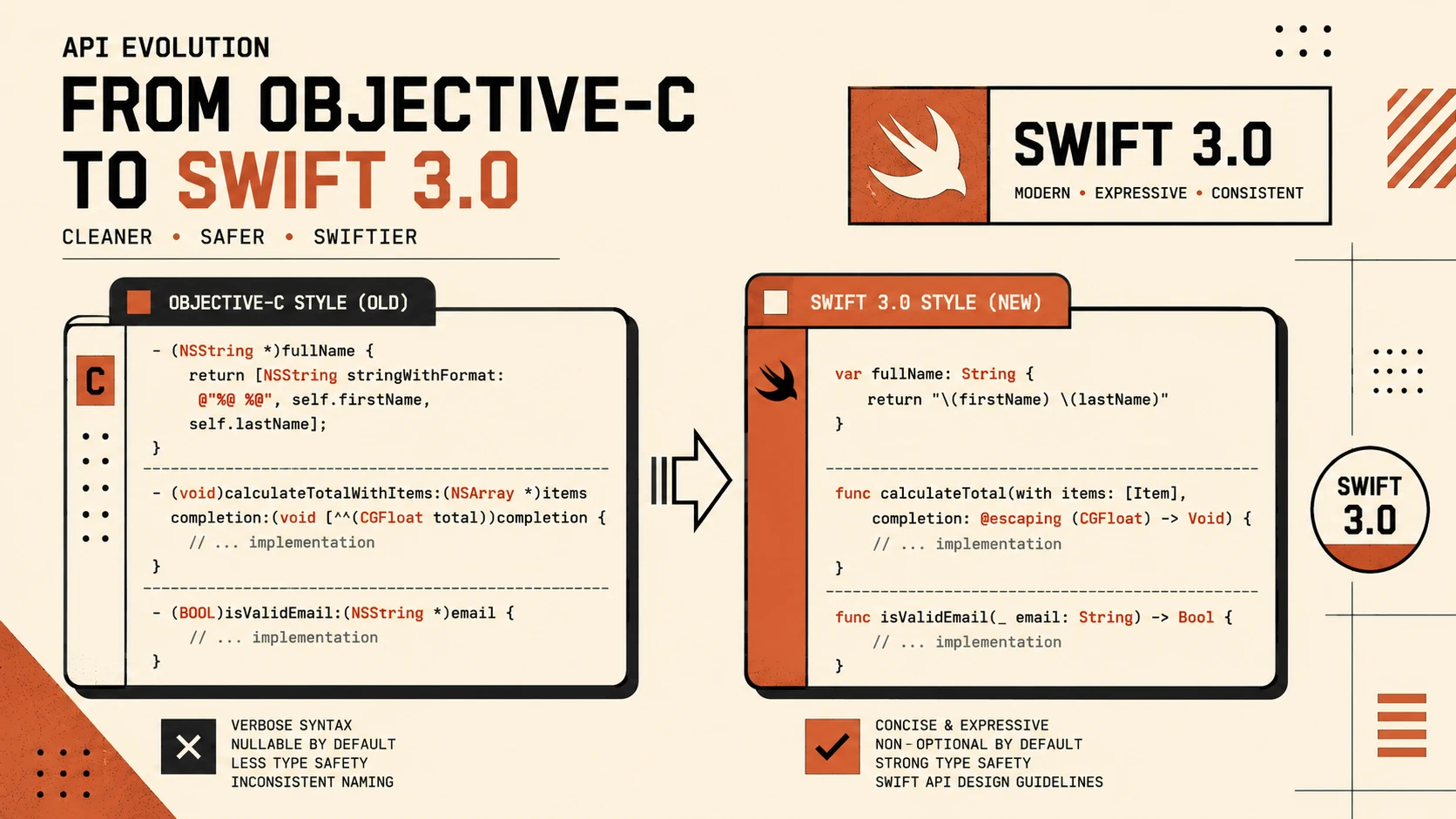
Following the major API stabilization efforts of Swift 3 and the ABI stability work underway within the Swift project, recent releases have increasingly focused on improving language consistency, compiler efficiency, tooling, and interoperability rather than introducing disruptive syntax changes.
Swift 4.2 represents another important refinement release. Rather than fundamentally changing the language, it improves compiler performance, enhances the standard library, strengthens tooling support, and lays important groundwork for future interoperability features such as Dynamic Member Lookup, which is under active evolution as part of the Swift language roadmap.
From the perspective of September 2018, Swift 4.2 demonstrates Apple's continued investment in making Swift an enterprise-ready language capable of supporting large-scale application development while remaining approachable for new developers.
Industry Background
Enterprise Apple development continues expanding across multiple industries.
Organizations increasingly develop:
- ◆Financial applications.
- ◆Healthcare solutions.
- ◆Retail commerce platforms.
- ◆Enterprise productivity software.
- ◆Customer engagement applications.
- ◆Media platforms.
- ◆Internal business applications.
Large development teams require:
- ◆Stable language evolution.
- ◆Fast compilation.
- ◆Predictable tooling.
- ◆Reliable refactoring.
- ◆Modern language features.
- ◆Long-term maintainability.
As Swift adoption continues increasing, developer productivity has become nearly as important as runtime performance.
The Business Problem
Large Swift applications frequently encounter several engineering challenges.
Organizations commonly experience:
- ◆Long compilation times.
- ◆Large codebases.
- ◆Complex interoperability.
- ◆Build pipeline optimization challenges.
- ◆Developer onboarding costs.
- ◆Framework maintenance.
- ◆Continuous Integration performance bottlenecks.
While earlier Swift releases modernized language syntax, enterprise teams increasingly seek improvements that reduce development overhead while maintaining application stability.
Swift 4.2 focuses primarily on these practical engineering concerns.
Understanding the Technology
Swift 4.2 continues evolving both the language and its supporting development ecosystem.
Major improvements include:
- ◆Compiler optimizations.
- ◆Standard Library enhancements.
- ◆Improved tooling.
- ◆Better diagnostics.
- ◆Build performance improvements.
- ◆Foundation refinements.
- ◆Ongoing language evolution proposals including Dynamic Member Lookup.
Rather than introducing a completely new programming model, Swift 4.2 refines the existing ecosystem while preparing for future language capabilities.
Core Architecture
A simplified Swift development architecture appears below.
| Component | Responsibility |
|---|---|
| Swift Source Code | Application implementation |
| Swift Compiler | Parsing, optimization, native compilation |
| Standard Library | Core language functionality |
| Foundation Framework | System APIs |
| Xcode | Development environment |
| Apple Operating Systems | Runtime execution |
Compiler improvements primarily target build performance while preserving language semantics.
Key Features
Compiler Optimizations
One of the most significant aspects of Swift 4.2 is continued compiler optimization.
Apple has invested considerable effort in improving:
- ◆Compilation speed.
- ◆Build scalability.
- ◆Optimization quality.
- ◆Diagnostic performance.
These improvements become increasingly valuable as enterprise applications continue growing.
Standard Library Refinements
Swift 4.2 introduces numerous refinements throughout the Standard Library.
These changes improve API consistency while maintaining compatibility with existing language conventions established in earlier releases.
Better Compiler Diagnostics
Improved compiler messages simplify debugging and reduce the effort required to resolve type inference, generic programming, and syntax issues.
Clear diagnostics contribute directly to developer productivity.
Dynamic Member Lookup Evolution
Dynamic Member Lookup has emerged as an important proposal within the Swift Evolution process.
The feature aims to simplify interoperability with dynamic programming environments by allowing property access to be resolved through custom subscripts rather than requiring explicit static declarations.
Although this capability remains part of Swift's ongoing language evolution, its direction illustrates Apple's interest in making Swift more adaptable when interacting with dynamically structured APIs.
Development Tooling
Swift 4.2 continues improving integration with Xcode, source indexing, code completion, and project maintenance workflows.
These enhancements contribute to a smoother enterprise development experience.
Source Compatibility
Apple continues emphasizing stable language evolution.
Organizations benefit from incremental improvements while minimizing unnecessary migration effort.
How It Works
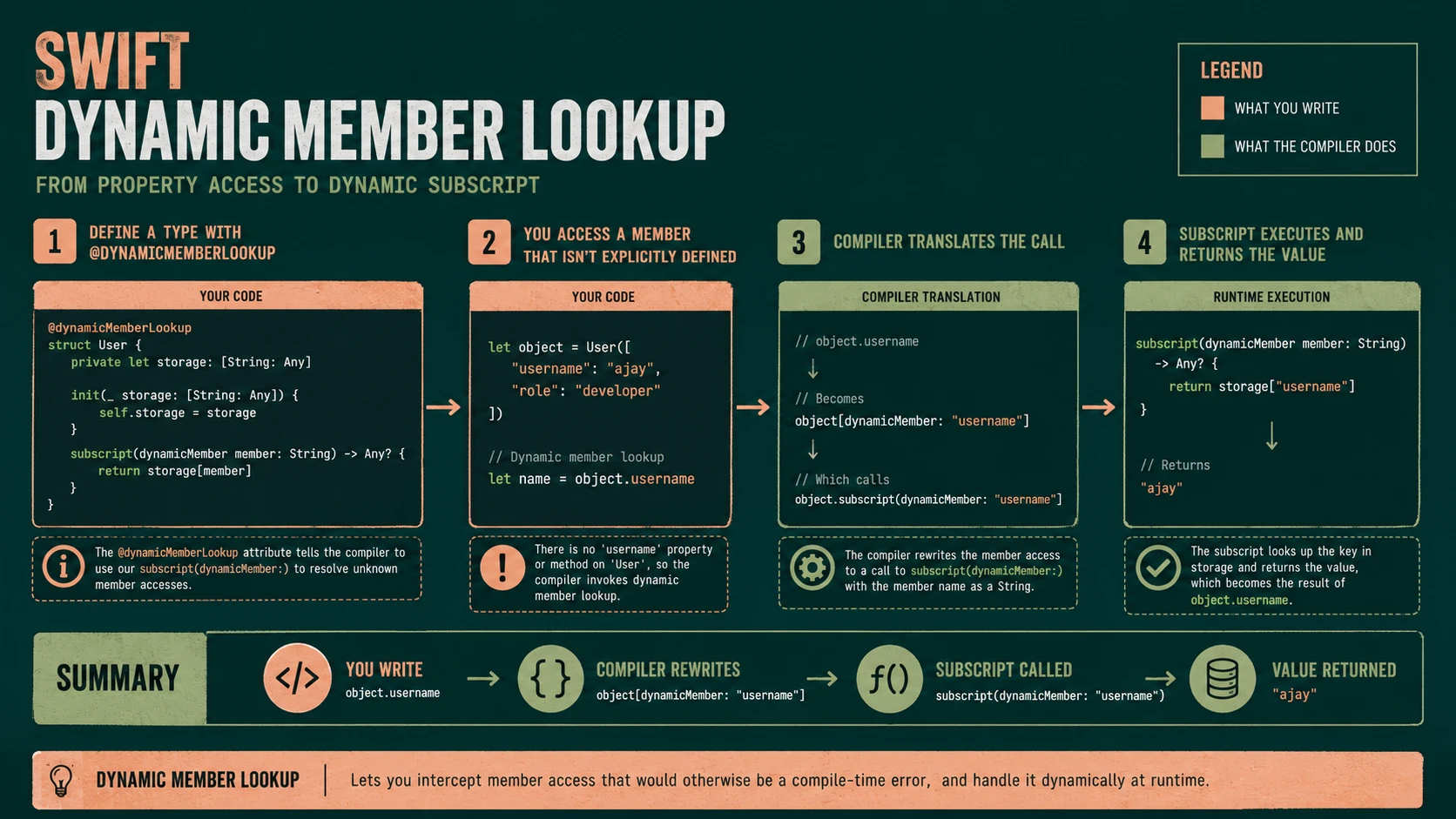
System architecture diagram and conceptual workflow layout for Swift 4.2: Dynamic Member Lookup and Compiler Optimizations.
A simplified development workflow appears below.
Swift Source Code
        |
Swift Compiler
        |
Optimization Pipeline
        |
Standard Library
        |
Native Binary
        |
Apple Operating Systems
Compiler optimizations improve development workflows while producing efficient native executables.
Enterprise Use Cases
Enterprise Mobile Applications
Large iOS applications benefit from improved build performance and enhanced developer tooling.
Shared SDK Development
Organizations maintaining reusable frameworks gain productivity improvements through compiler refinements and clearer diagnostics.
Continuous Integration
Faster compilation reduces build times across automated development pipelines.
Financial Services
Business-critical applications benefit from Swift's strong type system while compiler improvements accelerate development cycles.
Cross-Team Development
Improved tooling simplifies collaboration among multiple engineering teams working on large projects.
Performance Considerations
Swift 4.2 emphasizes both runtime efficiency and development performance.
Organizations should evaluate:
- ◆Incremental compilation speed.
- ◆Full build duration.
- ◆Binary size.
- ◆Memory utilization.
- ◆Compiler diagnostics.
- ◆Continuous Integration throughput.
Build performance improvements may significantly influence overall engineering productivity even when runtime execution remains largely unchanged.
Security Considerations
Swift continues promoting secure software engineering through modern language design.
Organizations should continue implementing:
- ◆Secure authentication.
- ◆Authorization.
- ◆Input validation.
- ◆Secure networking.
- ◆Keychain integration.
- ◆Code signing.
Language improvements complement secure application architecture rather than replacing it.
Scalability
Swift 4.2 strengthens software engineering scalability.
Advantages include:
- ◆Faster builds.
- ◆Improved diagnostics.
- ◆Better tooling.
- ◆Cleaner APIs.
- ◆Easier maintenance.
These characteristics support enterprise applications that continue evolving over many release cycles.
Best Practices
Organizations adopting Swift 4.2 should:
- ◆Upgrade development environments consistently.
- ◆Benchmark build performance.
- ◆Standardize coding conventions.
- ◆Expand automated testing.
- ◆Review compiler warnings carefully.
- ◆Keep third-party libraries updated.
- ◆Evaluate new language proposals before adopting them broadly.
A disciplined modernization strategy improves long-term maintainability.
Common Mistakes
| Mistake | Business Impact |
|---|---|
| Expecting major syntax changes in Swift 4.2 | Unrealistic migration planning |
| Ignoring compiler warnings | Reduced software quality |
| Failing to benchmark build performance | Missed productivity improvements |
| Adopting language proposals prematurely | Increased maintenance risk |
| Neglecting Continuous Integration optimization | Slower delivery pipelines |
| Delaying developer training | Reduced adoption efficiency |
Organizations should evaluate Swift 4.2 as an evolutionary refinement rather than a disruptive language redesign.
Technology Comparison
| Characteristic | Swift 4.1 | Swift 4.2 |
|---|---|---|
| Compiler Performance | Mature | Further optimized |
| Standard Library | Stable | Additional refinements |
| Tooling | Strong Xcode integration | Improved developer experience |
| Diagnostics | Mature | Enhanced compiler feedback |
| Language Evolution | Incremental improvements | Continued preparation for future capabilities |
Swift 4.2 prioritizes stability, productivity, and compiler quality while maintaining compatibility with existing enterprise applications.
Adoption Strategy
Organizations should adopt Swift 4.2 through structured upgrades.
- 1.Upgrade Xcode and Swift toolchains.
- 2.Validate third-party library compatibility.
- 3.Benchmark build pipelines.
- 4.Standardize compiler settings across development teams.
- 5.Expand automated regression testing.
- 6.Roll out upgrades incrementally following successful validation.
This measured approach minimizes operational risk while allowing engineering teams to benefit from improved tooling and compiler performance.
Limitations
As of September 2018, organizations should recognize several considerations.
- ◆Some language evolution proposals remain under active discussion.
- ◆Existing third-party frameworks should be validated before migration.
- ◆Compiler improvements vary depending on project characteristics.
- ◆Development teams should continue following established Swift coding guidelines.
- ◆Large enterprise projects should benchmark build performance before broad deployment.
These considerations should guide enterprise upgrade planning.
Looking Ahead
From the perspective of September 2018, Swift 4.2 reflects the language's transition from rapid innovation toward long-term maturity. Rather than introducing disruptive language redesigns, Apple has concentrated on compiler performance, developer productivity, tooling quality, and incremental language refinement.
The continued evolution of proposals such as Dynamic Member Lookup demonstrates Swift's ambition to remain a modern programming language capable of balancing strong static typing with practical interoperability. Organizations building long-lived applications across Apple's platforms should view Swift 4.2 as another important step toward a stable, high-performance, and enterprise-ready development ecosystem capable of supporting increasingly sophisticated software projects.