Introduction
The development of native iOS applications has traditionally relied on UIKit, Interface Builder, delegation patterns, notifications, and increasingly complex view controller architectures. While these technologies have enabled the creation of highly capable applications, large enterprise projects often struggle with growing interface complexity, repetitive UI code, fragmented state management, and asynchronous programming challenges.
Over the past several years, declarative user interface frameworks and reactive programming models have gained significant attention across the software industry. Rather than manually updating interface elements whenever application state changes, declarative frameworks describe what the interface should look like based on current state, leaving rendering responsibilities to the framework itself.
With iOS 13, Apple introduces SwiftUI, a declarative user interface framework built specifically for Swift, alongside Combine, a reactive programming framework designed to simplify asynchronous event processing.
Together, these technologies represent a fundamental shift in how developers build applications across Apple's platforms. Instead of centering applications around large view controllers and imperative update logic, developers can increasingly organize applications around observable state, reusable views, and data-driven rendering.
From the perspective of September 2019, SwiftUI and Combine establish a modern foundation for future Apple platform development while coexisting with existing UIKit applications.
Industry Background
Enterprise mobile development continues expanding across numerous industries.
Organizations increasingly build:
- ◆Banking applications.
- ◆Healthcare platforms.
- ◆Retail commerce systems.
- ◆Enterprise productivity tools.
- ◆Business intelligence dashboards.
- ◆Customer self-service portals.
- ◆Field service applications.
Modern applications increasingly require:
- ◆Reactive interfaces.
- ◆Real-time updates.
- ◆Cross-device consistency.
- ◆Maintainable codebases.
- ◆Reusable components.
- ◆Predictable state management.
Traditional UIKit architectures often require substantial engineering effort to coordinate these requirements.
The Business Problem
Large UIKit applications commonly encounter several architectural challenges.
Organizations frequently experience:
- ◆Massive view controllers.
- ◆Repeated UI update logic.
- ◆Complex delegation chains.
- ◆Callback-heavy asynchronous code.
- ◆Difficult interface testing.
- ◆State synchronization problems.
- ◆Higher maintenance costs.
As enterprise mobile applications continue expanding, simplifying interface architecture has become increasingly important.
SwiftUI and Combine address these challenges through declarative rendering and reactive event processing.
Understanding the Technology
SwiftUI is Apple's declarative user interface framework for building applications using Swift.
Combine is Apple's reactive programming framework for processing asynchronous values over time.
Together they provide:
- ◆Declarative UI.
- ◆Observable state.
- ◆Reactive data streams.
- ◆Automatic interface updates.
- ◆View composition.
- ◆Native framework integration.
- ◆Unified development experience.
Rather than manually synchronizing user interface changes, applications describe relationships between state and presentation.
Core Architecture
A simplified SwiftUI architecture appears below.
| Component | Responsibility |
|---|---|
| SwiftUI Views | Declarative interface |
| Application State | Business data |
| Combine Publishers | Event generation |
| Combine Subscribers | Event processing |
| SwiftUI Rendering Engine | View updates |
| UIKit Integration Layer | Existing application interoperability |
| iOS Runtime | Application execution |
SwiftUI automatically refreshes visible interfaces as observable application state changes.
Key Features
Declarative User Interface Development
SwiftUI introduces a declarative programming model.
Instead of explicitly creating, updating, and removing interface components, developers describe the desired interface based upon current application state.
The framework determines how to efficiently update the visible interface.
This approach reduces repetitive interface code while improving readability.
Combine Reactive Framework
Combine provides a standardized framework for asynchronous event processing.
Applications can represent:
- ◆User input.
- ◆Network responses.
- ◆Timer events.
- ◆Notification updates.
- ◆Data changes.
- ◆Application lifecycle events.
as observable streams processed through publishers and subscribers.
This simplifies asynchronous programming while encouraging consistent event handling.
State-Driven Rendering
SwiftUI automatically refreshes interface elements when observed state changes.
Rather than manually updating labels, buttons, or lists, developers modify application state while SwiftUI manages rendering.
This reduces synchronization errors commonly found in imperative UI architectures.
View Composition
SwiftUI encourages building interfaces from small reusable components.
Applications become easier to organize through:
- ◆Reusable views.
- ◆Modular layouts.
- ◆Shared interface components.
- ◆Consistent styling.
These characteristics improve maintainability for enterprise projects.
UIKit Interoperability
SwiftUI is designed to coexist with existing UIKit applications.
Organizations can introduce SwiftUI incrementally rather than rewriting entire applications.

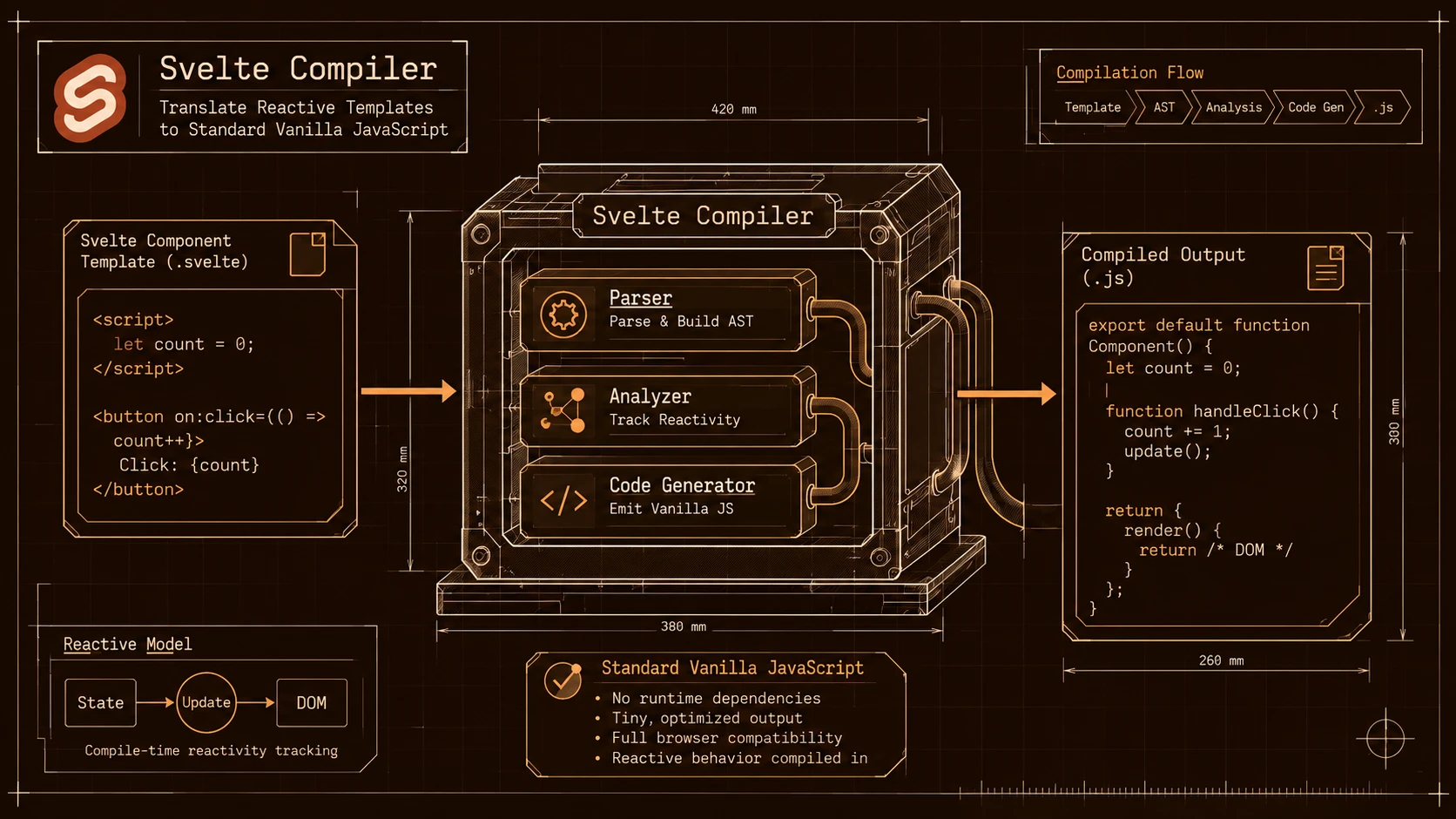
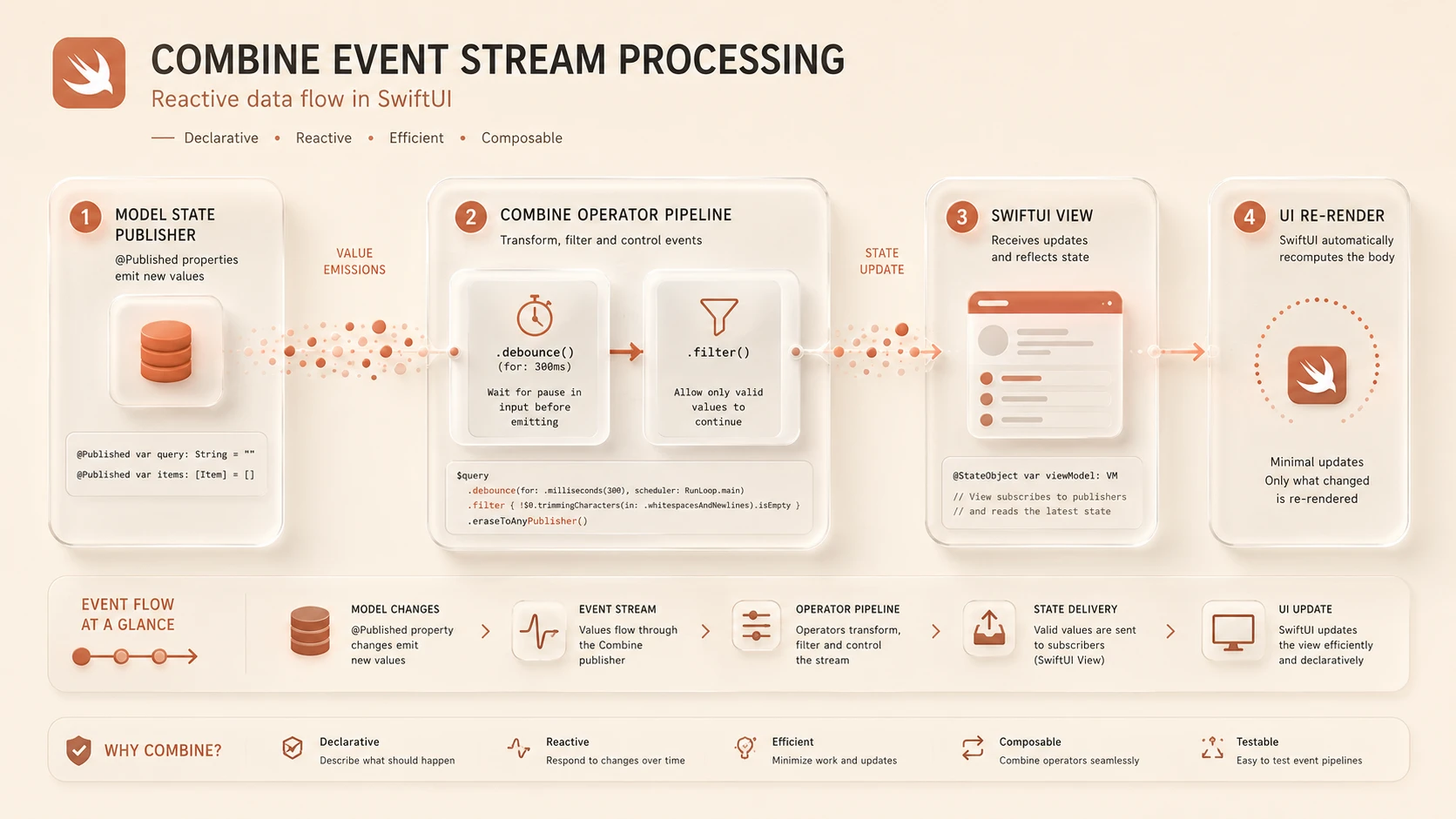
System architecture diagram and conceptual workflow layout for SwiftUI and Combine.
This significantly reduces migration risk.
Native Framework Integration
SwiftUI and Combine integrate directly with Apple's development ecosystem, including Xcode, Interface previews, accessibility technologies, and system frameworks.
How It Works
A simplified rendering workflow appears below.
Application State
        |
Combine Publisher
        |
Subscriber Receives Update
        |
SwiftUI View
        |
Rendering Engine
        |
Updated Interface
Changes to observable state automatically propagate through Combine before SwiftUI refreshes affected interface components.
Enterprise Use Cases
Enterprise Business Applications
Administrative dashboards benefit from simplified interface updates driven by changing business data.
Financial Services
Applications displaying continuously changing market information can organize asynchronous updates through Combine.
Healthcare Systems
Patient monitoring interfaces benefit from reactive data presentation while maintaining clean view structures.
Retail Commerce
Shopping applications can synchronize inventory, pricing, and customer interactions through observable state.
Internal Productivity Tools
Organizations developing long-lived enterprise applications benefit from modular interface composition and improved maintainability.
Performance Considerations
SwiftUI emphasizes efficient rendering through declarative updates.
Organizations should evaluate:
- ◆Rendering frequency.
- ◆State update granularity.
- ◆View hierarchy complexity.
- ◆Combine subscription management.
- ◆Memory utilization.
- ◆Startup performance.
Performance should be validated using representative production workloads before broad deployment.
Security Considerations
SwiftUI and Combine improve application architecture rather than application security.
Organizations should continue implementing:
- ◆Authentication.
- ◆Authorization.
- ◆Secure networking.
- ◆Secure data storage.
- ◆Keychain integration.
- ◆Input validation.
Modern UI architecture should complement comprehensive secure application design.
Scalability
SwiftUI and Combine strengthen enterprise scalability through:
- ◆Reusable interface components.
- ◆Reactive state management.
- ◆Reduced UI duplication.
- ◆Modular architecture.
- ◆Cleaner asynchronous programming.
These characteristics simplify maintenance as applications continue growing.
Best Practices
Organizations adopting SwiftUI and Combine should:
- ◆Begin with new application modules rather than complete rewrites.
- ◆Organize interfaces into reusable SwiftUI views.
- ◆Keep application state clearly defined.
- ◆Design Combine pipelines with clear responsibilities.
- ◆Test reactive workflows thoroughly.
- ◆Benchmark rendering performance.
- ◆Continue integrating with existing UIKit applications where appropriate.
Incremental adoption minimizes migration risk while allowing engineering teams to gain practical experience.
Common Mistakes
| Mistake | Business Impact |
|---|---|
| Rewriting mature UIKit applications immediately | Increased migration risk |
| Creating excessively large SwiftUI views | Reduced maintainability |
| Building overly complex Combine pipelines | Difficult debugging |
| Mixing imperative and declarative patterns inconsistently | Architectural complexity |
| Ignoring state ownership | Unpredictable interface behavior |
| Skipping performance validation | Deployment risk |
Successful adoption depends upon architectural discipline rather than replacing existing technologies indiscriminately.
Technology Comparison
| Characteristic | UIKit Development | SwiftUI and Combine |
|---|---|---|
| Interface Model | Imperative | Declarative |
| State Updates | Manual | Automatic state-driven rendering |
| Asynchronous Programming | Delegates, callbacks, notifications | Combine publishers and subscribers |
| View Composition | Reusable views with manual coordination | Declarative reusable components |
| Migration Strategy | Existing standard | Incremental adoption alongside UIKit |
SwiftUI and Combine modernize application architecture while preserving compatibility with existing Apple platform development.
Adoption Strategy
Organizations should approach SwiftUI adoption incrementally.
- 1.Upgrade development environments to support iOS 13.
- 2.Prototype isolated application features using SwiftUI.
- 3.Introduce Combine for new asynchronous workflows.
- 4.Integrate SwiftUI into existing UIKit applications where appropriate.
- 5.Benchmark production performance.
- 6.Establish internal architectural guidelines before organization-wide adoption.
This phased strategy reduces operational disruption while enabling engineering teams to evaluate the practical benefits of Apple's new development model.
Limitations
As of September 2019, organizations should recognize several considerations.
- ◆SwiftUI is a newly introduced framework and engineering teams should expect ongoing evolution.
- ◆Existing UIKit applications remain fully supported and continue to be appropriate for production development.
- ◆Development teams require training in declarative programming and reactive architecture.
- ◆Some mature UIKit capabilities may still require interoperability during early adoption.
- ◆Enterprise organizations should validate production readiness before large-scale migration.
These considerations should guide long-term modernization planning.
Looking Ahead
From the perspective of September 2019, SwiftUI and Combine represent one of the most significant architectural shifts in Apple platform development since the introduction of Swift. By combining declarative user interface construction with native reactive programming, Apple provides developers with a modern framework capable of simplifying application architecture while improving maintainability and code reuse.
Rather than replacing UIKit overnight, SwiftUI establishes a forward-looking development model that organizations can adopt incrementally. Combined with Combine's standardized approach to asynchronous programming, these technologies provide enterprise engineering teams with a compelling foundation for building scalable, maintainable, and responsive applications across the Apple ecosystem.