Introduction
Since its introduction, Swift has rapidly evolved into Apple's primary language for developing applications across iOS, macOS, watchOS, and tvOS. Its emphasis on type safety, expressive syntax, optionals, protocol-oriented programming, and modern compiler technology has attracted developers seeking an alternative to Objective-C while maintaining full compatibility with Apple's development ecosystem.
The rapid pace of Swift's evolution has also introduced challenges. As the language matured, inconsistencies in naming conventions, API design, and syntax became increasingly apparent. Different frameworks often followed different conventions, making code less predictable and increasing the learning curve for developers.
Swift 3.0 addresses these concerns through one of the most significant language refinements since Swift's introduction. Rather than focusing primarily on new capabilities, the release emphasizes consistency, readability, and long-term maintainability through standardized API Design Guidelines. Achieving these goals requires intentional source-breaking changes, making Swift 3.0 a major migration milestone.
From the perspective of October 2016, Swift 3.0 establishes a stronger foundation for future language evolution while encouraging developers to adopt more consistent coding practices.
Industry Background
Enterprise mobile applications continue growing in both scale and complexity.
Organizations increasingly develop:
- ◆Banking applications.
- ◆Healthcare platforms.
- ◆Retail commerce applications.
- ◆Enterprise productivity tools.
- ◆Business intelligence dashboards.
- ◆Customer service applications.
- ◆Internal corporate software.
Large development teams require programming languages that emphasize:
- ◆Readability.
- ◆Consistency.
- ◆Long-term maintainability.
- ◆Strong tooling.
- ◆Safe refactoring.
- ◆Clear APIs.
As Swift adoption accelerates, language consistency becomes increasingly important for collaboration across enterprise engineering teams.
The Business Problem
Earlier Swift releases introduced powerful language features but also exposed several development challenges.
Organizations commonly encountered:
- ◆Inconsistent API naming.
- ◆Verbose method signatures.
- ◆Difficult framework discoverability.
- ◆Frequent migration effort.
- ◆Mixed Objective-C naming conventions.
- ◆Reduced code readability.
- ◆Maintenance complexity across large projects.
These issues become increasingly significant as codebases grow and development teams expand.
Swift 3.0 addresses these concerns through standardized language conventions and API refinement.
Understanding the Technology
Swift 3.0 focuses heavily on language refinement rather than entirely new programming concepts.
Major improvements include:
- ◆API Design Guidelines.
- ◆Standardized naming conventions.
- ◆Improved Objective-C interoperability.
- ◆Simplified method signatures.
- ◆Better compiler diagnostics.
- ◆Continued protocol-oriented programming support.
- ◆Enhanced Foundation API consistency.
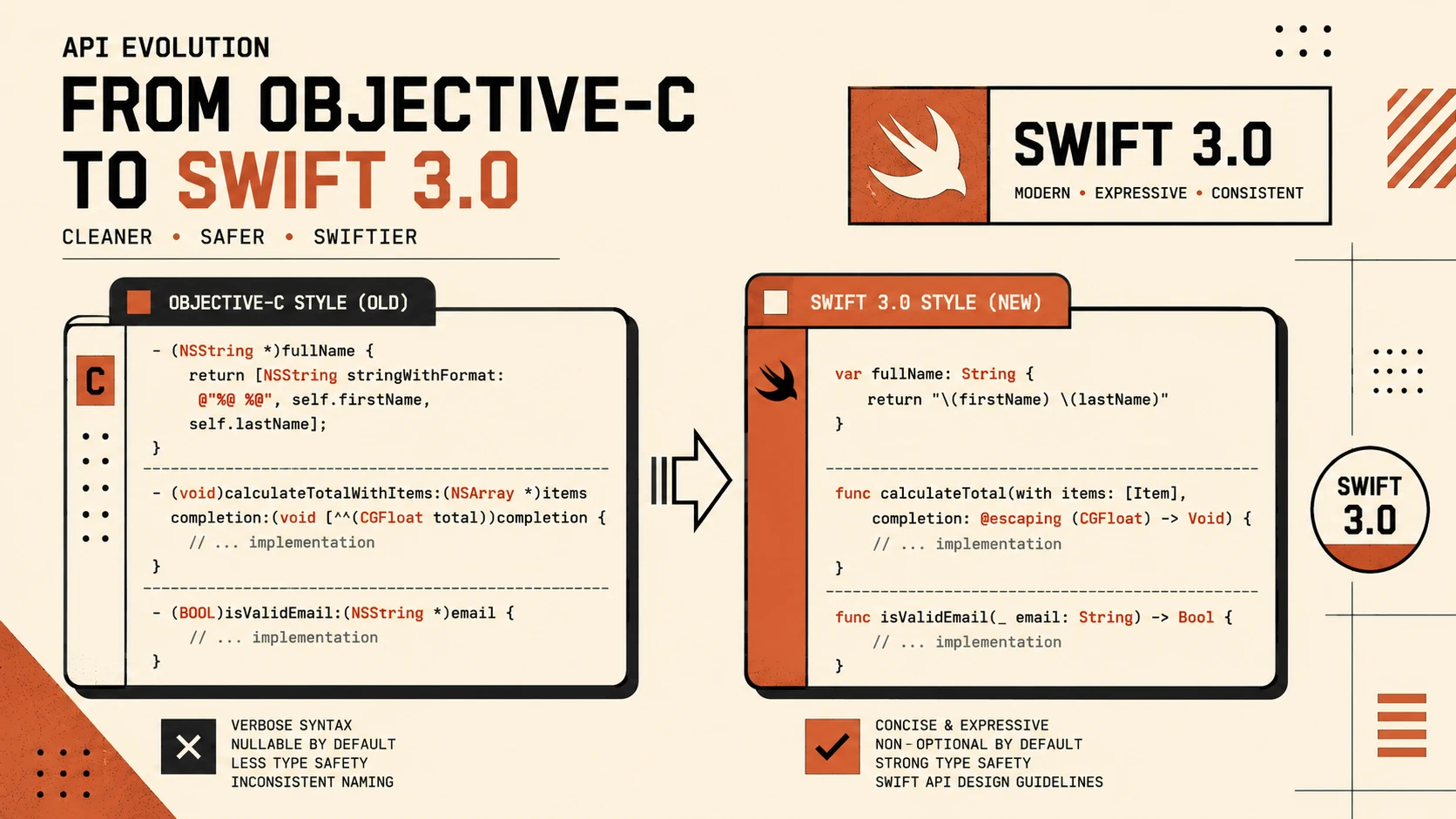
Many framework APIs have been renamed to better reflect Swift language conventions, resulting in widespread but intentional source incompatibilities.
Core Architecture
Swift 3.0 continues building upon the existing Apple development ecosystem.
| Component | Responsibility |
|---|---|
| Swift Source Code | Application implementation |
| Swift Compiler | Parsing and native compilation |
| Standard Library | Core language functionality |
| Foundation Framework | Platform services |
| Cocoa and Cocoa Touch | Application frameworks |
| Apple Operating Systems | Runtime execution |
The compiler and standard libraries now expose APIs that more consistently follow the official Swift API Design Guidelines.
Key Features
API Design Guidelines
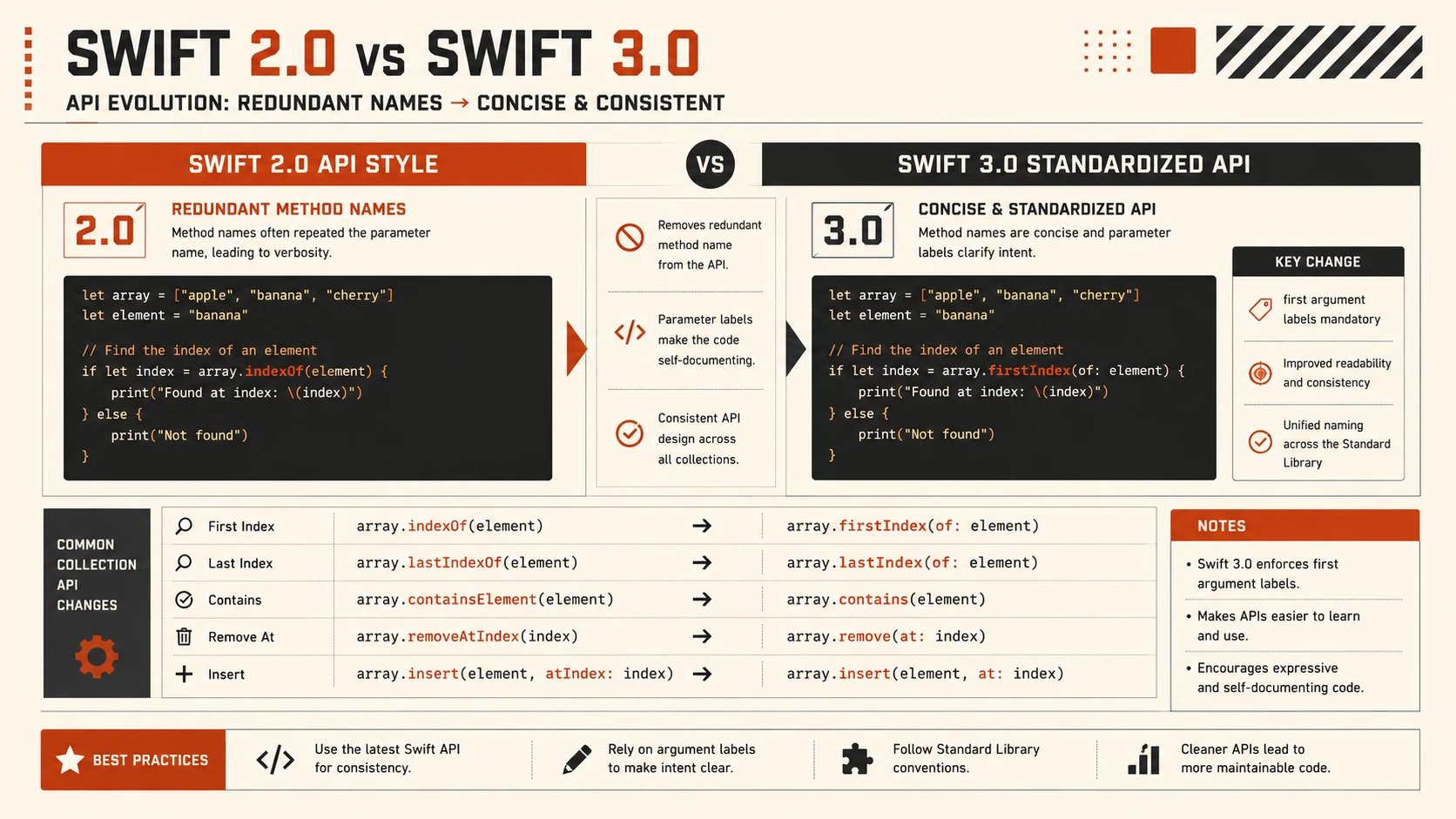
The defining feature of Swift 3.0 is the adoption of standardized API Design Guidelines.
The guidelines encourage APIs that:
- ◆Read naturally.
- ◆Express intent clearly.
- ◆Avoid unnecessary words.
- ◆Maintain consistency.
- ◆Improve discoverability.
Framework authors are encouraged to design interfaces that resemble natural language while remaining technically precise.
Source-Breaking Changes
Unlike minor language updates, Swift 3.0 intentionally introduces source-breaking changes.
Existing applications often require migration because many method names, parameter labels, and Foundation APIs have been redesigned.
Although migration requires effort, the resulting codebase becomes more consistent.
Improved Foundation APIs
Foundation classes have been renamed extensively to better align with Swift naming conventions.
Developers interact with APIs that feel more native to the language rather than direct translations from Objective-C.
Better Objective-C Interoperability
Swift continues improving interoperability with existing Cocoa and Cocoa Touch frameworks.
Organizations can modernize applications incrementally while continuing to leverage mature Objective-C libraries.
Enhanced Compiler Diagnostics
Compiler messages continue improving, helping developers identify migration issues more efficiently.
Language Consistency
Standardized naming reduces ambiguity and improves readability across the entire Apple development ecosystem.
How It Works
A simplified development workflow appears below.
System architecture diagram and conceptual workflow layout for Swift 3.0 Source-Breaking Changes.
Swift Source Code
        |
Swift Compiler
        |
API Validation
        |
Native Compilation
        |
Apple Frameworks
        |
Application Executable
The compiler validates application code using the updated language rules and redesigned APIs before producing native executables.
Enterprise Use Cases
Enterprise Mobile Applications
Organizations building long-lived business applications benefit from improved code consistency and maintainability.
Large Development Teams
Standardized naming conventions simplify collaboration across multiple engineering groups.
Internal SDK Development
Shared enterprise frameworks become easier to understand when APIs follow consistent design principles.
Financial Applications
Readable APIs improve long-term maintenance for business-critical software.
Cross-Team Platform Development
Reusable components become more approachable through predictable method naming and clearer interfaces.
Performance Considerations
Swift 3.0 primarily emphasizes language refinement rather than dramatic runtime performance improvements.
Organizations should evaluate:
- ◆Compiler optimization.
- ◆Build performance.
- ◆Application startup time.
- ◆Framework compatibility.
- ◆Binary size.
- ◆Migration effort.
Performance characteristics continue depending largely on application architecture rather than API naming changes.
Security Considerations
Swift continues supporting secure software development through modern language features.
Organizations should continue implementing:
- ◆Secure authentication.
- ◆Authorization.
- ◆Input validation.
- ◆Secure networking.
- ◆Proper key management.
- ◆Code signing.
Language improvements complement established enterprise security practices.
Scalability
Swift 3.0 strengthens scalability from a software engineering perspective.
Advantages include:
- ◆Consistent APIs.
- ◆Improved readability.
- ◆Better maintainability.
- ◆Easier onboarding.
- ◆Simplified code reviews.
These characteristics become increasingly valuable as applications continue expanding over multiple release cycles.
Best Practices
Organizations adopting Swift 3.0 should:
- ◆Review the official API Design Guidelines.
- ◆Plan application migration carefully.
- ◆Update shared libraries first.
- ◆Standardize coding conventions.
- ◆Leverage compiler migration assistance where appropriate.
- ◆Expand automated testing before migration.
- ◆Validate third-party framework compatibility.
Incremental migration reduces operational risk while improving long-term maintainability.
Common Mistakes
| Mistake | Business Impact |
|---|---|
| Treating Swift 3.0 as a minor language update | Underestimated migration effort |
| Ignoring updated API naming conventions | Inconsistent codebase |
| Migrating production applications without testing | Deployment instability |
| Delaying framework compatibility validation | Integration challenges |
| Mixing legacy and updated coding styles | Reduced maintainability |
| Skipping developer training | Slower adoption |
Organizations should approach Swift 3.0 as an architectural modernization rather than a routine compiler upgrade.
Technology Comparison
| Characteristic | Swift 2.x | Swift 3.0 |
|---|---|---|
| API Naming | Mixed historical conventions | Standardized API Design Guidelines |
| Foundation APIs | Less consistent Swift style | Redesigned Swift-native naming |
| Source Compatibility | Compatible within major version | Intentional source-breaking changes |
| Objective-C Integration | Strong | Further refined |
| Code Readability | Improved over Objective-C | Greater consistency across frameworks |
Swift 3.0 prioritizes long-term language quality even at the cost of short-term migration effort.
Adoption Strategy
Organizations should adopt Swift 3.0 through a structured migration process.
- 1.Assess existing Swift applications.
- 2.Upgrade development environments.
- 3.Validate third-party library compatibility.
- 4.Migrate shared frameworks before production applications.
- 5.Expand automated regression testing.
- 6.Standardize coding practices using the new API Design Guidelines.
A phased approach minimizes disruption while allowing teams to benefit from improved language consistency.
Limitations
As of October 2016, organizations should recognize several considerations.
- ◆Migration requires source code updates.
- ◆Existing libraries may not yet support Swift 3.0.
- ◆Development teams require training on revised conventions.
- ◆Large codebases should migrate incrementally.
- ◆Some tooling and ecosystem components continue adapting to the updated language.
These considerations should be incorporated into enterprise modernization planning.
Looking Ahead
From the perspective of October 2016, Swift 3.0 represents a defining moment in the language's evolution. By standardizing API design, refining framework naming conventions, and prioritizing readability over short-term compatibility, Apple has demonstrated a commitment to creating a language designed for long-term enterprise software development.
Although the transition requires significant migration effort, the resulting consistency across the language and standard libraries establishes a stronger foundation for future Swift development. Organizations building large-scale applications for Apple's platforms should view Swift 3.0 not simply as another language update, but as an investment in more maintainable, discoverable, and scalable software engineering practices.