Introduction
Spring Boot has become one of the most influential frameworks in enterprise Java development by simplifying application configuration, dependency management, embedded server deployment, and operational tooling. Organizations building REST APIs, microservices, cloud-native applications, and enterprise platforms increasingly rely on Spring Boot to accelerate development while maintaining production-grade quality.
At the same time, application workloads continue evolving. Modern systems increasingly process large numbers of concurrent client requests, event streams, asynchronous messaging workloads, and cloud-scale network traffic. Traditional thread-per-request architectures remain highly effective for many business applications, but they may become resource-intensive when applications spend significant time waiting for external services or network operations.
Spring Framework 5 introduced Spring WebFlux, a new reactive web framework built around asynchronous, non-blocking request processing. Spring Boot 2.0 integrates WebFlux directly into the Boot ecosystem through production-ready auto-configuration, starter dependencies, operational tooling, and deployment support.
As of April 2018, Spring Boot 2.0 represents one of the most significant platform updates since the framework's introduction, providing enterprise development teams with a practical path toward reactive application architectures while preserving the familiar Spring programming model.
Industry Background
Enterprise software increasingly emphasizes:
- ◆Microservices
- ◆Cloud-native deployment
- ◆Event-driven architecture
- ◆Reactive messaging
- ◆Containerized applications
- ◆Continuous delivery
- ◆High-concurrency services
Organizations are seeking application architectures capable of efficiently handling increasing numbers of concurrent users without proportional increases in infrastructure resources.
Reactive programming has emerged as one architectural approach to addressing these requirements.
The Business Problem
Traditional web applications commonly encounter:
- ◆Thread exhaustion under heavy load
- ◆Idle threads waiting on network operations
- ◆Resource-intensive blocking I/O
- ◆Reduced scalability for high-latency services
- ◆Increasing infrastructure costs
- ◆Complex asynchronous programming models
Organizations require programming frameworks that improve resource utilization while maintaining developer productivity.
Understanding Spring Boot 2.0
Spring Boot 2.0 builds upon Spring Framework 5 and introduces numerous improvements across application development, deployment, monitoring, and production operations.
Major platform capabilities include:
- ◆Spring WebFlux integration
- ◆Reactive starter dependencies
- ◆Project Reactor support
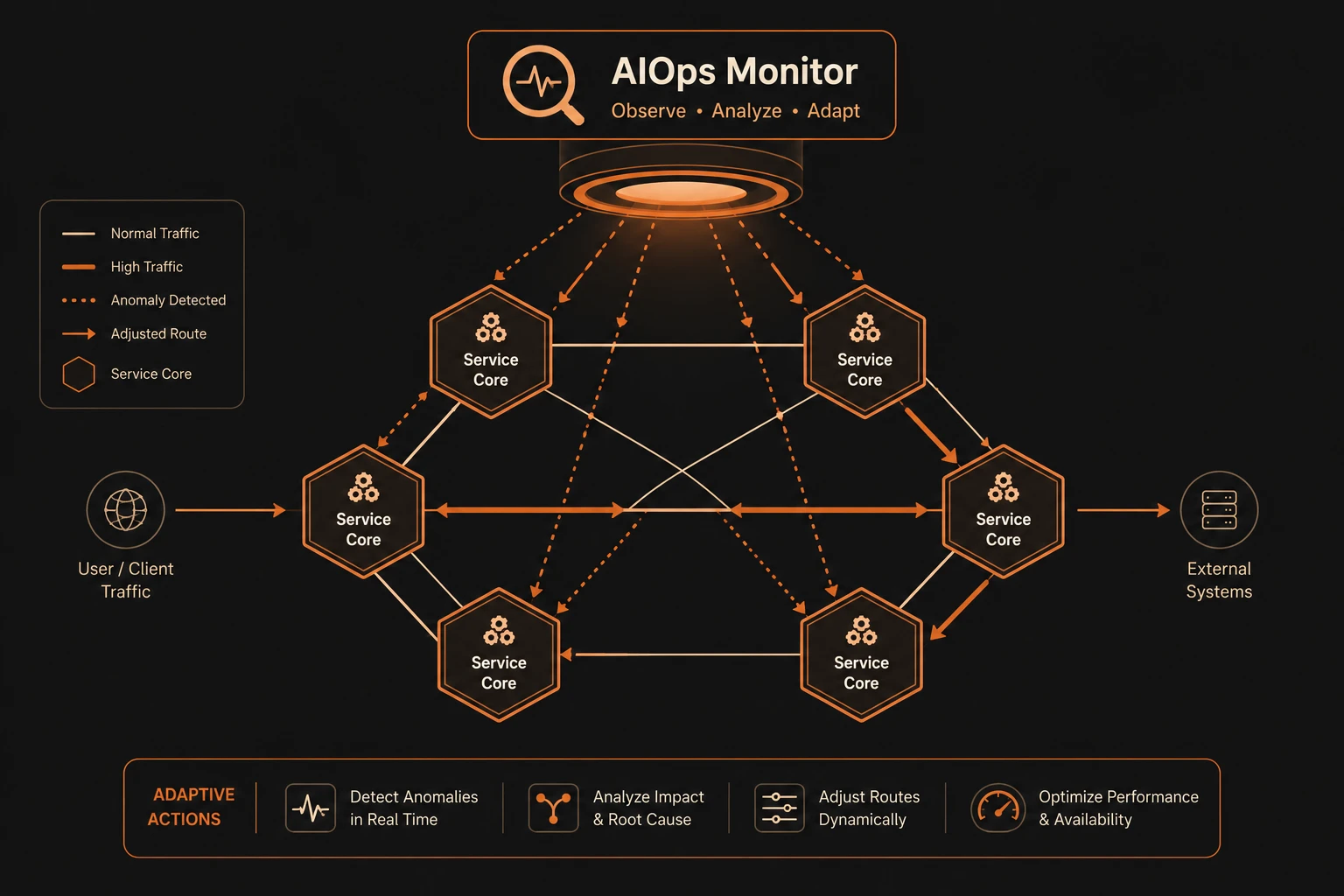
- ◆Improved Actuator endpoints
- ◆Updated dependency management
- ◆Enhanced production monitoring
Boot continues emphasizing convention over configuration while expanding support for modern application architectures.
Core Architecture
| Component | Responsibility |
|---|---|
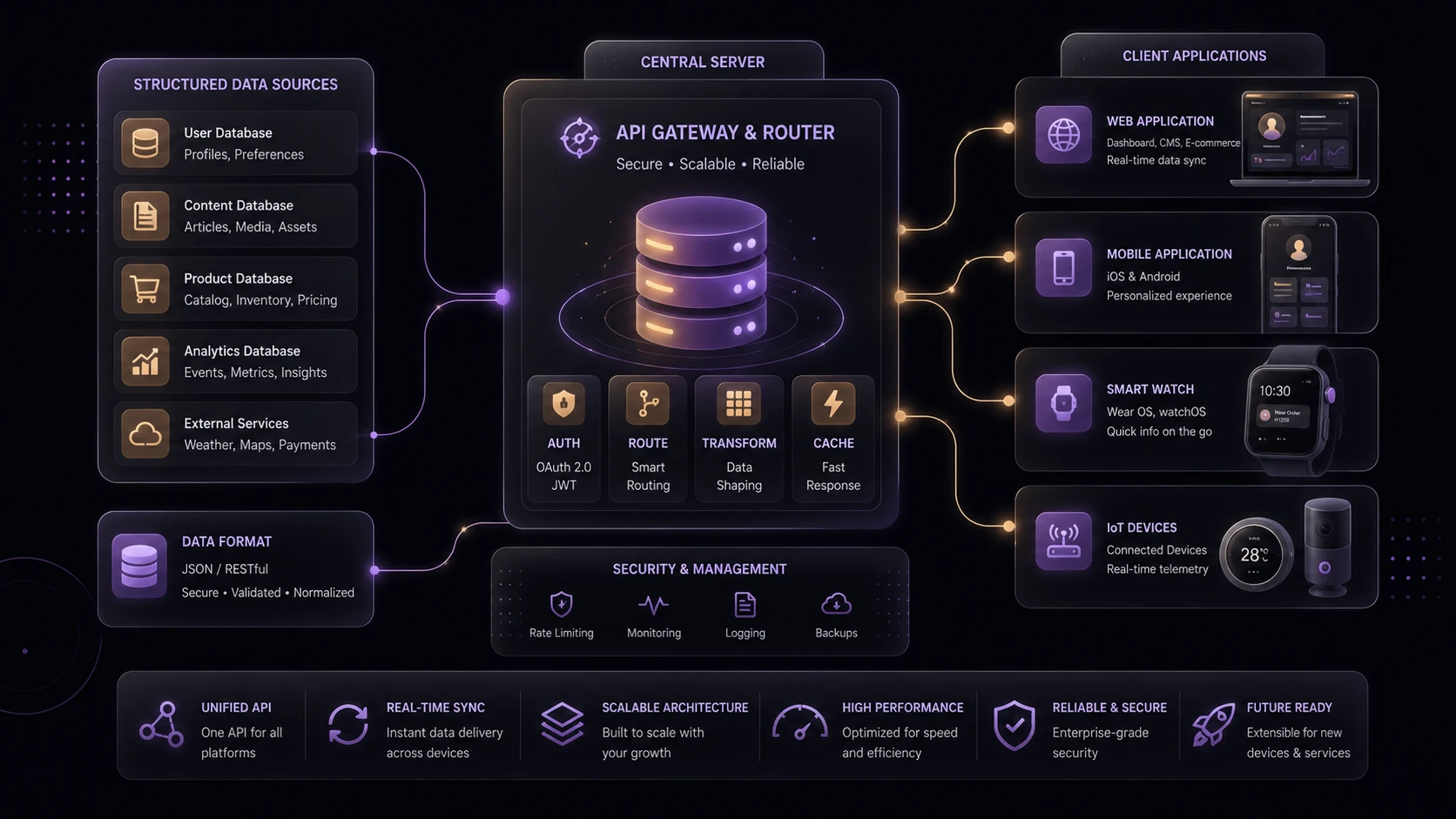
| Spring Boot | Application configuration and auto-configuration |
| Spring WebFlux | Reactive web framework |
| Project Reactor | Reactive programming foundation |
| Embedded Server | Hosts HTTP applications |
| Reactive Data Sources | Asynchronous data access |
| Actuator | Operational monitoring |
These components provide a production-ready foundation for building reactive enterprise services.
Understanding Spring WebFlux
// Spring WebFlux reactive REST Controller mapping event streams
import org.springframework.web.bind.annotation.GetMapping;
import org.springframework.web.bind.annotation.RestController;
import reactor.core.publisher.Flux;
import java.time.Duration;

@RestController
public class TicketController {
    @GetMapping(value = "/stream/tickets", produces = "text/event-stream")
    public Flux<Ticket> getTicketStream() {
        return Flux.interval(Duration.ofSeconds(1))
                   .map(seq -> new Ticket(seq, "Open Client Ticket"));
    }
}
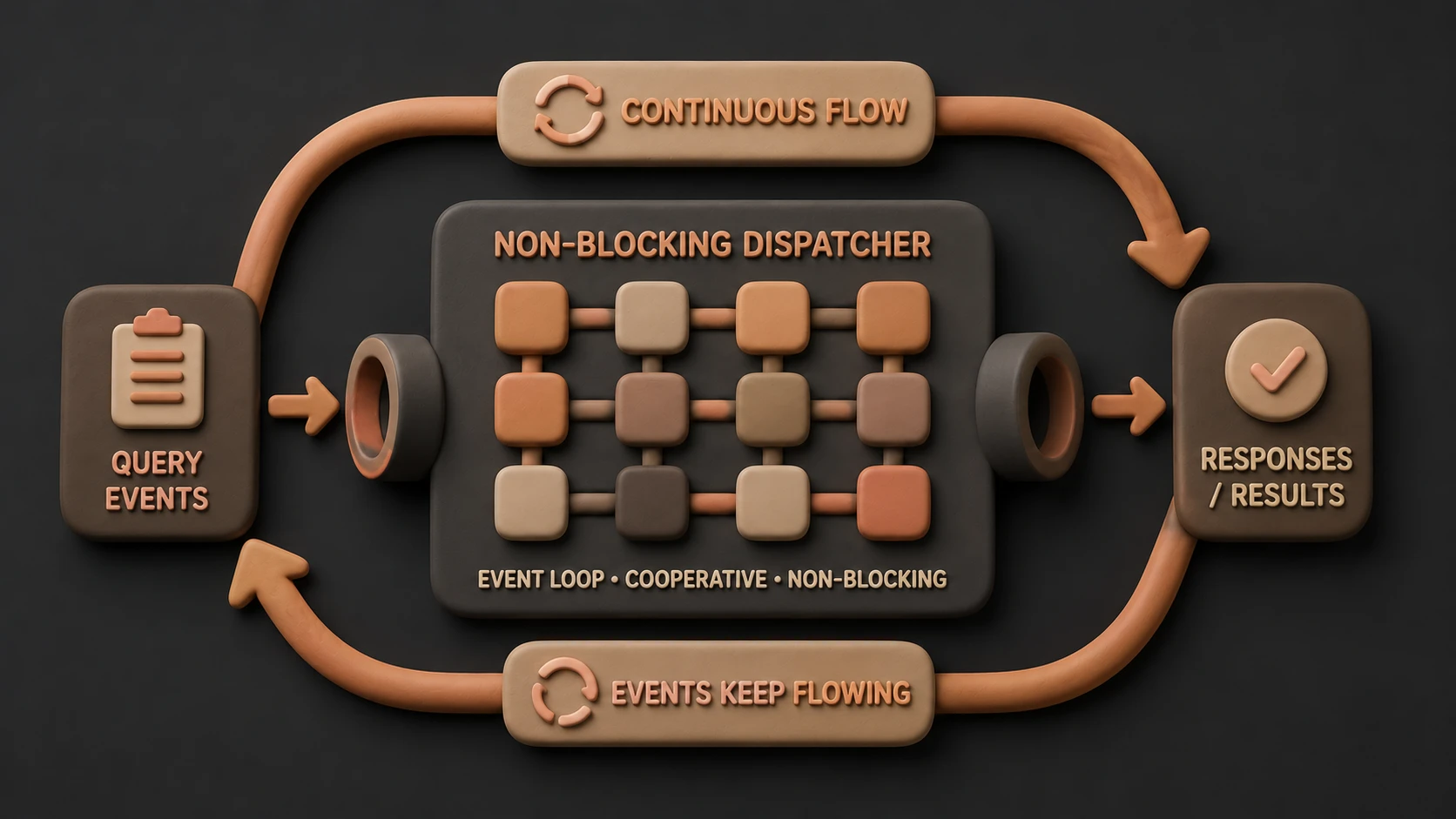
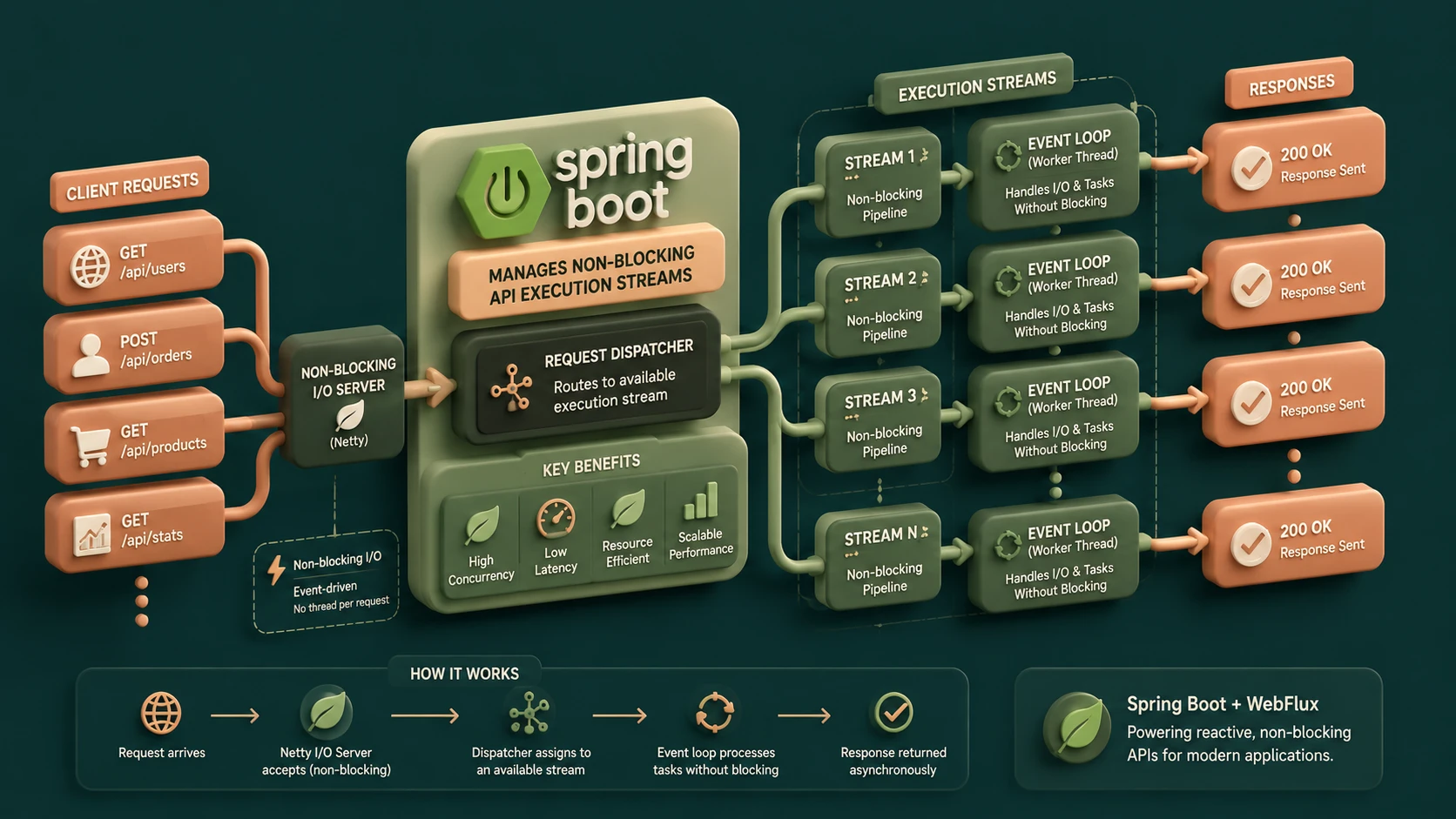
Spring WebFlux introduces a non-blocking programming model designed for asynchronous request processing.
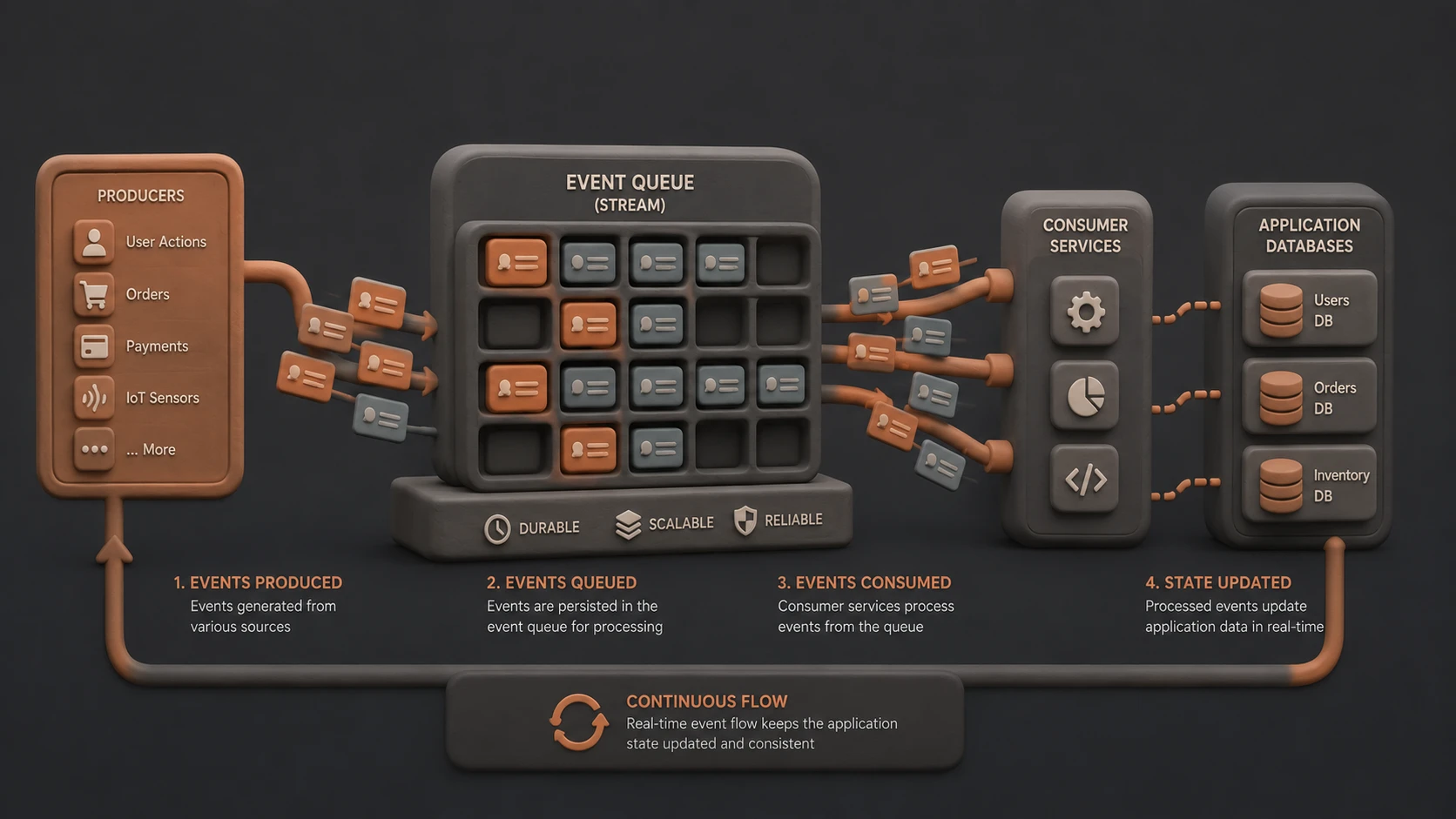
Unlike traditional servlet-based processing where requests are generally associated with dedicated threads during execution, WebFlux is designed around asynchronous event processing.
Key characteristics include:
- ◆Non-blocking request handling
- ◆Reactive streams support
- ◆Asynchronous execution
- ◆Event-driven processing
- ◆Backpressure awareness
The framework complements, rather than replaces, Spring MVC.
Organizations should choose the programming model most appropriate for individual workloads.
Project Reactor
Project Reactor serves as the reactive foundation for WebFlux.
It provides abstractions for asynchronous data processing while supporting stream composition and non-blocking execution.
Typical programming concepts include:
- ◆Publisher sequences
- ◆Stream transformation
- ◆Asynchronous composition
- ◆Event processing
- ◆Error propagation
Reactive programming emphasizes describing data flows rather than managing execution threads directly.
Reactive Starters
Spring Boot 2.0 simplifies reactive application development through starter dependencies.
Starter modules automatically configure required framework components while reducing manual configuration.
Benefits include:
- ◆Faster project initialization
- ◆Consistent dependency management
- ◆Simplified configuration
- ◆Standardized application architecture
Development teams continue benefiting from Boot's convention-based configuration philosophy.
Reactive Request Lifecycle
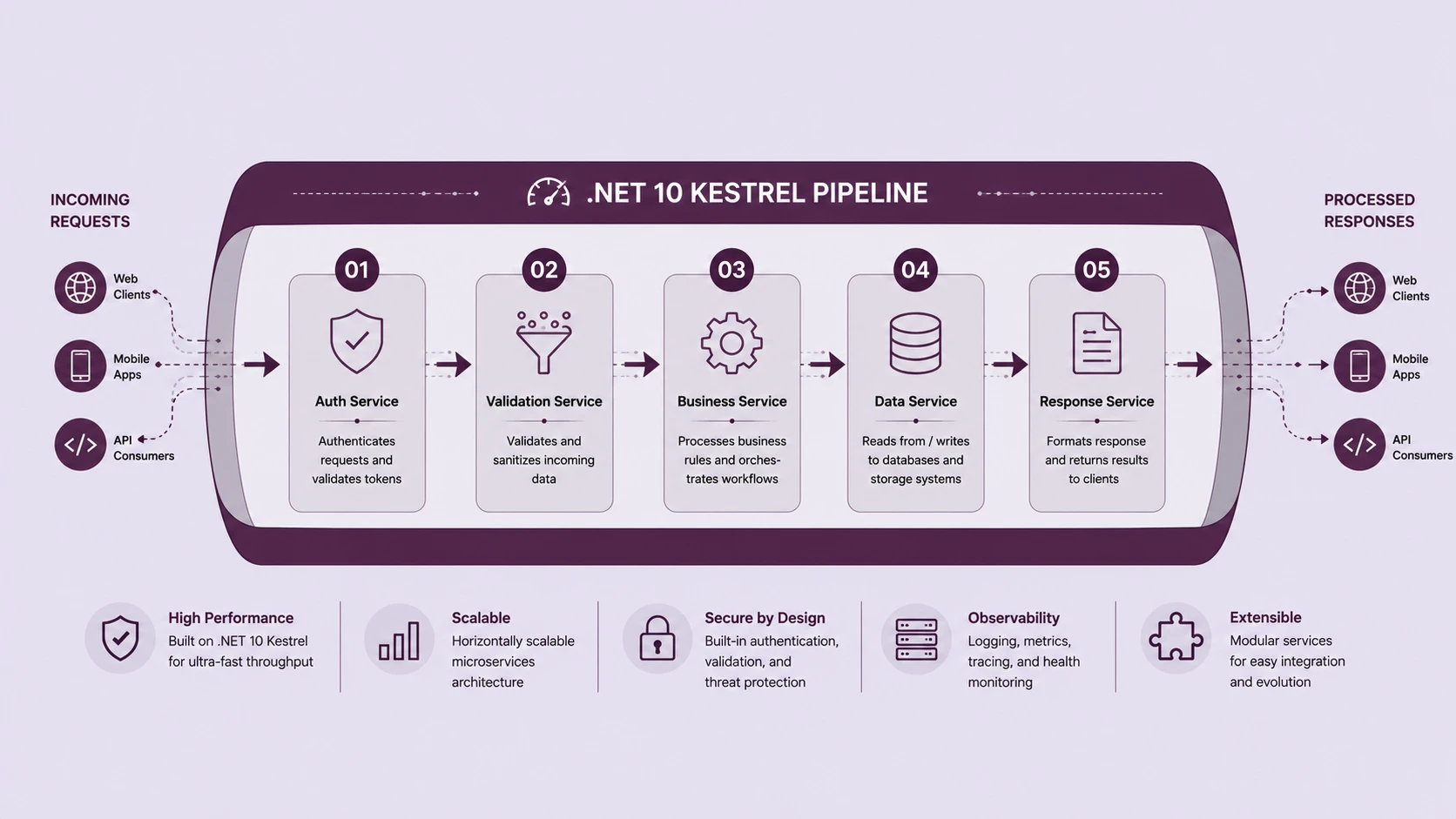
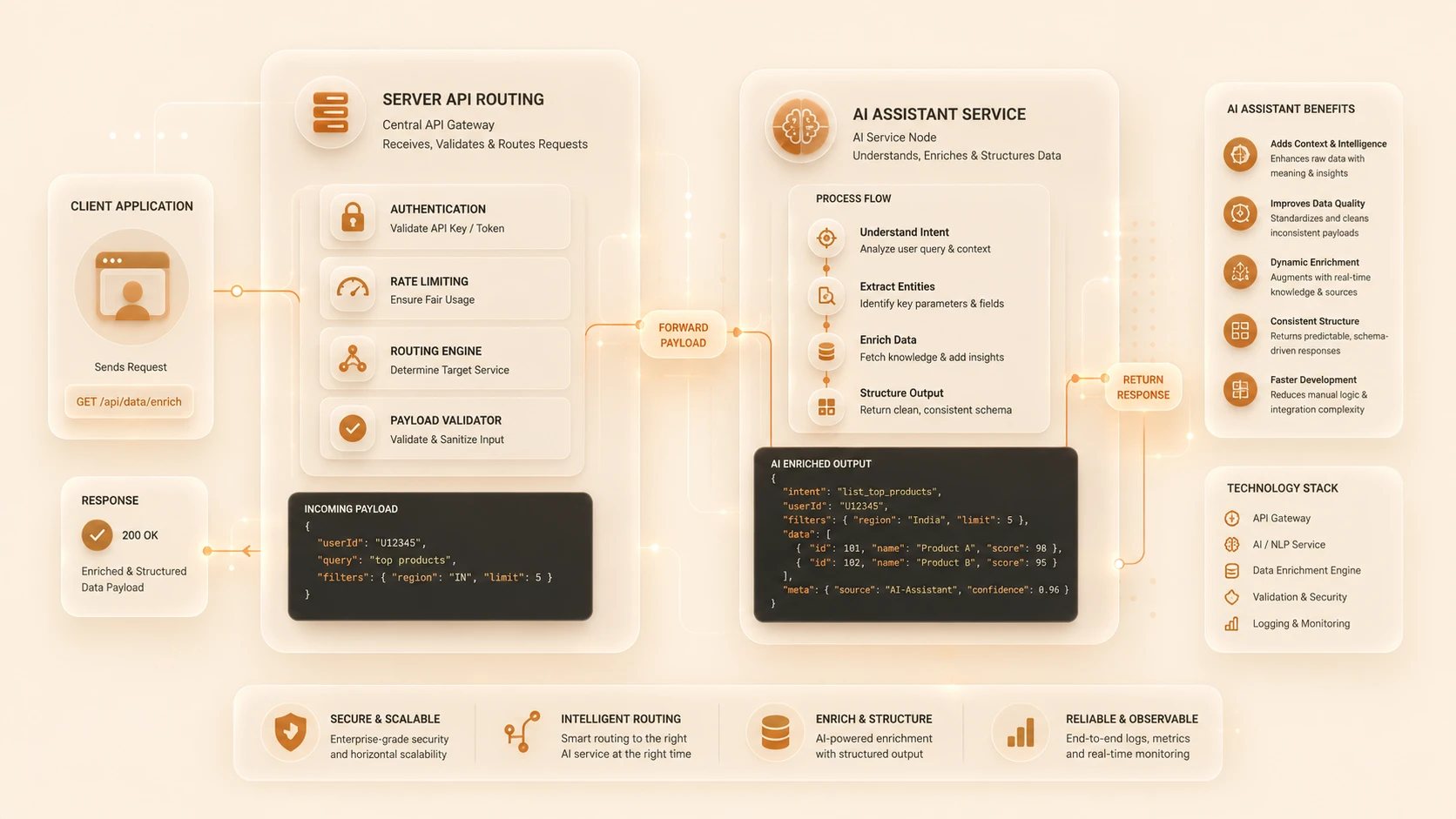
A typical reactive request follows these stages:
- 1.A client submits an HTTP request.
- 2.WebFlux receives the request.
- 3.Reactive handlers process the request asynchronously.
- 4.Business services execute non-blocking operations.
- 5.Data sources produce results.
- 6.Reactor propagates responses.
- 7.The server returns the completed response.
Resources are used efficiently while operations wait for external systems.
Production Monitoring
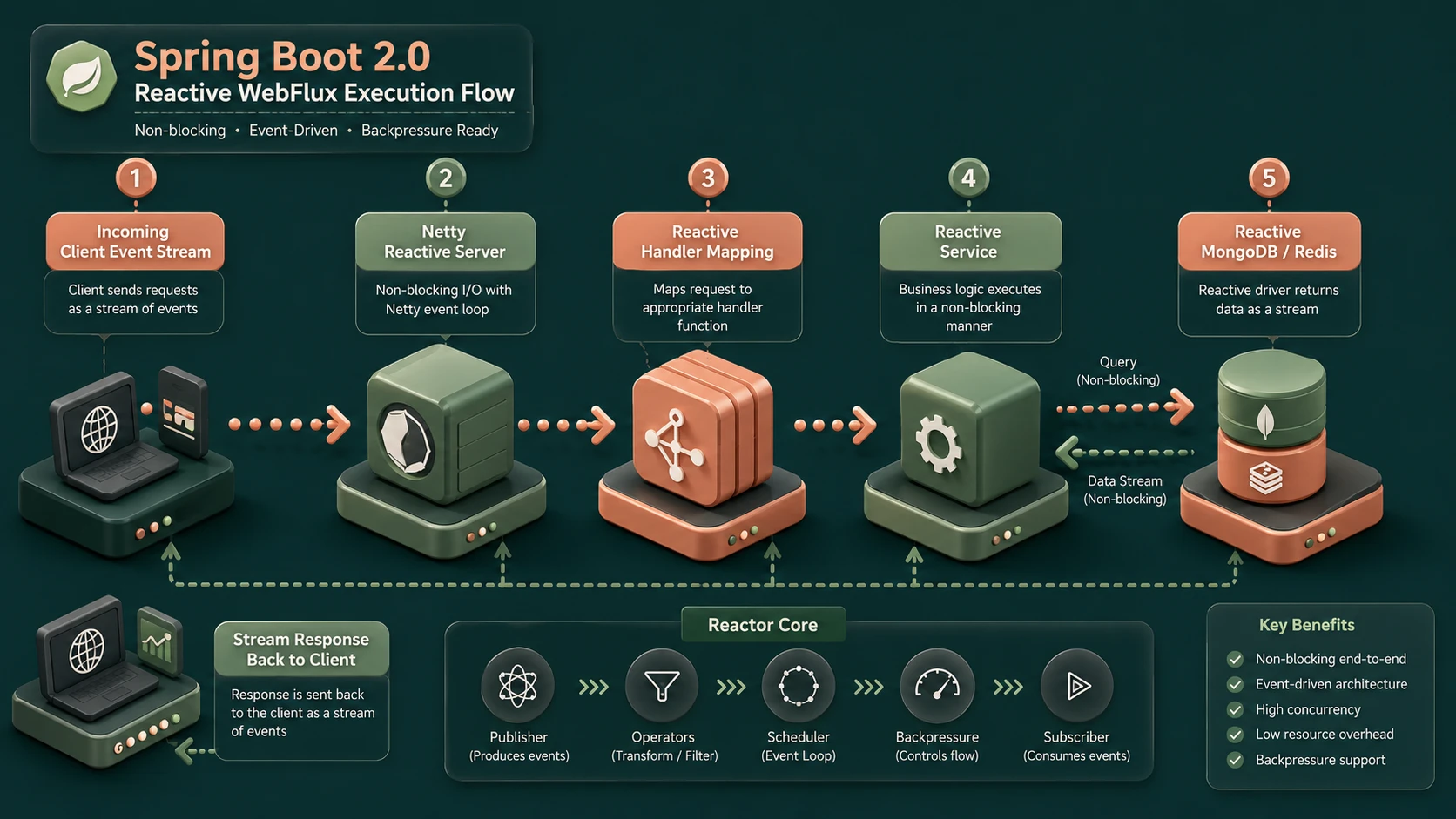
System architecture diagram and conceptual workflow layout for Spring Boot 2.0.
Spring Boot 2.0 continues improving operational visibility through enhanced Actuator capabilities.
Production teams benefit from:
- ◆Health endpoints
- ◆Metrics collection
- ◆Environment information
- ◆Application monitoring
- ◆Operational diagnostics
Operational observability remains an essential component of enterprise deployments.
Enterprise Use Cases
| Scenario | Benefit |
|---|---|
| REST APIs | Efficient concurrent request handling |
| Cloud Services | Better resource utilization |
| Microservices | Reactive communication |
| Event Processing | Non-blocking execution |
| API Gateways | High-concurrency request processing |
| Streaming Applications | Continuous data processing |
Organizations managing highly concurrent workloads may benefit from reactive programming where non-blocking execution aligns with application requirements.
Performance Considerations
Reactive programming does not automatically improve application performance.
Development teams should evaluate:
- ◆Request latency
- ◆Concurrent connections
- ◆External service latency
- ◆Thread utilization
- ◆Memory consumption
- ◆Throughput under representative workloads
Applications that perform extensive blocking operations may realize fewer benefits than workloads designed around asynchronous processing.
Performance decisions should always be guided by measurement rather than assumptions.
Security Considerations
Spring Boot 2.0 continues supporting enterprise security practices.
Organizations should continue implementing:
- ◆Authentication
- ◆Authorization
- ◆HTTPS communication
- ◆Input validation
- ◆Secure dependency management
- ◆Operational monitoring
Reactive programming changes execution models but does not reduce security requirements.
Scalability
Reactive architectures support horizontal scalability by improving resource utilization during high-concurrency workloads.
Organizations should continue designing systems around:
- ◆Stateless services
- ◆Load balancing
- ◆Service discovery
- ◆External configuration
- ◆Distributed deployment
Scalable architecture depends upon the complete system rather than any individual framework.
Best Practices
Organizations evaluating Spring Boot 2.0 should:
- ◆Select WebFlux only where reactive programming provides measurable value.
- ◆Keep blocking operations outside reactive execution paths whenever possible.
- ◆Benchmark representative production workloads.
- ◆Standardize dependency versions using Boot's dependency management.
- ◆Monitor application metrics continuously.
- ◆Maintain clear separation between business logic and infrastructure concerns.
- ◆Validate operational readiness before production deployment.
- ◆Train development teams on reactive programming concepts.
Thoughtful architecture is more important than adopting reactive technologies indiscriminately.
Common Mistakes
Development teams should avoid:
- ◆Assuming reactive programming always improves performance.
- ◆Mixing blocking operations throughout reactive request pipelines.
- ◆Migrating mature applications without performance objectives.
- ◆Ignoring operational monitoring.
- ◆Treating reactive programming as a replacement for sound architecture.
- ◆Choosing WebFlux solely because it represents newer technology.
Reactive systems should be introduced where application characteristics justify additional architectural complexity.
Technology Comparison
| Capability | Spring MVC | Spring WebFlux |
|---|---|---|
| Programming Model | Servlet-based | Reactive |
| Request Processing | Generally thread-per-request | Non-blocking |
| Reactive Streams Support | No | Yes |
| Project Reactor Integration | No | Yes |
| High-Concurrency Workloads | Good | Optimized for asynchronous scenarios |
| Spring Boot 2.0 Support | Yes | Yes |
Both frameworks remain first-class options within the Spring ecosystem, allowing organizations to choose according to workload requirements.
Adoption Strategy
Organizations should approach reactive development incrementally.
A practical strategy includes:
- 1.Identify services experiencing significant concurrent workloads.
- 2.Build a pilot application using WebFlux.
- 3.Benchmark against existing implementations.
- 4.Train development teams in reactive programming.
- 5.Integrate production monitoring.
- 6.Validate operational behavior under load.
- 7.Expand adoption only where measurable benefits are demonstrated.
Incremental adoption minimizes organizational risk while providing objective performance data.
Limitations
As of April 2018, organizations should recognize several considerations.
Current observations include:
- ◆Reactive programming introduces a different development model requiring additional expertise.
- ◆Existing Spring MVC applications continue to be fully supported and appropriate for many enterprise workloads.
- ◆Reactive benefits depend heavily on application architecture and external system behavior.
- ◆Successful adoption requires disciplined performance testing and operational monitoring.
Reactive frameworks should therefore be viewed as an additional architectural option rather than a universal replacement for established enterprise patterns.
Looking Ahead
Spring Boot 2.0 marks an important milestone in the evolution of enterprise Java development by integrating Spring WebFlux, Project Reactor, and reactive application architecture into the familiar Boot ecosystem. The platform enables organizations to build modern cloud-native services capable of handling highly concurrent workloads while preserving Spring's emphasis on productivity, convention-based configuration, and operational excellence.
As of April 2018, enterprise architects should evaluate Spring Boot 2.0 and WebFlux for services where asynchronous processing, high connection concurrency, and non-blocking I/O provide measurable operational advantages. Organizations that combine disciplined architecture, comprehensive monitoring, and incremental adoption will be well positioned to leverage reactive programming within modern enterprise Java platforms.