Introduction
After several years of development, Java 9 has officially reached general availability. This release represents one of the largest architectural updates to the Java platform in recent history, introducing fundamental improvements that affect application organization, runtime behavior, developer tooling, and long-term platform evolution.
Enterprise Java applications have continued to grow in scale, often consisting of hundreds of JAR files, thousands of classes, and complex dependency graphs. While packages have provided logical organization, they have not enforced strong encapsulation between application components. At the same time, developers have increasingly requested interactive tooling for experimentation and more efficient runtime behavior for modern server applications.
Java 9 addresses these requirements through the Java Platform Module System (JPMS), interactive development with JShell, improvements to the G1 Garbage Collector, compact runtime images, and numerous enhancements across the Java Development Kit.
From an enterprise perspective, Java 9 is not merely a language update. It represents a modernization of the Java platform intended to improve maintainability, deployment flexibility, and long-term application architecture.
Industry Background
Enterprise software continues evolving toward:
- ◆Cloud-native applications
- ◆Microservice architectures
- ◆Modular software design
- ◆Continuous integration pipelines
- ◆Containerized deployments
- ◆Shared platform libraries
- ◆Large-scale distributed systems
As applications become increasingly modular, organizations require stronger boundaries between components and improved dependency management.
Java 9 directly addresses these architectural needs by introducing modularity into the platform itself.
The Business Problem
Large enterprise Java systems commonly experience:
- ◆Complex classpaths
- ◆Accidental exposure of internal APIs
- ◆Difficult dependency management
- ◆Large runtime installations
- ◆Slow developer onboarding
- ◆Increasing maintenance costs
- ◆Limited architectural enforcement
Modern enterprise software benefits from explicit component boundaries that improve maintainability over many years of development.
Understanding Java 9
Java 9 introduces several major platform capabilities:
- ◆Java Platform Module System (Project Jigsaw)
- ◆JShell interactive REPL
- ◆G1 Garbage Collector improvements
- ◆jlink runtime image creation
- ◆Collection factory methods
- ◆Process API enhancements
- ◆Improved security libraries
Collectively these improvements modernize both the Java runtime and developer experience.
Core Architecture
| Component | Responsibility |
|---|---|
| Java Platform Module System | Defines modular application structure |
| module-info.java | Declares module metadata |
| JShell | Interactive Java execution |
| G1 Garbage Collector | Memory management |
| jlink | Creates custom runtime images |
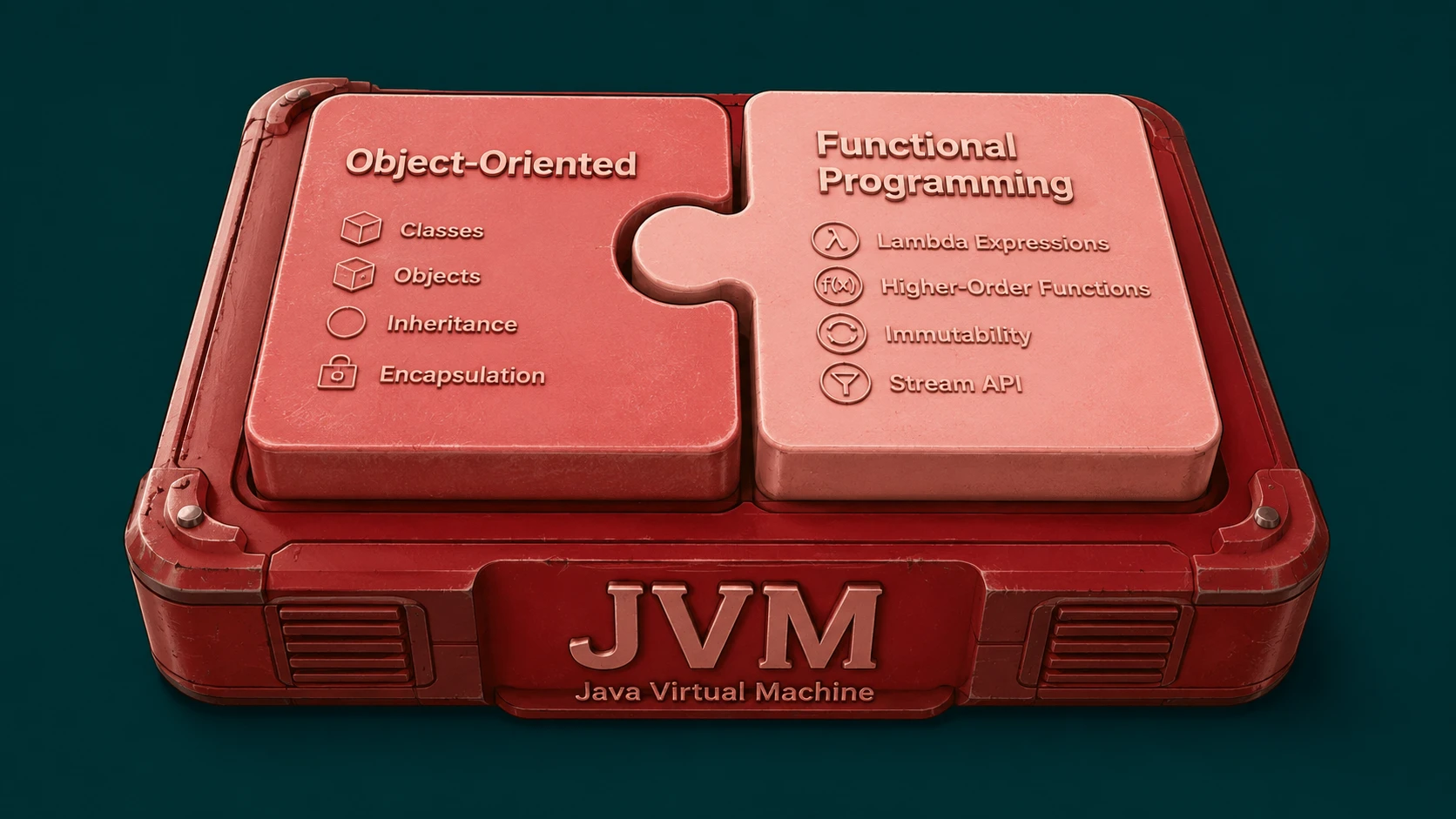
| JVM | Executes modular applications |
These components work together to improve application organization and deployment.
Java Platform Module System
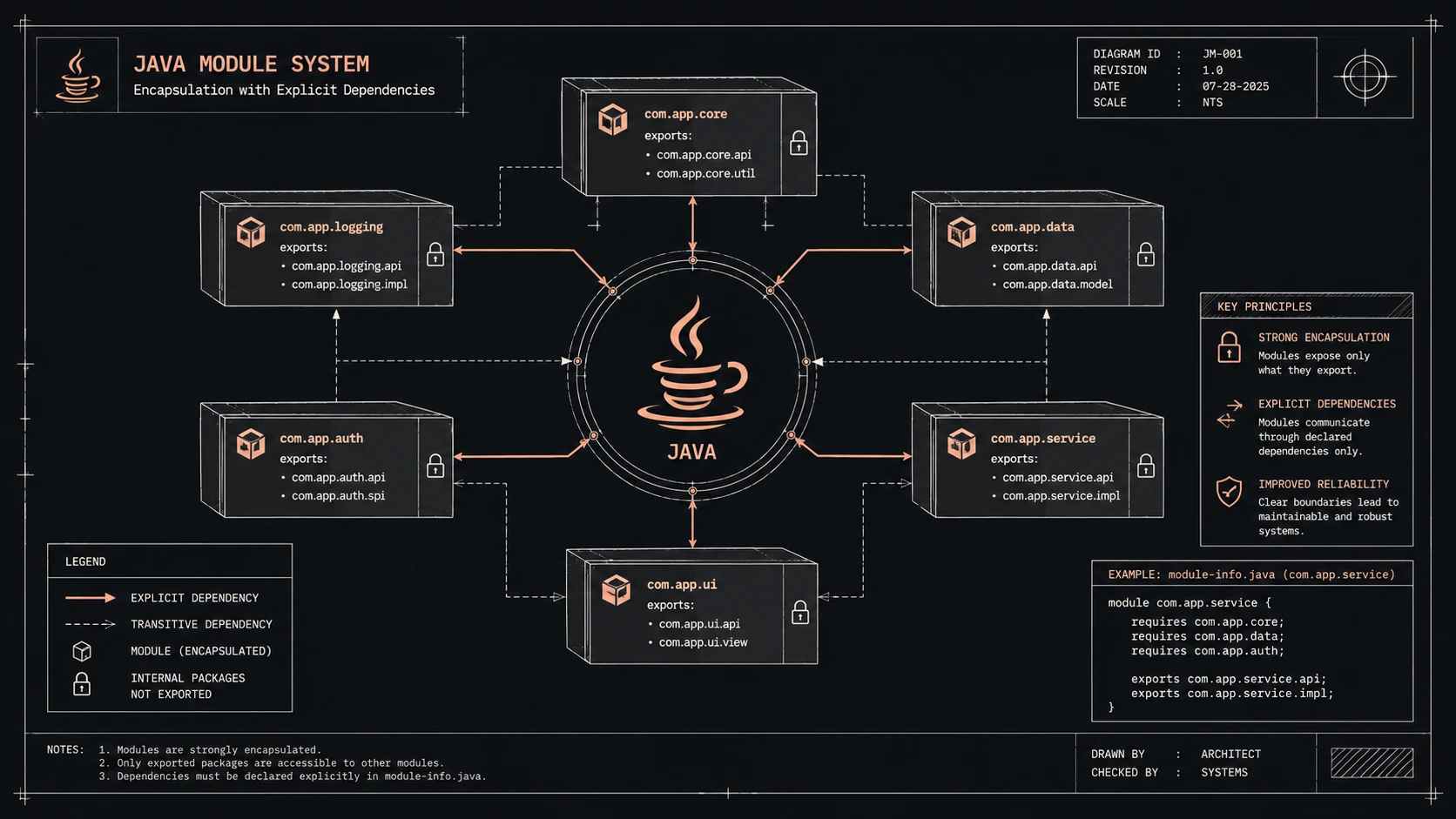
The Java Platform Module System (JPMS), developed through Project Jigsaw, is the defining feature of Java 9.
Modules provide explicit declarations describing:
- ◆Module identity
- ◆Required dependencies
- ◆Exported packages
- ◆Service relationships
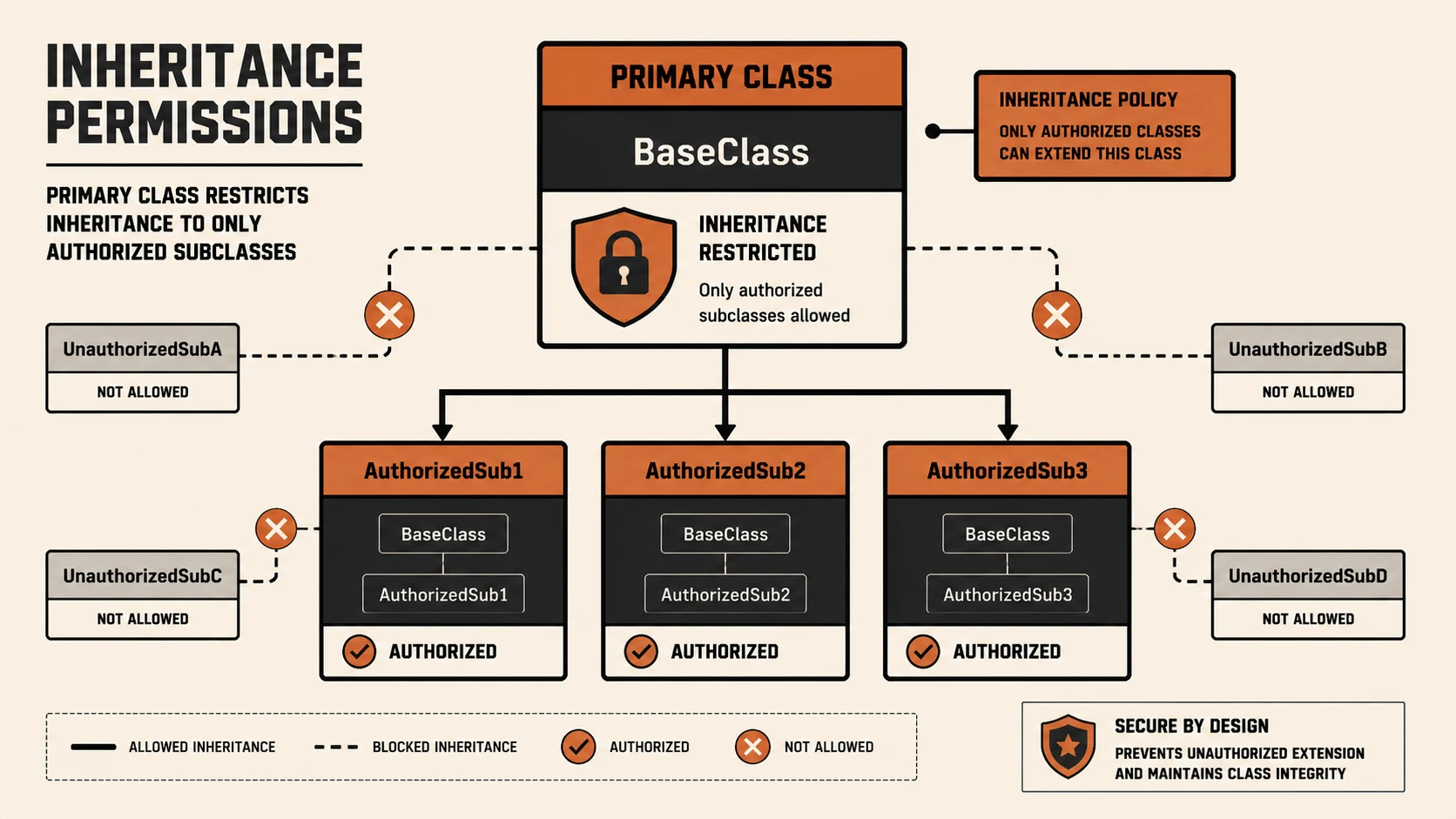
Unlike traditional package organization, modules introduce strong encapsulation between application components.
Benefits include:
- ◆Better architectural boundaries
- ◆Reduced accidental dependencies
- ◆Improved maintainability
- ◆Clearer application structure
Modules encourage software designs that are easier to evolve over time.
Strong Encapsulation
One of the primary goals of JPMS is strong encapsulation.
Only packages explicitly exported by a module become accessible to other modules.
Advantages include:
- ◆Smaller public APIs
- ◆Improved internal implementation isolation
- ◆Better dependency control
- ◆Reduced architectural coupling
This helps organizations build large systems with well-defined interfaces.
Module Resolution
Application startup now includes module resolution.
A typical workflow follows:
- 1.Module descriptors are discovered.
- 2.Required dependencies are validated.
- 3.The module graph is constructed.
- 4.Readability rules are enforced.
- 5.Encapsulation boundaries are established.
- 6.Application execution begins.
Validation during startup helps identify dependency issues earlier than traditional classpath execution.
JShell Interactive REPL
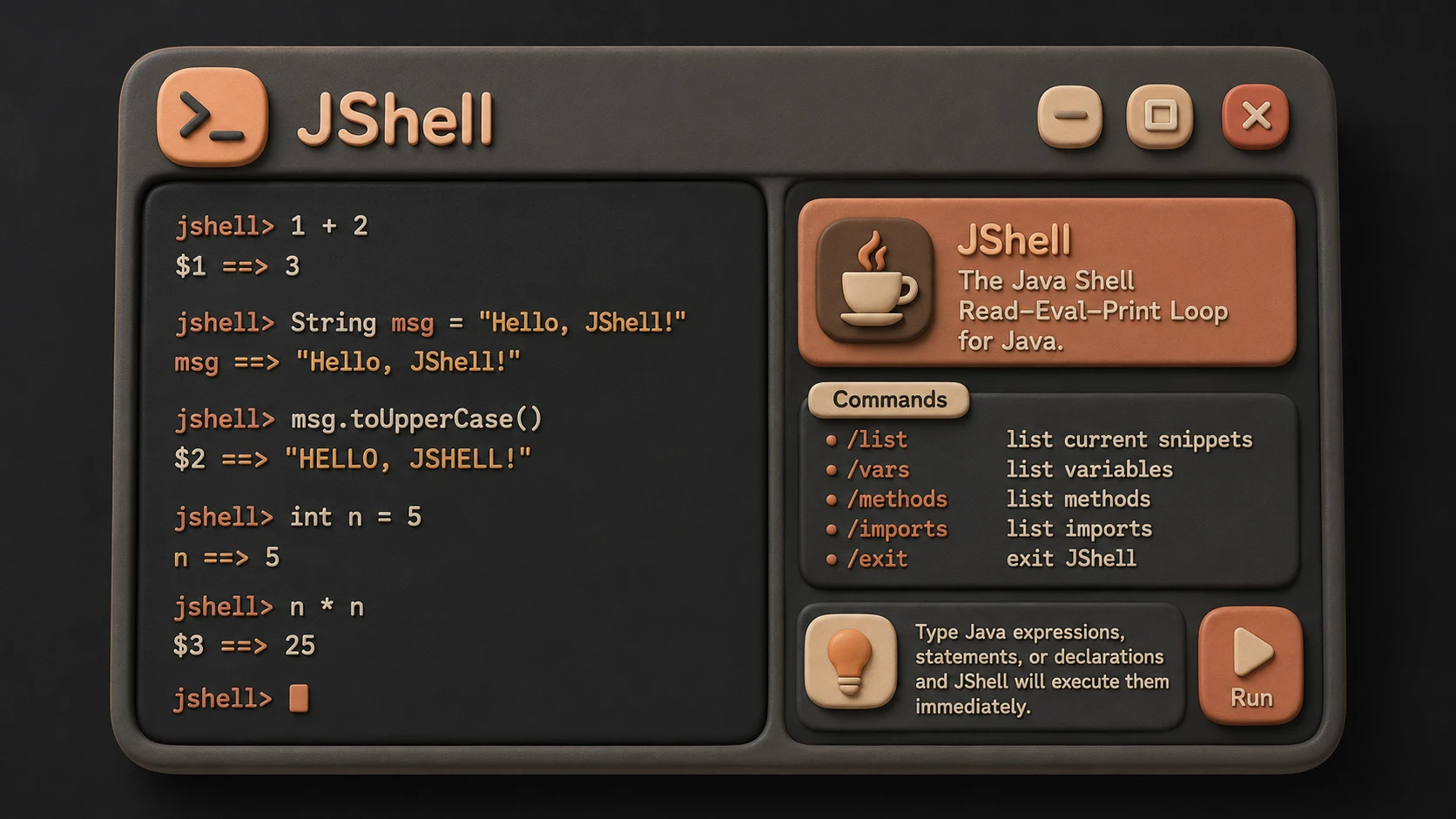
Java 9 introduces JShell, an interactive Read-Evaluate-Print Loop (REPL).
Developers can execute Java statements without creating complete application projects.
Typical use cases include:
- ◆API experimentation
- ◆Learning language features
- ◆Rapid algorithm testing
- ◆Demonstrating code examples
- ◆Library exploration
JShell improves developer productivity by reducing the feedback loop during experimentation.
G1 Garbage Collector Improvements
Garbage collection remains a critical aspect of enterprise JVM performance.
Java 9 continues improving the G1 Garbage Collector, which is designed to balance throughput with predictable pause times for large heap applications.
Enhancements focus on:
- ◆More efficient memory reclamation
- ◆Better pause time behavior
- ◆Improved heap management
- ◆Enhanced operational predictability
Organizations deploying memory-intensive server applications should evaluate these improvements using representative production workloads.
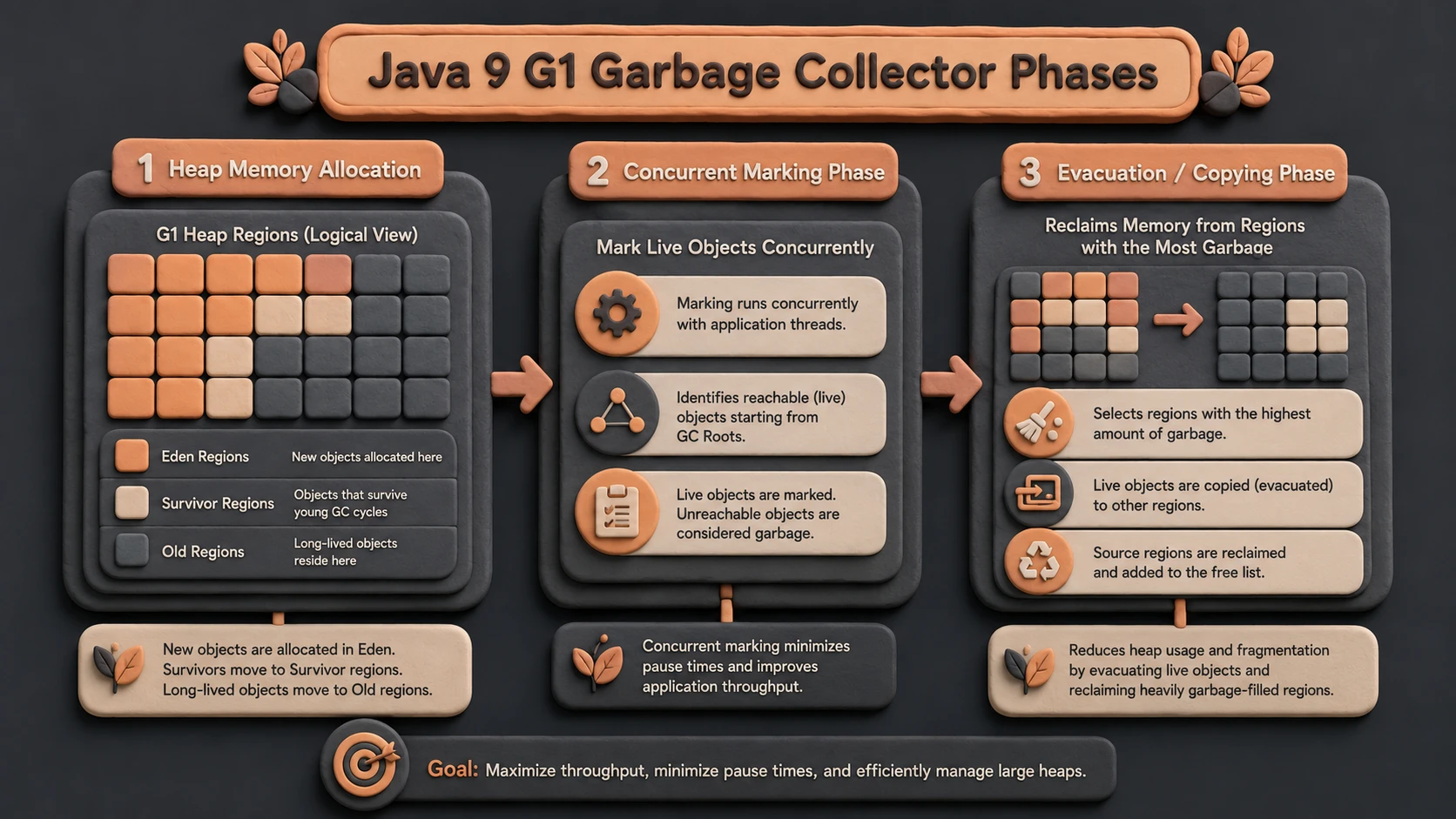
System architecture diagram and conceptual workflow layout for Java 9 Final Release.
jlink Runtime Images
Traditional Java deployments typically require installation of a complete Java Runtime Environment.
Java 9 introduces jlink, allowing developers to assemble custom runtime images containing only the required platform modules.
Potential benefits include:
- ◆Smaller deployments
- ◆Reduced runtime footprint
- ◆Simplified distribution
- ◆Improved deployment consistency
Custom runtime images align well with modern deployment practices.
Collection Factory Methods
Java 9 introduces convenient factory methods for creating immutable collections.
Benefits include:
- ◆Reduced boilerplate
- ◆Improved readability
- ◆Cleaner initialization code
- ◆Simpler utility implementations
Although a relatively small language improvement, these additions simplify common programming patterns.
Enterprise Use Cases
| Scenario | Benefit |
|---|---|
| Financial Systems | Strong modular architecture |
| Enterprise Middleware | Improved dependency management |
| Microservices | Smaller runtime images |
| Shared Libraries | Better encapsulation |
| Cloud Applications | Efficient deployments |
| Internal Platform Development | Cleaner module organization |
Organizations maintaining large Java platforms benefit most from explicit architectural boundaries.
Performance Considerations
Java 9 introduces improvements across multiple runtime areas.
Development teams should evaluate:
- ◆Application startup
- ◆Heap utilization
- ◆Garbage collection behavior
- ◆Runtime image size
- ◆Module resolution overhead
- ◆Deployment efficiency
Performance analysis should always be based on representative workloads rather than synthetic benchmarks.
Security Considerations
Strong encapsulation contributes positively to application architecture by reducing unintended exposure of implementation details.
Organizations should continue implementing:
- ◆Authentication
- ◆Authorization
- ◆Secure dependency management
- ◆HTTPS communication
- ◆Input validation
- ◆Security auditing
The module system complements but does not replace established security practices.
Scalability
Java 9 supports scalable enterprise development through:
- ◆Modular architecture
- ◆Explicit dependencies
- ◆Smaller runtime images
- ◆Cleaner component boundaries
- ◆Improved runtime management
These characteristics become increasingly valuable as enterprise applications continue growing in complexity.
Best Practices
Organizations adopting Java 9 should:
- ◆Introduce modules gradually.
- ◆Design modules around business capabilities.
- ◆Keep exported APIs intentionally small.
- ◆Evaluate JShell for developer productivity.
- ◆Benchmark G1 Garbage Collector behavior.
- ◆Use jlink for deployment optimization where appropriate.
- ◆Update build pipelines to support modular projects.
- ◆Train development teams on JPMS concepts.
Incremental adoption minimizes migration risk while providing long-term architectural benefits.
Common Mistakes
Development teams should avoid:
- ◆Treating modules as simple package replacements.
- ◆Exporting implementation packages unnecessarily.
- ◆Attempting to modularize very large applications without planning.
- ◆Ignoring dependency analysis.
- ◆Assuming runtime improvements eliminate application-level optimization.
- ◆Migrating production systems without compatibility testing.
Successful adoption requires thoughtful architectural planning.
Technology Comparison
| Capability | Java 8 | Java 9 |
|---|---|---|
| Module System | No | Yes |
| JShell REPL | No | Yes |
| jlink Runtime Images | No | Yes |
| Collection Factory Methods | No | Yes |
| Strong Encapsulation | Limited | Yes |
| G1 Garbage Collector | Available | Enhanced |
Java 9 significantly expands platform capabilities while maintaining Java's long-standing commitment to compatibility.
Adoption Strategy
Organizations should approach Java 9 through phased adoption.
A practical strategy includes:
- 1.Evaluate existing application dependencies.
- 2.Upgrade development environments.
- 3.Introduce modules into new projects.
- 4.Pilot modular deployments.
- 5.Evaluate G1 Garbage Collector performance.
- 6.Experiment with JShell for development workflows.
- 7.Expand migration after operational validation.
Gradual modernization allows teams to gain experience while minimizing disruption.
Limitations
As of September 2017, organizations should recognize several considerations.
Current observations include:
- ◆Existing enterprise applications may require careful migration planning.
- ◆Third-party library support for modules continues maturing.
- ◆Classpath-based applications remain fully supported but should be evaluated for future modularization.
- ◆Teams should validate build tooling and deployment automation before large-scale migration.
Java 9 introduces substantial architectural improvements, but successful adoption depends upon disciplined planning rather than immediate migration.
Looking Ahead
Java 9 represents one of the most significant platform releases in the history of Java. The Java Platform Module System fundamentally changes how enterprise applications can be organized, JShell modernizes the developer experience through interactive programming, and continued investment in the G1 Garbage Collector strengthens Java's suitability for demanding server workloads.
As of September 2017, enterprise architects should evaluate Java 9 not simply as another platform update, but as an opportunity to modernize application architecture through explicit modularity, improved deployment practices, and stronger encapsulation. Organizations that begin planning incremental adoption today will be well positioned to build maintainable, scalable Java systems on this new foundation.