Introduction
HTTP/2 introduced several protocol-level improvements intended to modernize web communication without changing the familiar HTTP programming model. Multiplexed streams, HPACK header compression, binary framing, request prioritization, and Server Push collectively promised to reduce page load latency while simplifying front-end optimization strategies.
Among these innovations, Server Push has attracted particular interest from enterprise architects. Rather than waiting for browsers to discover and request dependent resources, servers can proactively transmit assets immediately after the initial document request. The objective is straightforward: reduce round-trip delays and accelerate page rendering.
As organizations begin evaluating HTTP/2 deployments in production during early 2017, practical experience shows that Server Push is not universally beneficial. Application architecture, browser caching, bandwidth constraints, and TCP behavior all influence whether proactive delivery improves or degrades performance.
For enterprise development teams, understanding both the strengths and limitations of Server Push is essential before enabling it across production infrastructure.
Industry Background
Modern enterprise web applications routinely deliver:
- ◆JavaScript frameworks
- ◆CSS bundles
- ◆Web fonts
- ◆Images
- ◆REST API calls
- ◆Progressive Web App assets
- ◆Analytics libraries
- ◆Interactive dashboards
Reducing startup latency has become increasingly important as applications continue growing in size and complexity.
HTTP/2 attempts to address protocol inefficiencies while preserving compatibility with existing HTTP semantics.
The Business Problem
Even with HTTP/2 multiplexing, browsers must still discover many application resources after parsing HTML.
This introduces several challenges:
- ◆Additional network round trips
- ◆Delayed rendering
- ◆Increased startup latency
- ◆Resource dependency chains
- ◆Mobile network variability
- ◆Cache validation overhead
Server Push attempts to reduce these delays by allowing servers to anticipate client requirements.
Understanding HTTP/2 Server Push
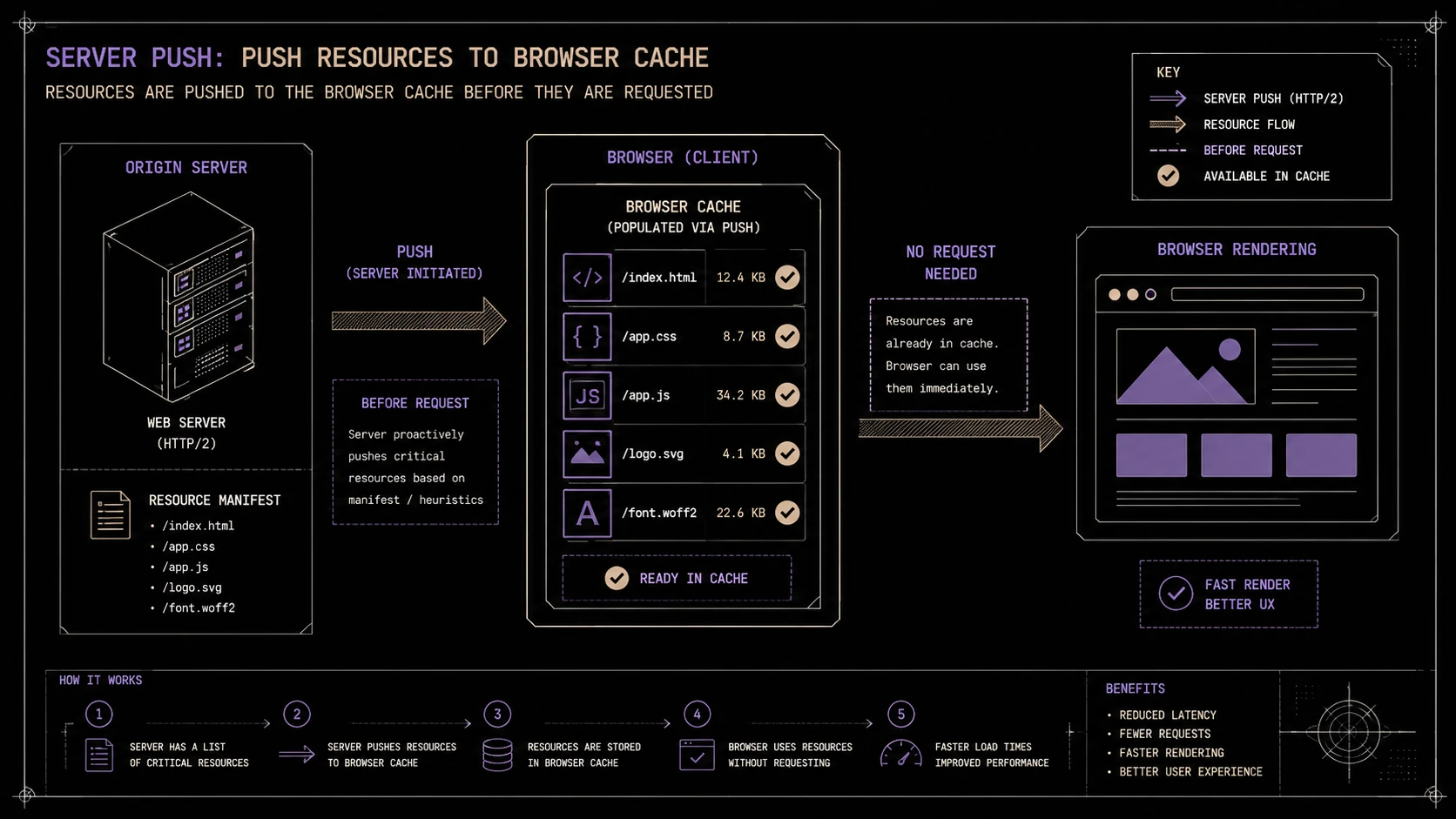
Server Push enables an HTTP/2 server to transmit resources before the client explicitly requests them.
Instead of waiting for the browser to parse HTML and discover dependent assets, the server proactively delivers resources likely to be needed during page rendering.
Typical candidates include:
- ◆CSS stylesheets
- ◆JavaScript bundles
- ◆Web fonts
- ◆Frequently required images
The browser can accept these resources and place them into its cache for immediate use.
Core Architecture
| Component | Responsibility |
|---|---|
| Browser | Receives pushed resources |
| HTTP/2 Connection | Multiplexes multiple streams |
| Web Server | Initiates Server Push |
| Push Promise | Announces upcoming resources |
| Browser Cache | Stores received assets |
| Application | Uses cached resources during rendering |
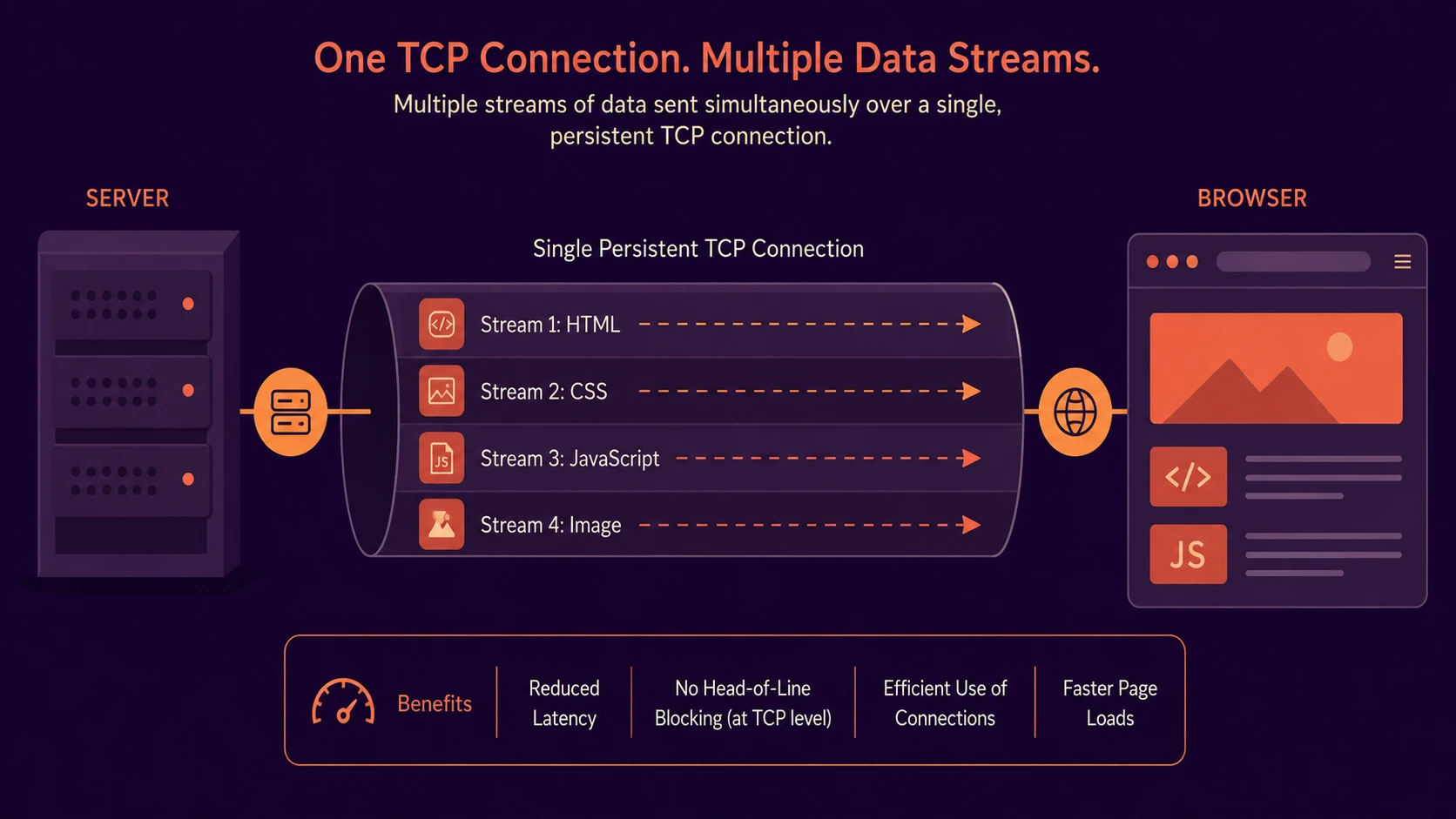
The protocol allows multiple resources to travel simultaneously across a single HTTP/2 connection.
How Server Push Works
# Nginx server block configuration executing HTTP/2 server push
server {
    listen 443 ssl http2;
    server_name shivamitcs.in;

    ssl_certificate /etc/nginx/certs/fullchain.pem;
    ssl_certificate_key /etc/nginx/certs/privkey.pem;

    location / {
        root /var/www/html;
        index index.html;

        # Proactively push CSS and JS resources when index.html is loaded
        http2_push /assets/css/main.css;
        http2_push /assets/js/bundle.js;
    }
}
A simplified workflow includes:
- 1.Browser requests the primary HTML document.
- 2.Server identifies resources likely to be required.
- 3.Server sends Push Promise frames.
- 4.Browser accepts or declines pushed resources.
- 5.Resources are transferred over existing HTTP/2 streams.
- 6.Browser stores resources in cache.
- 7.HTML rendering proceeds using locally available assets.
The goal is to eliminate the latency associated with subsequent client requests.
Key Features
Proactive Resource Delivery
Servers can begin transferring critical assets before the browser discovers them.
Reduced Request Latency
Fewer request-response cycles may improve initial rendering performance.
Shared HTTP/2 Connection
Pushed resources travel over the same multiplexed connection established for the original request.
Cache Integration
Successfully pushed assets become available within the browser cache for later use.
Improved First Page Experience
Applications with predictable dependency graphs may benefit from earlier asset availability.
Understanding TCP Head-of-Line Blocking
Although HTTP/2 eliminates application-layer head-of-line blocking between requests, it continues operating over TCP.
TCP guarantees ordered delivery of packets. When packet loss occurs, later packets cannot be processed until missing packets are retransmitted.
Consequences may include:
- ◆Delayed resource delivery
- ◆Increased latency on unreliable networks
- ◆Reduced effectiveness of multiplexing
- ◆Variable page load performance
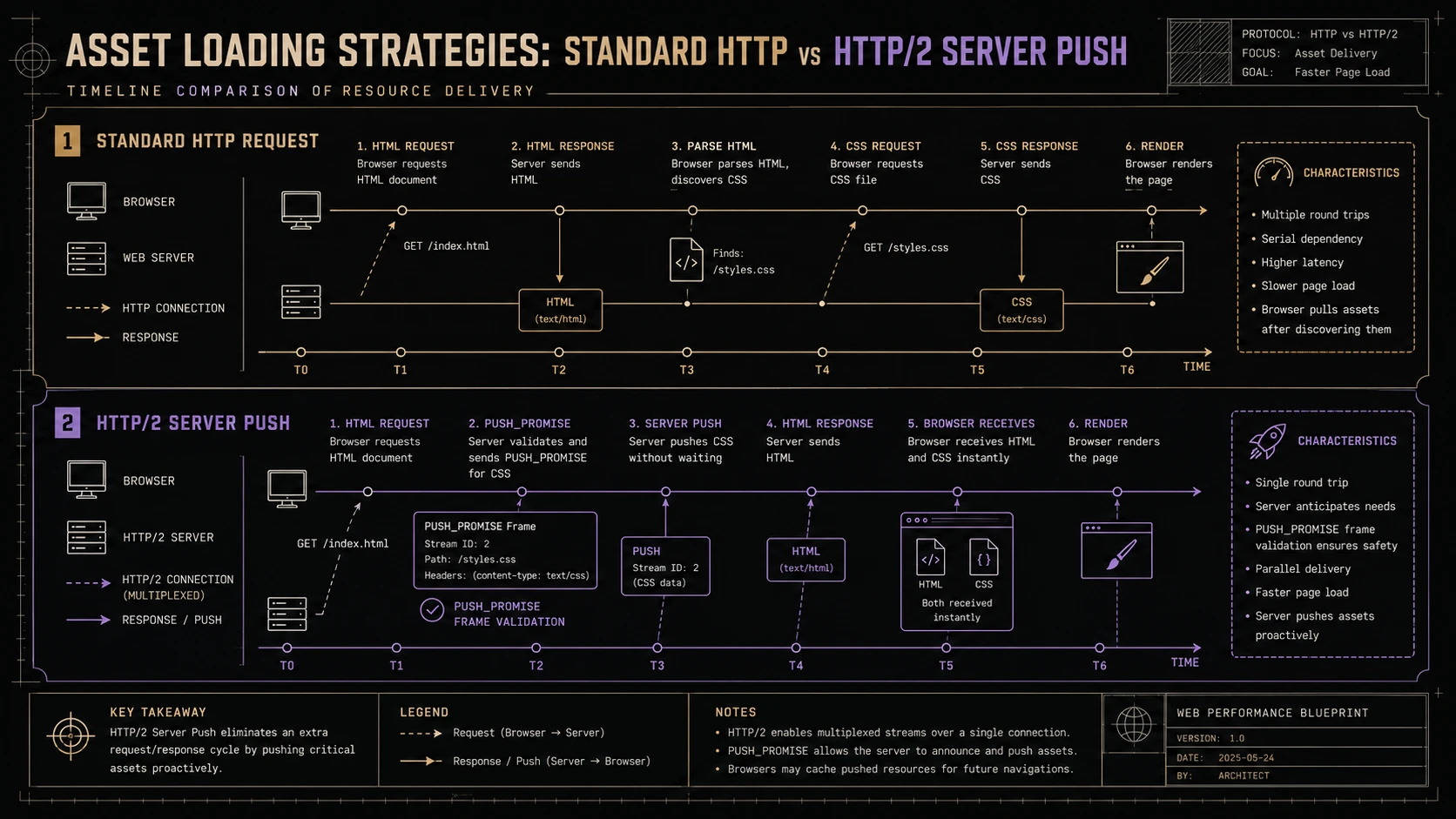
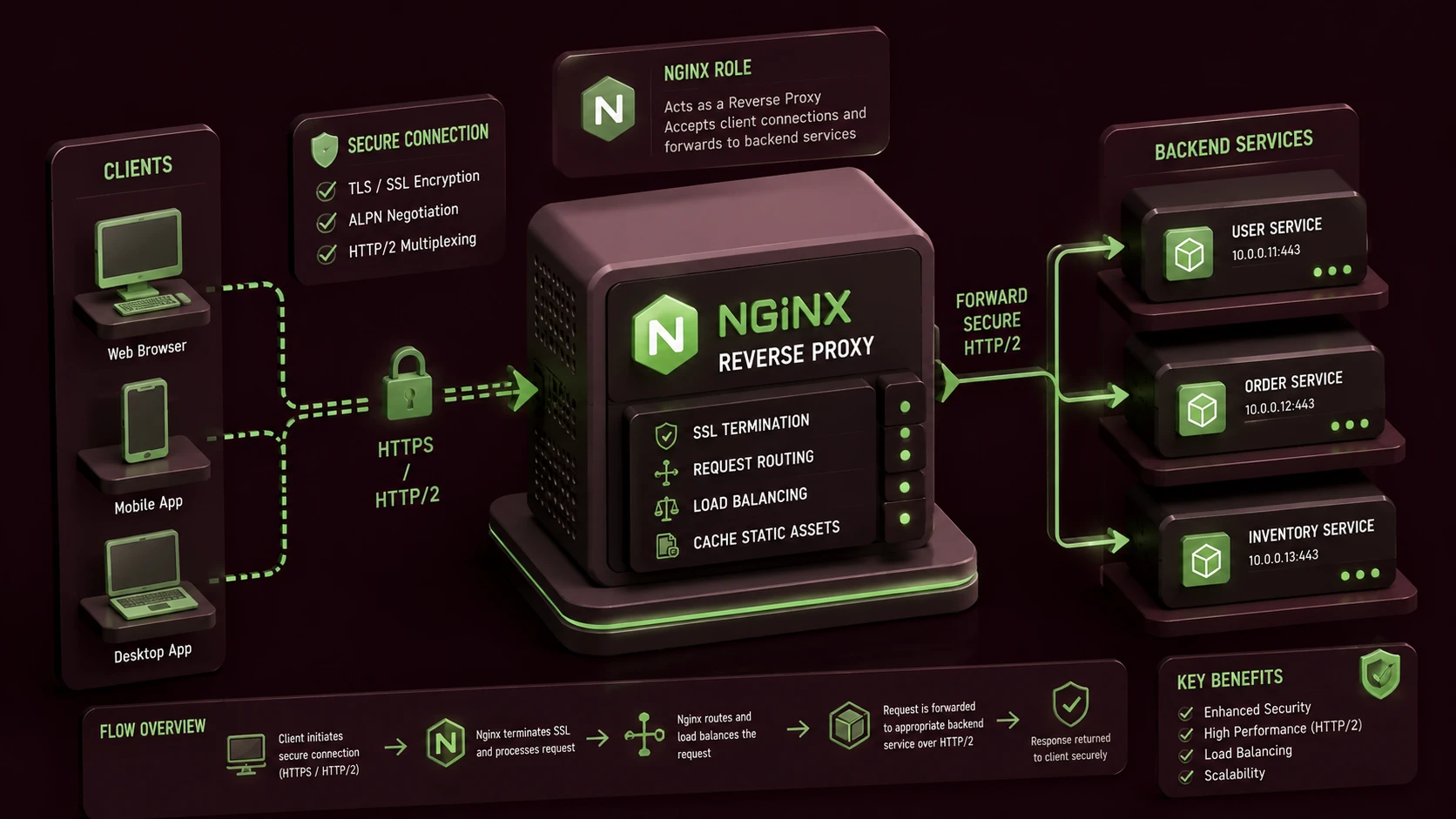
System architecture diagram and conceptual workflow layout for HTTP/2 Server Push.
These limitations originate from TCP itself rather than the HTTP/2 protocol.
Enterprise architects should therefore distinguish between application-layer multiplexing and transport-layer behavior.
Real-World Performance Considerations
Early production deployments suggest that Server Push should be applied selectively.
Potential advantages include:
- ◆Faster delivery of critical assets
- ◆Reduced request overhead
- ◆Improved startup responsiveness
- ◆Better utilization of existing connections
Potential drawbacks include:
- ◆Pushing resources already present in browser cache
- ◆Increased bandwidth consumption
- ◆Incorrect prioritization
- ◆Additional server complexity
- ◆Limited benefits for unpredictable application flows
Performance gains therefore depend heavily upon workload characteristics.
Enterprise Use Cases
Public Websites
Critical CSS and small JavaScript resources may benefit from proactive delivery.
Enterprise Dashboards
Applications with predictable startup resources can reduce initial rendering delays.
Progressive Web Apps
Server Push complements Service Worker caching during first application visits.
E-Commerce Platforms
Frequently reused interface assets may be delivered earlier to improve customer experience.
SaaS Applications
Consistent application shells make proactive resource delivery easier to optimize.
Performance Considerations
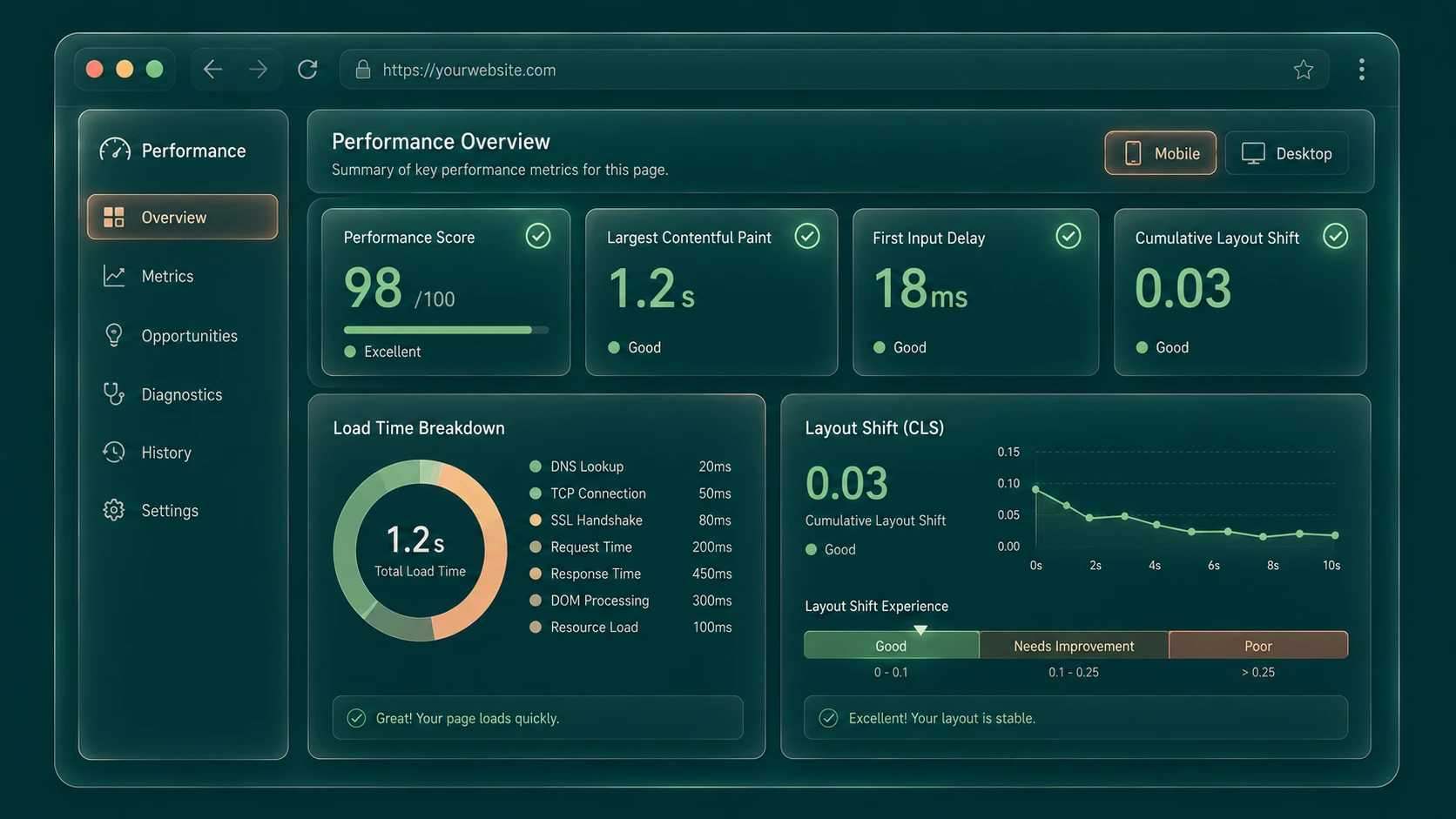
Organizations evaluating Server Push should measure:
- ◆First render time
- ◆Resource download timing
- ◆Cache utilization
- ◆Network bandwidth
- ◆Mobile performance
- ◆Server resource consumption
Benchmarking under realistic production workloads is more valuable than relying upon synthetic demonstrations.
Security Considerations
HTTP/2 Server Push operates within existing HTTPS connections.
Enterprise deployments should continue implementing:
- ◆Strong TLS configuration
- ◆Secure authentication
- ◆Authorization
- ◆Certificate management
- ◆Secure cache policies
- ◆Input validation
Server Push improves resource delivery but does not alter established web security responsibilities.
Scalability
Large-scale deployments should consider:
- ◆Cache-aware push strategies
- ◆Content delivery network integration
- ◆Load balancing
- ◆Asset versioning
- ◆Monitoring push effectiveness
Poorly planned push policies may increase bandwidth usage without improving user experience.
Best Practices
- ◆Push only critical resources.
- ◆Avoid pushing large optional assets.
- ◆Monitor browser cache behavior.
- ◆Benchmark mobile and desktop performance separately.
- ◆Review resource prioritization regularly.
- ◆Validate CDN compatibility.
- ◆Measure production outcomes before broad deployment.
- ◆Continue optimizing application architecture alongside protocol improvements.
Common Mistakes
| Mistake | Enterprise Impact |
|---|---|
| Pushing every static asset | Increased bandwidth usage |
| Ignoring browser cache state | Redundant transfers |
| Assuming Server Push always improves performance | Unpredictable results |
| Poor resource prioritization | Slower rendering |
| Lack of production benchmarking | Inefficient deployment |
| Confusing HTTP/2 multiplexing with TCP behavior | Architectural misunderstanding |
Technology Comparison
| Capability | Traditional HTTP/2 Requests | HTTP/2 Server Push |
|---|---|---|
| Resource Discovery | Browser Initiated | Server Initiated |
| Round Trips | More | Potentially Fewer |
| Cache Awareness | Browser Controlled | Requires Careful Planning |
| Startup Latency | Standard | Potentially Reduced |
| Bandwidth Efficiency | Predictable | Depends on Push Strategy |
| Deployment Complexity | Moderate | Higher |
Adoption Strategy
- 1.Identify critical rendering resources.
- 2.Enable Server Push selectively.
- 3.Benchmark production performance.
- 4.Measure cache effectiveness.
- 5.Optimize resource prioritization.
- 6.Monitor bandwidth utilization.
- 7.Refine push policies continuously.
- 8.Expand deployment only where measurable improvements are demonstrated.
Limitations
As of January 2017, Server Push remains an emerging capability whose effectiveness varies across applications and network environments. While the protocol introduces valuable optimization opportunities, successful deployments require careful tuning, realistic performance measurement, and an understanding of TCP transport characteristics. Organizations should evaluate Server Push as one optimization technique rather than a universal solution for web performance.
Looking Ahead
From the perspective of January 2017, HTTP/2 Server Push represents one of the more innovative features introduced by the protocol, but practical experience is beginning to reveal its complexity. Enterprise organizations should approach adoption with careful measurement, selective deployment, and realistic expectations. Combined with multiplexing, efficient caching, and modern front-end architecture, Server Push has the potential to improve user experience when applied thoughtfully, while TCP head-of-line blocking continues to remind architects that transport-layer behavior remains an important consideration in web performance engineering.