Introduction
For more than fifteen years, HTTP/1.1 has served as the foundation of the modern web. During that period, developers introduced numerous optimization techniques to overcome protocol limitations, particularly the restriction on concurrent requests per connection. As enterprise applications became increasingly dependent on JavaScript, CSS, images, and other static assets, front-end engineering evolved around minimizing the number of HTTP requests.
The approval of HTTP/2 marks the most significant evolution of the HTTP protocol since HTTP/1.1. Rather than requiring developers to work around protocol inefficiencies, HTTP/2 introduces architectural improvements including multiplexed streams, binary framing, header compression, request prioritization, and optional server push.
For enterprise architects, this transition requires reconsidering long-established web performance practices. Optimizations that once improved application performance may become unnecessary or even counterproductive under HTTP/2.
Industry Background
Modern enterprise websites routinely deliver:
- ◆JavaScript libraries
- ◆CSS stylesheets
- ◆Images
- ◆Fonts
- ◆REST API requests
- ◆Video assets
- ◆Interactive dashboards
- ◆Mobile web applications
Under HTTP/1.1, browsers establish only a limited number of simultaneous connections per host, encouraging developers to reduce request counts through asset bundling and other techniques.
These practices have shaped front-end engineering throughout the past decade.
The Business Problem
HTTP/1.1 introduces several operational constraints:
- ◆Head-of-line blocking within a connection
- ◆Multiple TCP connections per page
- ◆Repeated request headers
- ◆Increased latency
- ◆Asset management complexity
- ◆Difficult front-end optimization
Organizations frequently compensate by introducing build processes that merge files, create image sprites, and distribute resources across multiple domains.
Understanding HTTP/2
HTTP/2 is the next major version of the Hypertext Transfer Protocol designed to improve efficiency while preserving the existing HTTP semantics used by applications.
Unlike previous optimization techniques implemented by developers, HTTP/2 addresses performance limitations at the protocol layer.
Major objectives include:
- ◆Lower latency
- ◆Improved resource utilization
- ◆Reduced protocol overhead
- ◆Better browser performance
- ◆Simplified application delivery
Applications generally continue using familiar HTTP methods, status codes, and URIs while benefiting from a more efficient transport mechanism.
Core Architecture
| Component | Responsibility |
|---|---|
| Binary Framing Layer | Efficient message transport |
| Streams | Independent request and response channels |
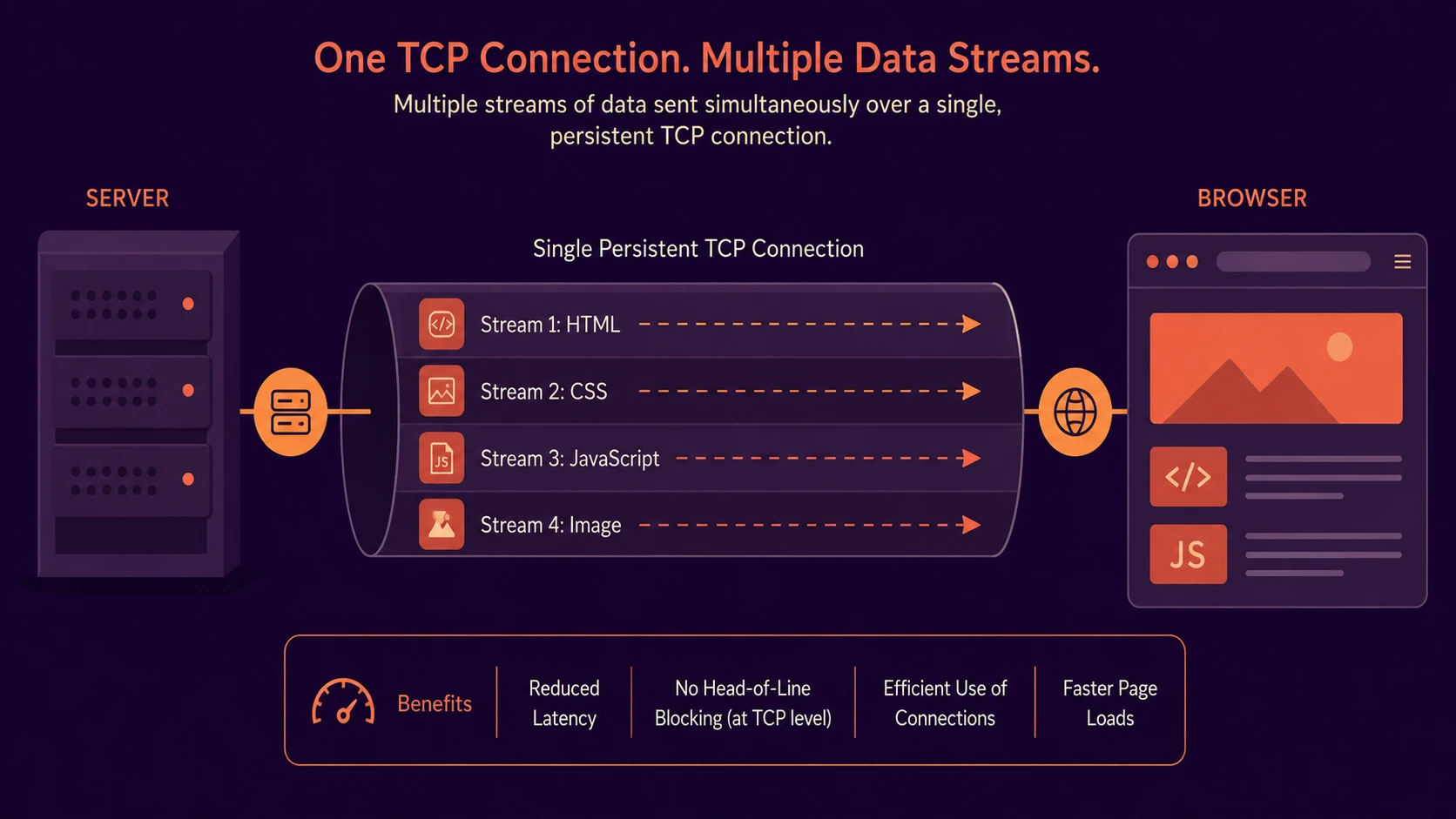
| Multiplexing | Concurrent communication over one connection |
| HPACK Header Compression | Reduces repeated header transmission |
| Stream Prioritization | Optimizes delivery order |
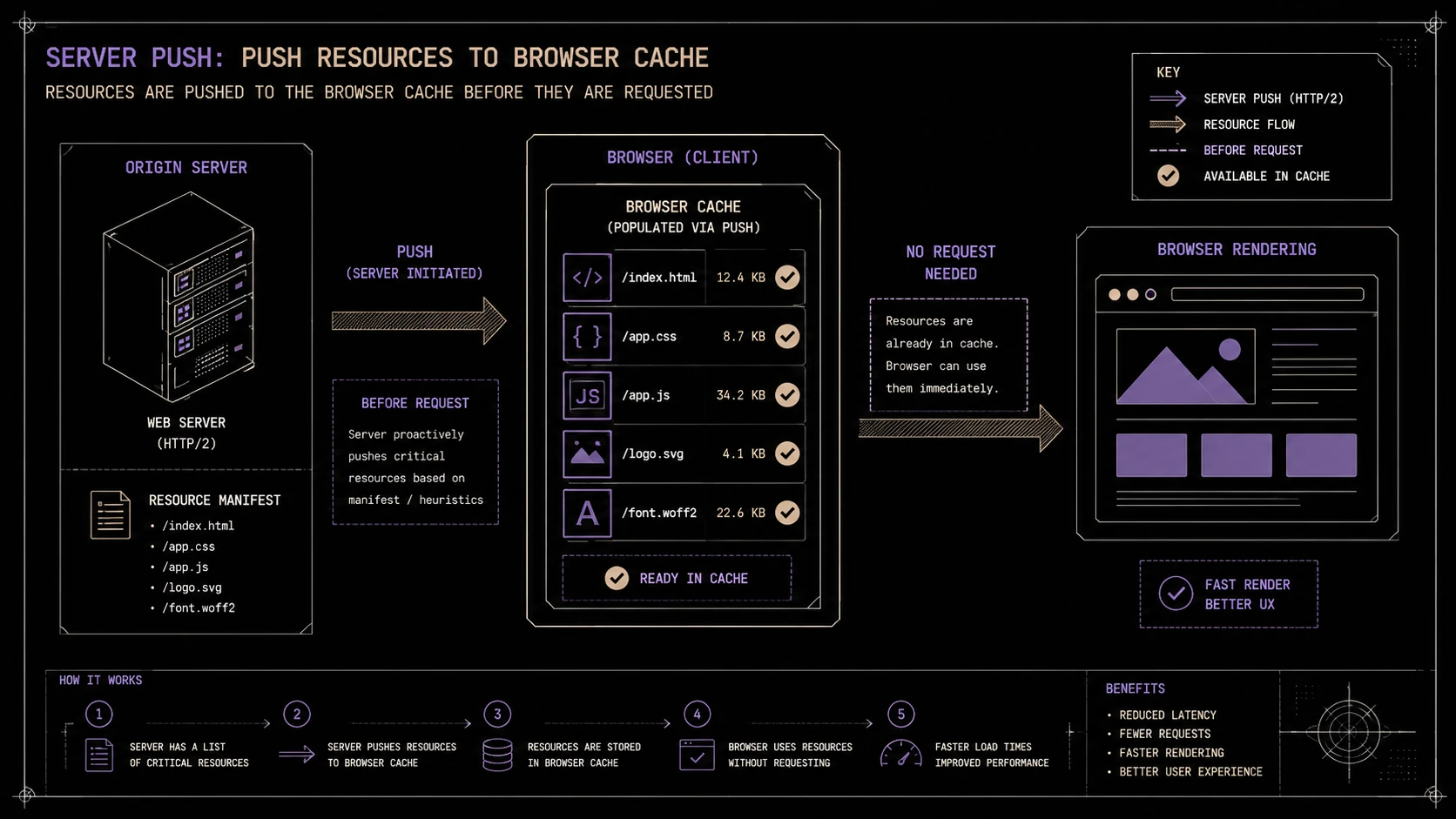
| Server Push | Allows proactive resource delivery |
These architectural improvements reduce many inefficiencies associated with HTTP/1.1.
How HTTP/2 Works
A simplified request flow includes:
- 1.Client establishes a single HTTP/2 connection.
- 2.Multiple requests are transmitted concurrently.
- 3.Responses return independently using separate streams.
- 4.Header compression minimizes protocol overhead.
- 5.Priority information guides resource delivery.
- 6.Optional server push delivers anticipated resources.
This model significantly reduces the need for multiple simultaneous TCP connections.
Key Features
Binary Protocol
HTTP/2 replaces the text-based framing mechanism with a binary protocol that is more efficient for computers to process.
Multiplexing
HTTP/2 Multiplexed connection layout vs HTTP/1.1 Head-of-line blocking

HTTP/1.1 (Sequential/Blocking):
[TCP Connection 1] ---> Request 1 (styles.css) ===> Response 1
[TCP Connection 1] ---> Request 2 (script.js)  ===> [Block/Wait for connection]

HTTP/2 (Simultaneous/Multiplexed):
[Single TCP Connection]
    |---> Frame 1 (Stream 1, Request styles.css)
    |---> Frame 2 (Stream 3, Request script.js)
    |---> Frame 3 (Stream 1, Response data chunk)
    |---> Frame 4 (Stream 3, Response data chunk)
Multiple requests and responses share a single connection without blocking one another.
HPACK Header Compression
Repeated HTTP headers consume less bandwidth through standardized compression.
Stream Prioritization
Browsers communicate resource priorities to improve page rendering.
Server Push
Servers may proactively send resources expected to be required by the client.
The End of Traditional Front-End Optimizations
Several common optimization strategies deserve reevaluation.
Domain Sharding
Historically, developers distributed resources across multiple hostnames to increase parallel browser connections.
With multiplexing available through a single HTTP/2 connection, this technique may provide diminishing returns while introducing additional DNS lookups and connection overhead.
Image Sprites
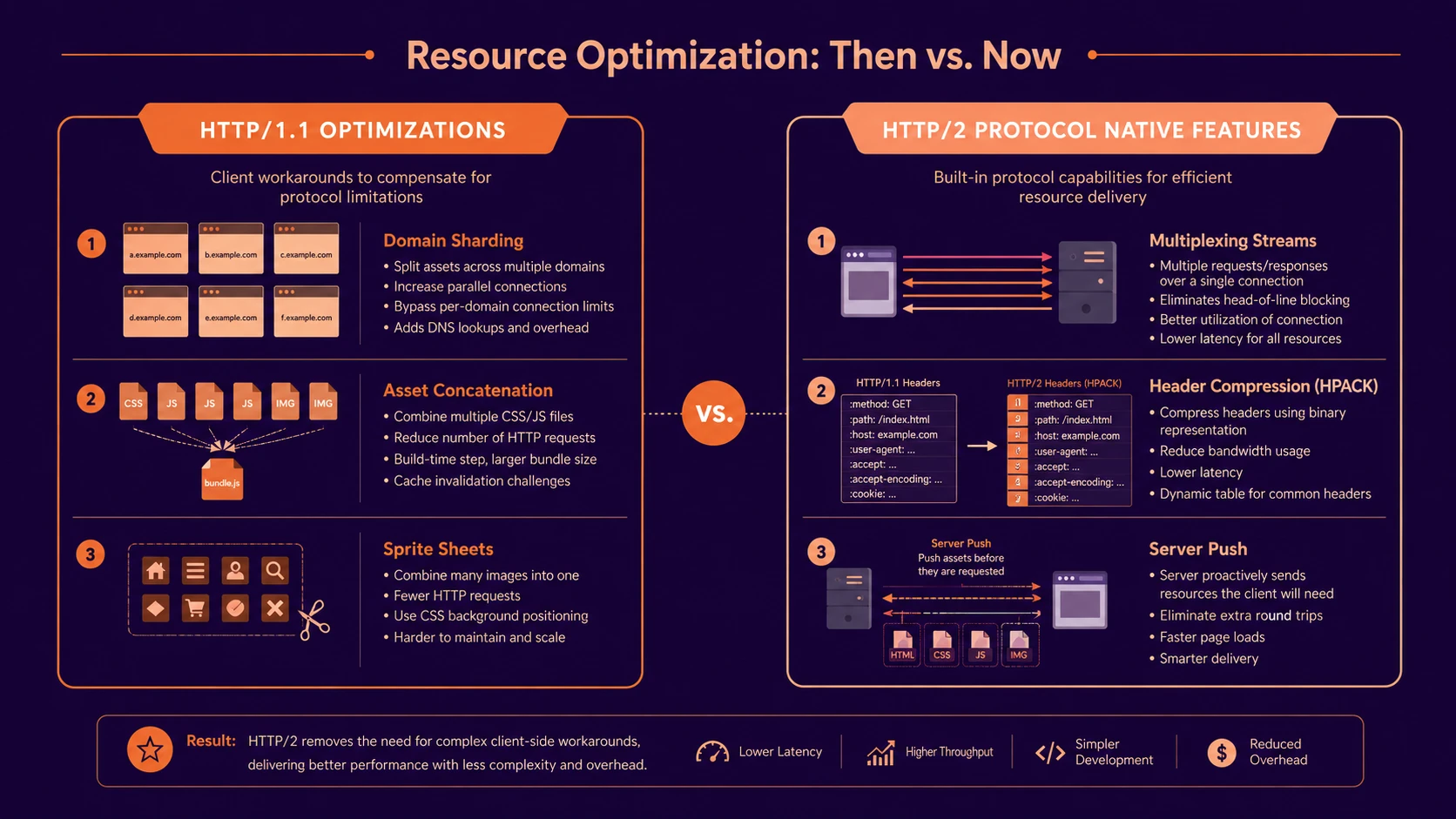
System architecture diagram and conceptual workflow layout for HTTP/2 Standard Approval.
Combining numerous images into a single sprite reduced request counts under HTTP/1.1.
Since HTTP/2 efficiently transfers many small resources concurrently, separate image delivery may become more practical in many scenarios.
Asset Concatenation
Large bundled JavaScript and CSS files have traditionally reduced request overhead.
HTTP/2's multiplexing allows organizations to reconsider whether aggressive concatenation remains the most efficient deployment strategy.
Enterprise Use Cases
HTTP/2 benefits numerous enterprise environments.
Corporate Portals
Large employee portals containing many static assets can reduce page load latency.
E-Commerce Platforms
Improved asset delivery contributes to faster product browsing and checkout experiences.
Software as a Service
Cloud-hosted business applications benefit from more efficient communication between browsers and application servers.
Mobile Web Applications
Reduced protocol overhead is particularly valuable where network latency is significant.
API Platforms
Applications making numerous concurrent HTTP requests can benefit from multiplexed communication.
Performance Considerations
HTTP/2 introduces several performance advantages.
- ◆Fewer TCP connections
- ◆Lower connection overhead
- ◆Reduced latency
- ◆Improved bandwidth utilization
- ◆Better resource scheduling
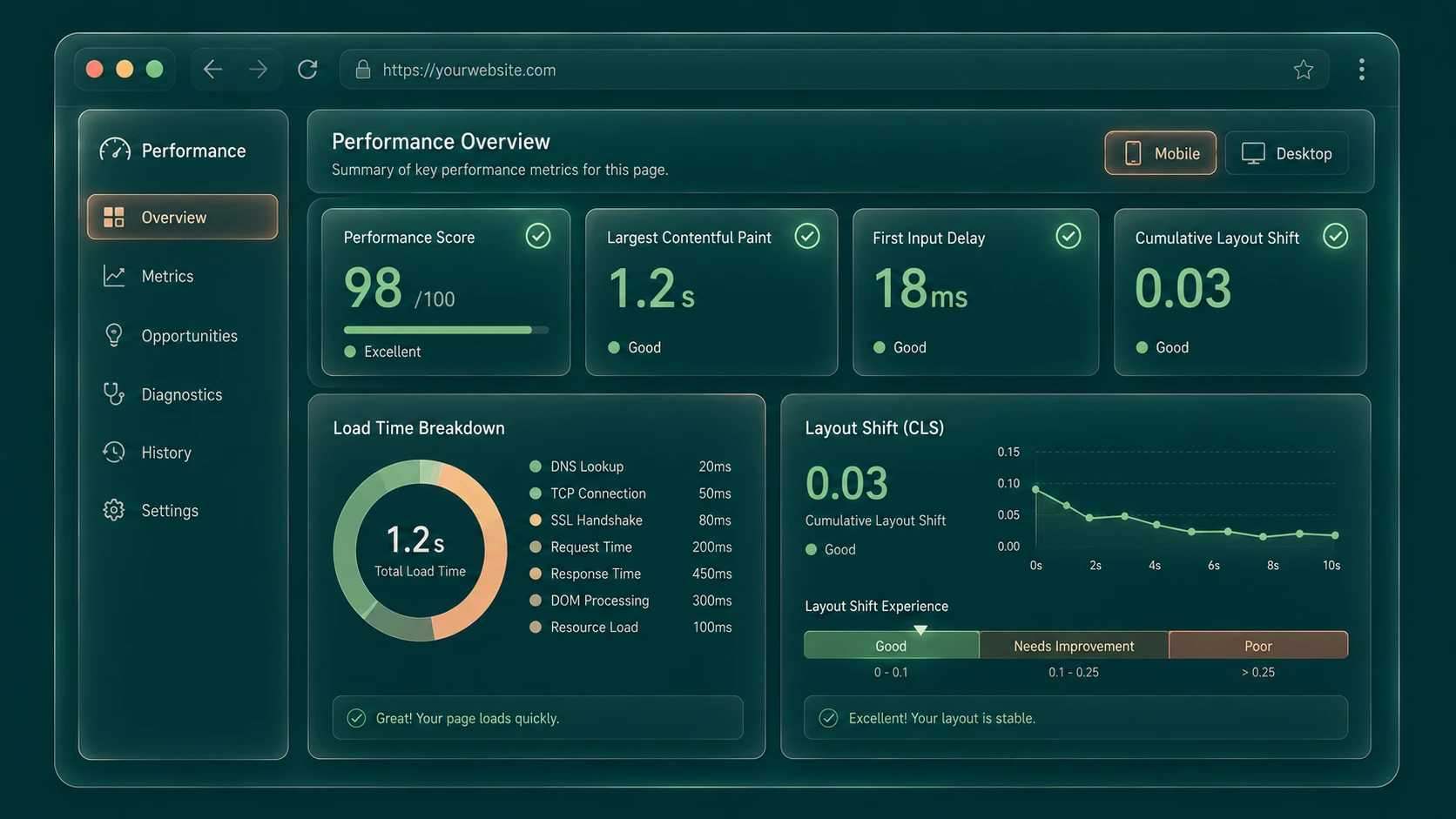
- ◆Faster page rendering under appropriate workloads
Organizations should benchmark production applications because application architecture, caching strategy, and network conditions continue to influence overall performance.
Security Considerations
Although HTTP/2 focuses primarily on transport efficiency, enterprise deployments should continue emphasizing:
- ◆Strong TLS configurations
- ◆Certificate management
- ◆Secure cipher selection
- ◆Authentication controls
- ◆Application-layer security
- ◆Regular protocol updates
Many browser implementations are expected to deploy HTTP/2 primarily alongside encrypted connections.
Scalability
HTTP/2 improves scalability by reducing connection management overhead.
Benefits include:
- ◆More efficient connection reuse
- ◆Lower protocol overhead
- ◆Improved server resource utilization
- ◆Better support for asset-rich applications
- ◆Simplified client communication
These characteristics are particularly valuable for large enterprise web platforms serving significant traffic volumes.
Best Practices
Organizations preparing for HTTP/2 should consider the following recommendations.
- ◆Benchmark existing applications before migration.
- ◆Reevaluate domain sharding strategies.
- ◆Review asset bundling policies.
- ◆Maintain effective caching practices.
- ◆Optimize TLS deployment.
- ◆Test browser compatibility.
- ◆Monitor network performance after deployment.
- ◆Update front-end optimization guidelines.
Common Mistakes
| Mistake | Enterprise Impact |
|---|---|
| Assuming all HTTP/1.1 optimizations remain beneficial | Reduced efficiency |
| Ignoring real-world performance testing | Uncertain results |
| Excessive asset bundling | Reduced flexibility |
| Delaying infrastructure upgrades | Missed performance opportunities |
| Overlooking TLS configuration | Security and compatibility risks |
| Treating HTTP/2 as an application rewrite | Unnecessary migration effort |
Technology Comparison
| Capability | HTTP/1.1 | HTTP/2 |
|---|---|---|
| Protocol Format | Text-Based | Binary |
| Concurrent Requests | Limited by Connections | Multiplexed Streams |
| Header Compression | No | HPACK |
| Stream Prioritization | No | Yes |
| Server Push | No | Supported |
| Need for Domain Sharding | Common | Significantly Reduced |
Adoption Strategy
Organizations planning HTTP/2 adoption should:
- 1.Verify server support.
- 2.Upgrade compatible web infrastructure.
- 3.Evaluate TLS deployment.
- 4.Benchmark production workloads.
- 5.Review front-end build processes.
- 6.Simplify legacy optimization techniques where appropriate.
- 7.Monitor application performance.
- 8.Update development standards based on observed results.
Limitations
As of January 2015, HTTP/2 adoption depends upon server software, browser support, and infrastructure upgrades. Organizations should also recognize that protocol improvements do not eliminate the need for efficient application design, caching, content optimization, and careful network architecture.
Looking Ahead
From the perspective of January 2015, the approval of HTTP/2 represents a major milestone in the evolution of the web. By addressing long-standing inefficiencies within HTTP/1.1, the new protocol shifts performance optimization from application workarounds toward protocol-level improvements. Enterprise development teams should begin reassessing established front-end practices and prepare their infrastructure for a gradual transition to HTTP/2 as server implementations and browser support continue expanding.