Introduction
As enterprise software systems continue to grow in complexity, effective diagnostics have become just as important as application functionality. Large .NET applications often consist of hundreds of projects, thousands of classes, and millions of lines of source code maintained by multiple development teams. Identifying the origin of runtime issues quickly can significantly reduce troubleshooting time and operational costs.
Historically, developers have manually supplied method names, source identifiers, or logging context whenever diagnostic information was required. Although effective, this approach introduces repetitive code, maintenance overhead, and the possibility of inaccurate logging after refactoring.
C# 5.0 addresses this challenge through Caller Information Attributes, allowing the compiler to automatically provide contextual information such as the calling member, source file, and source line number during compilation.
From the perspective of December 2013, this feature represents a practical improvement to developer productivity and enterprise diagnostics rather than a fundamental language redesign.
Industry Background
Enterprise software development has increasingly emphasized operational visibility alongside application functionality.
Organizations routinely depend on:
- ◆Centralized logging.
- ◆Exception reporting.
- ◆Production diagnostics.
- ◆Performance monitoring.
- ◆Automated testing.
- ◆Continuous Integration.
As software systems become more distributed, manually maintaining diagnostic metadata becomes increasingly difficult.
The .NET ecosystem has steadily expanded support for structured logging, automated testing, and asynchronous programming, making accurate runtime diagnostics more valuable than ever.
The Business Problem
Traditional logging implementations often require developers to explicitly provide contextual information.
Common challenges include:
- ◆Hardcoded method names.
- ◆Incorrect logging after refactoring.
- ◆Duplicate diagnostic code.
- ◆Limited traceability.
- ◆Increased maintenance effort.
- ◆Inconsistent logging conventions.
These issues reduce diagnostic accuracy while increasing long-term maintenance costs.
Caller Information Attributes eliminate much of this repetitive work by allowing the compiler to supply contextual metadata automatically.
Understanding the Technology
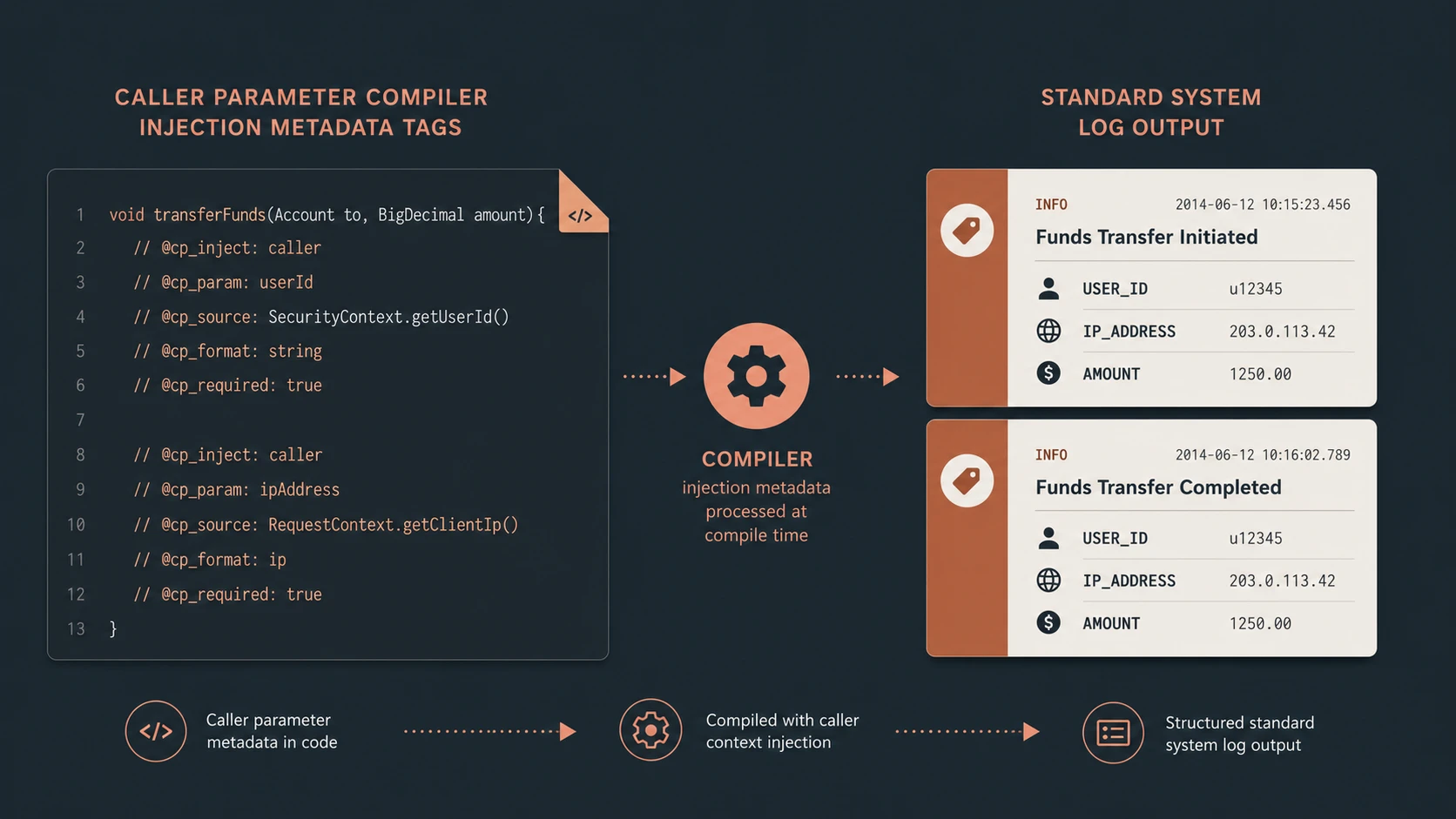
Caller Information Attributes enable optional parameters to receive compiler-generated values describing the calling code.
The feature introduces three primary attributes.
- ◆CallerMemberName.
- ◆CallerFilePath.
- ◆CallerLineNumber.
Rather than relying on reflection or runtime inspection, the compiler substitutes appropriate values during compilation.
This design provides diagnostic information with minimal runtime overhead.
Core Architecture
Caller Information Attributes participate directly in the compilation process.
| Component | Responsibility |
|---|---|
| Application Code | Invokes diagnostic methods |
| C# Compiler | Injects caller information |
| Caller Attributes | Receive compiler-generated values |
| Logging Framework | Records diagnostic information |
| Monitoring Systems | Analyze application events |
The compiler automatically supplies caller information whenever optional parameters decorated with the appropriate attributes are omitted.
Key Features
CallerMemberName
Automatically captures the name of the calling method or property.
CallerFilePath
Provides the source file path associated with the caller during compilation.
CallerLineNumber
Records the source line where the method invocation occurs.
Reduced Boilerplate
Developers no longer need to manually duplicate method names throughout logging code.
Improved Refactoring Support
Diagnostic information remains accurate when methods are renamed using development tools.
Compile-Time Resolution
Values are generated during compilation rather than through runtime reflection.
How It Works
A simplified workflow appears below.
Application Method
        |
Calls Logging Method
        |
Caller Information Attributes
        |
C# Compiler Inserts Values
        |
Logging Framework Records Entry
        |
Diagnostics Repository
When optional caller parameters are omitted, the compiler automatically substitutes the appropriate contextual values before the application is executed.
Enterprise Use Cases
Caller Information Attributes support numerous enterprise scenarios.
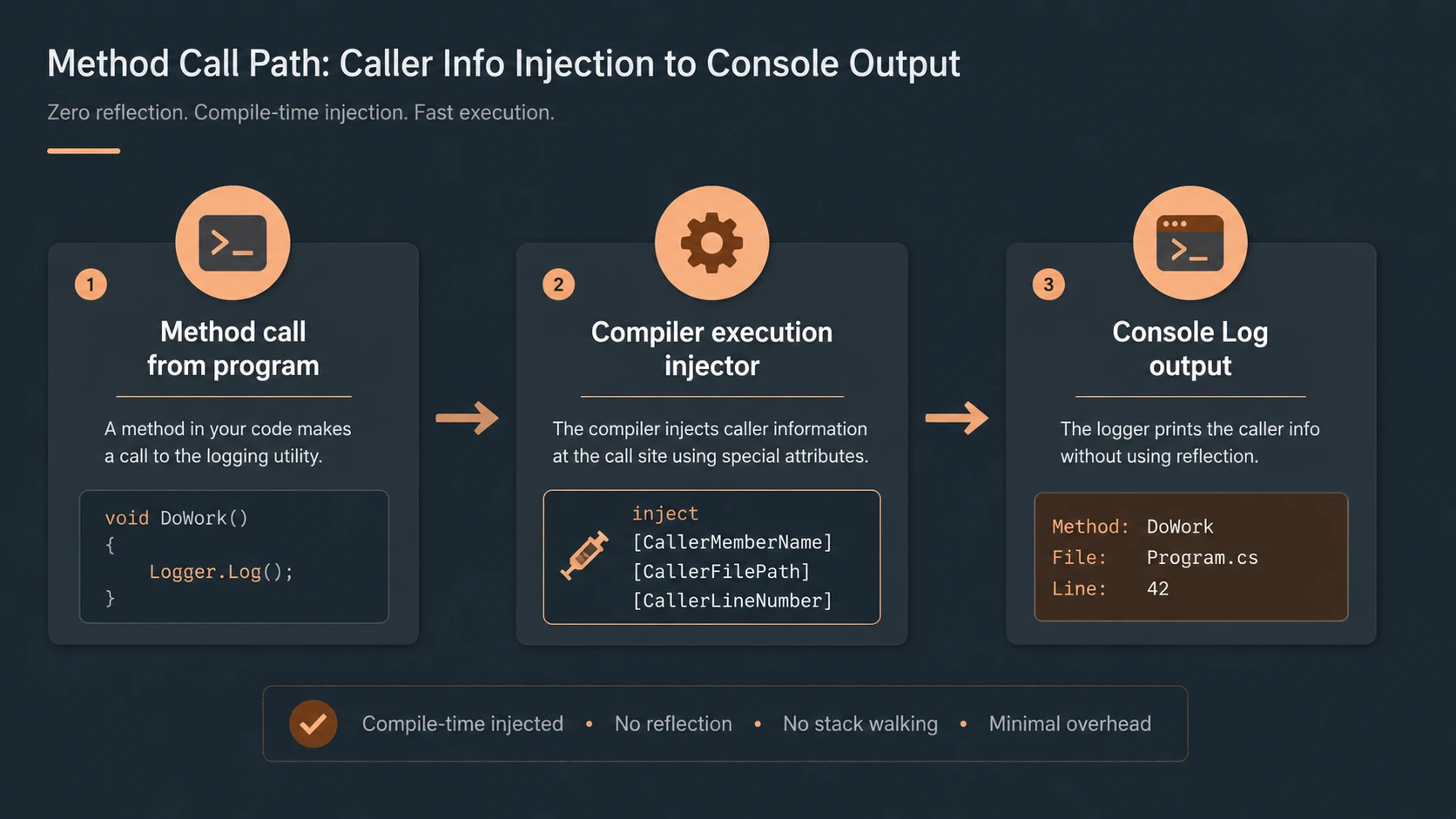
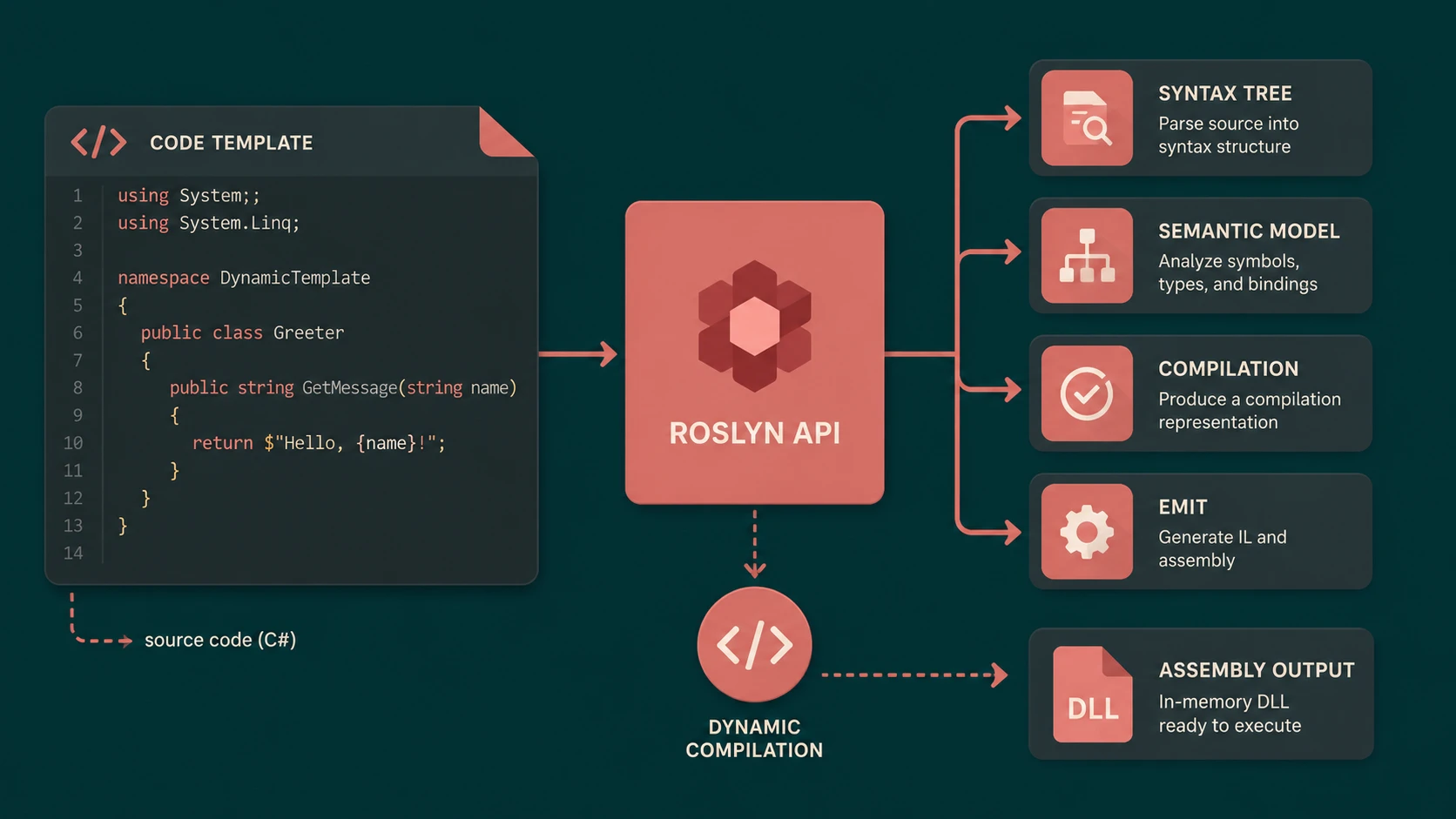
System architecture diagram and conceptual workflow layout for C# 5.0 Caller Information Attributes.
Application Logging
Logging frameworks can automatically capture the origin of diagnostic messages.
Exception Reporting
Support teams receive more detailed information regarding application failures.
Audit Systems
Operational events become easier to trace throughout complex business applications.
Framework Development
Reusable libraries can expose diagnostic APIs without requiring consumers to manually provide contextual information.
Internal Development Tools
Engineering teams can build utilities that consistently capture execution context across large codebases.
Performance Considerations
One advantage of Caller Information Attributes is that values are resolved during compilation.
Performance considerations include:
- ◆No runtime reflection required.
- ◆Minimal execution overhead.
- ◆Improved diagnostic consistency.
- ◆Efficient parameter substitution.
- ◆Reduced manual string allocation within application code.
Applications gain richer diagnostics without introducing significant runtime cost.
Security Considerations
Diagnostic information should be handled carefully within enterprise environments.
Organizations should:
- ◆Protect application logs.
- ◆Limit access to diagnostic information.
- ◆Avoid exposing sensitive implementation details to end users.
- ◆Review production logging policies.
- ◆Secure centralized log repositories.
Source file paths and implementation details may reveal internal application structure if exposed improperly.
Scalability
Caller Information Attributes support scalable application diagnostics by standardizing contextual logging.
Benefits include:
- ◆Consistent diagnostic metadata.
- ◆Simplified reusable logging APIs.
- ◆Reduced maintenance overhead.
- ◆Improved debugging efficiency.
- ◆Easier integration with centralized monitoring platforms.
As enterprise applications grow, automated diagnostic context becomes increasingly valuable.
Best Practices
Development teams should:
- ◆Centralize logging implementations.
- ◆Use Caller Information Attributes within reusable diagnostic utilities.
- ◆Protect sensitive diagnostic data.
- ◆Standardize logging conventions.
- ◆Combine caller information with structured exception handling.
- ◆Integrate diagnostic logging into Continuous Integration validation.
- ◆Review production log retention policies.
These practices improve operational visibility while maintaining manageable logging systems.
Common Mistakes
| Mistake | Business Impact |
|---|---|
| Continuing to hardcode method names | Increased maintenance effort |
| Exposing source paths to end users | Information disclosure |
| Inconsistent logging implementation | Difficult troubleshooting |
| Excessive diagnostic logging | Increased storage requirements |
| Ignoring log security | Operational risk |
| Using diagnostics without monitoring | Reduced operational value |
Avoiding these issues helps maximize the effectiveness of enterprise diagnostics.
Technology Comparison
| Approach | Advantages | Limitations |
|---|---|---|
| Manual Method Names | Simple implementation | Difficult to maintain during refactoring |
| Reflection-Based Inspection | Automatic discovery | Runtime overhead |
| Caller Information Attributes | Compile-time generation with minimal overhead | Requires C# 5.0 compiler support |
Caller Information Attributes provide a balanced solution by improving maintainability without introducing significant runtime cost.
Adoption Strategy
Organizations should adopt Caller Information Attributes incrementally.
Recommended roadmap:
- 1.Identify shared logging utilities.
- 2.Introduce Caller Information Attributes into reusable diagnostic APIs.
- 3.Remove hardcoded method identifiers.
- 4.Standardize logging practices across projects.
- 5.Validate diagnostic output through automated testing.
- 6.Integrate diagnostics with enterprise monitoring infrastructure.
This gradual approach improves code quality while minimizing migration effort.
Limitations
Although Caller Information Attributes simplify diagnostics, organizations should recognize several considerations.
- ◆They provide compile-time information rather than runtime execution analysis.
- ◆Existing logging frameworks may require minor updates to leverage the feature.
- ◆Diagnostic data should be protected appropriately.
- ◆Source file paths may differ across build environments.
- ◆Effective monitoring still depends on well-designed logging strategies.
Caller Information Attributes enhance diagnostics but do not replace comprehensive monitoring or exception management.
Looking Ahead
From the perspective of December 2013, Caller Information Attributes represent one of the most practical enhancements introduced in C# 5.0 for enterprise application development. By allowing the compiler to automatically supply caller context, the language reduces repetitive code while improving the accuracy and maintainability of logging frameworks.
As enterprise software systems continue expanding in size and complexity, automated diagnostics will play an increasingly important role in reducing operational costs and improving software reliability. Development teams that integrate Caller Information Attributes into standardized logging libraries today will be better positioned to build maintainable, observable, and supportable .NET applications in the years ahead.