Introduction
As enterprise web applications continue growing in both functionality and organizational complexity, traditional front-end monoliths have become increasingly difficult to maintain. Applications supporting millions of users often contain hundreds of pages, thousands of reusable components, and contributions from dozens of engineering teams. Even with modern JavaScript frameworks, a single front-end repository can become a bottleneck for development velocity, deployment frequency, and long-term maintainability.
Inspired by the success of microservices on the backend, software architects began exploring whether similar principles could be applied to front-end applications. Rather than treating the browser as a single deployable artifact, Micro-Frontend Architecture divides large user interfaces into independently owned, independently deployed, and independently maintained application modules.
Over the past several years, the ecosystem has matured significantly. Module Federation, improved CI/CD automation, container-based deployments, shared design systems, and enterprise platform engineering have transformed micro-frontends from architectural experiments into production-ready solutions.
By early 2023, organizations across finance, e-commerce, telecommunications, healthcare, and SaaS increasingly view Micro-Frontend Architecture as an effective strategy for scaling engineering organizations alongside application complexity.
From the perspective of February 2023, the discussion has shifted away from whether micro-frontends are technically possible toward identifying when they provide measurable business value.
Industry Background
Enterprise digital platforms continue expanding rapidly.
Organizations increasingly build:
- ◆Customer portals.
- ◆Enterprise SaaS platforms.
- ◆E-commerce marketplaces.
- ◆Banking applications.
- ◆Healthcare systems.
- ◆Internal business platforms.
- ◆B2B management portals.
Large engineering organizations increasingly prioritize:
- ◆Independent team ownership.
- ◆Continuous deployment.
- ◆Platform engineering.
- ◆Design system consistency.
- ◆Cloud-native delivery.
- ◆Organizational scalability.
Modern front-end architecture must scale both technically and organizationally.
The Business Problem
Large front-end monoliths frequently encounter several operational challenges.
Organizations commonly experience:
- ◆Slow release cycles.
- ◆Repository contention.
- ◆Merge conflicts.
- ◆Large bundle sizes.
- ◆Cross-team dependencies.
- ◆Difficult code ownership.
- ◆Increasing maintenance costs.
As development teams grow, coordinating changes within a single application becomes increasingly expensive.
Micro-Frontend Architecture addresses these concerns by decentralizing front-end ownership.
Understanding the Technology
Micro-Frontend Architecture applies distributed system principles to browser-based applications.
Instead of delivering one large front-end application, organizations compose multiple independently deployable user interface modules into a unified experience.
Core architectural capabilities include:
- ◆Independent deployment.
- ◆Team autonomy.
- ◆Module Federation.
- ◆Shared design systems.
- ◆Runtime composition.
- ◆CI/CD automation.
- ◆Platform governance.
Each application module can evolve independently while contributing to a consistent overall user experience.
Core Architecture
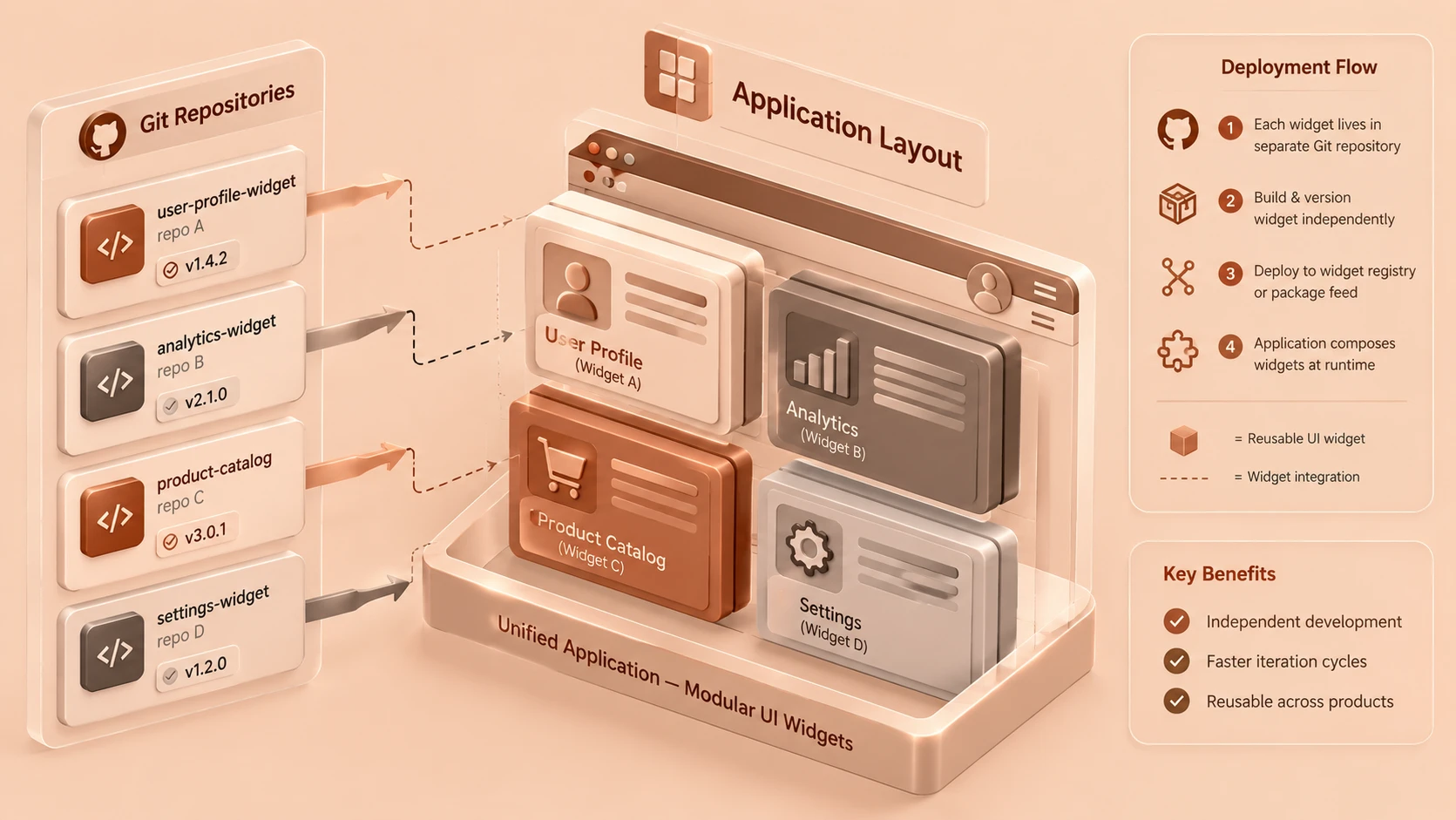
A simplified Micro-Frontend Architecture appears below.
| Component | Responsibility |
|---|---|
| Shell Application | Routing and application composition |
| Micro-Frontend Modules | Independent business domains |
| Module Federation | Runtime module sharing |
| Shared Design System | UI consistency |
| API Gateway | Backend integration |
| CI/CD Pipeline | Independent deployments |
| Monitoring Platform | Observability and diagnostics |
The shell application coordinates routing while independently deployed modules provide business functionality.
Key Features
Independent Team Ownership
The defining advantage of Micro-Frontend Architecture is organizational independence.
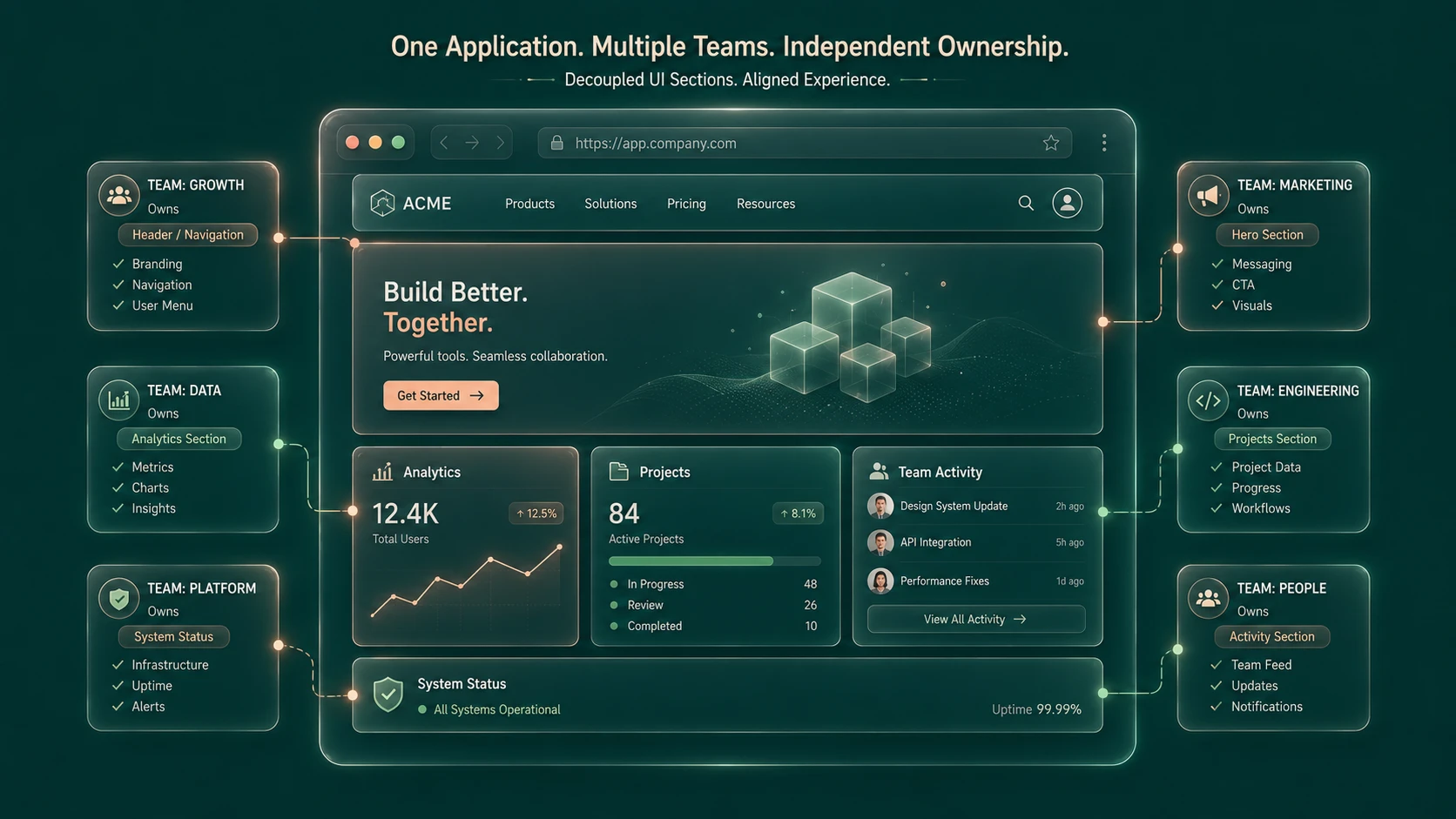
Each product team owns a specific business capability, including:
- ◆Development.
- ◆Testing.
- ◆Deployment.
- ◆Monitoring.
- ◆Maintenance.
This reduces cross-team coordination while enabling faster software delivery.
Independent Deployments
Unlike traditional front-end monoliths, micro-frontends allow individual application modules to be deployed without rebuilding the entire platform.
Benefits include:
- ◆Faster releases.
- ◆Reduced deployment risk.
- ◆Smaller rollback scope.
- ◆Improved operational agility.
Deployment independence aligns closely with modern DevOps practices.
Module Federation
Module Federation has become one of the most influential technologies enabling production micro-frontends.
Rather than duplicating shared code across applications, runtime module sharing enables:
- ◆Shared libraries.
- ◆Shared UI components.
- ◆Reduced duplication.
- ◆Independent application composition.
This significantly simplifies distributed front-end development.
Shared Design Systems
Enterprise design systems remain essential.
Although application teams work independently, shared:
- ◆Typography.
- ◆Components.
- ◆Color systems.
- ◆Accessibility standards.
- ◆Interaction patterns.
ensure a consistent customer experience.
Platform Engineering
Modern micro-frontends increasingly depend on centralized platform engineering.
Platform teams provide:
- ◆Build infrastructure.
- ◆Deployment automation.
- ◆Monitoring.
- ◆Security standards.
- ◆Shared tooling.
This enables product teams to focus on business functionality.
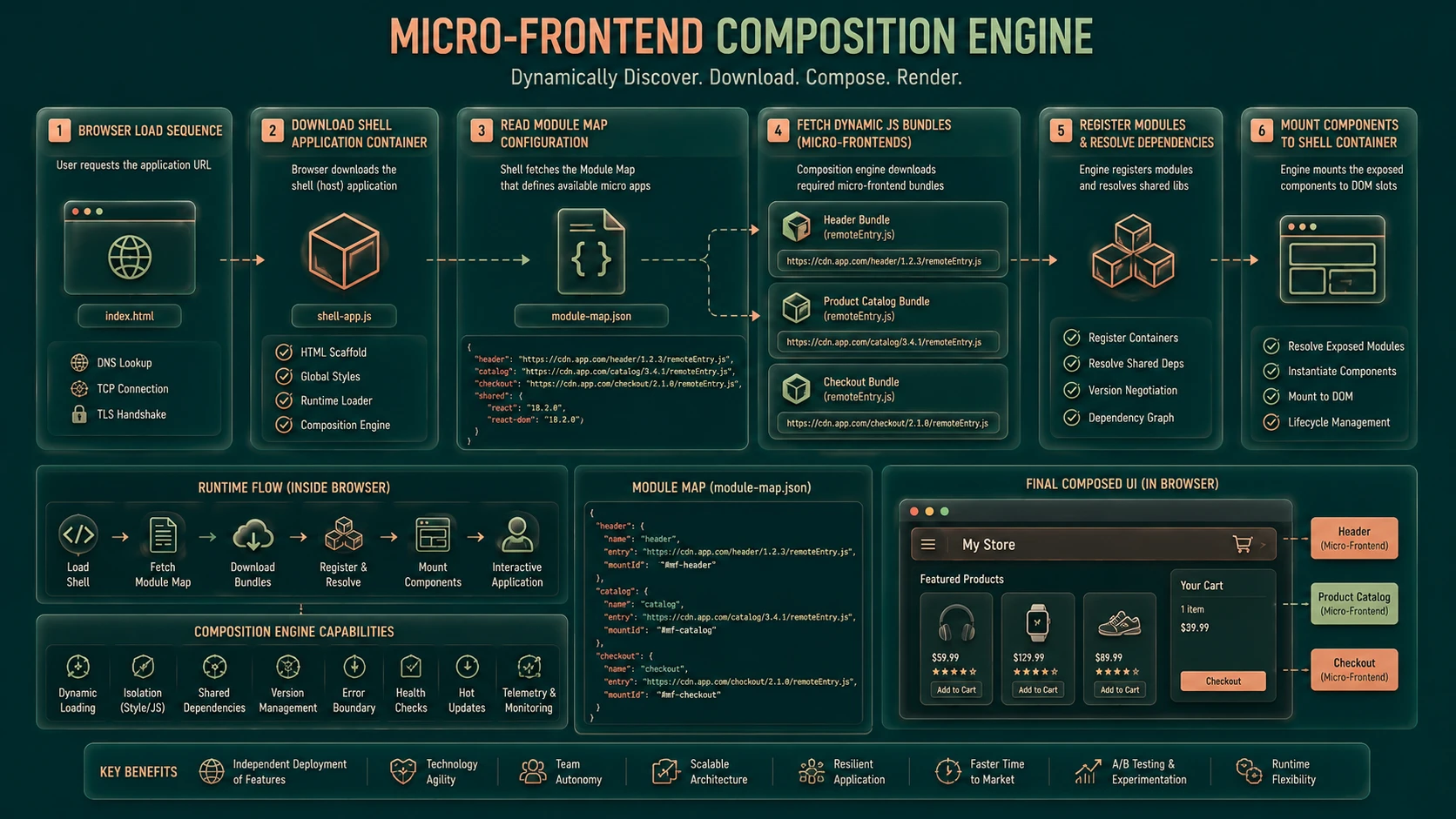
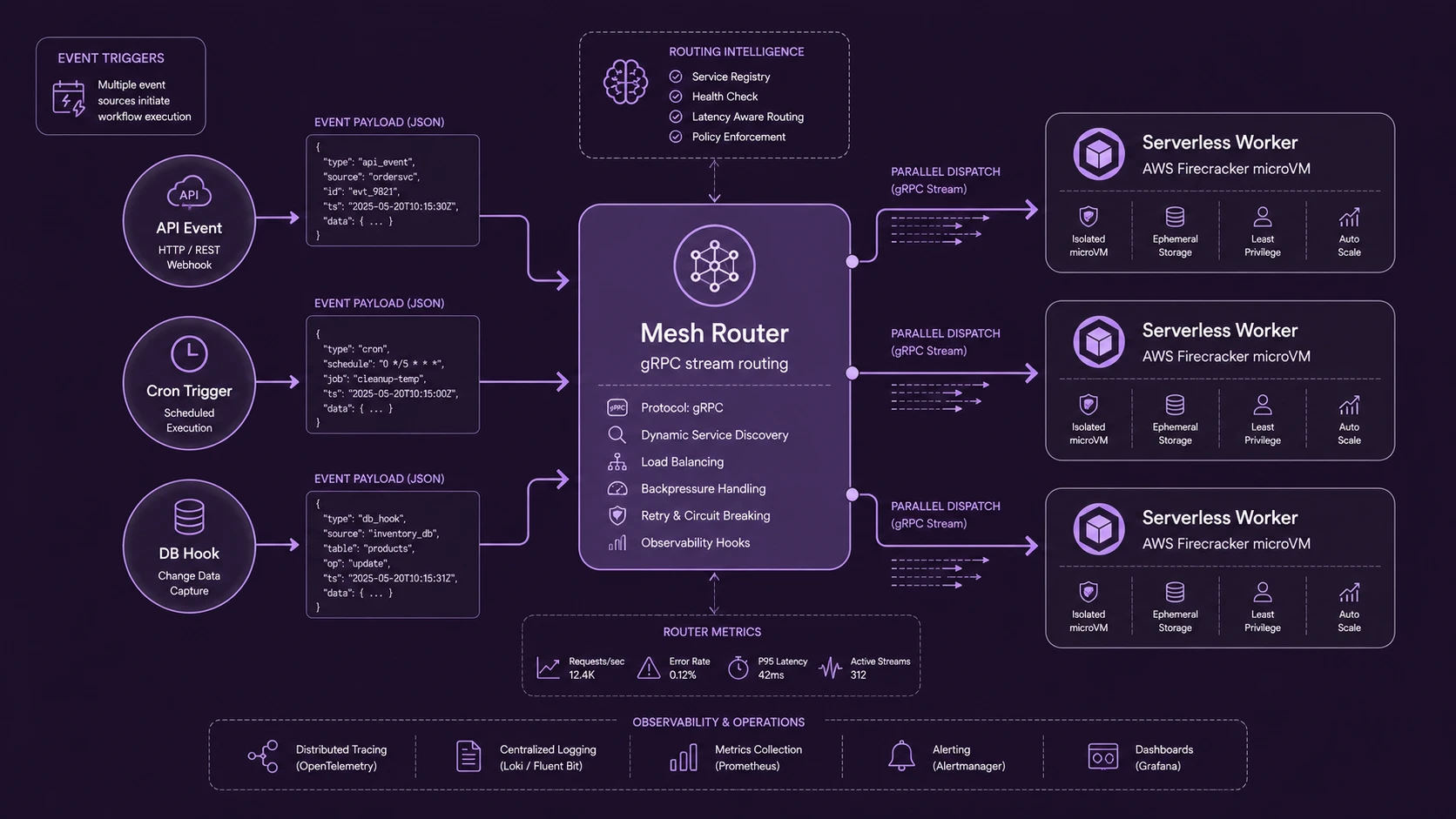
System architecture diagram and conceptual workflow layout for Advances in Micro-Frontend Architecture.
Domain-Oriented Architecture
Applications are typically organized around business capabilities rather than technical layers.
Examples include:
- ◆Customer Management.
- ◆Payments.
- ◆Product Catalog.
- ◆Inventory.
- ◆Analytics.
- ◆Administration.
This improves ownership and long-term maintainability.
How It Works
A simplified architecture workflow appears below.
User Request
      |
Application Shell
      |
Routing
      |
Load Required Micro-Frontend
      |
Module Federation
      |
Shared Design System
      |
Business Functionality
The application shell loads the required business module while maintaining a unified user experience.
Enterprise Use Cases
Enterprise SaaS Platforms
Independent product teams deliver features without affecting unrelated application areas.
E-Commerce
Shopping, checkout, catalog, search, and customer account modules evolve independently.
Financial Services
Payments, customer onboarding, compliance, and reporting teams maintain separate application modules.
Telecommunications
Billing, support, subscriptions, and customer portals benefit from domain-driven ownership.
Internal Enterprise Platforms
Business departments develop specialized interfaces while adhering to centralized governance.
Performance Considerations
Micro-frontends improve organizational scalability but require careful performance engineering.
Organizations should evaluate:
- ◆Initial page load.
- ◆JavaScript bundle size.
- ◆Runtime composition overhead.
- ◆Shared dependency management.
- ◆Network requests.
- ◆Client-side caching.
Architectural decomposition should not compromise application responsiveness.
Security Considerations
Distributed front-end architectures require centralized security governance.
Organizations should implement:
- ◆Single Sign-On.
- ◆Role-Based Access Control.
- ◆Content Security Policy.
- ◆Secure API gateways.
- ◆Dependency management.
- ◆Runtime integrity validation.
Security standards should remain consistent across independently deployed modules.
Scalability
Micro-Frontend Architecture improves enterprise scalability through:
- ◆Independent deployments.
- ◆Team autonomy.
- ◆Domain ownership.
- ◆Smaller codebases.
- ◆Platform engineering.
- ◆Continuous delivery.
These characteristics allow engineering organizations to scale alongside growing product portfolios.
Best Practices
Organizations adopting Micro-Frontend Architecture should:
- ◆Decompose applications around business domains rather than UI widgets.
- ◆Establish shared design systems.
- ◆Standardize authentication and authorization.
- ◆Build centralized platform engineering capabilities.
- ◆Monitor application performance continuously.
- ◆Minimize duplicate dependencies.
- ◆Define clear ownership boundaries for every module.
Successful implementations prioritize organizational clarity as much as technical architecture.
Common Mistakes
| Mistake | Business Impact |
|---|---|
| Splitting applications into excessively small modules | Increased operational complexity |
| Ignoring shared design systems | Inconsistent user experience |
| Duplicating large framework dependencies | Larger application bundles |
| Allowing inconsistent deployment practices | Operational instability |
| Treating every project as a candidate for micro-frontends | Unnecessary architectural complexity |
| Neglecting platform engineering investment | Reduced developer productivity |
Organizations should adopt micro-frontends where team scale and business complexity justify the additional architectural investment.
Technology Comparison
| Characteristic | Front-End Monolith | Micro-Frontend Architecture |
|---|---|---|
| Deployment | Single application | Independent modules |
| Team Ownership | Shared repository | Domain ownership |
| Scaling | Limited by coordination | Organizational scalability |
| Release Process | Coordinated deployment | Independent releases |
| Codebase | Large monolith | Modular applications |
| Governance | Centralized | Shared platform with distributed ownership |
Micro-frontends extend many principles of microservices to browser applications while introducing new organizational and operational capabilities.
Adoption Strategy
Organizations should adopt Micro-Frontend Architecture incrementally.
- 1.Identify business domains with clear ownership boundaries.
- 2.Establish a shared design system.
- 3.Implement centralized authentication and routing.
- 4.Introduce Module Federation or an equivalent composition strategy.
- 5.Build standardized CI/CD pipelines.
- 6.Expand modularization as engineering teams and application complexity grow.
This phased approach minimizes architectural risk while allowing organizations to validate operational benefits.
Limitations
As of February 2023, organizations should recognize several considerations.
- ◆Micro-frontends introduce operational complexity that may not be justified for small applications or small engineering teams.
- ◆Shared governance is essential to prevent fragmented user experiences.
- ◆Performance optimization requires careful dependency management.
- ◆Platform engineering investment is often necessary for long-term success.
- ◆Organizations should evaluate business structure alongside technical architecture before adopting micro-frontends.
These considerations should guide enterprise modernization planning.
Looking Ahead
From the perspective of February 2023, Micro-Frontend Architecture has matured into a practical enterprise strategy for organizations operating large-scale digital platforms. Advances in Module Federation, cloud-native deployment, design systems, and platform engineering have significantly reduced the technical barriers to independent front-end delivery.
More importantly, the architecture has demonstrated that scaling software is no longer solely a technical challenge—it is equally an organizational one. By aligning application boundaries with business domains and empowering autonomous engineering teams, micro-frontends enable enterprises to accelerate innovation without sacrificing governance, consistency, or long-term maintainability. Organizations undergoing large-scale digital transformation should evaluate Micro-Frontend Architecture not as a universal solution, but as a strategic approach for managing complexity in rapidly growing front-end ecosystems.