Technical Overview & Strategic Context
Artificial intelligence is rapidly changing how modern web applications are designed. Instead of treating AI as an external API that the frontend simply calls, Next.js 16 enables developers to build interfaces where AI becomes a core part of the rendering pipeline. React Server Components (RSC) shift AI orchestration to the server, allowing applications to stream intelligent responses while keeping the browser lightweight and responsive.
For enterprise teams building AI assistants, knowledge platforms, copilots, and autonomous workflows, Server Components introduce a new architectural pattern. The frontend becomes a cognitive layer that continuously receives streamed intelligence rather than waiting for complete responses before rendering.
Key Principle: Execute AI workloads on the server, stream meaningful UI updates to the client, and minimize client-side computation for maximum scalability.
---
Why Server Components Matter for AI Applications
Traditional React applications rely heavily on client-side API requests. Every AI interaction requires fetching data, managing loading states, serializing large JSON responses, and updating complex component trees.
Next.js 16 changes this workflow by allowing Server Components to execute AI requests directly on the server. Since the server handles data fetching and rendering, only the required UI is streamed to the browser.
This architecture provides several benefits:
- ◆Reduced JavaScript bundle size
- ◆Lower client CPU utilization
- ◆Faster initial page rendering
- ◆Secure API key management
- ◆Native support for streaming interfaces
- ◆Improved scalability under high AI workloads
The result is an application that feels significantly faster while remaining easier to maintain.
---
AI Streaming with React Server Components
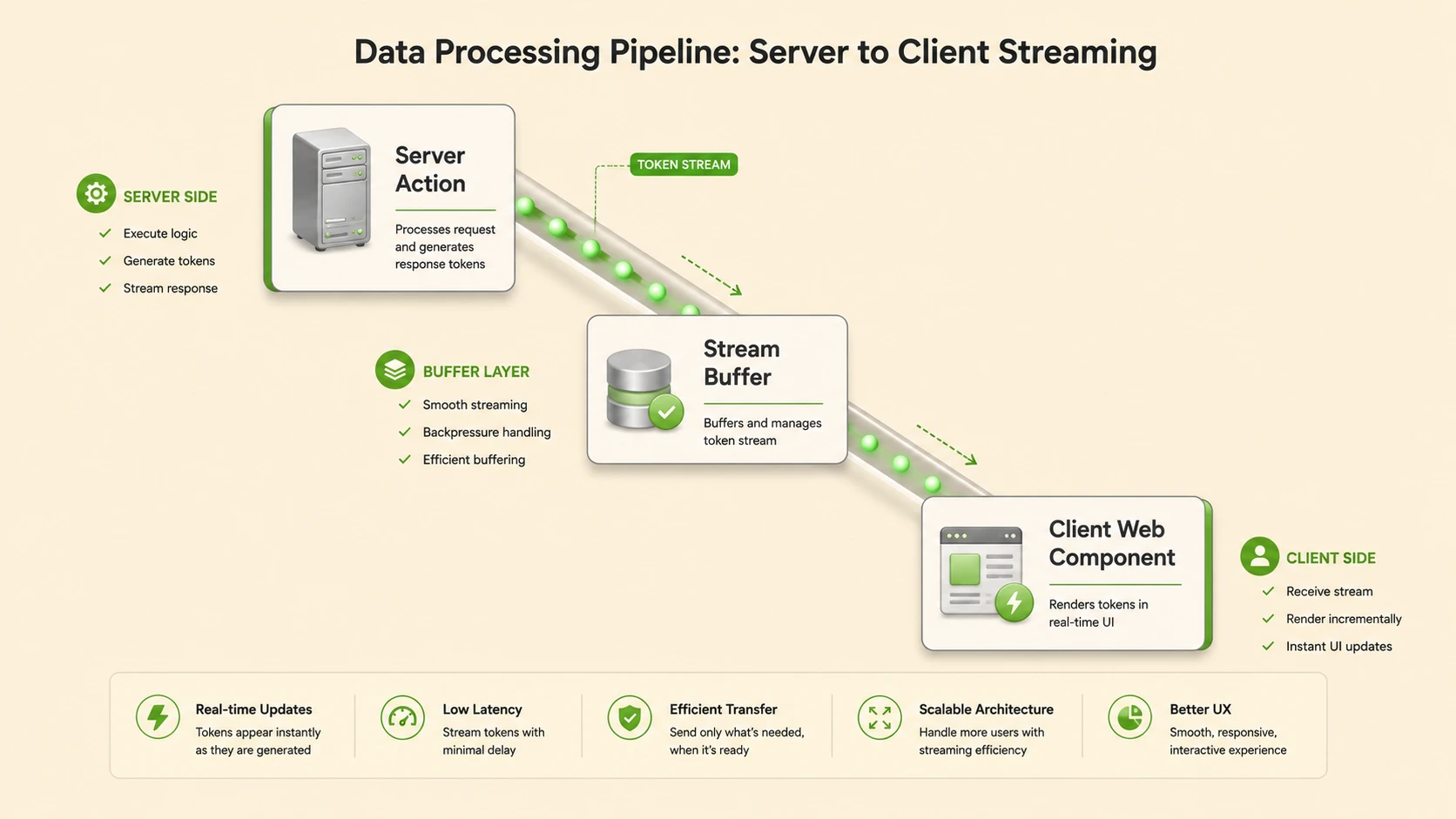
Large Language Models generate tokens progressively rather than producing an entire response at once. Server Components integrate naturally with this behavior through streaming rendering.
Instead of displaying a loading spinner for several seconds, the interface begins rendering immediately as tokens arrive from the model.
A typical workflow follows these steps:
- 1.User submits a prompt.
- 2.Server Component invokes the AI model.
- 3.Tokens stream from the provider.
- 4.React progressively renders updated UI.
- 5.The browser displays content without waiting for completion.
This creates a conversational experience that feels natural while reducing perceived latency.
---
Building the Frontend Cognitive Layer
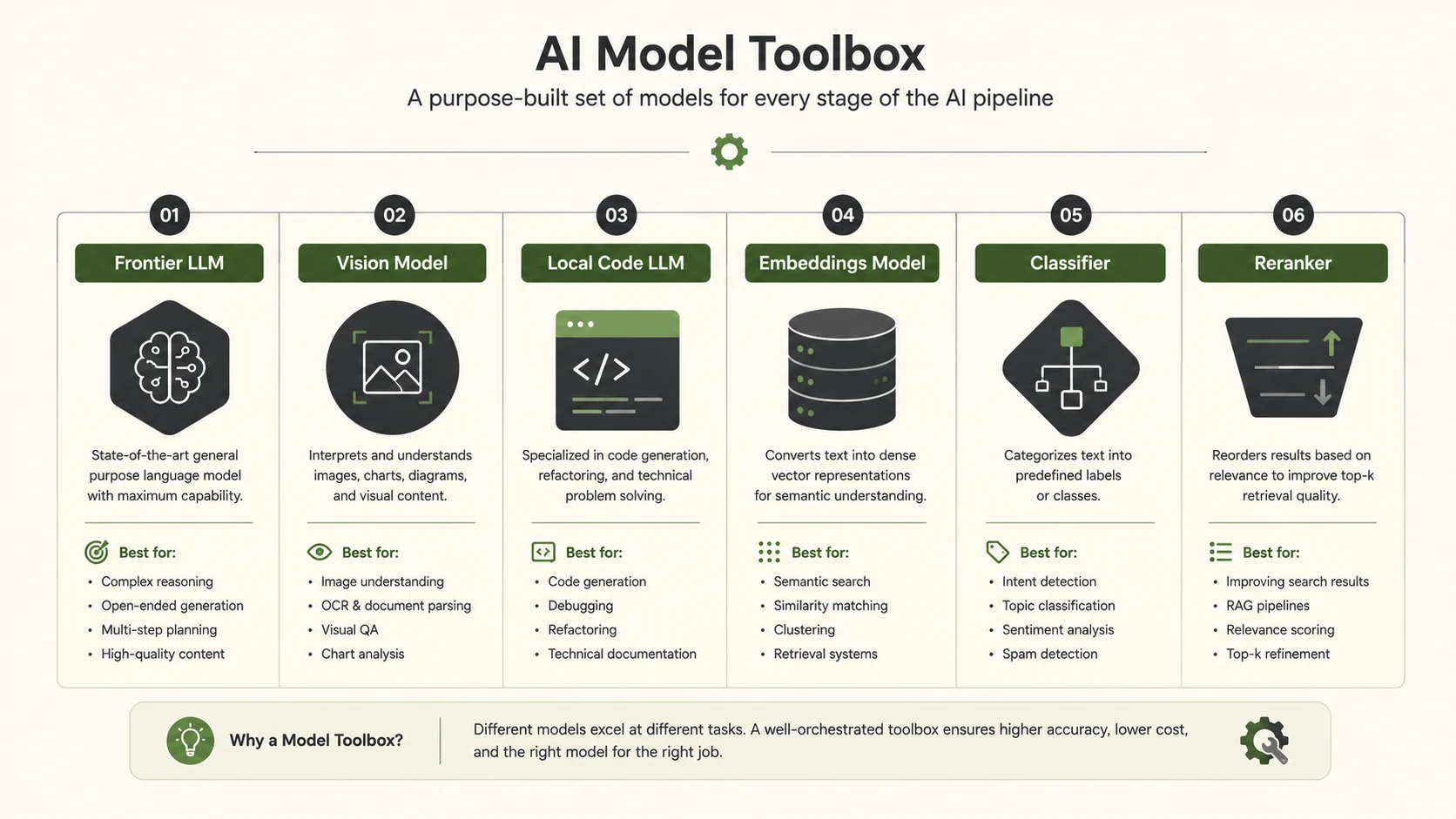
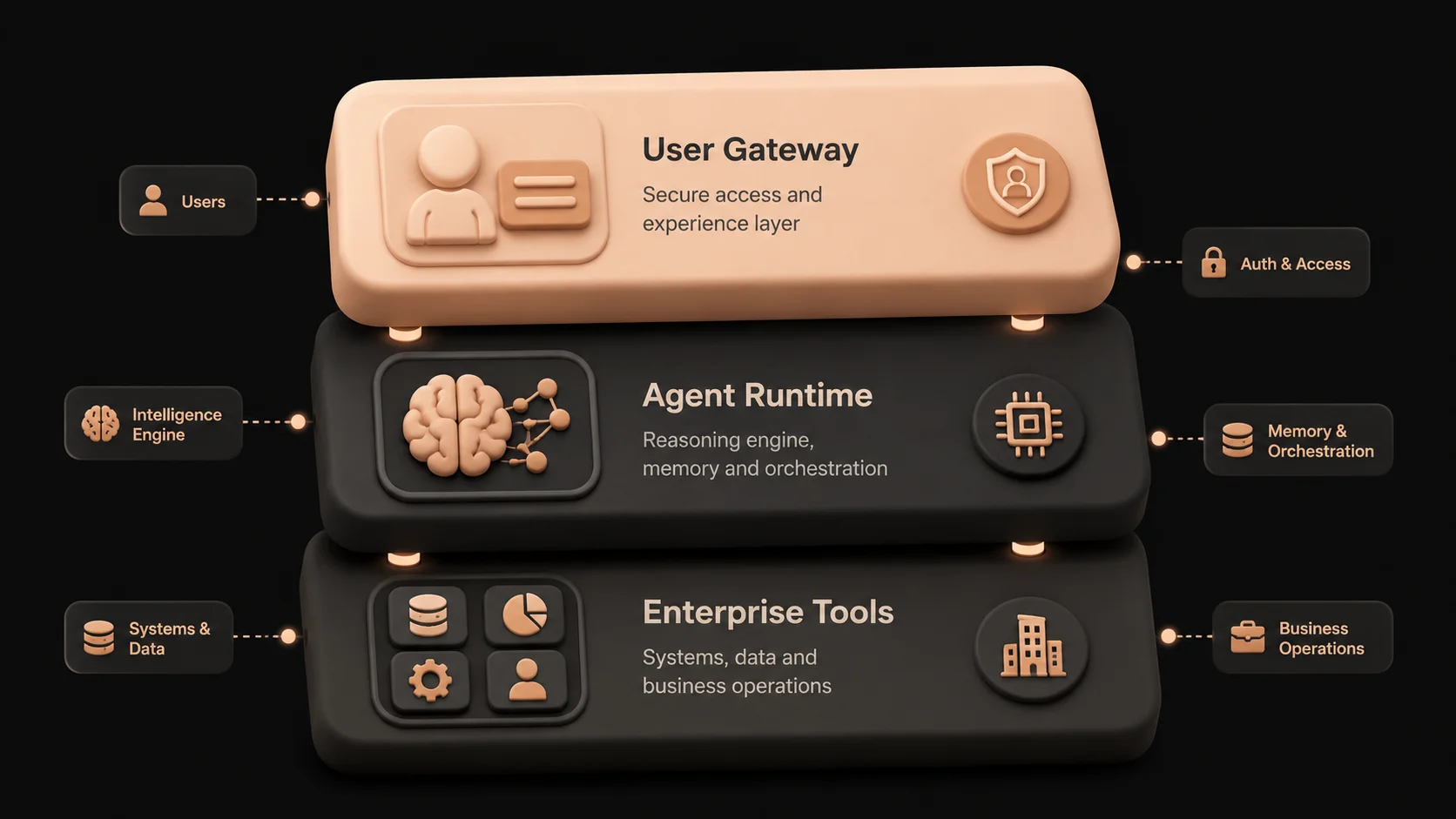
A cognitive layer is more than a chat interface. It coordinates AI reasoning, business logic, retrieval systems, and user interaction into a unified experience.
In Next.js 16, this layer often consists of:
- ◆Server Components for AI orchestration
- ◆Server Actions for user interactions
- ◆Streaming UI boundaries
- ◆Retrieval pipelines
- ◆Agent workflows
- ◆Authentication middleware
- ◆Persistent conversation state
Rather than exposing raw model responses, applications deliver structured, contextual, and business-aware experiences.
---
Enterprise Architecture Pattern
A production AI application commonly follows this architecture:
User
   │
   ▼
Next.js 16 App Router
   │
Server Components
   │
Server Actions
   │
AI Gateway
   │
LLM Provider
   │
Knowledge Base / Vector Database
   │
Business Services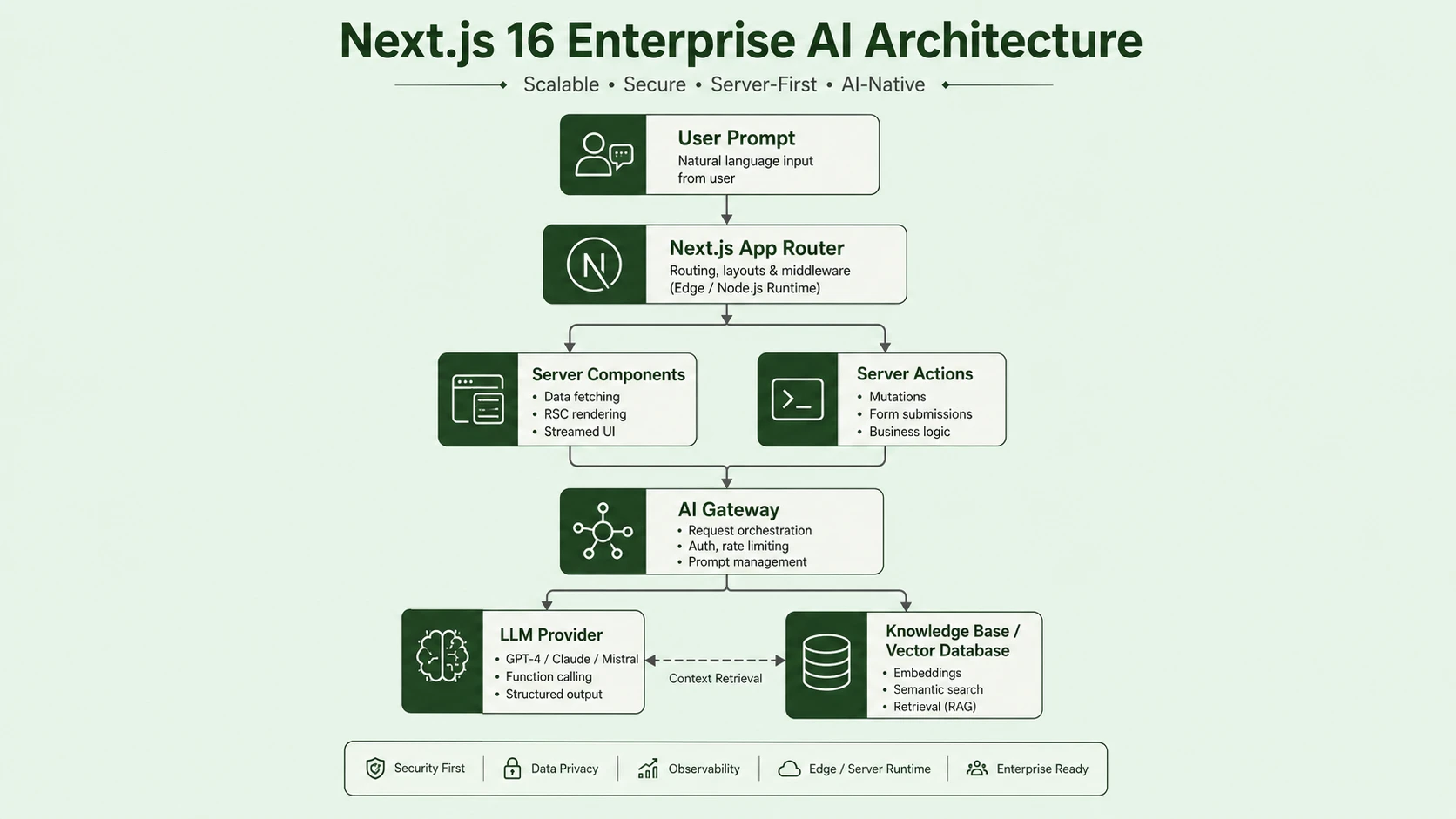
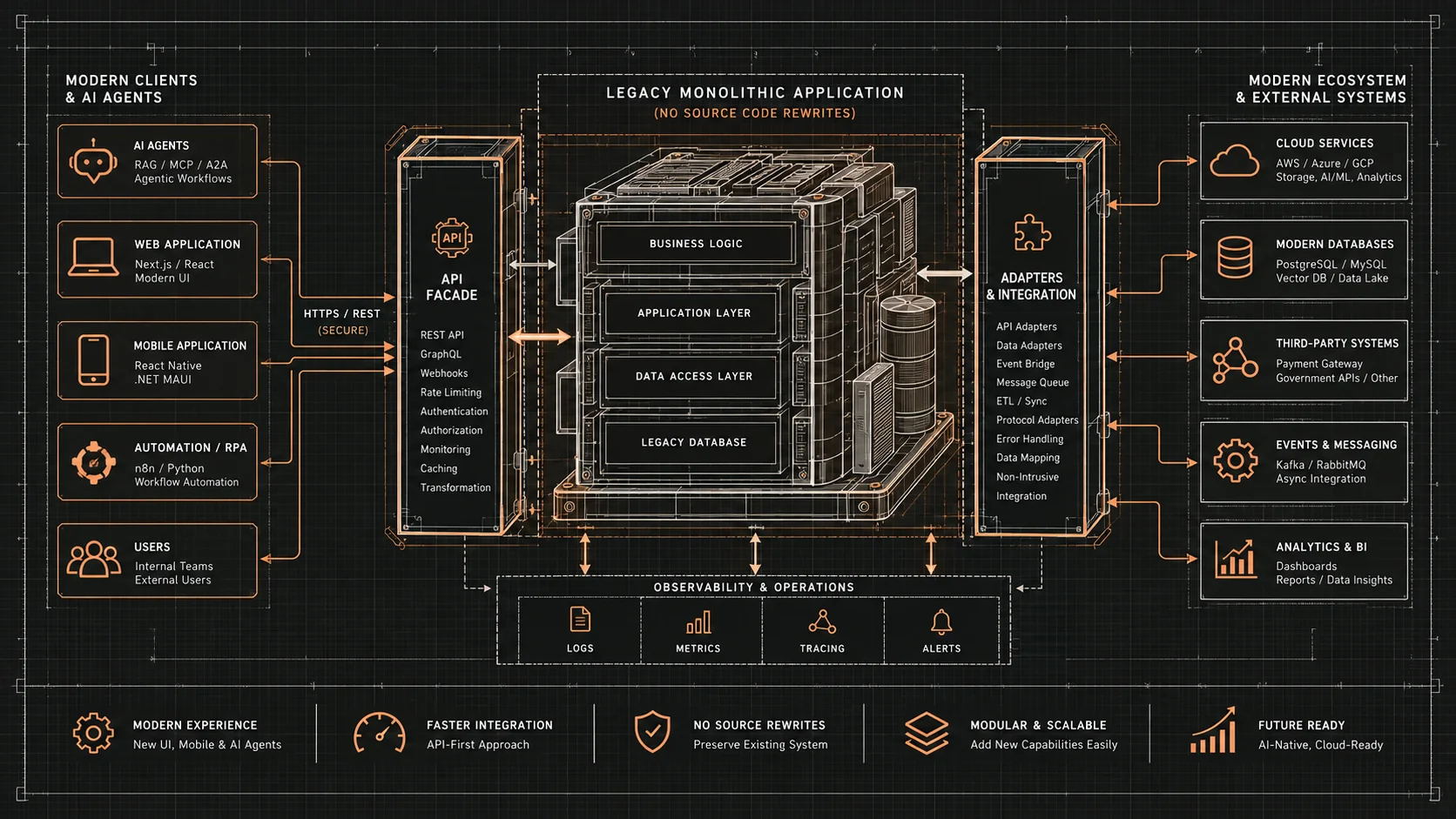
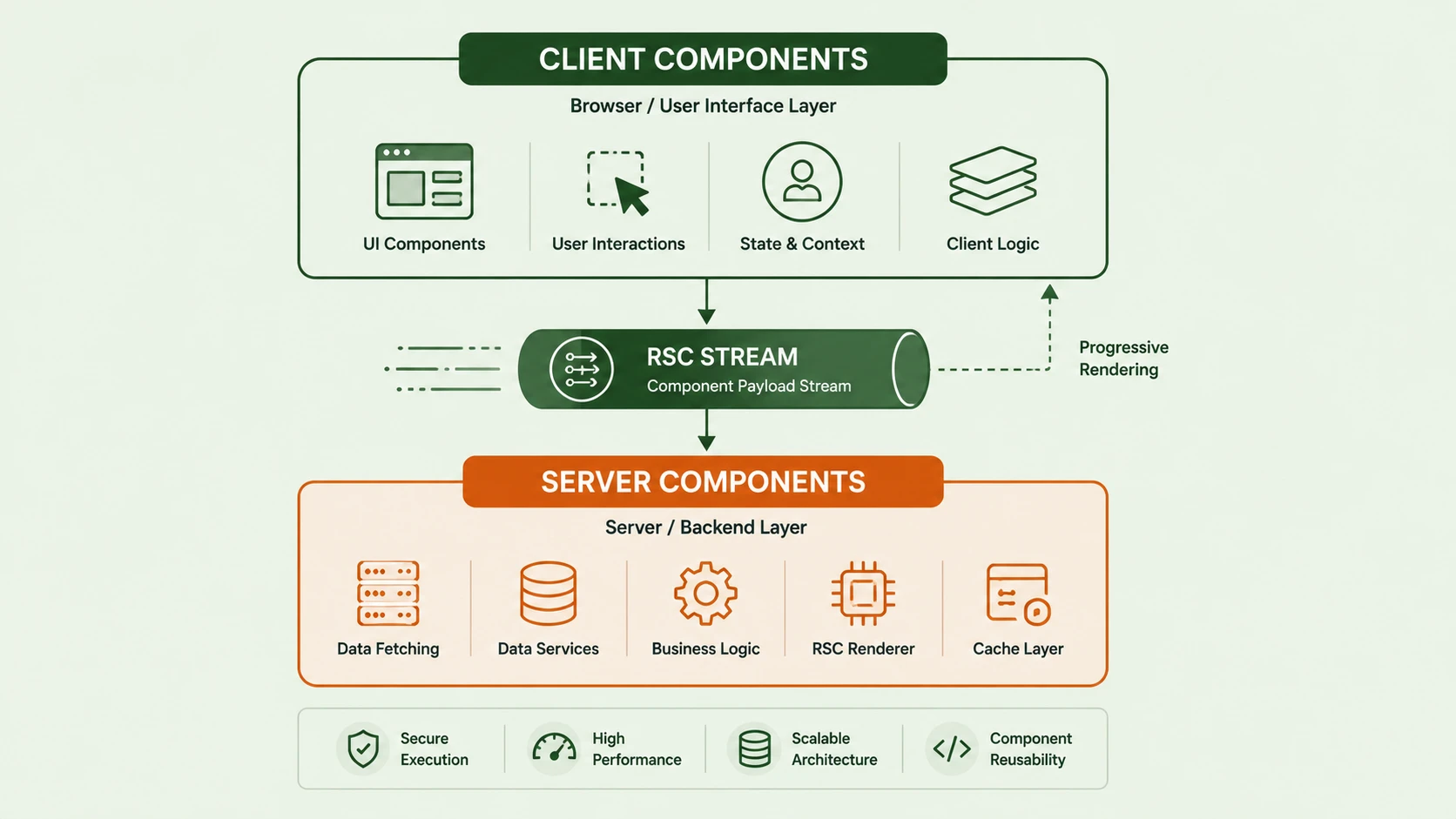
System architecture diagram and conceptual workflow layout for Next.js 16 Server Components & AI Integration.
Each layer has a clearly defined responsibility, improving maintainability and scalability as the application evolves.
---
Performance Advantages
Compared to traditional client-heavy architectures, Server Components deliver measurable improvements.
| Capability | Traditional SPA | Next.js 16 Server Components |
|---|---|---|
| AI Execution | Client API Calls | Server-side |
| API Security | Exposed Proxy Layer | Fully Server Protected |
| Streaming | Manual Implementation | Native |
| JavaScript Bundle | Large | Smaller |
| Initial Load | Slower | Faster |
| SEO | Limited | Excellent |
| Server Rendering | Partial | Native |
| Scalability | Moderate | High |
For enterprise applications serving thousands of concurrent AI requests, these differences become increasingly significant.
---
Security Considerations
Enterprise AI systems often interact with confidential business data. Executing AI logic inside Server Components provides important security benefits.
Sensitive credentials remain on the server, reducing the risk of accidental exposure.
Additional best practices include:
- ◆Never expose API keys to the browser.
- ◆Validate every AI request.
- ◆Implement rate limiting.
- ◆Apply role-based authorization.
- ◆Sanitize user input before model execution.
- ◆Log AI interactions for auditing.
- ◆Encrypt sensitive conversation history.
These practices help organizations meet compliance and governance requirements.
---
Integrating AI SDKs
Next.js 16 works well with modern AI frameworks and SDKs that support streaming and tool calling.
Popular integrations include:
- ◆OpenAI Responses API
- ◆Vercel AI SDK
- ◆Anthropic Claude
- ◆Google Gemini
- ◆Azure OpenAI
- ◆Ollama
- ◆LangChain
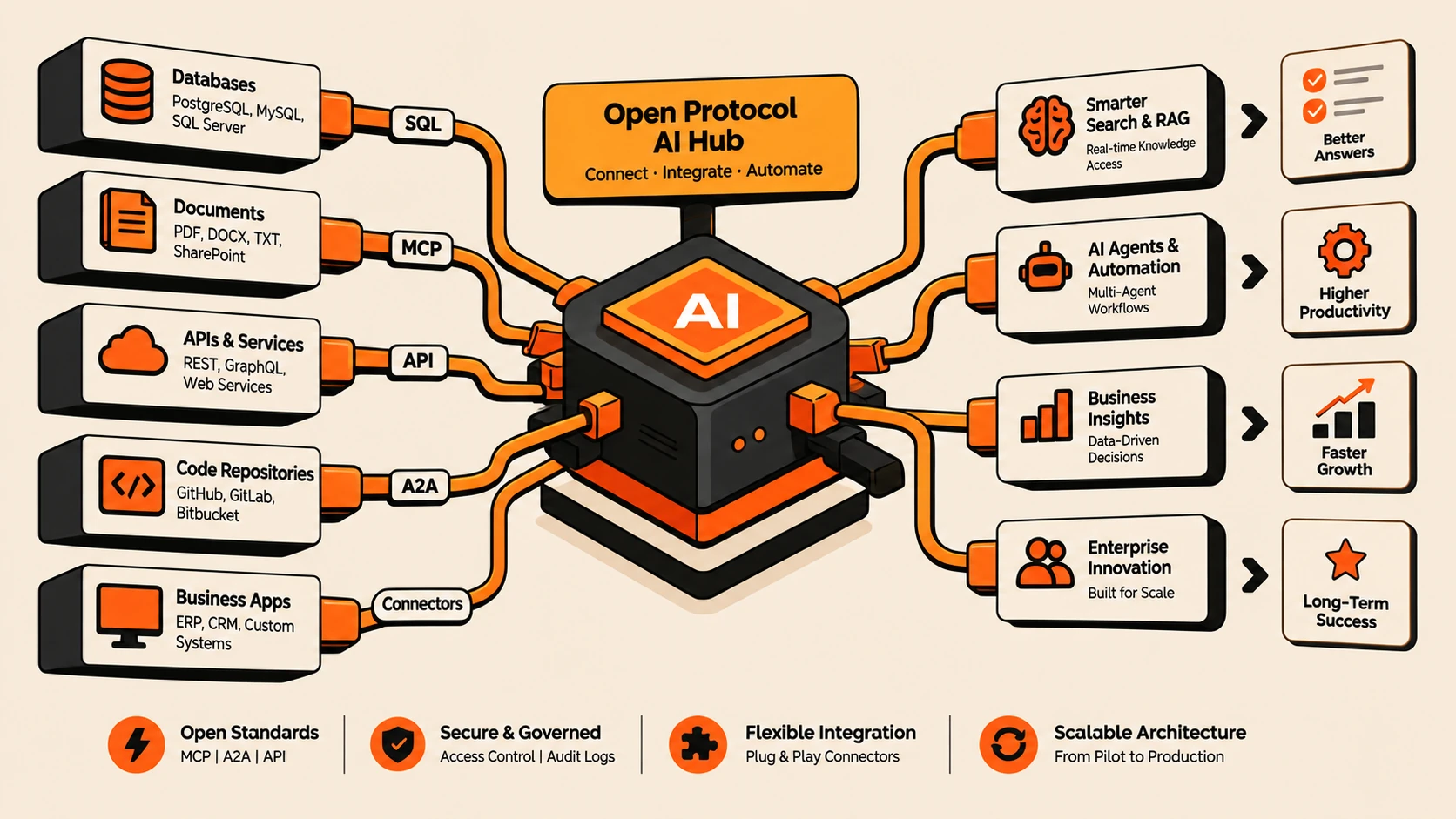
- ◆Model Context Protocol (MCP)
A provider abstraction layer makes it easier to switch models without rewriting application logic.
---
Best Practices for Production
When building AI-powered applications with Server Components, consider the following recommendations:
- ◆Keep AI orchestration on the server.
- ◆Stream responses whenever possible.
- ◆Cache retrieval results intelligently.
- ◆Separate business logic from UI rendering.
- ◆Use Suspense boundaries for incremental updates.
- ◆Monitor latency and token usage.
- ◆Design for model provider failover.
- ◆Optimize prompts for deterministic outputs.
- ◆Implement observability for AI workflows.
Following these practices improves reliability while reducing operational costs.
---
Looking Ahead
Server Components represent a significant evolution in frontend architecture for AI-native applications. By combining server-side execution, streaming rendering, and intelligent orchestration, Next.js 16 enables developers to create interfaces that are faster, more secure, and easier to scale.
As enterprises adopt autonomous agents, retrieval-augmented generation, and real-time AI experiences, the frontend is no longer just a presentation layer. It becomes the cognitive interface that connects users with intelligent systems, making Next.js 16 a foundational technology for the next generation of AI-powered web applications.