Introduction
For nearly three decades, Microsoft SQL Server has been closely associated with the Windows operating system. Enterprises building applications on the Microsoft ecosystem have traditionally deployed SQL Server alongside Windows Server, Active Directory, IIS, and the .NET Framework, creating tightly integrated enterprise infrastructure.
The announcement that SQL Server is becoming available on Linux represents a significant strategic and technical milestone. Rather than rewriting the database engine specifically for Linux, Microsoft has chosen an architectural approach that preserves the mature SQL Server engine while introducing a compatibility layer known as SQLPAL (SQL Platform Abstraction Layer).
This decision allows Microsoft to extend SQL Server into Linux environments while minimizing changes to decades of database engine development.
From the perspective of December 2016, SQL Server on Linux is one of the most important developments in enterprise database infrastructure and reflects Microsoft's increasing investment in cross-platform technologies.
Industry Background
Enterprise infrastructure is becoming increasingly heterogeneous.
Organizations now operate:
- ◆Windows Server.
- ◆Linux servers.
- ◆Virtualized infrastructure.
- ◆Public cloud platforms.
- ◆Private cloud deployments.
- ◆Containers.
- ◆Hybrid enterprise environments.
Many enterprises prefer Linux for web servers, cloud-native applications, and infrastructure automation while continuing to rely on SQL Server for mission-critical databases.
Until now, these deployment preferences frequently required Windows-based database servers even when the remainder of the application stack operated on Linux.
Microsoft's announcement addresses this deployment challenge.
The Business Problem
Organizations deploying enterprise databases frequently encounter infrastructure constraints.
Common challenges include:
- ◆Operating system standardization.
- ◆Mixed platform administration.
- ◆Licensing complexity.
- ◆Hybrid cloud deployments.
- ◆Infrastructure migration.
- ◆Cross-platform application hosting.
- ◆Operational consistency.
Rewriting SQL Server specifically for Linux would introduce significant engineering risk and long-term maintenance complexity.
Instead, Microsoft has chosen to preserve the proven SQL Server engine while adapting its operating system interactions.
Understanding the Technology
SQL Server on Linux is built around SQLPAL, an architectural compatibility layer that abstracts operating system services.
Rather than modifying the SQL Server storage engine extensively, SQLPAL provides interfaces for:
- ◆Memory management.
- ◆Scheduling.
- ◆Thread management.
- ◆Synchronization.
- ◆Networking.
- ◆File system interaction.
- ◆Operating system services.
This allows the core SQL Server engine to execute with relatively few platform-specific modifications.
Although SQL Server and .NET both originate from Microsoft, SQLPAL is distinct from the CoreCLR runtime. SQL Server is a native database engine, while SQLPAL is the compatibility layer that enables its execution on Linux.
Core Architecture
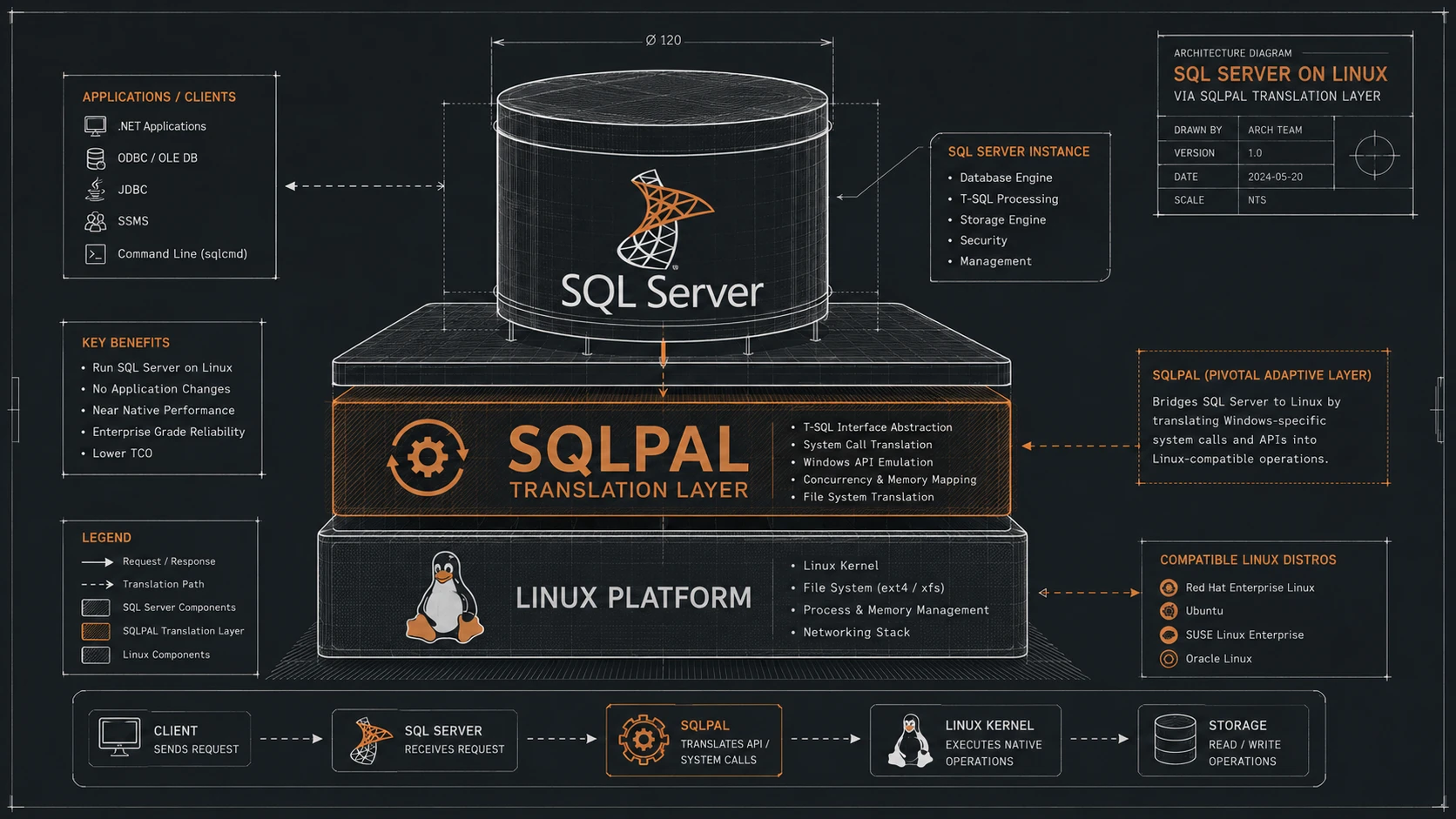
A simplified SQL Server on Linux architecture appears below.
| Component | Responsibility |
|---|---|
| Client Applications | Submit SQL requests |
| SQL Server Engine | Query processing and storage engine |
| SQLPAL | Platform abstraction layer |
| Linux Kernel | Operating system services |
| Storage Subsystem | Persistent database files |
| Network Stack | Client connectivity |
SQLPAL acts as the interface between the SQL Server engine and Linux system services, allowing the database engine to remain largely platform independent.
Key Features
SQL Platform Abstraction Layer (SQLPAL)
SQLPAL is the defining architectural innovation behind SQL Server on Linux.
Rather than rewriting decades of database engine logic, SQLPAL translates operating system interactions into forms compatible with Linux.
This architectural separation significantly reduces the engineering effort required to support multiple operating systems.
Enterprise SQL Server Engine
The underlying relational engine remains the same mature SQL Server technology used in enterprise deployments.
This preserves:
- ◆Transaction processing.
- ◆Query optimization.
- ◆Recovery mechanisms.
- ◆Storage engine behavior.
- ◆Database reliability.
Cross-Platform Deployment
Organizations can evaluate SQL Server in Linux environments while continuing to use familiar SQL programming models and administration practices.
Cloud Alignment
Linux compatibility aligns SQL Server with cloud infrastructures where Linux deployments are increasingly common.
Consistent Application Development
Applications communicating through T-SQL and standard SQL Server protocols require minimal modification when migrating database servers between supported operating systems.
Existing Administrative Experience
Database administrators familiar with SQL Server can continue leveraging established operational knowledge while adapting deployment processes for Linux environments.
How It Works
A simplified execution workflow appears below.
Application
      |
SQL Request
      |
SQL Server Engine
      |
SQLPAL
      |
Linux Kernel
      |
Storage and Networking
      |
Query Results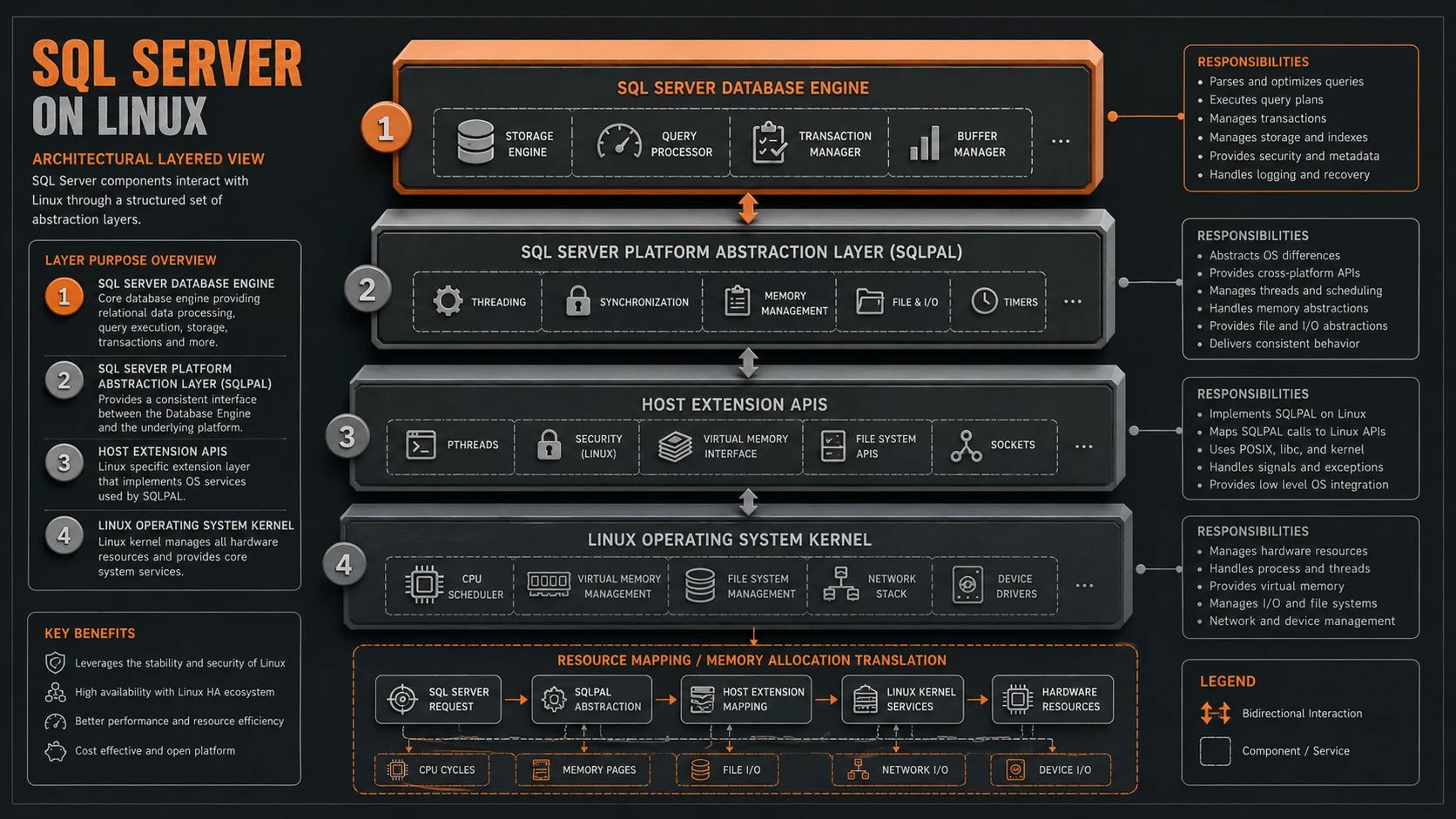
System architecture diagram and conceptual workflow layout for SQL Server on Linux.
The database engine executes familiar SQL Server functionality while SQLPAL translates operating system interactions.
Enterprise Use Cases
Hybrid Infrastructure
Organizations operating both Windows and Linux environments can standardize database technology across multiple operating systems.
Cloud Deployments
Linux compatibility expands SQL Server deployment options within cloud infrastructure.
DevOps Automation
Infrastructure automation pipelines targeting Linux servers can now include SQL Server alongside other enterprise services.
Enterprise Application Modernization
Organizations migrating application tiers to Linux may evaluate SQL Server without redesigning their database layer.
Cross-Platform Development
Development teams gain additional flexibility when selecting operating systems for testing and production environments.
Performance Considerations
The architectural objective of SQLPAL is to preserve SQL Server performance characteristics while introducing minimal abstraction overhead.
Organizations should evaluate:
- ◆Query execution.
- ◆Storage throughput.
- ◆Memory utilization.
- ◆CPU scheduling.
- ◆I/O latency.
- ◆Parallel workload performance.
Production benchmarking remains essential before large-scale deployment.
Security Considerations
Database security practices remain fundamentally unchanged.
Organizations should continue implementing:
- ◆Authentication.
- ◆Authorization.
- ◆Encryption.
- ◆Backup protection.
- ◆Audit logging.
- ◆Principle of least privilege.
Linux deployment complements existing SQL Server security capabilities rather than replacing them.
Scalability
SQL Server on Linux is designed to support enterprise-scale deployments.
Scalable characteristics include:
- ◆Mature query optimizer.
- ◆Parallel query execution.
- ◆Transaction consistency.
- ◆High-volume OLTP support.
- ◆Enterprise storage capabilities.
Combined with Linux infrastructure, these capabilities provide additional deployment flexibility for modern enterprise environments.
Best Practices
Organizations evaluating SQL Server on Linux should:
- ◆Benchmark representative workloads.
- ◆Validate application compatibility.
- ◆Standardize operational procedures.
- ◆Monitor resource utilization.
- ◆Review backup and recovery processes.
- ◆Test high-availability configurations.
- ◆Train administrators on Linux operational practices.
Careful planning reduces migration risk while maximizing operational consistency.
Common Mistakes
| Mistake | Business Impact |
|---|---|
| Assuming SQL Server was completely rewritten for Linux | Misunderstanding architecture |
| Ignoring Linux operational differences | Deployment challenges |
| Migrating production workloads without benchmarking | Performance uncertainty |
| Skipping backup validation | Increased operational risk |
| Treating SQLPAL as a database engine | Architectural confusion |
| Neglecting administrator training | Slower enterprise adoption |
Understanding the separation between the SQL Server engine and SQLPAL is essential for accurate architectural planning.
Technology Comparison
| Characteristic | SQL Server on Windows | SQL Server on Linux |
|---|---|---|
| Database Engine | SQL Server Engine | Same SQL Server Engine |
| Operating System | Windows Server | Linux |
| Platform Integration | Native Windows services | SQLPAL abstraction layer |
| SQL Language | T-SQL | T-SQL |
| Enterprise Features | Mature SQL Server capabilities | Intended to preserve core engine behavior |
The principal architectural difference lies in the operating system abstraction rather than the relational database engine itself.
Adoption Strategy
Organizations should evaluate SQL Server on Linux through incremental deployment.
- 1.Assess application compatibility.
- 2.Build Linux test environments.
- 3.Benchmark representative database workloads.
- 4.Validate backup and recovery procedures.
- 5.Train operations teams.
- 6.Introduce production deployments following comprehensive testing.
This phased approach minimizes operational risk while allowing organizations to evaluate cross-platform infrastructure.
Limitations
As of December 2016, SQL Server on Linux is still in the early stages of enterprise adoption.
Organizations should recognize several considerations.
- ◆Operational best practices continue developing.
- ◆Existing Windows-centric administration procedures may require adjustment.
- ◆Third-party ecosystem support is continuing to evolve.
- ◆Production migration should be carefully validated.
- ◆Performance characteristics should be benchmarked using representative enterprise workloads.
These considerations should guide infrastructure planning before broad deployment.
Looking Ahead
From the perspective of December 2016, SQL Server on Linux represents one of Microsoft's most significant enterprise infrastructure announcements in recent years. By preserving the mature SQL Server engine while introducing SQLPAL as a platform abstraction layer, Microsoft has chosen an architectural strategy that emphasizes portability without sacrificing decades of database engineering investment.
As hybrid cloud infrastructure, Linux adoption, and cross-platform enterprise development continue expanding, SQL Server's availability beyond Windows significantly broadens deployment flexibility. Organizations invested in SQL Server should closely evaluate this new platform option as they plan future infrastructure modernization and cloud deployment strategies.