Introduction
Enterprise software development has undergone a significant transformation over the past decade. Organizations increasingly deploy applications across Windows servers, Linux infrastructure, cloud platforms, containers, and microservice-based architectures. At the same time, development teams seek greater code reuse across desktop, server, mobile, and cloud workloads while minimizing platform-specific implementations.
Microsoft's introduction of .NET Core established a modern, modular, open source implementation of the .NET platform designed for cross-platform development. While early releases demonstrated the platform's technical direction, many organizations delayed large-scale adoption because portions of the traditional .NET Framework API surface were not yet available.
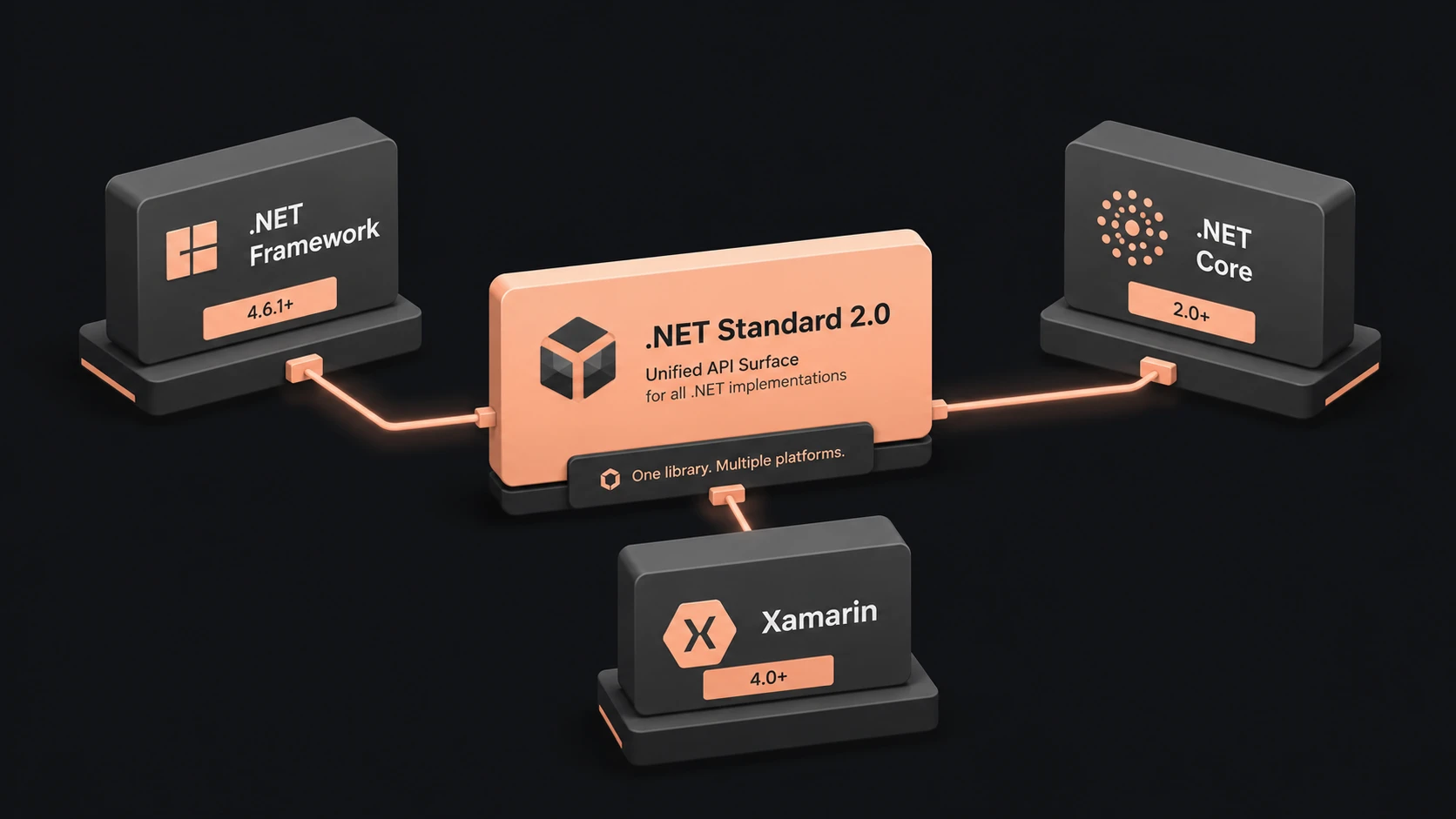
The release of .NET Core 2.0 together with .NET Standard 2.0 addresses one of the most frequently cited enterprise concerns: API compatibility. By dramatically expanding the available Base Class Library and introducing broader compatibility across .NET implementations, Microsoft significantly reduces migration barriers while strengthening the vision of a unified .NET ecosystem.
From the perspective of August 2017, these releases represent one of the most important milestones in Microsoft's long-term application platform strategy.
Industry Background
Modern enterprise applications increasingly target diverse deployment environments.
Organizations commonly deploy software across:
- ◆Windows Server.
- ◆Linux servers.
- ◆macOS development environments.
- ◆Public cloud platforms.
- ◆Private cloud infrastructure.
- ◆Containers.
- ◆Microservices.
Development teams also expect:
- ◆Shared business logic.
- ◆Portable libraries.
- ◆Modern tooling.
- ◆High-performance runtimes.
- ◆Open source ecosystems.
- ◆Continuous Integration pipelines.
Meeting these expectations requires a consistent application programming model across multiple runtime implementations.
The Business Problem
Organizations modernizing enterprise applications frequently encounter several challenges.
Common concerns include:
- ◆Platform fragmentation.
- ◆Limited code portability.
- ◆API incompatibilities.
- ◆Multiple runtime implementations.
- ◆Migration complexity.
- ◆Legacy framework dependencies.
- ◆Operational inconsistency.
Maintaining separate codebases for different .NET platforms increases development costs and complicates long-term maintenance.
.NET Standard 2.0 seeks to reduce these challenges through standardized API contracts.
Understanding the Technology
.NET Core 2.0 is Microsoft's cross-platform runtime and development platform for modern applications.
.NET Standard 2.0 defines a common specification of APIs that multiple .NET implementations can support.
Together they provide:
- ◆Cross-platform execution.
- ◆Unified API contracts.
- ◆Expanded Base Class Library coverage.
- ◆Improved compatibility.
- ◆High-performance runtime.
- ◆Modern command-line tooling.
- ◆Open source development model.
Rather than replacing every existing .NET implementation, .NET Standard establishes a common programming surface that libraries can target.
Core Architecture
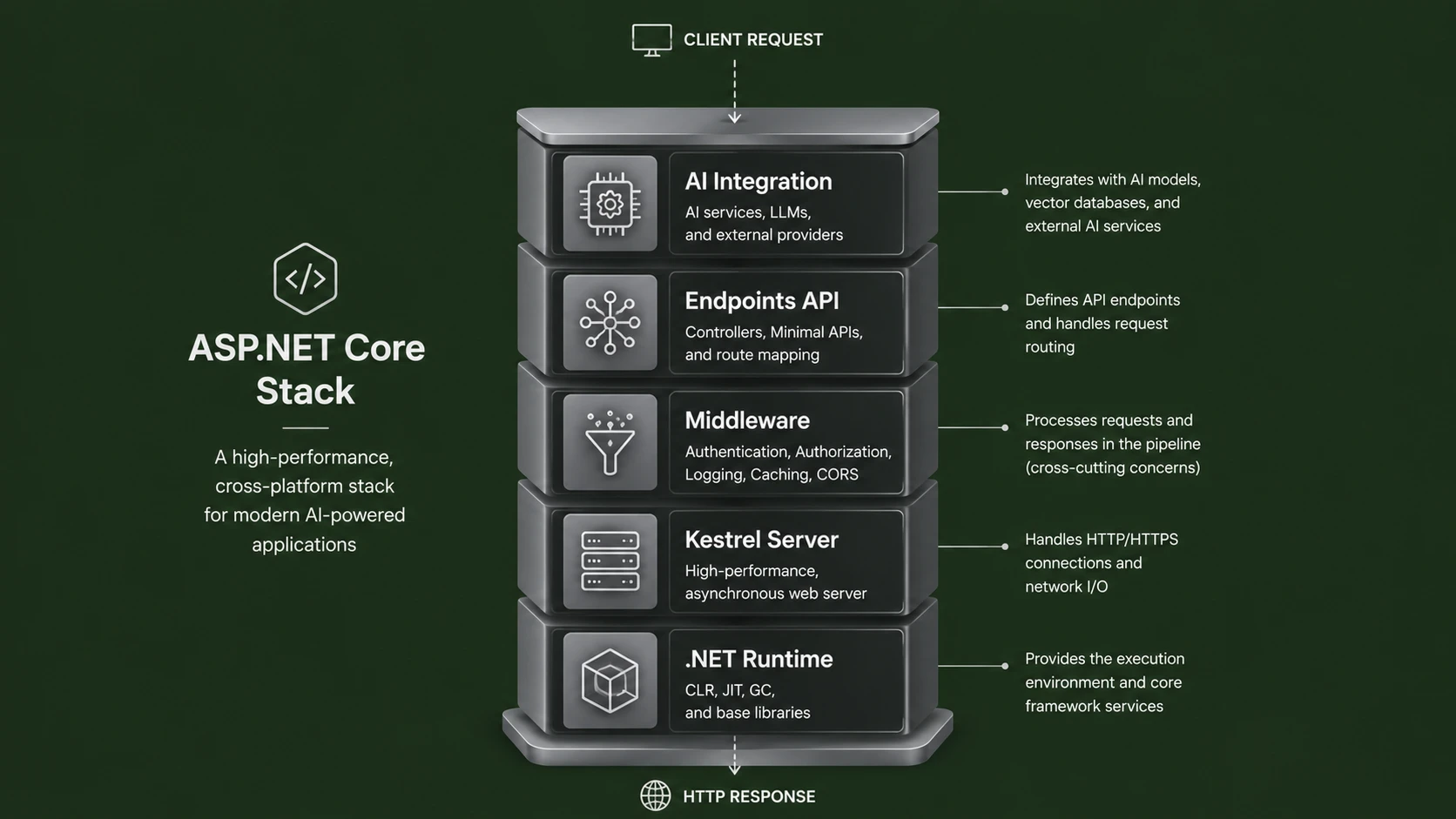
A simplified .NET architecture appears below.
| Component | Responsibility |
|---|---|
| Application Code | Business logic |
| .NET Standard 2.0 | Common API specification |
| .NET Core 2.0 Runtime | Cross-platform execution |
| CoreCLR | Managed code execution |
| Base Class Library | Core framework functionality |
| Operating System | Windows, Linux, or macOS |
This architecture enables applications and reusable libraries to share a consistent programming model while executing across multiple operating systems.
Key Features
.NET Standard 2.0
The defining feature of this release is the expansion of .NET Standard.
By providing a substantially larger API surface than earlier versions, .NET Standard 2.0 enables many existing libraries to become portable with significantly fewer modifications.
This improves library reuse while reducing migration effort.
Expanded API Compatibility
A major enterprise benefit is increased compatibility with existing .NET Framework APIs.
Organizations evaluating migration to .NET Core encounter fewer missing framework capabilities, making modernization projects more practical.
Cross-Platform Runtime
.NET Core 2.0 continues supporting application execution across Windows, Linux, and macOS.
Development teams can build applications using a consistent programming model while selecting deployment platforms based on operational requirements.
Performance Improvements
Microsoft continues optimizing runtime execution, memory management, startup performance, and framework libraries.
These improvements strengthen .NET Core's suitability for cloud-hosted and service-oriented workloads.
Command-Line Development
The .NET CLI remains a central development tool for creating, restoring, building, testing, and publishing applications across supported operating systems.
Open Source Platform
The continued open source development model encourages community participation while increasing transparency for enterprise adoption.
How It Works
A simplified application workflow appears below.
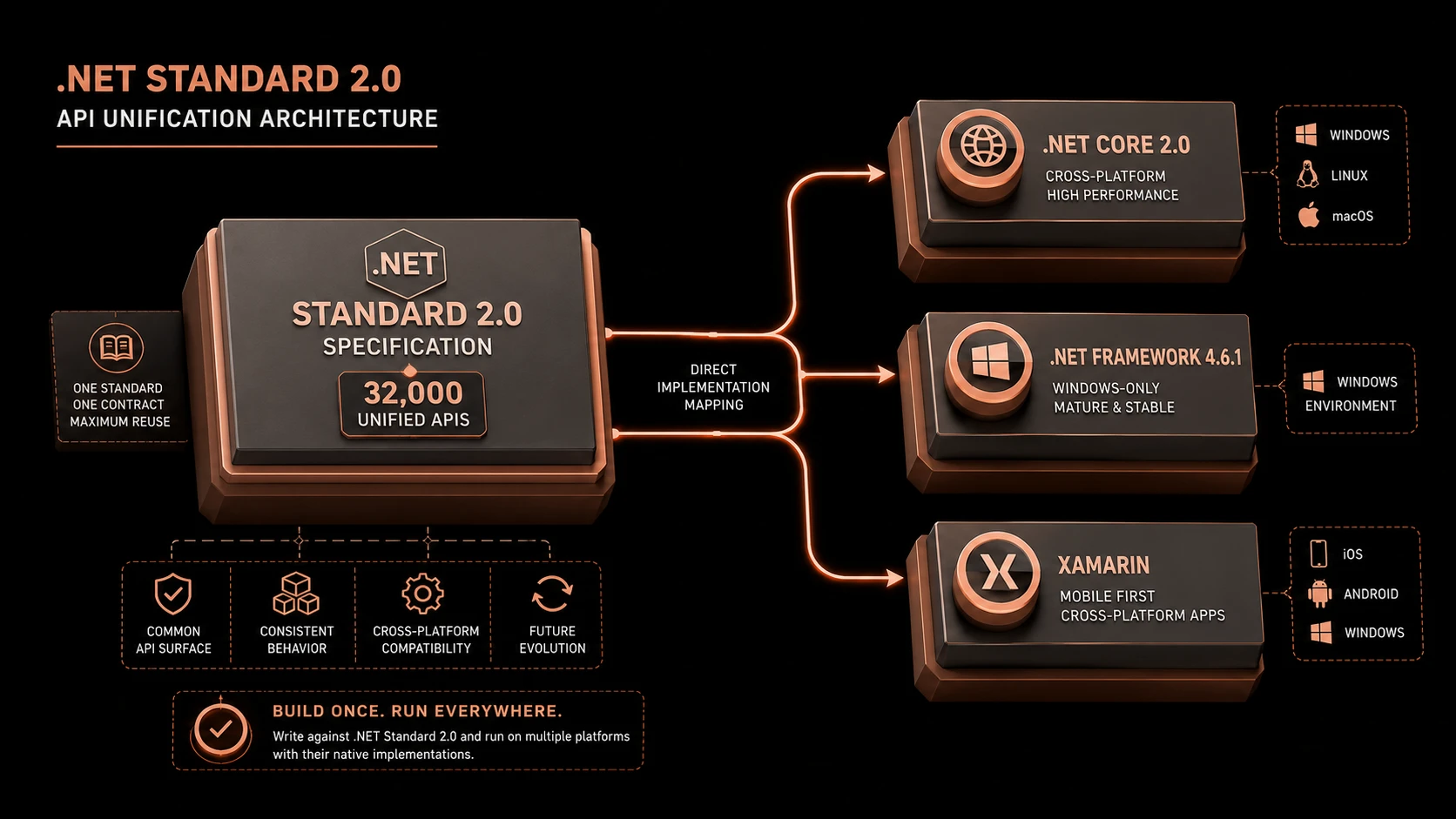
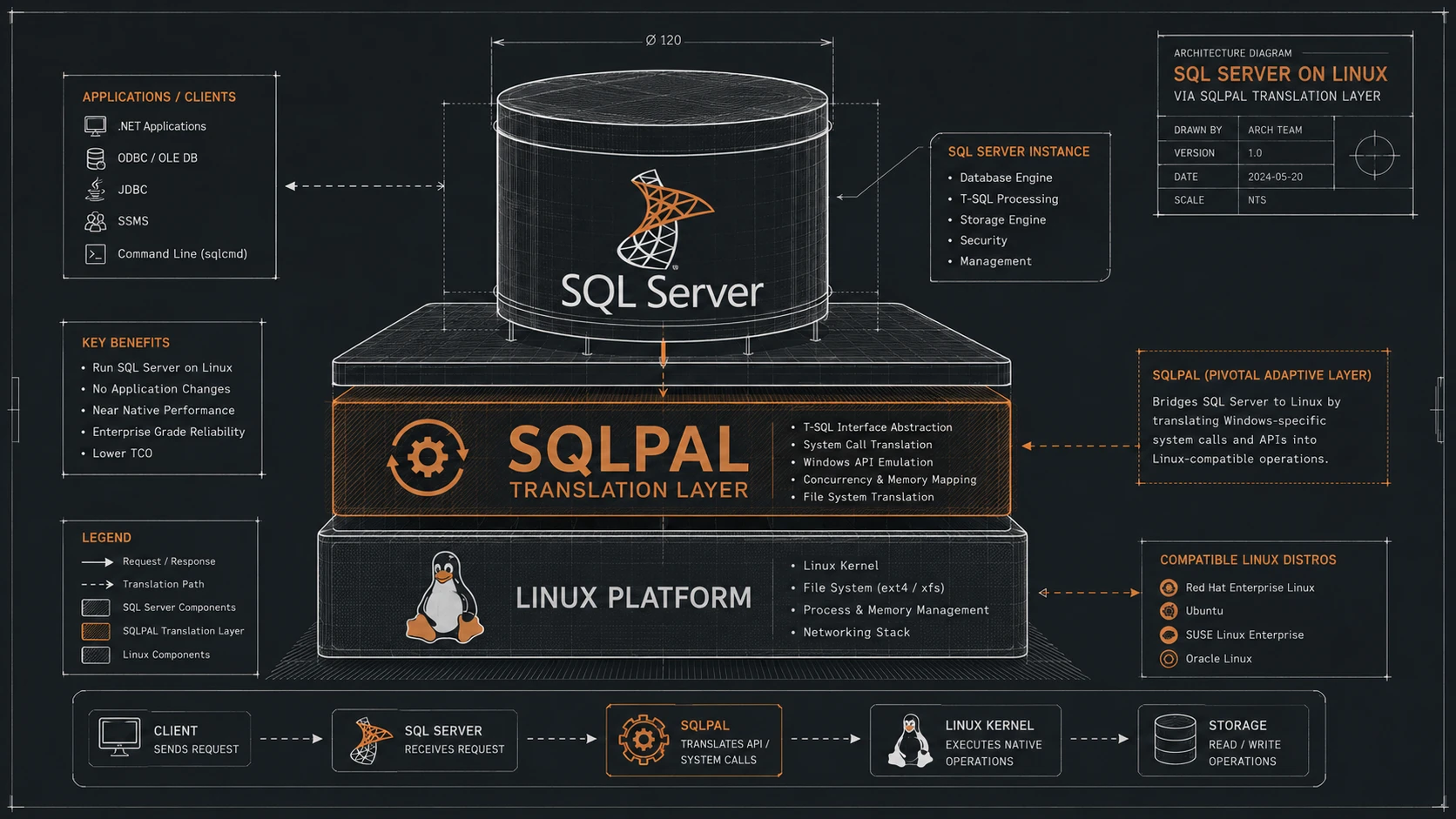
System architecture diagram and conceptual workflow layout for .NET Core 2.0 and .NET Standard 2.0.
Application Source Code
          |
Target .NET Standard 2.0
          |
.NET Core Compiler and SDK
          |
CoreCLR Runtime
          |
Windows / Linux / macOS
          |
Enterprise Application
Applications targeting .NET Standard benefit from a consistent API contract while executing on supported runtime implementations.
Enterprise Use Cases
Cloud Services
Cross-platform deployment enables organizations to select infrastructure based on operational requirements rather than runtime limitations.
Microservices
Small independently deployable services benefit from the lightweight architecture of .NET Core.
Shared Enterprise Libraries
Organizations can develop reusable business logic targeting .NET Standard for use across multiple application types.
REST APIs
Cross-platform web services can be developed using modern .NET tooling while integrating into diverse infrastructure environments.
Internal Business Applications
Development teams can modernize applications incrementally while preserving substantial portions of existing .NET expertise.
Performance Considerations
.NET Core 2.0 continues emphasizing efficient runtime execution.
Organizations should evaluate:
- ◆Application startup time.
- ◆Memory utilization.
- ◆Garbage collection behavior.
- ◆API compatibility.
- ◆Cross-platform performance.
- ◆Deployment size.
Benchmarking representative production workloads remains essential before large-scale migration.
Security Considerations
Enterprise security practices remain critical regardless of runtime improvements.
Organizations should continue implementing:
- ◆Authentication.
- ◆Authorization.
- ◆HTTPS.
- ◆Secure configuration management.
- ◆Dependency management.
- ◆Secure secret storage.
Cross-platform capability complements rather than replaces secure application architecture.
Scalability
.NET Core 2.0 is designed for modern scalable application development.
Advantages include:
- ◆Cross-platform deployment.
- ◆Modular runtime.
- ◆Improved runtime efficiency.
- ◆Shared libraries.
- ◆Cloud-ready architecture.
These characteristics align well with modern distributed enterprise systems.
Best Practices
Organizations adopting .NET Core 2.0 should:
- ◆Target .NET Standard 2.0 for reusable libraries.
- ◆Evaluate API compatibility before migration.
- ◆Modernize applications incrementally.
- ◆Integrate automated testing into Continuous Integration pipelines.
- ◆Benchmark representative workloads.
- ◆Standardize development tooling.
- ◆Validate third-party library compatibility.
A phased modernization strategy reduces migration risk while maximizing long-term maintainability.
Common Mistakes
| Mistake | Business Impact |
|---|---|
| Assuming every existing application can migrate without assessment | Increased migration complexity |
| Ignoring API compatibility analysis | Unexpected development effort |
| Targeting platform-specific APIs unnecessarily | Reduced portability |
| Skipping performance benchmarking | Inaccurate capacity planning |
| Delaying developer training | Slower enterprise adoption |
| Treating .NET Standard as a runtime | Architectural misunderstanding |
Understanding the distinction between runtime implementations and API specifications is essential for successful adoption.
Technology Comparison
| Characteristic | .NET Framework | .NET Core 2.0 |
|---|---|---|
| Operating Systems | Primarily Windows | Windows, Linux, macOS |
| Deployment Model | Framework installed on system | Modern cross-platform deployment |
| Open Source | Limited | Open source |
| Cloud Orientation | Traditional server workloads | Cloud-native and cross-platform workloads |
| API Sharing | Platform-specific libraries | .NET Standard 2.0 compatibility |
.NET Standard 2.0 serves as the common API contract that helps unify development across multiple .NET implementations.
Adoption Strategy
Organizations should modernize through incremental adoption.
- 1.Inventory existing .NET applications.
- 2.Evaluate API compatibility.
- 3.Target .NET Standard 2.0 for reusable libraries.
- 4.Develop new services using .NET Core 2.0.
- 5.Validate cross-platform deployment processes.
- 6.Expand modernization based on operational experience.
This phased approach minimizes disruption while allowing engineering teams to build expertise with the evolving platform.
Limitations
As of August 2017, organizations should recognize several considerations.
- ◆Some applications remain dependent on platform-specific technologies.
- ◆Existing third-party libraries should be validated before migration.
- ◆Migration planning remains essential for large enterprise systems.
- ◆Operational practices continue evolving as adoption grows.
- ◆Development teams require familiarity with new tooling and deployment models.
These considerations should guide enterprise modernization initiatives.
Looking Ahead
From the perspective of August 2017, .NET Core 2.0 and .NET Standard 2.0 represent a defining step toward a unified Microsoft development platform. By significantly expanding API compatibility, strengthening cross-platform capabilities, and encouraging library portability, Microsoft has reduced many of the barriers that previously limited enterprise adoption of .NET Core.
Organizations building modern cloud services, distributed systems, and reusable enterprise libraries should evaluate these releases carefully. While migration planning remains an important architectural responsibility, the combination of .NET Core 2.0 and .NET Standard 2.0 provides a stronger and more practical foundation for cross-platform enterprise application development than any previous generation of the .NET ecosystem.