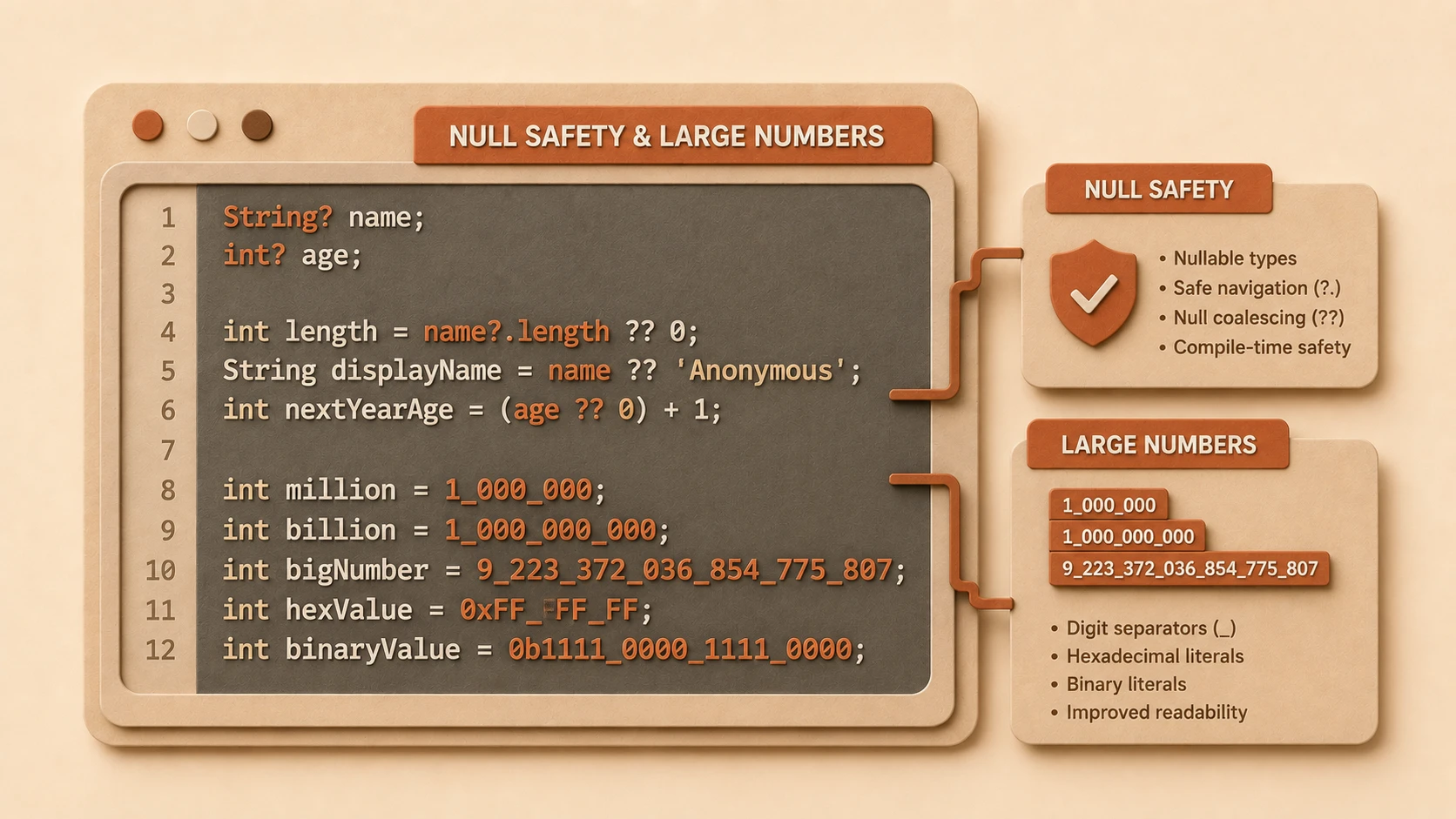
Introduction
JavaScript has evolved into one of the most important programming languages in enterprise software development. Modern web applications, cloud-native platforms, server-side services powered by Node.js, desktop applications, mobile frameworks, and developer tooling all increasingly depend on ECMAScript as their common language foundation.
The annual ECMAScript release cycle has enabled the language to evolve steadily without introducing disruptive changes that require organizations to redesign existing applications. Rather than emphasizing entirely new programming paradigms, ECMAScript 2020 (ES11) delivers several practical language enhancements that address common patterns developers encounter every day.
The introduction of Optional Chaining and Nullish Coalescing simplifies defensive programming when working with nested objects and optional values. BigInt extends the language by supporting integers larger than JavaScript's traditional numeric precision limit, making it possible to model large numerical values without external libraries. Additional capabilities such as Promise.allSettled(), dynamic import(), globalThis, String.prototype.matchAll(), and standardized module improvements further strengthen JavaScript's suitability for enterprise-scale development.
As of June 2020, ECMAScript 2020 represents one of the most developer-focused language releases, improving readability, maintainability, and correctness while preserving backward compatibility.
Industry Background
Modern JavaScript applications increasingly support:
- ◆Single Page Applications
- ◆Progressive Web Applications
- ◆Cloud-native services
- ◆Serverless platforms
- ◆REST APIs
- ◆GraphQL APIs
- ◆Microservices
- ◆Cross-platform desktop applications
Enterprise systems frequently process deeply nested API responses, configurable application settings, large datasets, asynchronous operations, and financial identifiers. Language features that simplify these scenarios improve both development efficiency and long-term maintainability.
The Business Problem
Enterprise JavaScript codebases commonly encounter:
- ◆Verbose null checking
- ◆Nested conditional statements
- ◆Default value handling
- ◆Numeric precision limitations
- ◆Complex asynchronous coordination
- ◆Dynamic module loading requirements
- ◆Boilerplate defensive programming
Development teams require language capabilities that reduce repetitive code while preserving correctness and readability.
Understanding ECMAScript 2020
ECMAScript 2020 introduces several standardized language capabilities including:
- ◆Optional Chaining
- ◆Nullish Coalescing
- ◆BigInt
- ◆Promise.allSettled()
- ◆globalThis
- ◆String.prototype.matchAll()
- ◆Dynamic import()
Rather than changing JavaScript's execution model, these additions improve common programming workflows encountered in enterprise software.
Core Architecture
| Component | Responsibility |
|---|---|
| JavaScript Engine | Executes ECMAScript code |
| Optional Chaining | Safe property access |
| Nullish Coalescing | Predictable default values |
| BigInt | Arbitrary-sized integer support |
| Promise.allSettled() | Asynchronous coordination |
| Standard Library | Provides built-in language APIs |
These capabilities extend JavaScript's standard library while maintaining compatibility with existing applications.
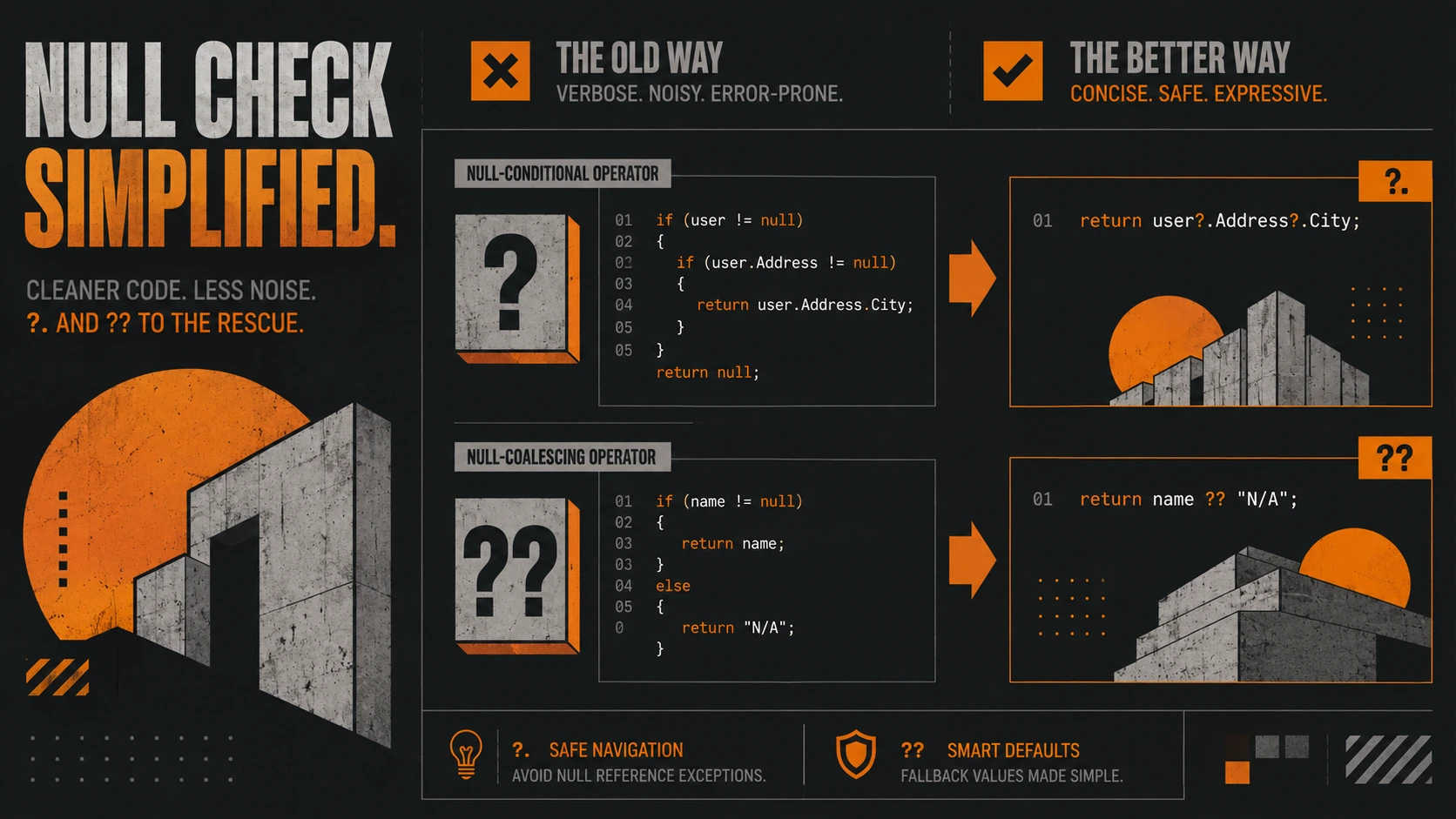
Optional Chaining
Accessing nested object properties has historically required repetitive defensive checks.
Enterprise applications frequently consume:
- ◆REST API responses
- ◆Configuration objects
- ◆User preferences
- ◆Content management data
- ◆Third-party service payloads
Before Optional Chaining, developers commonly wrote lengthy conditional expressions to verify that each object existed before accessing deeper properties.
Optional Chaining simplifies this pattern by allowing property access to stop gracefully whenever a reference evaluates to null or undefined.
Potential enterprise benefits include:
- ◆Cleaner business logic
- ◆Reduced defensive code
- ◆Improved readability
- ◆Fewer runtime errors caused by invalid property access
Applications consuming variable API responses may particularly benefit from this feature.
Nullish Coalescing
JavaScript has traditionally used logical OR operators when assigning default values.
However, values such as:
- ◆0
- ◆false
- ◆Empty strings
are valid application data but may unintentionally trigger fallback behavior.
Nullish Coalescing addresses this limitation by applying default values only when an expression evaluates to null or undefined.
Typical enterprise scenarios include:
- ◆Configuration loading
- ◆Form processing
- ◆User preferences
- ◆Financial values
- ◆Reporting applications
This behavior improves correctness while reducing subtle programming defects.
BigInt
JavaScript numbers have historically been represented using the IEEE 754 double-precision floating-point format.
While suitable for most applications, extremely large integers exceed JavaScript's precise integer range.
BigInt introduces a dedicated primitive type for representing arbitrarily large integers.
Potential enterprise use cases include:
- ◆Financial identifiers
- ◆Distributed system identifiers
- ◆Scientific computation
- ◆Cryptographic applications
- ◆Large numerical datasets
BigInt enables precise integer arithmetic without relying on external numerical libraries.
Promise.allSettled()
Enterprise applications frequently execute multiple asynchronous operations simultaneously.
In many situations, applications need to know the outcome of every operation regardless of whether individual tasks succeed or fail.
Promise.allSettled() provides standardized coordination by waiting until every promise reaches either a fulfilled or rejected state.
Typical scenarios include:
- ◆Dashboard initialization
- ◆Multiple API requests
- ◆Batch processing
- ◆Reporting systems
- ◆Distributed service aggregation
The method simplifies orchestration where partial failure should not immediately terminate processing.
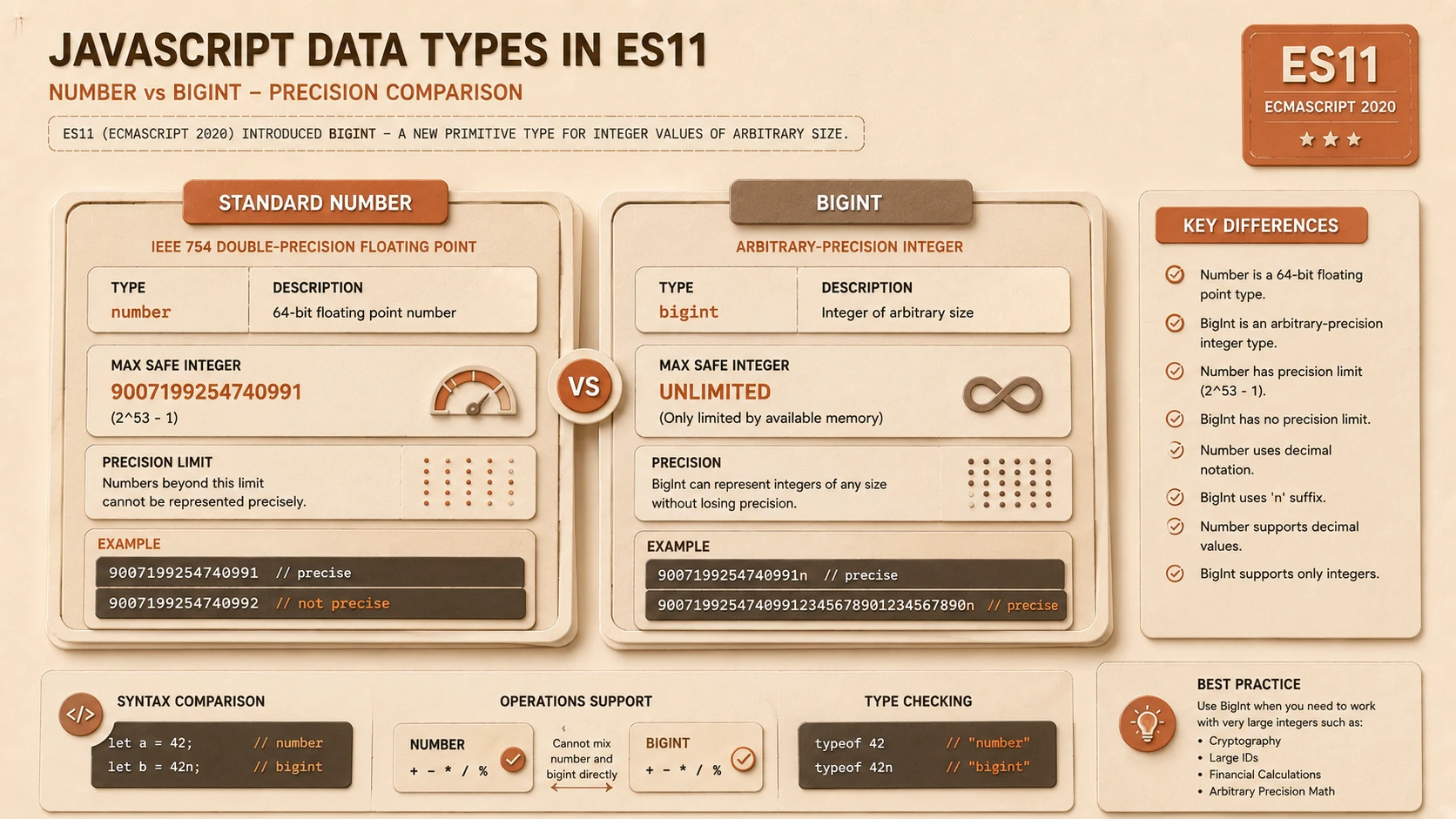
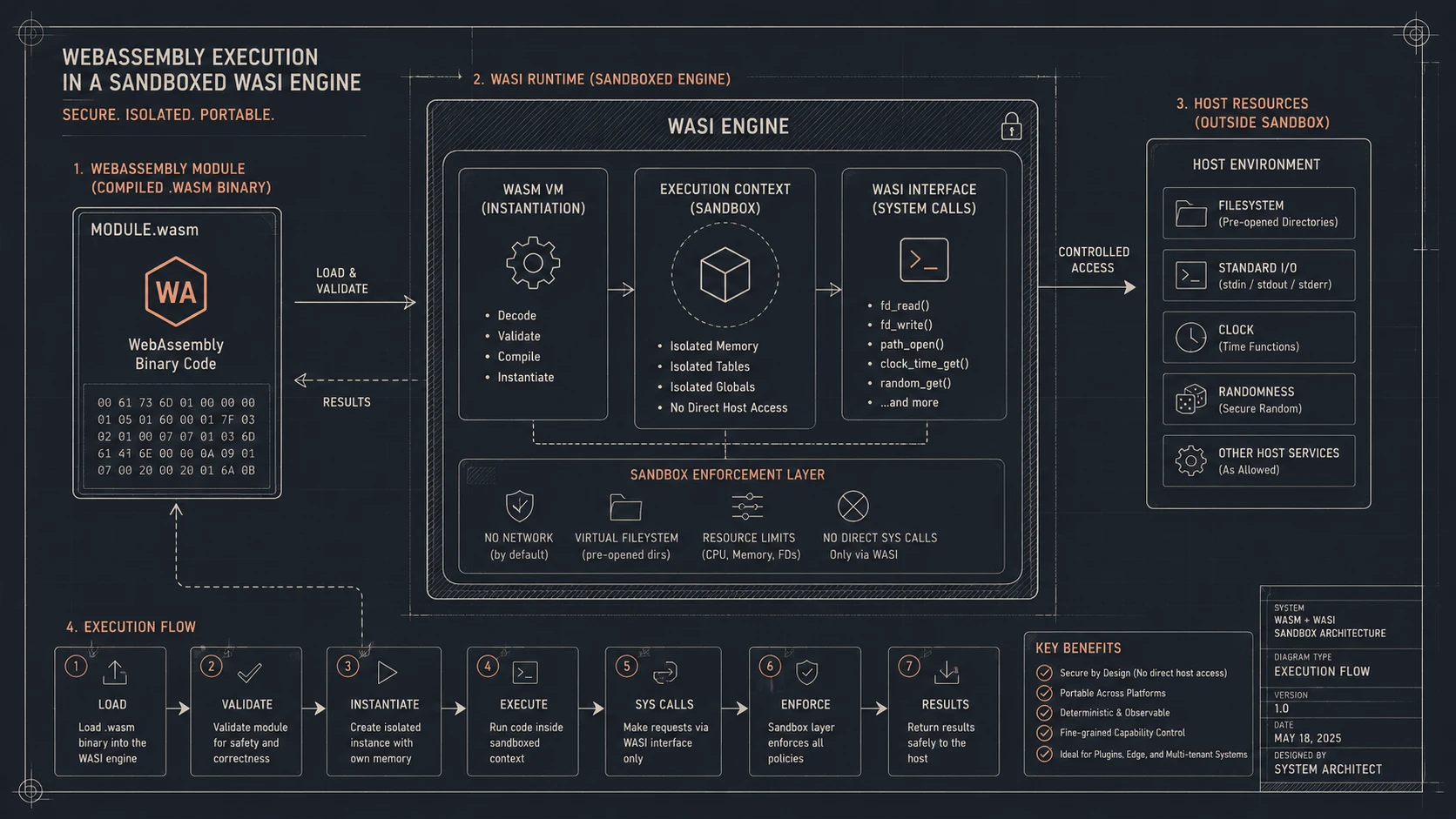
System architecture diagram and conceptual workflow layout for ES11 / ECMAScript 2020.
Dynamic import()
Modern applications increasingly split JavaScript into multiple bundles.
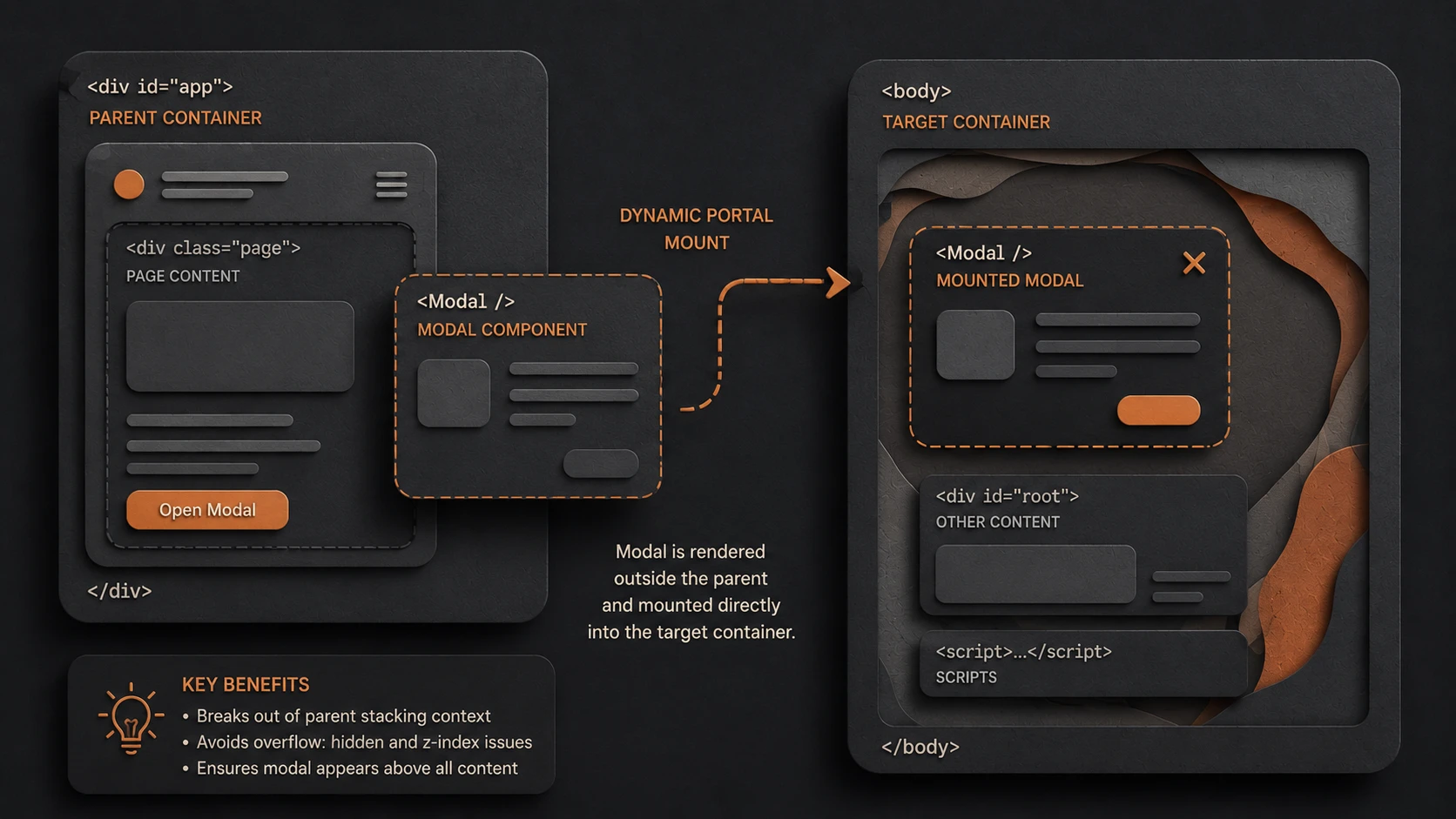
Dynamic import() enables modules to be loaded only when required.
Potential advantages include:
- ◆Reduced initial bundle size
- ◆Deferred feature loading
- ◆Improved startup performance
- ◆Better resource utilization
Applications can load optional functionality without increasing the cost of the initial application launch.
globalThis
JavaScript executes across multiple runtime environments including:
- ◆Browsers
- ◆Node.js
- ◆Web Workers
Historically, identifying the global execution context required environment-specific code.
globalThis standardizes access to the global object across compliant JavaScript environments.
This simplifies cross-platform library development while reducing environment-specific implementation logic.
Enterprise Use Cases
| Scenario | Benefit |
|---|---|
| REST API Clients | Safer nested object access |
| SaaS Platforms | Cleaner configuration management |
| Financial Applications | Accurate large integer support |
| Cloud Services | Improved asynchronous coordination |
| Component Libraries | Cross-platform global access |
| Progressive Web Applications | Dynamic module loading |
Organizations maintaining large JavaScript codebases benefit from replacing custom utility patterns with standardized language features.
Performance Considerations
ECMAScript 2020 primarily improves language expressiveness rather than introducing direct runtime optimizations.
Development teams should continue evaluating:
- ◆Bundle size
- ◆Dynamic import loading behavior
- ◆Memory utilization
- ◆Promise coordination overhead
- ◆JavaScript engine optimization
- ◆Production startup performance
Performance decisions should continue relying on representative production benchmarks.
Security Considerations
Language improvements do not fundamentally modify JavaScript security practices.
Organizations should continue implementing:
- ◆Input validation
- ◆Output encoding
- ◆Authentication
- ◆Authorization
- ◆Secure dependency management
- ◆Secure API communication
Cleaner language constructs complement secure software engineering but do not replace established security controls.
Scalability
ECMAScript 2020 supports scalable application development through:
- ◆Reduced boilerplate
- ◆Improved defensive programming
- ◆Standardized asynchronous coordination
- ◆Better module loading flexibility
- ◆Accurate large integer representation
These improvements become increasingly valuable as enterprise applications continue expanding across multiple services and development teams.
Best Practices
Organizations adopting ECMAScript 2020 should:
- ◆Use Optional Chaining for deeply nested object traversal.
- ◆Apply Nullish Coalescing instead of logical OR when preserving valid falsy values is important.
- ◆Introduce BigInt only where integer precision requirements justify its use.
- ◆Use Promise.allSettled() for independent asynchronous operations.
- ◆Implement dynamic import() for optional application features.
- ◆Standardize coding guidelines around new language capabilities.
- ◆Benchmark production builds after modernization.
- ◆Continue validating runtime compatibility across supported environments.
Thoughtful adoption improves readability while reducing long-term maintenance costs.
Common Mistakes
Development teams should avoid:
- ◆Using Optional Chaining indiscriminately where explicit validation is more appropriate.
- ◆Confusing Nullish Coalescing with logical OR behavior.
- ◆Mixing BigInt values with ordinary numbers without understanding language semantics.
- ◆Assuming Promise.allSettled() replaces every asynchronous coordination strategy.
- ◆Loading excessive numbers of dynamically imported modules.
- ◆Introducing inconsistent coding styles throughout large applications.
Successful modernization depends upon disciplined engineering standards rather than adopting every language feature automatically.
Technology Comparison
| Capability | ECMAScript 2019 | ECMAScript 2020 |
|---|---|---|
| Optional Chaining | No | Yes |
| Nullish Coalescing | No | Yes |
| BigInt | No | Yes |
| Promise.allSettled() | No | Yes |
| globalThis | No | Yes |
| Dynamic import() | Standardized proposal support evolving | Standardized |
| String.prototype.matchAll() | No | Yes |
ECMAScript 2020 continues JavaScript's incremental modernization by addressing many of the language's most common development patterns.
Adoption Strategy
Organizations should modernize through phased adoption.
A recommended strategy includes:
- 1.Upgrade JavaScript runtimes and build tooling.
- 2.Validate browser and Node.js compatibility.
- 3.Introduce Optional Chaining in new development.
- 4.Replace legacy default-value patterns with Nullish Coalescing where appropriate.
- 5.Evaluate BigInt for applications requiring precise large integer arithmetic.
- 6.Update coding standards.
- 7.Expand automated testing to validate modernized implementations.
Incremental migration minimizes operational risk while enabling engineering teams to standardize on modern ECMAScript features.
Limitations
As of June 2020, organizations should recognize several considerations.
Current observations include:
- ◆Runtime compatibility should be verified across supported browser versions and server-side environments.
- ◆BigInt is intended specifically for integer arithmetic and should be introduced only where precision requirements exist.
- ◆Dynamic module loading requires thoughtful application architecture to maximize performance benefits.
- ◆Language enhancements improve maintainability but do not fundamentally change application architecture.
Organizations should therefore evaluate each capability according to measurable business requirements rather than adopting features solely because they are available.
Looking Ahead
ECMAScript 2020 represents one of the most practical JavaScript releases in recent years. Optional Chaining and Nullish Coalescing dramatically simplify defensive programming, BigInt extends the language's numerical capabilities, and Promise.allSettled(), dynamic import(), and globalThis strengthen JavaScript's suitability for modern enterprise software.
As of June 2020, enterprise architects and senior JavaScript developers should evaluate these capabilities as important improvements that reduce boilerplate, improve correctness, and simplify application maintenance. Organizations that combine disciplined coding standards, comprehensive testing, and incremental modernization will be well positioned to continue building scalable JavaScript applications using standardized language capabilities.