Introduction
CSS Grid Layout fundamentally changed how developers build responsive web interfaces by introducing a true two-dimensional layout system. Enterprise applications quickly adopted Grid for dashboards, administrative portals, reporting systems, documentation sites, media platforms, and complex responsive websites because it significantly reduced dependence on float-based layouts and excessive nesting.
Despite these improvements, one important limitation remains. Nested grid containers operate independently of their parent grids, making it difficult to maintain perfectly aligned columns and rows across multiple layout levels. Developers frequently duplicate grid definitions, introduce wrapper elements, or rely on custom calculations to keep interfaces visually consistent.
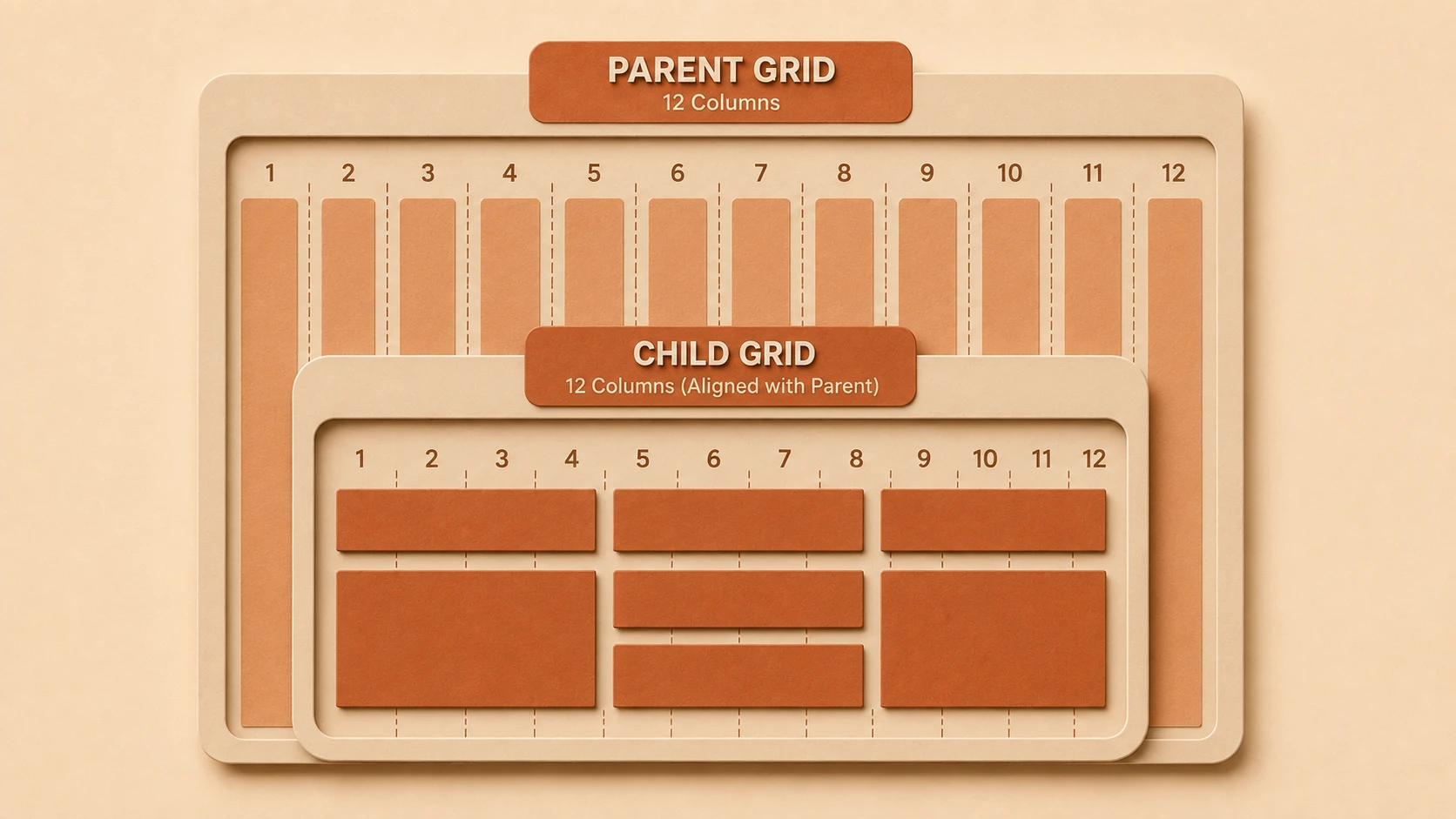
The CSS Subgrid specification addresses this limitation by allowing child grid containers to participate in the sizing tracks defined by an ancestor grid. Instead of creating isolated grid systems, nested layouts can inherit row and column definitions directly from their parent.
From the perspective of March 2020, CSS Subgrid is one of the most promising additions to the CSS Grid ecosystem. Although browser implementation remains in progress, the specification demonstrates a clear direction toward simplifying sophisticated responsive layouts.
Industry Background
Enterprise web applications continue increasing in visual complexity.
Organizations commonly develop:
- ◆Business dashboards.
- ◆Financial reporting platforms.
- ◆Analytics portals.
- ◆E-commerce interfaces.
- ◆Documentation websites.
- ◆Content management systems.
- ◆Internal enterprise applications.
These applications frequently require:
- ◆Consistent spacing.
- ◆Responsive layouts.
- ◆Nested components.
- ◆Shared alignment.
- ◆Maintainable CSS.
- ◆Flexible page composition.
As interface complexity grows, maintaining alignment across multiple nested containers becomes increasingly difficult.
The Business Problem
Traditional nested Grid layouts introduce several engineering challenges.
Organizations commonly experience:
- ◆Duplicate grid definitions.
- ◆Inconsistent column alignment.
- ◆Complex responsive calculations.
- ◆Excessive wrapper elements.
- ◆Difficult maintenance.
- ◆Repeated layout declarations.
- ◆CSS architecture complexity.
Independent nested grids often require manual synchronization whenever parent layouts change.
CSS Subgrid addresses these concerns through inherited track definitions.
Understanding the Technology
CSS Subgrid extends the CSS Grid specification by allowing nested grid containers to reuse row and column tracks established by their parent grid.
Rather than defining entirely new track sizing, a child grid may participate directly in the parent's grid structure.
Major capabilities include:
- ◆Shared column definitions.
- ◆Shared row definitions.
- ◆Nested alignment.
- ◆Cleaner responsive layouts.
- ◆Reduced CSS duplication.
- ◆Better component consistency.
- ◆Improved layout maintainability.
Subgrid builds upon existing CSS Grid concepts instead of introducing an entirely new layout model.
Core Architecture
A simplified Subgrid architecture appears below.
| Component | Responsibility |
|---|---|
| Parent Grid | Defines master layout tracks |
| Grid Items | Primary layout regions |
| Nested Grid | Child layout container |
| Subgrid | Inherits parent tracks |
| Browser Layout Engine | Calculates final positioning |
Subgrid enables nested layouts to participate in the parent's sizing calculations instead of maintaining separate track definitions.
Key Features
Shared Grid Tracks
The defining capability of Subgrid is inherited track sizing.
A nested grid may reuse column or row definitions established by its parent rather than declaring identical measurements again.
This reduces duplicated layout definitions and improves long-term maintainability.
Consistent Column Alignment
Enterprise interfaces often require tables, forms, cards, and dashboards to align perfectly across nested components.
Subgrid allows child layouts to remain synchronized with parent columns, producing more consistent visual structure.
Responsive Layout Simplification
Without Subgrid, responsive breakpoint changes frequently require updates across multiple independent grids.
Subgrid centralizes track definitions, allowing nested components to adapt automatically when parent layouts change.
Reduced CSS Duplication
Many existing Grid implementations repeat identical column declarations across multiple nested containers.
Subgrid minimizes this duplication while improving readability.
Cleaner Component Architecture
Reusable interface components can participate within larger page layouts without redefining common grid measurements.
This encourages more modular CSS architecture.
Standards-Based Layout Evolution
Subgrid extends existing CSS Grid capabilities using familiar Grid concepts, making adoption easier for development teams already experienced with Grid Layout.
How It Works
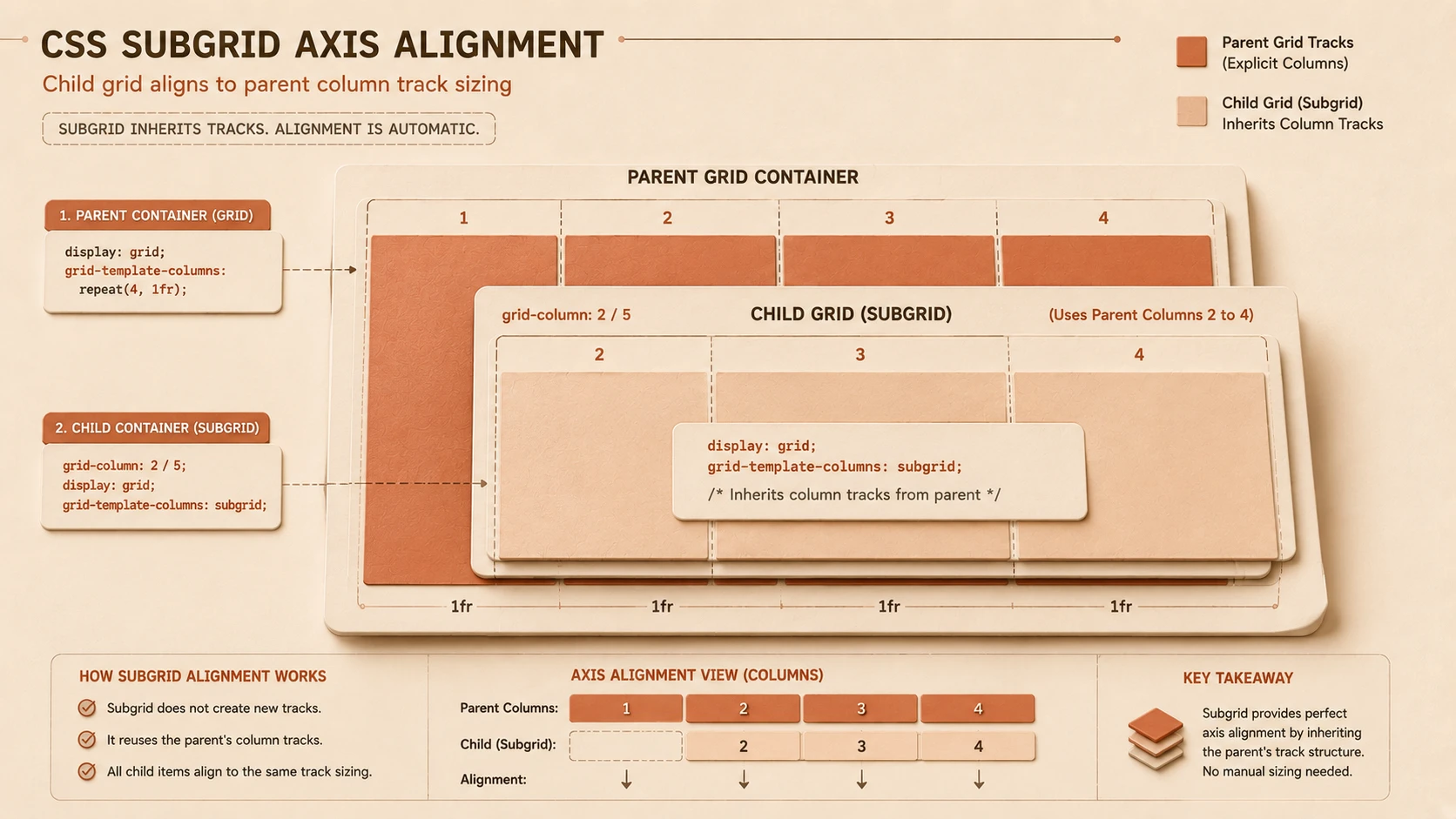
System architecture diagram and conceptual workflow layout for CSS Subgrid Layout Specification Status.
A simplified layout workflow appears below.
Parent Grid
      |
Defines Columns
      |
Nested Grid
      |
Uses Subgrid
      |
Inherited Track Sizes
      |
Aligned Child Layout
The browser computes layout using parent track definitions while allowing nested components to participate in the same grid structure.
Enterprise Use Cases
Administrative Dashboards
Nested widgets can maintain consistent alignment across multiple dashboard sections.
Financial Reporting Systems
Reports containing grouped tables and summary panels benefit from synchronized column layouts.
Content Management Systems
Editorial interfaces can maintain consistent spacing across nested content components.
E-Commerce Platforms
Product listings, promotional cards, and recommendation panels can share common layout structures.
Design Systems
Reusable components integrate more naturally into larger responsive page layouts while preserving alignment consistency.
Performance Considerations
Subgrid primarily simplifies layout authoring rather than introducing new rendering capabilities.
Organizations should evaluate:
- ◆Layout calculation performance.
- ◆CSS maintainability.
- ◆Responsive behavior.
- ◆Browser rendering consistency.
- ◆Component complexity.
- ◆Overall stylesheet organization.
Benefits are expected to arise primarily through cleaner architecture rather than measurable rendering speed improvements.
Security Considerations
CSS Subgrid is a presentation technology and introduces no significant application security changes.
Organizations should continue implementing:
- ◆HTTPS.
- ◆Content Security Policy.
- ◆Secure authentication.
- ◆Authorization.
- ◆Dependency management.
- ◆Secure deployment practices.
Layout technologies should complement comprehensive secure application architecture.
Scalability
Subgrid strengthens enterprise front-end scalability through:
- ◆Reduced CSS duplication.
- ◆Better component reuse.
- ◆Consistent alignment.
- ◆Simpler responsive maintenance.
- ◆Cleaner layout architecture.
These characteristics become increasingly valuable as enterprise design systems continue expanding.
Best Practices
Organizations preparing for Subgrid should:
- ◆Continue adopting CSS Grid as the primary layout system.
- ◆Centralize layout definitions where practical.
- ◆Design reusable responsive components.
- ◆Monitor browser implementation progress.
- ◆Validate layouts across supported browsers.
- ◆Avoid unnecessary wrapper elements.
- ◆Document layout conventions within design systems.
Preparation today simplifies future adoption once browser support becomes sufficiently widespread.
Common Mistakes
| Mistake | Business Impact |
|---|---|
| Assuming universal browser availability | Deployment compatibility issues |
| Replacing stable production layouts prematurely | Increased implementation risk |
| Overcomplicating Grid architecture before Subgrid support is available | Reduced maintainability |
| Ignoring responsive testing | Inconsistent layouts |
| Duplicating grid definitions unnecessarily | Higher maintenance effort |
| Treating Subgrid as a replacement for Grid | Architectural misunderstanding |
Successful adoption depends on understanding that Subgrid extends CSS Grid rather than replacing it.
Technology Comparison
| Characteristic | Standard CSS Grid | CSS Grid with Subgrid |
|---|---|---|
| Nested Grid Tracks | Independent definitions | Parent track inheritance |
| Column Alignment | Manual synchronization | Automatic shared alignment |
| CSS Duplication | Common in nested layouts | Reduced |
| Responsive Maintenance | Multiple layout updates | Centralized track management |
| Component Integration | Separate grid definitions | Shared layout structure |
Subgrid enhances existing Grid architecture by improving coordination between parent and child layouts.
Adoption Strategy
Organizations should approach Subgrid through gradual modernization.
- 1.Standardize new layouts using CSS Grid.
- 2.Identify components that duplicate grid definitions.
- 3.Monitor browser implementation status for production environments.
- 4.Prototype Subgrid in development environments.
- 5.Validate responsive behavior across supported browsers.
- 6.Introduce Subgrid into production after browser support satisfies organizational requirements.
This phased approach minimizes deployment risk while preparing engineering teams for future layout capabilities.
Limitations
As of March 2020, organizations should recognize several considerations.
- ◆Browser implementation remains incomplete and should be evaluated carefully before production adoption.
- ◆Existing CSS Grid techniques remain necessary for broad compatibility.
- ◆Development teams should continue designing responsive layouts that degrade gracefully.
- ◆Production support should be validated against target browser requirements.
- ◆Design systems should remain adaptable while browser implementations mature.
These considerations should guide enterprise front-end modernization efforts.
Looking Ahead
From the perspective of March 2020, CSS Subgrid represents one of the most significant forthcoming enhancements to CSS Grid Layout. By enabling nested layouts to inherit parent grid tracks, the specification addresses a long-standing limitation affecting complex responsive interfaces and enterprise design systems.
Although widespread browser implementation is still evolving, the architectural direction is clear. Subgrid promises cleaner CSS, reduced duplication, improved alignment, and more maintainable component hierarchies. Organizations investing in modern front-end architecture should closely follow the specification's progress, as it has the potential to simplify the construction of sophisticated responsive layouts while reinforcing the role of CSS Grid as the foundation for enterprise web interface development.