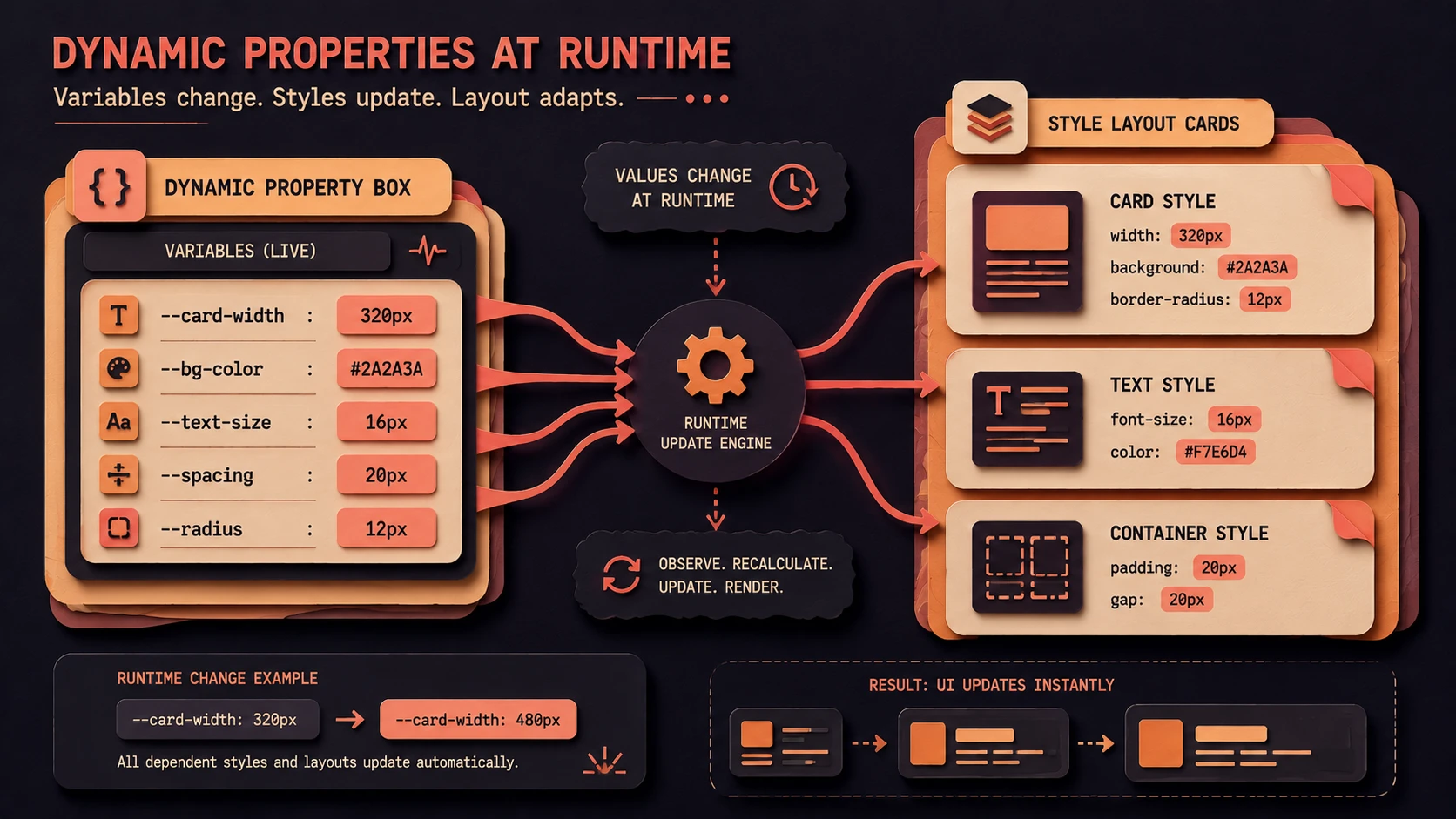
Introduction
Enterprise web applications continue to grow in both size and complexity. Customer relationship management platforms, enterprise resource planning systems, business intelligence dashboards, Software as a Service (SaaS) applications, and internal corporate portals frequently contain thousands of CSS rules distributed across dozens of style sheets.
Managing consistent colors, spacing, typography, and visual identity across these applications has historically required significant duplication or the adoption of CSS preprocessors such as Sass and Less. While preprocessors provide variables and reusable abstractions, they generate static CSS during compilation, limiting their ability to respond dynamically at runtime.
CSS Custom Properties introduce a native mechanism for defining reusable values directly within CSS. Unlike preprocessor variables, Custom Properties participate in the browser's rendering engine and can be modified while an application is running. This opens new possibilities for runtime theming, component customization, and more maintainable stylesheet architectures.
As of January 2016, browser support for CSS Custom Properties is emerging, making this an appropriate time for enterprise development teams to evaluate where the technology fits within long-term front-end architecture.
Industry Background
Modern front-end development increasingly emphasizes:
- ◆Responsive layouts
- ◆Component-based user interfaces
- ◆Modular CSS architecture
- ◆Design consistency
- ◆Maintainable styling
- ◆Reusable interface libraries
Many organizations currently rely on CSS preprocessors to reduce duplication. Although these tools simplify development, their variables exist only during compilation and disappear in the generated CSS.
CSS Custom Properties introduce a standards-based alternative that remains available during browser execution.
The Business Problem
Large enterprise applications commonly encounter:
- ◆Duplicate color definitions
- ◆Inconsistent spacing values
- ◆Difficult theme management
- ◆Large stylesheet maintenance costs
- ◆Limited runtime customization
- ◆Hard-coded design values
- ◆Complex UI branding updates
As applications expand across multiple teams, maintaining visual consistency becomes increasingly difficult.
Native CSS variables seek to address these challenges through reusable runtime values.
Understanding CSS Custom Properties
CSS Custom Properties allow developers to define reusable values using property names that begin with two hyphens.
These values may then be referenced elsewhere within stylesheets using the var() function.
Unlike variables provided by preprocessors, Custom Properties become part of the browser's CSS Object Model (CSSOM) and participate in the normal cascade, inheritance, and runtime style calculation.
This enables applications to modify values dynamically without recompiling stylesheets.
Core Architecture
| Component | Responsibility |
|---|---|
| CSS Custom Property | Stores reusable value |
| var() Function | Retrieves property value |
| CSS Cascade | Resolves inherited values |
| Browser Rendering Engine | Computes final styles |
| DOM | Applies computed styles to elements |
| JavaScript | May update custom properties at runtime |
Together these components allow styling values to participate directly in browser rendering.
Declaring Custom Properties
Custom Properties are typically declared using descriptive names.
Example:
:root {
  --primary-color: #2b6cb0;
  --secondary-color: #4a5568;
  --base-spacing: 16px;
}
The :root selector commonly serves as a central location for application-wide styling values.
Organizing commonly used values in one location improves maintainability and simplifies future design changes.
Using Runtime Variables
Defined values can be referenced through the var() function.
Example:
.button {
  background-color: var(--primary-color);
  padding: var(--base-spacing);
}
Because resolution occurs during browser execution, updates to Custom Properties are reflected automatically throughout the interface.
Runtime Behavior
One of the most significant characteristics of Custom Properties is their runtime behavior.
Unlike preprocessor variables, values are not replaced during compilation.
Instead, the browser:
- 1.Parses the stylesheet.
- 2.Stores Custom Property definitions.
- 3.Resolves values during style computation.
- 4.Applies inherited values where appropriate.
- 5.Recalculates affected styles when values change.
This dynamic model enables applications to update appearance without rebuilding CSS.
Inheritance and Cascading
Custom Properties participate fully in CSS inheritance.
This allows values to be:
- ◆Defined globally
- ◆Overridden for specific sections
- ◆Scoped to individual components
- ◆Customized for nested interface elements
Developers can therefore create flexible styling hierarchies using familiar CSS mechanisms.
Dynamic Theming
Enterprise applications increasingly support:
- ◆Customer branding
- ◆Department-specific themes
- ◆Accessibility preferences
- ◆White-label deployments
- ◆User customization
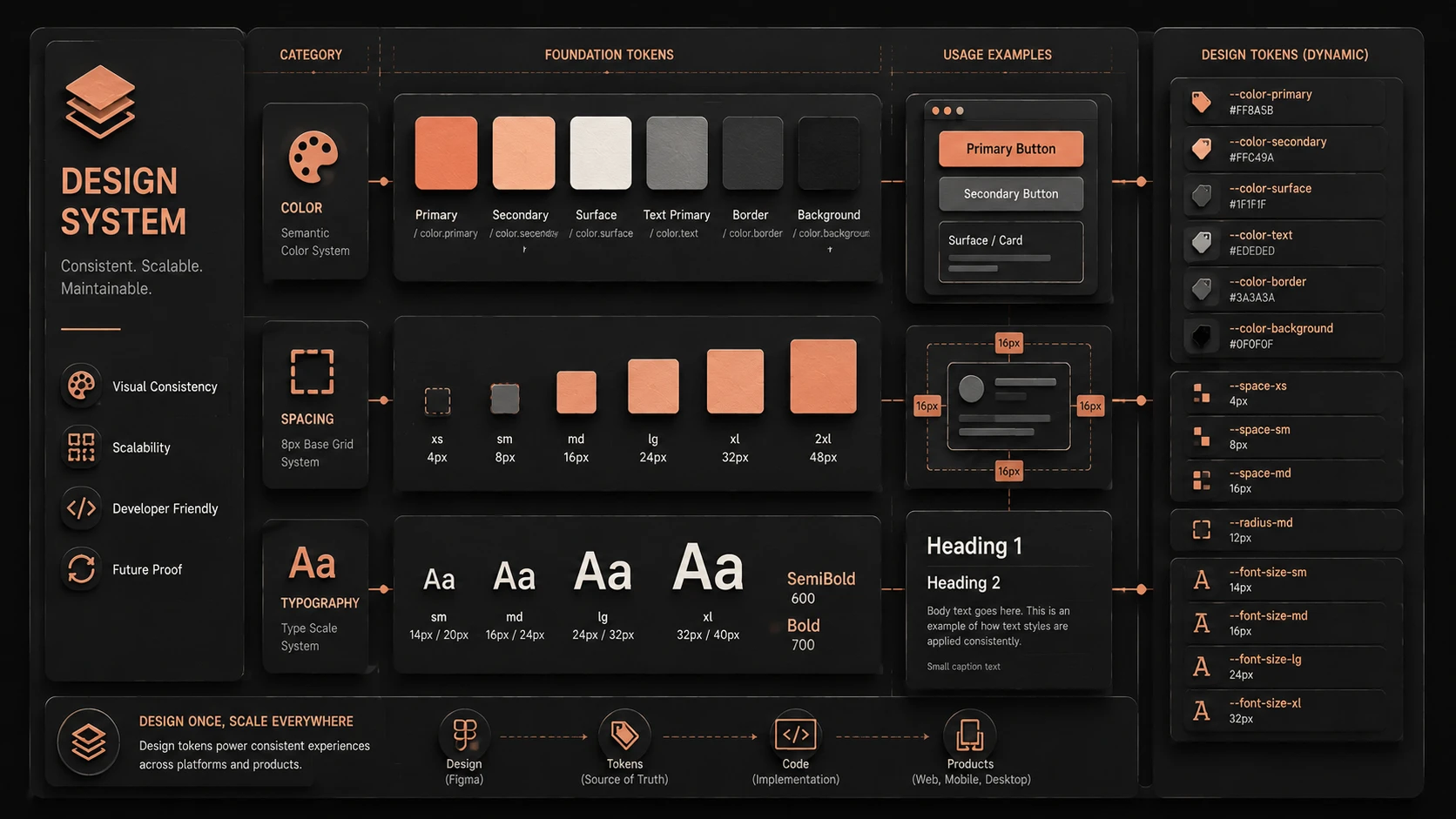
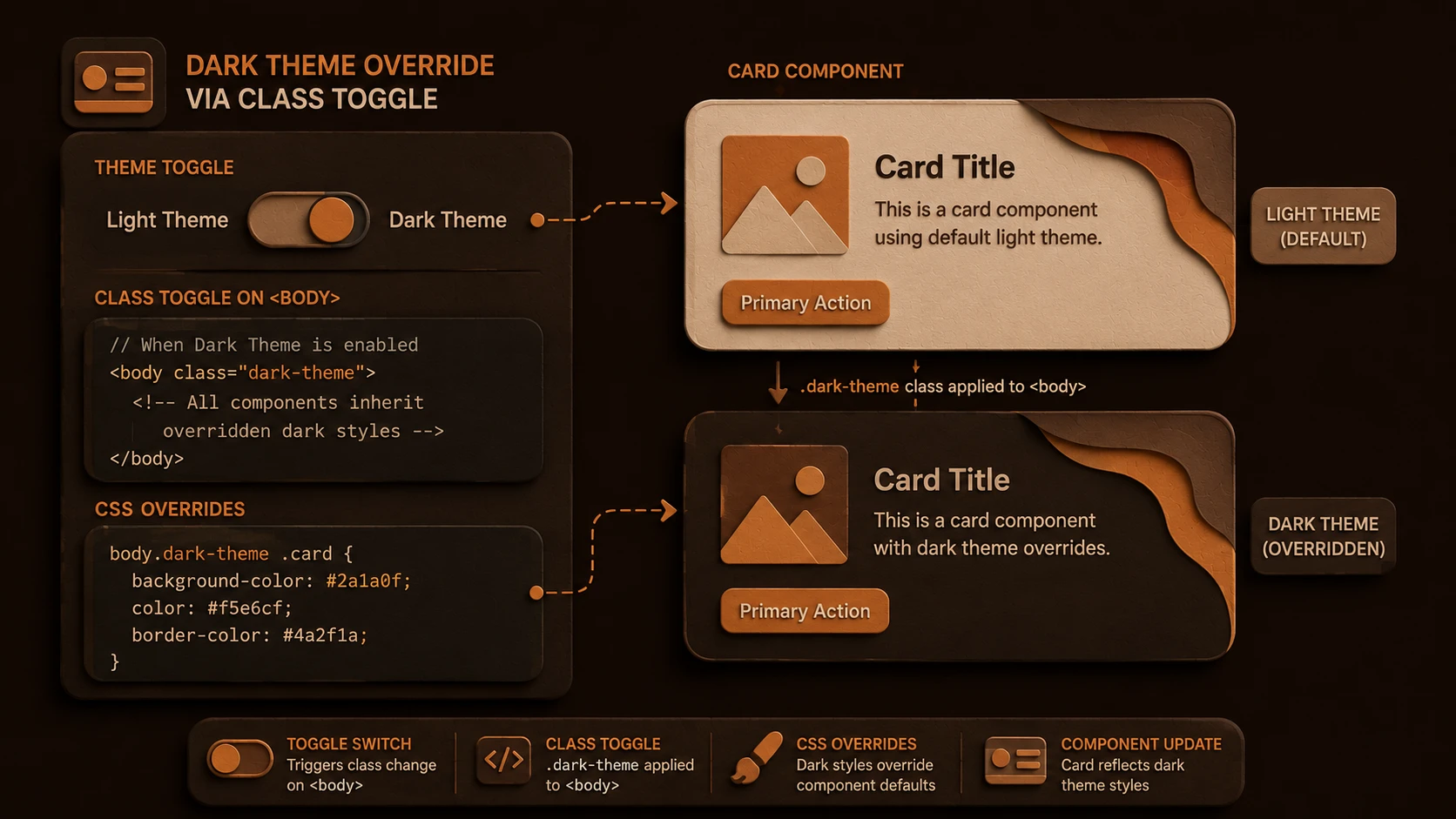
Runtime variables simplify these scenarios by allowing visual values to change without generating new stylesheets.
Instead of maintaining multiple CSS files, applications can adjust a relatively small collection of Custom Properties.
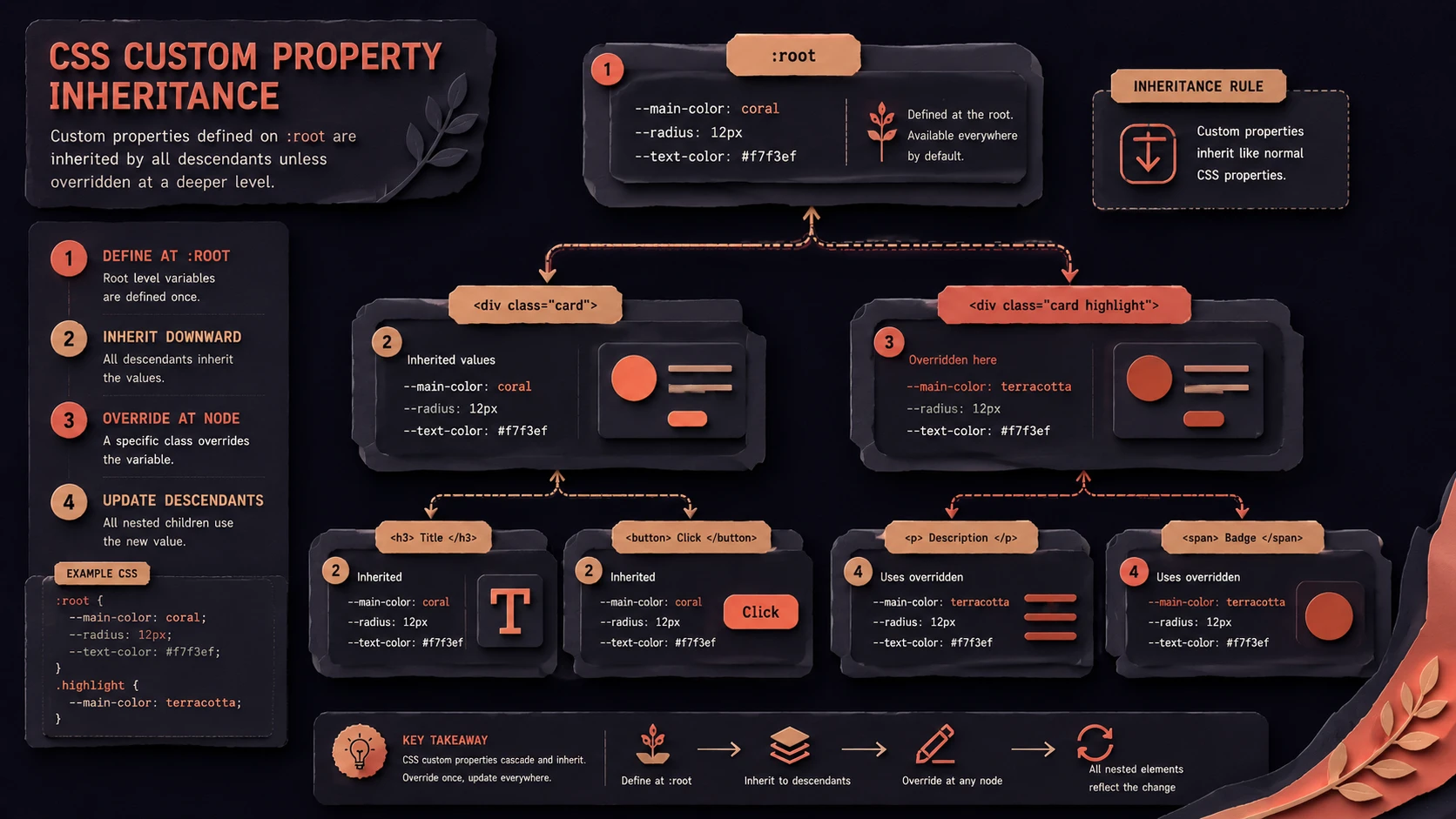
System architecture diagram and conceptual workflow layout for CSS Custom Properties.
CSS Custom Properties vs. Preprocessor Variables
Although the syntax appears similar, important architectural differences exist.
| Capability | Sass or Less Variables | CSS Custom Properties |
|---|---|---|
| Evaluation Time | Compilation | Runtime |
| Browser Awareness | No | Yes |
| Dynamic Updates | No | Yes |
| CSS Cascade | No | Yes |
| JavaScript Integration | Indirect | Direct |
| Native CSS Feature | No | Yes |
Custom Properties complement rather than replace CSS preprocessors.
Many organizations may continue using preprocessors while adopting runtime variables where dynamic behavior is beneficial.
Browser Support Considerations
As of January 2016, support for CSS Custom Properties is emerging rather than universal.
Organizations developing enterprise applications should:
- ◆Review browser compatibility requirements.
- ◆Validate support within target environments.
- ◆Plan appropriate fallback strategies where necessary.
- ◆Continue testing across supported browsers.
Technology adoption should align with enterprise browser policies rather than individual developer preferences.
Enterprise Use Cases
| Scenario | Benefit |
|---|---|
| SaaS Platforms | Runtime customer branding |
| Enterprise Dashboards | Centralized design tokens |
| Component Libraries | Shared visual consistency |
| Corporate Portals | Easier theme management |
| White-Label Products | Reduced stylesheet duplication |
| Internal Applications | Simplified design maintenance |
Organizations maintaining large user interfaces benefit from centralized control over commonly reused styling values.
Performance Considerations
Custom Properties participate directly in browser style calculation.
Development teams should evaluate:
- ◆Style recalculation frequency
- ◆Scope of variable updates
- ◆DOM complexity
- ◆Rendering performance
- ◆Browser compatibility
Applications that update variables frequently should benchmark representative workloads to ensure acceptable responsiveness.
Security Considerations
CSS Custom Properties primarily affect presentation rather than application security.
Nevertheless, organizations should continue implementing:
- ◆Secure input validation
- ◆Protection against cross-site scripting
- ◆Proper separation between presentation and business logic
- ◆Controlled generation of dynamic styles
Visual customization should never compromise secure application behavior.
Scalability
Native runtime variables support long-term scalability by encouraging:
- ◆Centralized design values
- ◆Consistent branding
- ◆Component reuse
- ◆Reduced stylesheet duplication
- ◆Easier maintenance across large teams
As interface libraries expand, centralized styling definitions become increasingly valuable.
Best Practices
Organizations evaluating CSS Custom Properties should:
- ◆Define common values within
:rootwhere appropriate. - ◆Use descriptive variable names.
- ◆Group related design values logically.
- ◆Maintain consistent naming conventions.
- ◆Test browser compatibility thoroughly.
- ◆Use runtime variables for values that may change dynamically.
- ◆Continue leveraging preprocessors where compile-time abstractions remain beneficial.
- ◆Document design conventions for development teams.
A disciplined styling strategy simplifies long-term maintenance.
Common Mistakes
Development teams should avoid:
- ◆Replacing every preprocessor feature unnecessarily.
- ◆Using inconsistent naming conventions.
- ◆Ignoring browser compatibility requirements.
- ◆Creating deeply nested variable dependencies.
- ◆Storing unrelated values within the same namespace.
- ◆Treating runtime variables as a substitute for sound CSS architecture.
Custom Properties are most effective when incorporated into an organized styling system.
Technology Comparison
| Capability | Traditional CSS | CSS Preprocessors | CSS Custom Properties |
|---|---|---|---|
| Variables | No | Yes | Yes |
| Runtime Updates | No | No | Yes |
| Native Browser Support | Yes | Generated CSS only | Emerging |
| Dynamic Theming | Limited | Limited | Excellent |
| Component-Level Overrides | Limited | Compilation dependent | Native |
| Standards-Based | Yes | External tooling | Yes |
CSS Custom Properties extend the language by providing runtime capabilities previously unavailable within native CSS.
Adoption Strategy
Enterprise teams should adopt Custom Properties incrementally.
A practical approach includes:
- 1.Identify commonly reused design values.
- 2.Introduce Custom Properties for global colors and spacing.
- 3.Continue using preprocessors where appropriate.
- 4.Validate browser compatibility.
- 5.Build reusable component libraries around shared design values.
- 6.Measure runtime behavior.
- 7.Expand usage as browser support matures.
Gradual adoption allows organizations to gain practical experience while minimizing compatibility risks.
Limitations
As of January 2016, several considerations remain.
Current observations include:
- ◆Browser support continues to evolve.
- ◆Existing enterprise browser standards may influence adoption timelines.
- ◆Development teams may continue requiring preprocessors for additional language features.
- ◆Runtime flexibility introduces new considerations for testing and maintenance.
Organizations should evaluate Custom Properties within the broader context of their existing front-end tooling.
Looking Ahead
CSS Custom Properties represent an important evolution of the CSS language by introducing native runtime variables directly into browser styling. Rather than relying exclusively on compile-time preprocessing, developers can now define reusable values that participate in the CSS cascade, inheritance model, and runtime rendering process.
As of January 2016, enterprise architects should view CSS Custom Properties as an emerging capability with considerable potential for design systems, component libraries, and runtime theming. Organizations that carefully evaluate browser compatibility while adopting disciplined styling conventions will be well positioned to take advantage of this increasingly important addition to modern web development.